Bitwise Seeks to Acquire Chorus One to Dominate Institutional Staking as BMIC Momentum Builds

bitcoinistОпубликовано 2026-02-04Обновлено 2026-02-04

Введение

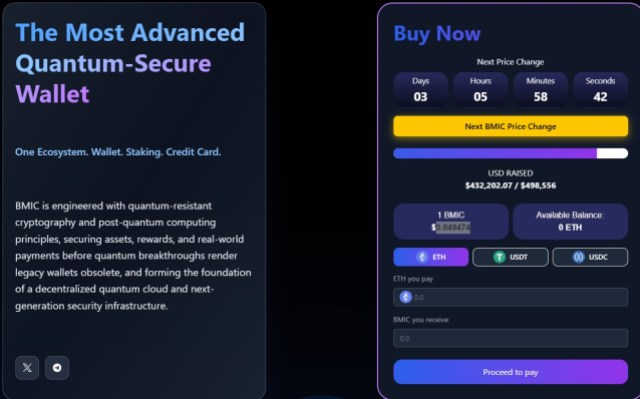
Bitwise, a major asset management firm, is reportedly seeking to acquire Chorus One, a leading European institutional staking provider, signaling a strategic move to dominate the crypto yield infrastructure. This acquisition highlights the growing institutional focus on staking as a key revenue stream. However, this consolidation raises concerns over centralization risks and vulnerabilities, such as potential "Harvest Now, Decrypt Later" quantum attacks. In response, projects like BMIC ($BMIC) are gaining attention for offering a quantum-secure finance stack designed to protect digital assets against future cryptographic threats. BMIC's presale has already raised significant funds, reflecting strong market interest in next-generation security solutions.

The institutional race to capture the crypto yield economy just entered a new, aggressive phase. Reports indicating that asset management giant Bitwise seeks to acquire Chorus One, a leading European institutional staking provider, signal a pivotal shift in market structure.

This isn’t merely about accumulation, it’s a battle for control of the infrastructure itself.

Bitwise (already a heavyweight in the ETF sector) appears to be positioning itself vertically within the crypto stack. By targeting Chorus One, which operates validators for over 60 networks and secures billions in assets, Bitwise is moving beyond simple asset exposure.

They’re aiming to capture the technical ‘yield layer’ of the blockchain ecosystem. Why? Because it validates the thesis that staking, not just trading, is where the next trillion dollars of institutional capital will flow.

With Bitcoin hovering near $76K and Ethereum dominance holding steady, the market appetite for yield-bearing infrastructure is insatiable. But let’s be honest: this consolidation of staking power brings new risks.

As centralized entities amass validator keys, the attack surface for bad actors grows. This centralization paradox is driving capital toward decentralized, next-generation security solutions that can protect assets even as the stakes get higher.

While the giants fight for today’s yields, forward-looking investors are positioning themselves in protocols like BMIC ($BMIC), which addresses the existential threat looming over all digital assets: quantum decryption.

Buy $BMIC here.

The Quantum Threat to Institutional Staking Infrastructure

The potential acquisition of Chorus One by Bitwise underscores a critical reality: digital assets are only as valuable as the cryptography securing them.

As institutions lock up billions in staking contracts, they become prime targets for ‘Harvest Now, Decrypt Later’ (HNDL) attacks. State actors and sophisticated syndicates are already hoarding encrypted data, waiting for quantum computing power to mature enough to shatter current encryption standards like RSA and ECC.

Here is where the narrative shifts from simple accumulation to survival. If the underlying cryptographic signatures of a validator are compromised, the entire stake is at risk. The industry is finally waking up to the fact that legacy wallets and staking mechanisms, regardless of who owns them, are built on math that has an expiration date.

BMIC ($BMIC) tackles this vulnerability head-on.

Unlike traditional wallets that merely store keys, BMIC offers a full quantum-secure finance stack. By integrating ERC-4337 smart accounts with proprietary post-quantum cryptography, the project ensures that user keys are never exposed during transactions or staking activities.

This creates a defensive moat that appeals to both retail users fearing wallet drains and enterprise players looking to future-proof their operations against the inevitability of quantum computing.

Learn more about BMIC here.

BMIC Offers ‘Harvest Now, Decrypt Later’ Protection as Presale Surges

While Bitwise focuses on aggregating current market share, BMIC is engineering the safety rails for the next decade of crypto. The project’s unique value proposition centers on eliminating public key exposure, the primary vector for both current phishing attacks and future quantum breaks.

Through its Quantum Meta-Cloud and AI-enhanced threat detection, the platform creates an ecosystem where users can transact, stake, and govern without the perpetual anxiety of private key management.

The market has responded sharply to this utility. The BMIC presale has already raised over $432K so far, a figure that suggests a significant appetite for security-first infrastructure. With tokens currently priced at $0.049474, early participants are betting on the transition from legacy wallets to quantum-resistant architectures.

What distinguishes BMIC from standard wallet providers is its recognition of the ‘burn-to-compute’ economy and governance utility. It isn’t just a storage solution; it’s ecosystem fuel designed to power a secure, decentralized computing layer.

As the industry watches giants like Bitwise consolidate the staking layer, the smart money is hedging against the technical debt of that very infrastructure by backing the only platform built to withstand the post-quantum era.

Visit the BMIC presale page.

Disclaimer This article is for informational purposes only and does not constitute financial advice. Cryptocurrency investments carry high risks, including total loss of capital. Always conduct your own due diligence.

Связанные с этим вопросы

QWhat is the main strategic move by Bitwise discussed in the article, and what is its significance?

AThe article discusses Bitwise's move to acquire Chorus One, a leading European institutional staking provider. This signifies a pivotal shift in market structure, representing a vertical integration into the crypto stack and a battle for control of the yield infrastructure itself, not just asset accumulation.

QAccording to the article, what is the 'Quantum Threat' to institutional staking infrastructure?

AThe 'Quantum Threat' refers to 'Harvest Now, Decrypt Later' (HNDL) attacks, where state actors or sophisticated syndicates hoard encrypted data, waiting for quantum computing to mature enough to break current encryption standards like RSA and ECC, thereby compromising validator signatures and putting entire stakes at risk.

QHow does the BMIC ($BMIC) protocol claim to address the vulnerabilities of traditional staking and wallets?

ABMIC offers a full quantum-secure finance stack by integrating ERC-4337 smart accounts with proprietary post-quantum cryptography. This ensures user keys are never exposed during transactions or staking, creating a defensive moat against both current threats and future quantum decryption.

QWhat market response is cited as evidence of appetite for BMIC's solution?

AThe article cites that the BMIC presale has raised over $432K, suggesting a significant market appetite for its security-first infrastructure, with investors betting on the transition from legacy wallets to quantum-resistant architectures.

QWhat centralization risk does the article associate with the consolidation of staking power by entities like Bitwise?

AThe article states that as centralized entities amass validator keys, the attack surface for bad actors grows. This centralization paradox increases risk and is driving capital toward decentralized, next-generation security solutions.

Похожее

Trade.xyz's Rebase Refusal Sparks Controversy, On-Chain Pre-IPO Market Faces Major Pricing Test

The debate surrounding Trade.xyz's refusal to adjust its SPCX (SpaceX pre-IPO) perpetual contract pricing amid updated share count revelations highlights a key challenge for on-chain pre-IPO markets. While several centralized exchanges (CEXs) paused and repriced their contracts after SpaceX's filing showed a ~10% increase in total shares, Trade.xyz maintained its market-driven pricing logic, which tracks expected per-share price sentiment rather than fundamental valuation metrics like market cap. This discrepancy triggered cross-platform arbitrage and caused leveraged long positions on Trade.xyz to suffer significant losses, as the platform's HIP-3 architecture lacks a native "Rebase" mechanism to neutrally adjust all user positions following such corporate actions. The incident underscores the difficulty for decentralized perpetual exchanges (Perp DEXs) to implement Rebase—a process CEXs handle by centrally pausing markets and adjusting ledger data. On-chain, this requires complex smart contract modifications, increasing gas costs, complexity, and potential attack surfaces. While some DEXs have managed similar adjustments, Trade.xyz's current design does not natively support it, though the team is reportedly exploring solutions for future events like stock splits. Ultimately, the controversy serves as a critical case study for the nascent on-chain pre-IPO sector, raising questions about price discovery reliability, transparent rule disclosure, and the readiness of DeFi infrastructures to handle traditional corporate actions as real-world assets (RWAs) gain traction.

marsbit9 мин. назад

Trade.xyz's Rebase Refusal Sparks Controversy, On-Chain Pre-IPO Market Faces Major Pricing Test

marsbit9 мин. назад

The 'Middle Eastern Prince' Swindles a Wealthy Woman: Renting Planes and Rolls-Royces, Scamming 120 Million Over Three Years

Two brothers who posed as "Middle Eastern princes" have been sentenced in the United States to 24 and 23 years in prison, respectively, and ordered to pay over $21.2 million in restitution and back taxes. Over three years, they fraudulently obtained approximately $21 million, primarily by promoting fictitious investment projects, including a non-existent cryptocurrency mining operation in a former General Electric industrial park in East Cleveland. The brothers, aged 42 and 33, created elaborate personas: one claimed to be a wealthy royal family heir and the city's "International Economic Advisor," while the other posed as a hedge fund manager with expertise from watching the TV show *Billions*. They bolstered their image by renting luxury cars and private jets and cultivating a relationship with a local mayor's chief of staff, who provided official-looking documents and government event access. A significant portion of the victims' funds, about $18 million, came from a single Chinese investor, a woman from Sichuan with experience in Bitcoin mining. The brothers also defrauded several women, including one former girlfriend. Their scheme unraveled when the primary investor discovered her $6 million worth of mining equipment had been sold off. The case highlights a trend of impostors using fabricated "Middle Eastern royal" identities to target wealthy individuals. Similar incidents include a "Dubai prince" who recently promoted a $500 million family office in Hong Kong and a Colombian man who impersonated a Saudi prince for decades in the US before being caught and sentenced in 2019.

marsbit23 мин. назад

The 'Middle Eastern Prince' Swindles a Wealthy Woman: Renting Planes and Rolls-Royces, Scamming 120 Million Over Three Years

marsbit23 мин. назад

a16z Partner: Being in the Flow of Capital Is the True Moat

A16z Partner: Standing in the Cash Flow is the True Moat Historically, many of the strongest companies built their moats by positioning themselves within "cash flows"—facilitating value creation and transfer in a network and taking a cut. The more value flows, the larger they grow. Crypto is the first modern technology natively built for this. With open ledgers, programmable settlement, and stablecoins enabling internet-speed global value transfer, it allows startups to inherit network effects from day one. Well-designed tokens align users, developers, and the protocol towards network growth, distributing value to contributors. This model isn't new (e.g., railroads, Visa, Google, AWS) but Crypto democratizes it. It lets entrepreneurs target areas with high inefficiency and profit extraction—like traditional finance's payments, custody, FX, and settlement—to compress costs, increase speed, and redistribute value by standing in the new flow. The opportunity extends beyond finance to emerging markets like GPU/compute, AI training data, energy, and space, where new, programmable infrastructure can be built without legacy constraints. Key questions for founders: Are you already in the cash flow? Does your revenue scale 10x with network activity? Where is profit extraction highest relative to value created in your market? The strategy is clear: compress the old cost structure, position yourself in the new value stream, and let the network compound.

marsbit51 мин. назад

a16z Partner: Being in the Flow of Capital Is the True Moat

marsbit51 мин. назад

Capturing 15 Top-Tier Zero-Day Vulnerabilities: A Consensus Protocol Debug Agent Framework Built by 0G Lab in Collaboration with Teams from NUS, PKU, and BUPT

"Agents Capture 15 Critical Zero-Day Bugs: 0G Lab's Multi-Agent Framework Automates Debugging in Consensus Protocols" Distributed consensus protocols are notoriously difficult to debug due to complex, intertwined states. A novel framework, Agora, developed by 0G Labs with researchers from NUS, Peking University, and Beijing University of Posts and Telecommunications, tackles this by fusing deep domain expertise with a collaborative multi-agent LLM architecture. Agora moves beyond the limitations of single LLMs and traditional testing like fuzzing. It employs three specialized agents: an Orchestrator for global state, a Strategy agent for generating attack scenarios using distributed systems knowledge, and a TestGen agent that creates executable tests. A core innovation is its efficient "Succinct Memory & Communication" mechanism and a dynamic test harness. This allows the system to translate abstract hypotheses into concrete tests across languages like Go and Rust, run them, capture failures, and refine the approach in a closed loop—all with minimal token overhead. In rigorous evaluations on production-level protocols including Raft, EPaxos, and components from etcd and Sui, Agora discovered 15 previously unknown deep logic bugs (e.g., execution divergence, liveness violations). In stark contrast, powerful standalone LLMs like GPT-5.2 and Claude 4.5 found zero such bugs. Agora achieved this with a high precision of 73.9% and at an average cost of only about $40 per bug found. The framework demonstrates high generalizability. Its decoupled design allows the "Multi-Agent + Hypothesis-Driven Testing" paradigm to be applied to other complex domains like database concurrency control, OS kernels, and Web3 smart contract auditing. By enabling efficient, automated detection of deep logic flaws, Agora points the way for AI-powered security in critical infrastructure, aligning with the growing trends of agentic systems and automated quality control.

marsbit54 мин. назад

Capturing 15 Top-Tier Zero-Day Vulnerabilities: A Consensus Protocol Debug Agent Framework Built by 0G Lab in Collaboration with Teams from NUS, PKU, and BUPT

marsbit54 мин. назад

Торговля

Спот
Фьючерсы

Популярные статьи

Как купить ONE

Добро пожаловать на HTX.com! Мы сделали приобретение Harmony (ONE) простым и удобным. Следуйте нашему пошаговому руководству и отправляйтесь в свое крипто-путешествие.Шаг 1: Создайте аккаунт на HTXИспользуйте свой адрес электронной почты или номер телефона, чтобы зарегистрироваться и бесплатно создать аккаунт на HTX. Пройдите удобную регистрацию и откройте для себя весь функционал.Создать аккаунтШаг 2: Перейдите в Купить криптовалюту и выберите свой способ оплатыКредитная/Дебетовая Карта: Используйте свою карту Visa или Mastercard для мгновенной покупки Harmony (ONE).Баланс: Используйте средства с баланса вашего аккаунта HTX для простой торговли.Третьи Лица: Мы добавили популярные способы оплаты, такие как Google Pay и Apple Pay, для повышения удобства.P2P: Торгуйте напрямую с другими пользователями на HTX.Внебиржевая Торговля (OTC): Мы предлагаем индивидуальные услуги и конкурентоспособные обменные курсы для трейдеров.Шаг 3: Хранение Harmony (ONE)После приобретения вами Harmony (ONE) храните их в своем аккаунте на HTX. В качестве альтернативы вы можете отправить их куда-либо с помощью перевода в блокчейне или использовать для торговли с другими криптовалютами.Шаг 4: Торговля Harmony (ONE)С легкостью торгуйте Harmony (ONE) на спотовом рынке HTX. Просто зайдите в свой аккаунт, выберите торговую пару, совершайте сделки и следите за ними в режиме реального времени. Мы предлагаем удобный интерфейс как для начинающих, так и для опытных трейдеров.

723 просмотров всегоОпубликовано 2024.04.12Обновлено 2026.06.02

Как купить ONE

Обсуждения

Добро пожаловать в Сообщество HTX. Здесь вы сможете быть в курсе последних новостей о развитии платформы и получить доступ к профессиональной аналитической информации о рынке. Мнения пользователей о цене на ONE (ONE) представлены ниже.

活动图片