Bittensor: Should TAO bulls buy now or wait for a pullback below $300?

ambcryptoОпубликовано 2026-03-28Обновлено 2026-03-28

Введение

Bittensor (TAO) has demonstrated notable strength by maintaining its position above the critical $300 support level, even as major cryptocurrencies like Bitcoin and Ethereum faced selling pressure. The recent move above $302.4 confirmed a bullish structural shift on the 3-day chart, supported by new highs in the On-Balance Volume (OBV) indicator. This resilience is attributed to growing demand for decentralized AI infrastructure. Analysts suggest that a pullback toward the $286–$305 zone could offer a strategic buying opportunity, with potential upward targets at $405–$450. The 4-hour chart reinforces this bullish outlook, showing steady buying pressure and a constructive price structure. However, a drop below $261 would invalidate this optimistic setup. Traders are advised to consider entering within the $286–$319 range, anticipating further gains in the near term.

Bittensor [TAO] continued to trade above the psychological $300 level. While the market leaders Bitcoin [BTC] and Ethereum [ETH] faced strong selling pressure over the past week and were forced to register losses, TAO continued to trend higher.

The $300 was therefore an important support level that swing traders should keep an eye on. Is the sustained uptrend another buying opportunity for TAO traders, or should they take profits and expect a deep retracement next?

The bullish TAO swing structure confirms the trend direction

Source: TAO/USDT on TradingView

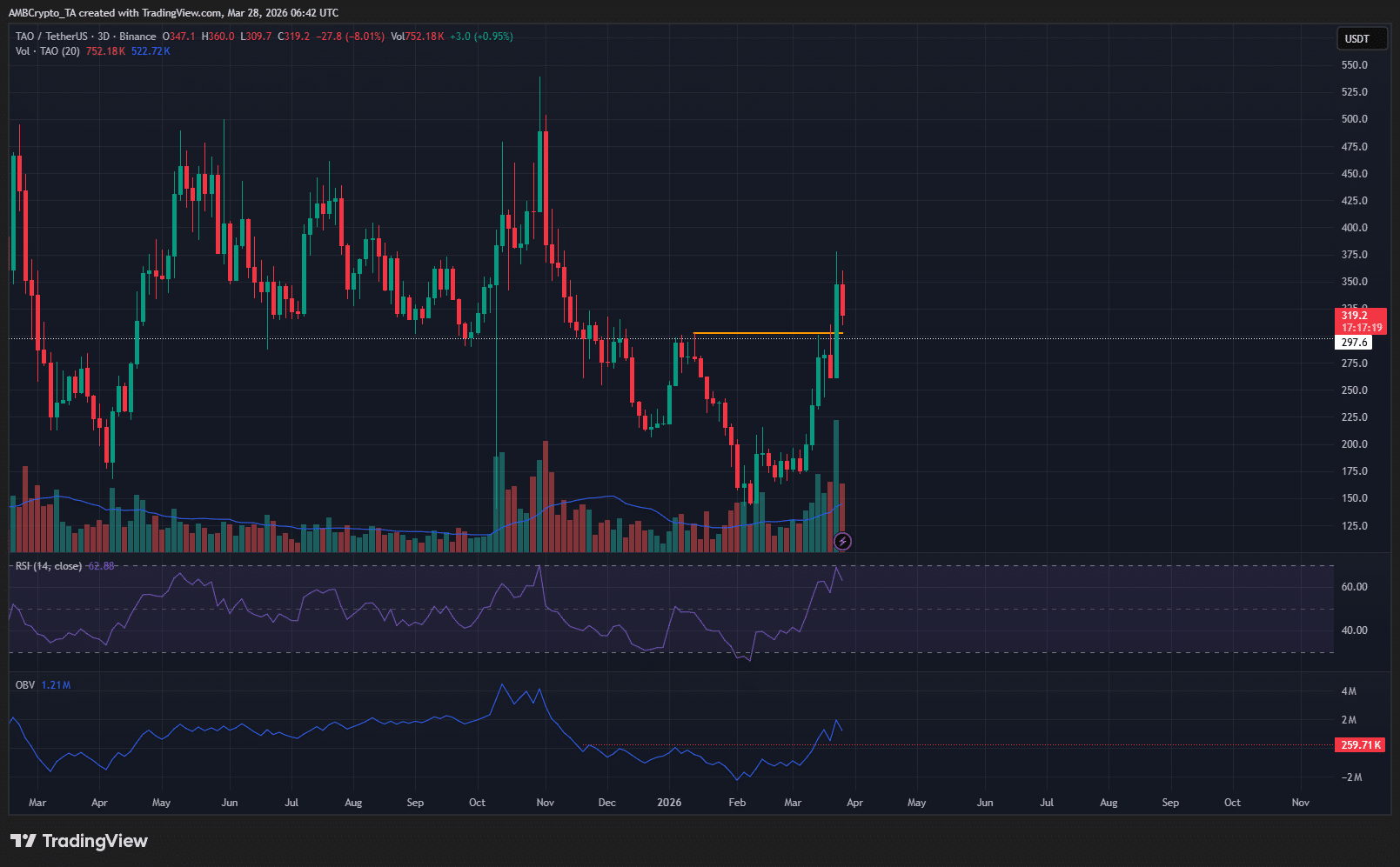
The move above $302.4 last week represented a bullish swing structural shift for TAO on the 3-day chart. At the same time, the OBV was making new local highs, and a psychological round number resistance had been overcome.

These developments were remarkable, especially as Bitcoin and many altcoins were forced to go lower or trade sideways. The demand for decentralized AI infrastructure likely explained the AI token’s relative strength.

A pullback toward $300 would be a buying opportunity for Bittensor traders and investors. Their next targets would be $450-$500.

Why traders should buy now

Source: TAO/USDT on TradingView

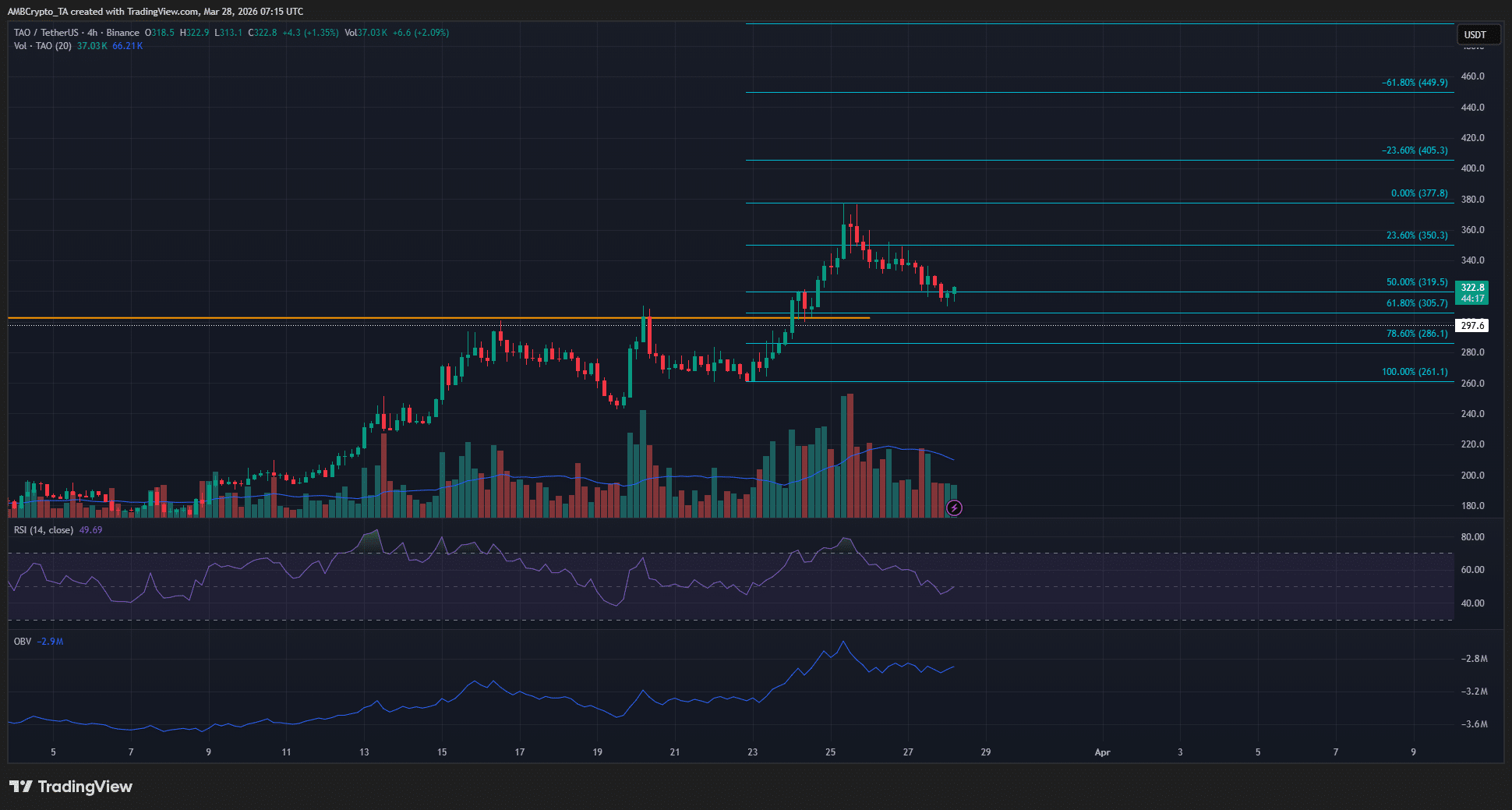
The 4-hour chart was quite encouraging. In this timeframe, the price structure was firmly bullish. The technical indicators also supported the upward momentum and reflected steady buying pressure on the altcoin.

The Fibonacci retracement levels (cyan) showed that a retracement was underway. The $286-$305 pocket would be the ideal buying zone, but it is unclear if we will get this dip.

Traders can look to buy anywhere within the $286-$319 area, as many traders and analysts also consider the 50% retracement as a key support in an uptrend. In either scenario, the $405 and $449 levels would be the next targets.

A drop below the $261.1 mark will shift the H4 structure bearishly and invalidate the bullish setup laid out above.


Final Summary

  • Bittensor continued to trade above the $300 level despite the crypto market correction over the past two days.
  • This show of relative strength could see another uptrend next week, with $409 and $450 being the next targets.

Связанные с этим вопросы

QWhat is the key psychological support level for Bittensor (TAO) mentioned in the article?

AThe key psychological support level for Bittensor (TAO) is $300.

QWhat did the move above $302.4 represent for TAO on the 3-day chart?

AThe move above $302.4 represented a bullish swing structural shift for TAO on the 3-day chart.

QAccording to the article, what is the ideal buying zone for TAO on the 4-hour chart?

AThe ideal buying zone for TAO on the 4-hour chart is the $286-$305 price pocket.

QWhat price level would invalidate the bullish setup and shift the H4 structure bearishly?

AA drop below the $261.1 mark would invalidate the bullish setup and shift the H4 structure bearishly.

QWhat are the next major price targets for TAO if the uptrend continues?

AThe next major price targets for TAO are the $405, $409, $449, and $450 levels.

Похожее

UBS: The Crowdedness of A-Share Tech Stocks Is Far From Reaching Historical Peaks

UBS: A-share tech stocks still far from peak crowding levels A-shares' technology sector has seen a strong rebound, with trading activity hitting record highs, raising concerns about market crowding. However, UBS Securities argues that a key indicator of institutional positioning suggests the current crowding level remains well below historical peaks. While the large-cap tech sector's share of total A-share trading volume and market capitalization have reached historical highs, the overweight ratio of domestic mutual funds in this sector stood at 9.9% in Q1 2026. This is down from 11.6% in Q3 2025 and significantly lower than the historical peak of 14.1% in Q4 2015. It also pales in comparison to the historical peak overweight of 18.7% for the consumer sector. UBS notes that typical cycles from a low to a peak in fund overweighting last about three years, and the current outperformance of the tech/growth style has lasted less than two years since the policy pivot in September 2024. UBS expects A-share earnings recovery to accelerate, providing fundamental support. It forecasts 2026 A-share profit growth to rise to 11% from 3.9% in 2025. Non-financial A-share profits grew 11.8% YoY in Q1 2026, with gross and net profit margins at their highest since 2023. Persistent fund inflows, the expansion of thematic ETFs, and a recovery in private fund issuance are supporting market liquidity. In tactical allocation, UBS favors growth and cyclical styles under its "slow bull" base case, with overweight ratings on six sectors: Electronics (benefiting from semiconductor inventory recovery and AI innovation), Communications (driven by AI computing demand), Machinery (aided by domestic capex recovery), Non-ferrous Metals (due to rising copper/aluminum prices), Chemicals (supported by anti-involution policies), and Electrical Equipment (driven by policy support and AI data center power demand).

marsbit4 мин. назад

UBS: The Crowdedness of A-Share Tech Stocks Is Far From Reaching Historical Peaks

marsbit4 мин. назад

Should You Buy SpaceX Stock at $1.7 Trillion? Here's What the Market Is Worried About

SpaceX is preparing for a massive IPO aiming to raise around $75 billion at a valuation of approximately $1.75 trillion. While its achievements in reusable rockets and the profitable Starlink satellite internet service are clear, the market is concerned about the aggressive valuation. Key issues include: the current $1.75 trillion valuation, which is about 94 times 2025 revenue, seems to price in not just existing businesses but also unproven future ventures like AI infrastructure and orbital data centers. Financially, while Starlink is profitable, the AI division, bolstered by the acquisition of xAI, is incurring massive losses and consuming the majority of capital expenditures. This acquisition also introduced complex related-party financing arrangements and debt onto SpaceX's balance sheet. Furthermore, corporate governance poses a challenge. SpaceX's dual-class share structure ensures founder Elon Musk retains absolute control, limiting ordinary shareholders' influence over high-risk, long-term strategic decisions. The future success of ambitious projects like the Starship rocket—critical for lowering costs and enabling new services—remains a significant variable for the valuation. In summary, the market's apprehension (FUD) centers not on doubting SpaceX's past technological triumphs but on questioning how much premium public investors should pay for a future that combines proven profits with highly speculative and capital-intensive new ventures, all under a governance structure that offers limited shareholder oversight.

marsbit1 ч. назад

Should You Buy SpaceX Stock at $1.7 Trillion? Here's What the Market Is Worried About

marsbit1 ч. назад

Breaking the DeFi Cascading Liquidation Curse: Vitalik Proposes a New Solution

Vitalik Buterin has proposed a new DeFi design to eliminate the automatic liquidation mechanism that causes market instability during sharp downturns. The current system, used by protocols like Aave, triggers forced sales when collateral value falls below a threshold, often exacerbating price drops and creating systemic selling pressure. Buterin's alternative model is based on splitting an asset like ETH into two synthetic option-like tokens, P and N, pegged to a price index. Their combined value always equals one ETH. Instead of sudden liquidation, a position's value gradually drifts from its target peg if the market moves. Users must proactively rebalance their holdings to maintain their desired exposure, transferring the management burden from the protocol to the user or automated tools. A key advantage is the reduced reliance on real-time oracles. Pricing decisions are deferred until contract expiry, allowing for more robust, fault-tolerant oracle designs. This removes a clear liquidation threshold that speculators can target for manipulation or MEV extraction. However, significant challenges remain. Frequent rebalancing could incur high slippage and transaction costs, necessitating new liquidity provider models. The design is better suited for hedging instruments than for stablecoins requiring a rigid 1:1 peg. While not an immediate replacement for existing systems, the proposal challenges the foundational assumption that instantaneous forced liquidation is an unavoidable necessity in DeFi, opening the door for fundamentally different risk management architectures.

marsbit1 ч. назад

Breaking the DeFi Cascading Liquidation Curse: Vitalik Proposes a New Solution

marsbit1 ч. назад

Торговля

Спот
Фьючерсы
活动图片