Bitcoin's Weak Rebound Fails to Conceal Adjustment Trend; HYPE's Top Signals Warn of Short-Term Risks | Guest Analysis

Odaily星球日报Опубликовано 2026-06-01Обновлено 2026-06-01

Введение

Bitcoin's Weak Bounce Fails to Mask Correction Trend; HYPE Top Signals Warn of Short-Term Risks | Invited Analysis Core Weekly View: Bitcoin's daily chart structure has weakened. The key question is whether its short-term rebound can effectively break above the upper boundary of the descending channel. Has HYPE's seven-wave advance reached its conclusion? This analysis systematically examines the current market structure across multiple timeframes and outlines operational strategies for the week. **Bitcoin (BTC) Analysis:** The daily chart shows BTC trading within a long-term rising channel (yellow) since February but has recently broken below its midline, indicating structural weakness. It is currently confined within a short-term descending channel (blue) originating from the May 6 high. The ongoing bounce appears to be a weak technical correction targeting the blue channel's upper rail (approx. $75,000-$76,000). The 4-hour chart reveals a complex 10-segment corrective structure from the May high, containing two downward pivot zones (Central D and E). The current rebound (segment 36-37) is expected to face resistance in the $75,000-$76,000 area. A failure to break above could lead to a resumption of the downtrend, testing support at $69,500-$70,500 and potentially $65,000. **BTC Weekly Strategy:** The price is currently below the "Bull-Bear Channel," placing it in a technically weak zone. The core focus is on the test of the $75,000-$76,000 resistance and $69,500-$70,500...

This Week's Core: Bitcoin's daily structure weakens; can the short-term rebound effectively break above the upper rail of the descending channel? Has HYPE's seven-segment rally reached its endpoint? The following analysis systematically reviews the current market structure from multiple timeframes and outlines mid- and short-term trading strategies for this week, for reference.

Summary of This Week's Core Trading Views:

• BTC multi-timeframe trend structure analysis. (Details in Part 1)

• BTC price outlook and mid-/short-term trading strategies for this week. (Details in Part 2)

• HYPE hourly timeframe trend structure analysis. (Details in Part 3)

• HYPE price outlook and short-term trading strategies for this week. (Details in Part 4)

Market Validation of Last Week's Trading Strategies and Core Views:

• BTC short-term trading performance: Bitcoin completed one short-term short trade (1x leverage) last week, successfully achieving a return of approximately 5.07%. (Details in Table 1)

• Market validation of BTC price trend prediction: Last week's article indicated that Bitcoin would continue its consolidation and downward adjustment pattern, with the short-term strategy primarily focused on 'selling on rallies'. The current market movement validates our previous prediction.

I. Bitcoin Multi-Timeframe Trend Structure Analysis

1. BTC Daily Timeframe Trend Structure Analysis

Bitcoin _ Daily K-Line Chart:
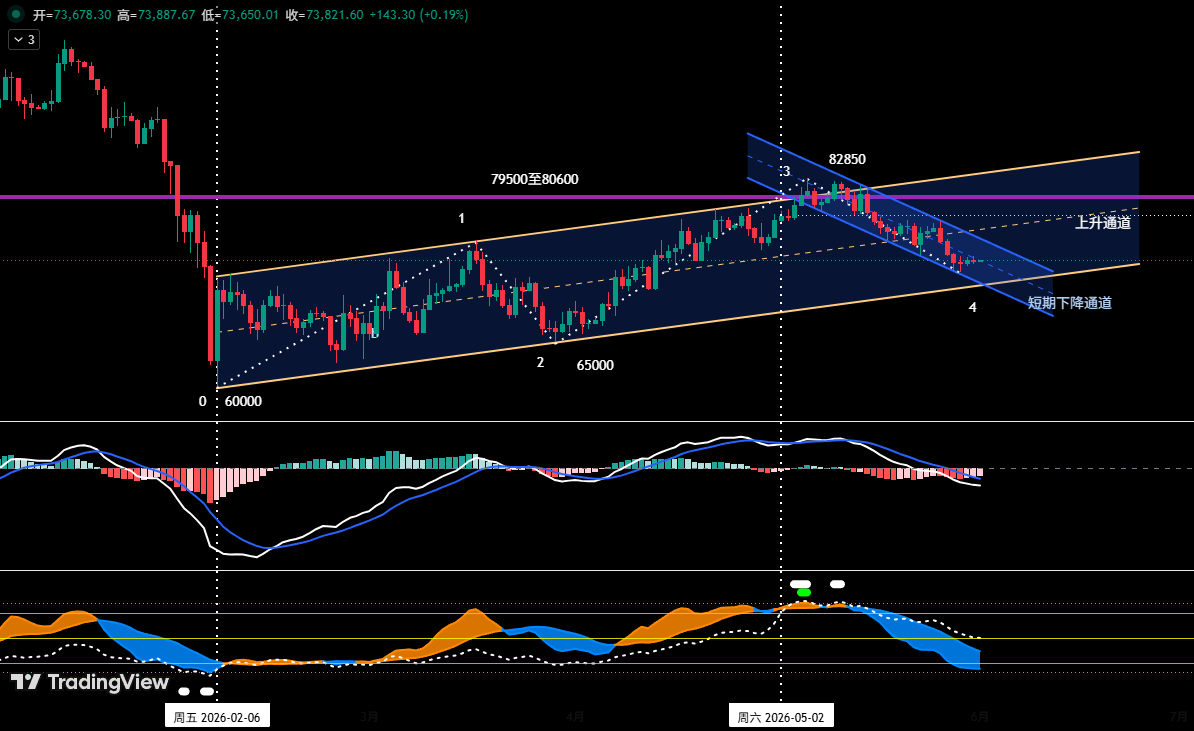
Figure 1

Ascending Channel (Yellow): As shown in (Figure 1), since the low on February 6, 2026, Bitcoin has maintained a consolidation uptrend within an ascending channel. (Lower rail: line connecting the lows of February 6 and March 29; Upper rail: a line parallel to the lower rail drawn through the high of March 17)

Short-term Descending Channel (Blue): Since touching the high of $82,850 on May 6, Bitcoin has entered and is operating within a short-term descending channel. (Upper rail: line connecting the rally highs of May 14 and May 26; Lower rail: line connecting the correction lows of May 7 and May 23)

Based on the Ascending Channel (Yellow) analysis, the price has broken below the channel's midline and is seeking stronger support towards the lower rail.

Based on the Short-term Descending Channel (Blue) analysis, the price found brief support upon reaching the channel's lower rail (approximately $72,500) and is currently in a period of weak rebound towards the channel's upper rail.

Comprehensive Judgment: From a technical structure perspective, Bitcoin is facing the dual influence of long and short-term channels. The current rebound is primarily a correction for short-term oversold conditions, targeting the upper rail of the short-term descending channel (Blue). However, as the price has broken below the midline of the ascending channel (Yellow), the overall technical structure has weakened. It is expected that after the rebound concludes, the price will most likely revert to the previous downtrend and further test the support strength of the ascending channel's lower rail.

2. In-depth Analysis of BTC Hourly Timeframe Trend Structure: (Using the 4-hour chart as the analysis timeframe)

Bitcoin _ 4-hour K-Line Chart
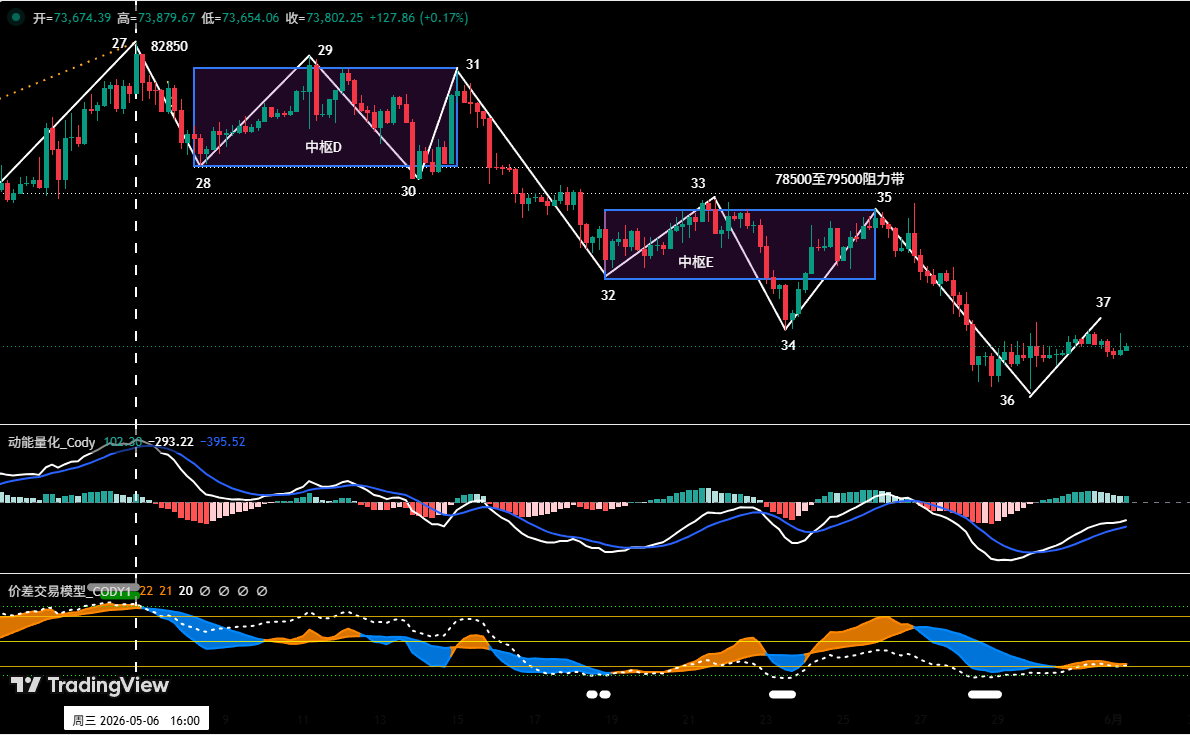
Figure 2

1. As shown in (Figure 2), from the high of $82,850 on May 6 to the ongoing adjustment, the 4-hour chart reveals a detailed subdivision into a total of 10 segments of adjustment structure: from "Segment 27-28" to "Segment 36-37". This includes two descending pivots (zhongshu):

• Pivot D: Formed by the overlapping of segments 28-29, 29-30, and 30-31.

• Pivot E: Formed by the overlapping of segments 32-33, 33-34, and 34-35.

2. From the 4-hour trend structure perspective, the market is currently undergoing the rebound of segment 36-37. If the price faces resistance and falls back after rebounding to the $75,000~$76,000 area, failing to form an effective breakout, the market is highly likely to continue its previous pattern of consolidation and decline, testing the support strength around $69,500~$70,500.

II. Bitcoin Price Outlook and Trading Strategies for This Week

1. BTC Price Trend Outlook for This Week:

This week's core view: Focus on the test results of the resistance area at $75,000~$76,000 and the support area at $69,500~$70,500 by both bulls and bears.

2. Core Resistance Levels:

• First Resistance Area: $75,000~$76,000 region (near the lower rail of Pivot E)

• Second Resistance Area: $78,500~$79,500 region (near the upper/lower rails of the two pivots)

3. Core Support Levels:

• First Support Level: $69,500~$70,500 region (previous important support level)

• Second Support Level: Around $65,000 (previous important support level)

4. Trading Strategies for This Week (Excluding Impact of Unexpected News)

1. Mid-term Strategy:

Bitcoin _ Daily K-Line Chart: (Position Monitoring Model)
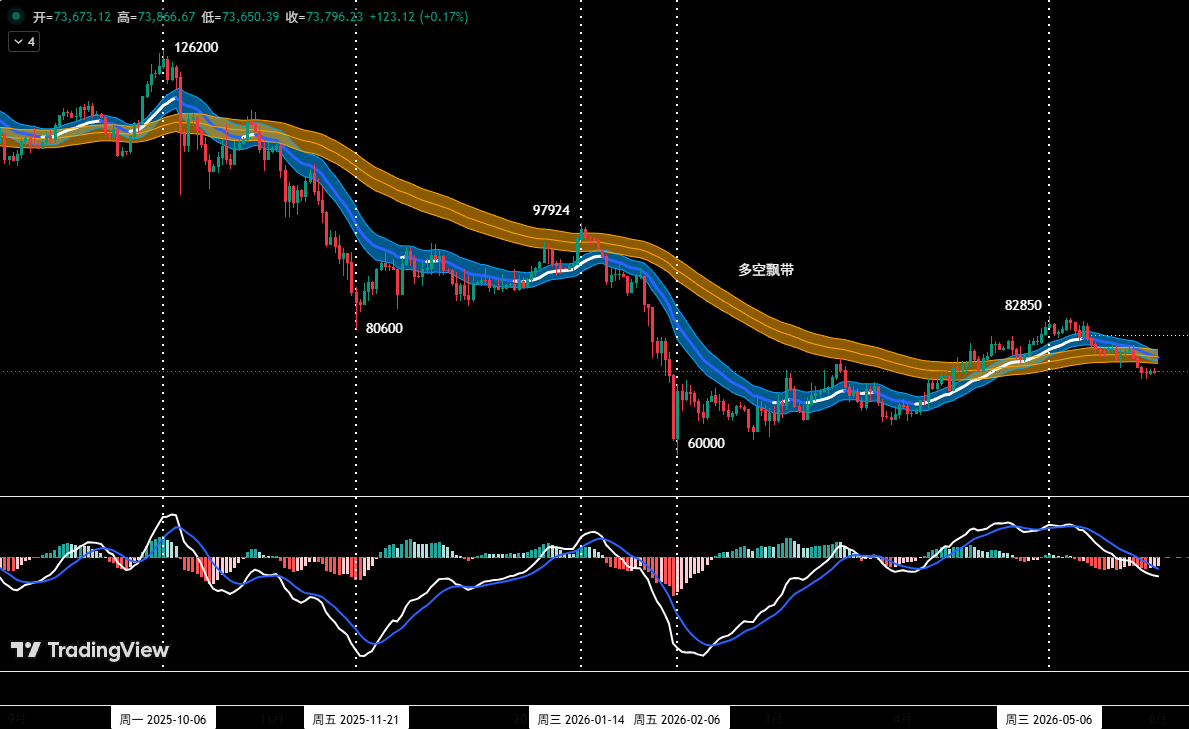
Figure 3

Position Monitoring Model: As shown in (Figure 3), the price has fallen below the "Bull-Bear Channel", entering a technically weak area. This week, focus on its retest of the Bull-Bear Channel (approximately the $75,000~$76,000 region). If the price shows signs of stalling, encountering resistance, and falling back after rebounding to this level, initiating a mid-term short position layout will begin. To control risk, the initial position can be set below 30% of the total capital; subsequently, after the price breaks below the lower rail of the ascending channel (Yellow), the mid-term position can be increased to around 60%.

2. Short-term Strategy: Utilize 30% of capital, set stop-loss points, and look for 'spread' trading opportunities based on support and resistance levels. (Use the 30-minute/60-minute chart as the operational timeframe).

3. In short-term trading, to dynamically respond to the complex evolution of the market, we have pre-formulated two specific operational plans: Plan A/B.

Plan A: Rebound Meets Resistance, Sell High.

• Entry: When the price rebounds to the $75,000~$76,000 area and encounters resistance, combined with a top signal from the quantitative model, a short position of less than 30% can be established.

• Risk Control: Initial stop-loss set above $77,000.

• Exit: Gradually close the position to take profits when the price adjusts near important support levels combined with model signals.

Plan B: Effectively Breaks Support, Follow the Trend Short.

• Entry: When the price effectively breaks below the support area of $69,500~$70,500 combined with a model top signal, a short position of less than 30% can be established.

• Risk Control: Initial stop-loss set above $72,000.

• Exit: Gradually close the position to take profits when the price falls to important support levels combined with model signals.

III. HYPE Hourly Timeframe Trend Structure Analysis:

HYPE_4-hour K-Line Chart
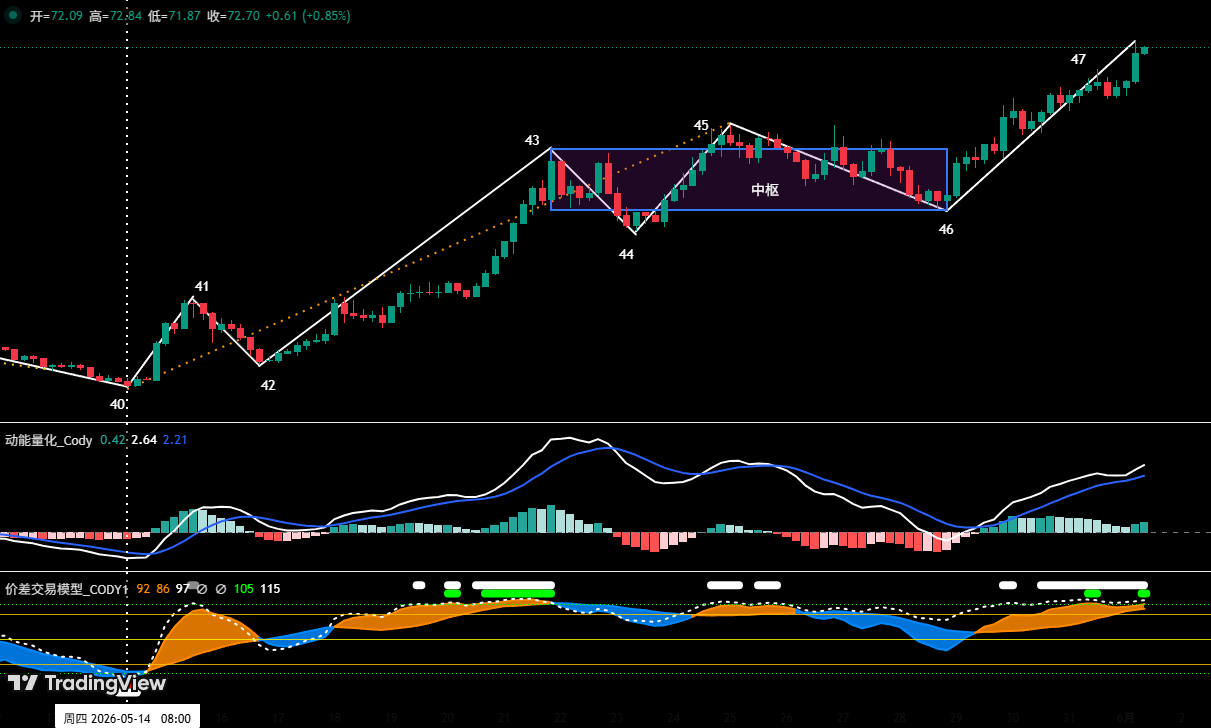
Figure 4

1. As shown in (Figure 4), on the 4-hour timeframe, since the low of $38.14 on May 14, HYPE has clearly constructed a seven-segment structure (i.e., 40-41 to 46-47) including a "rising pivot". Segments 43-44, 44-45, and 45-46 overlap with each other, forming the "rising pivot".

2. Last week's review warned: Due to the momentum top divergence state at "Endpoint 45", coupled with the top warning signal from the "Spread Trading Model", a resonance formed. Therefore, the probability of forming a short-term high here was significant. Market movement confirmed this judgment: the price adjusted from "Endpoint 45" ($64.75) to "Endpoint 46" ($56.30), with a maximum decline of 13.05%.

3. Currently, comparing the pivot exit segment (46-47) with the entry segment (42-43), its upward momentum appears weak, constituting a high probability of potential "momentum divergence".

4. Analysis based on our self-built "Spread Trading Model" shows that "Endpoint 47" has triggered a strong top warning signal (red dot + white dot).

5. In summary, if the price forms a topping signal at "Endpoint 47" while the "momentum divergence" signal remains valid, the probability of this point becoming the phase endpoint of the rally since "Endpoint 40" will significantly increase. Subsequent price action needs to focus on the test results of the key area between $62.5 and $64.57.

IV. HYPE Price Outlook and Short-term Trading Strategies for This Week

1. HYPE Price Trend Outlook for This Week:

This week's core HYPE view:

• Observe whether "momentum divergence" is established when "Endpoint 47" issues a clear topping signal.

• If this phenomenon occurs and the subsequent price effectively breaks below the support area of $62.5 to $64.57, it can be considered that "Endpoint 47" has become the endpoint of the uptrend since the low on May 14.

2. HYPE Short-term Trading Strategies for This Week: (Buy on Support)

This week's HYPE short-term trading should follow the strategy of "buying on dips, avoiding chasing rallies". The core is to observe the test results of the price retracement on the $62.5 to $64.75 area:

Strategy One: Test Long on Support Area Stabilization

If the price retraces to this area, shows signs of stopping the decline and stabilizing, and is combined with bottom signals triggered by both major models, consider a light long position test. The position must be controlled below 30%, with strict stop-loss discipline.

Strategy Two: Support Fails, Transitioning to a Larger Correction

If the price effectively breaks below this area, the short-term correction will upgrade to a larger-scale (e.g., daily timeframe) adjustment, extending its duration and space. The downward target initially looks at the $54 to $56.3 area.

V. Bitcoin Trade Review

1. Short-term Trade Review: (See Table 1)

We strictly followed the operational plan, based on trading signals issued by our self-built "Spread Trading Model" and "Momentum Quantitative Model", and completed one short-term (short) trade last week, achieving a profit of 5.07%.

1. Bitcoin Short-term Trade Details Summary: (Leverage*1x)
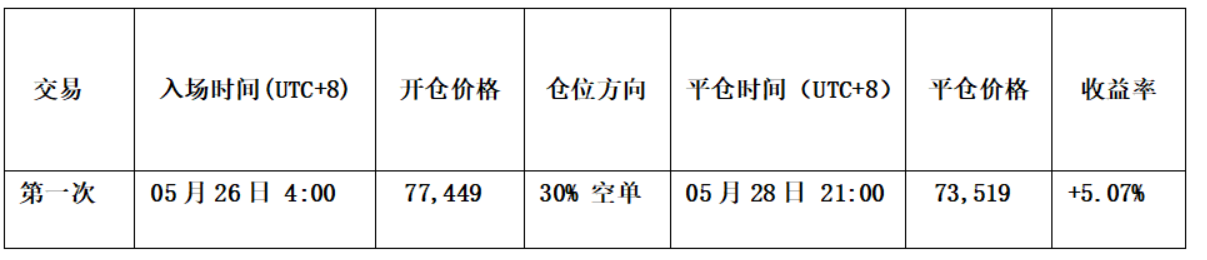
Table 1

2. Short-term Trade Review: (See Figure 5)

• Entry Strategy:

a. When the price rebounded near $78,000 and showed resistance signals, the K-line formed a 'top reversal' bearish pattern;

b. The "Spread Trading Model" triggered a top warning signal (white dot);

c. The "Momentum Quantitative Model" issued a momentum top divergence signal.

Therefore, we established a 30% short position at $77,449.

• Exit Strategy:

a. When the price fell near $73,000 and issued a stopping decline signal, the K-line formed a 'bottom reversal' pattern;

b. The "Spread Trading Model" triggered a strong bottom warning signal (red dot + white dot), forming a bottom resonance signal with the "Momentum Quantitative Model".

Therefore, we closed all positions near $73,519.

• Summary: This trade successfully achieved a profit of approximately 5.07%.

BTC_60-minute K-Line Chart: (Momentum Quantitative Model + Spread Trading Model)
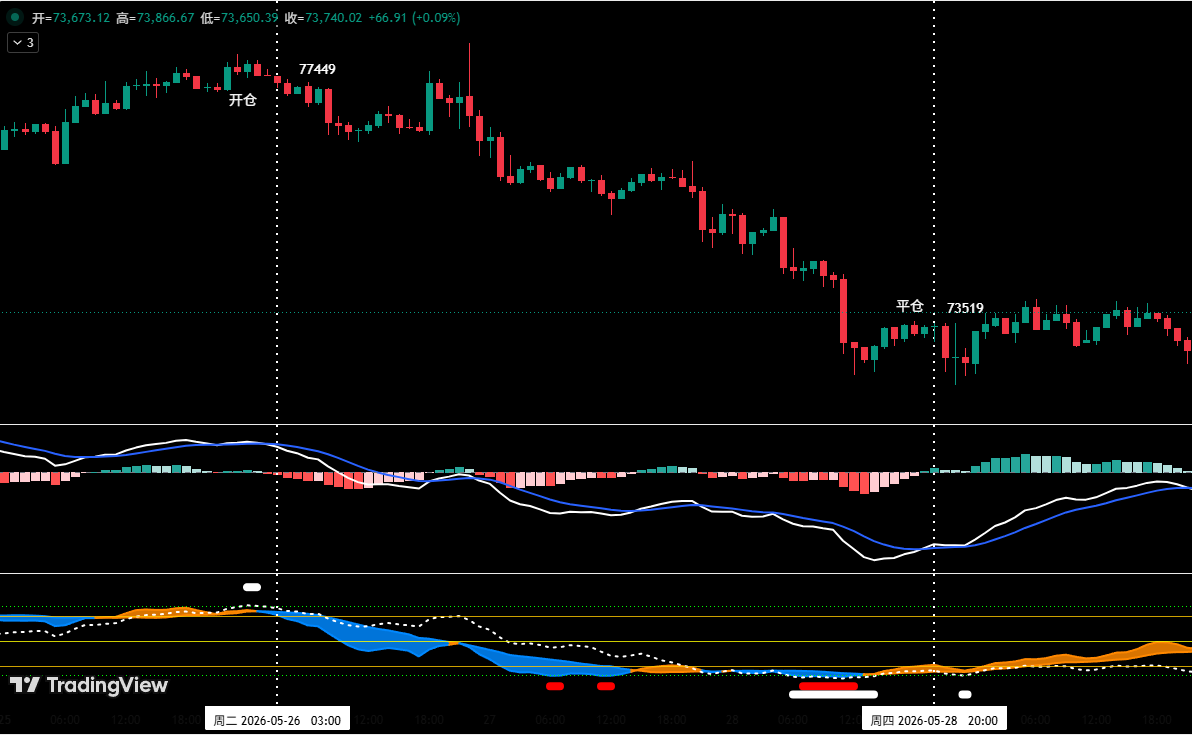
Figure 5 (Short-term Trade Illustration)

VI. Special Notes:​​

1. When opening a position: Immediately set the initial stop-loss level.

2. When profit reaches 1%: Move the stop-loss to the entry cost price (breakeven point) to ensure capital safety.

3. When profit reaches 2%​​: Move the stop-loss to the 1% profit level.

4. Continuous tracking: Thereafter, for every additional 1% profit the price makes, move the stop-loss up by 1% accordingly, dynamically protecting and locking in profits.

Financial markets change rapidly; all market analysis and trading strategies require dynamic adjustment. All views, analytical models, and operational strategies mentioned in this article are derived from personal technical analysis, intended solely for personal trading log purposes, and do not constitute any investment advice or operational basis. The market involves risks; investment requires caution. Please do not make decisions based on this.


Связанные с этим вопросы

QBased on the analysis, what are the key resistance levels for Bitcoin (BTC) this week?

AThe key resistance levels for Bitcoin this week are the first resistance zone at 75,000~76,000 USD (near the lower rail of Central E) and the second resistance zone at 78,500~79,500 USD (near the upper and lower rails of the two central structures).

QWhat technical condition suggests HYPE may be reaching a top in its current uptrend?

AHYPE shows a potential 'momentum divergence' on the 4-hour chart, where the momentum of the central breakout segment (46-47) appears weaker than the initial entry segment (42-43). Furthermore, the proprietary 'Spread Trading Model' has triggered a strong top warning signal (red dot + white dot) at 'endpoint 47', increasing the probability of a significant short-term top.

QWhat are the two main short-term operational plans (A and B) outlined for Bitcoin trading?

APlan A: 'Sell on rallies upon encountering resistance.' Open a short position of less than 30% when the price rebounds and faces resistance in the 75,000~76,000 USD zone, with a stop-loss above 77,000 USD. Plan B: 'Sell on a breakdown of support.' Open a short position of less than 30% when the price effectively breaks below the 69,500~70,500 USD support zone, with a stop-loss above 72,000 USD.

QWhat was the profit from last week's Bitcoin short trade, and what signals triggered the entry and exit?

ALast week's Bitcoin short trade yielded a profit of approximately 5.07%. The entry was triggered at 77,449 USD due to: price resistance near 78,000 USD forming a 'top-fractal' bearish candlestick pattern, the 'Spread Trading Model' giving a top warning (white dot), and the 'Momentum Quantification Model' showing a bearish momentum divergence. The exit at 73,519 USD was triggered by a 'bottom-fractal' pattern near 73,000 USD and a strong bottom resonance signal from both the 'Spread Trading Model' (red+white dots) and the 'Momentum Quantification Model'.

QWhat is the core strategy recommended for HYPE's short-term trading this week, and what is the key support area to watch?

AThe core short-term strategy for HYPE this week is to 'buy on dips and avoid chasing rallies.' Traders should observe the price test of the key support area between 62.5 and 64.75 USD. Strategy 1 is to attempt a light long position (under 30%) if the price finds support and stabilizes in this zone with confirming bottom signals from the models. Strategy 2 warns that an effective break below this support area would likely lead to a larger-scale (e.g., daily chart) correction towards the 54-56.3 USD zone.

Похожее

Korean Youth, Making a 'Last Stand' in an Epic Bull Market

South Korea is experiencing an unprecedented stock market boom in the first half of 2026, with the KOSPI index doubling in six months, driven primarily by tech giants Samsung Electronics and SK Hynix. This "epic bull run," tied to the semiconductor cycle, has sparked a nationwide frenzy for stock trading. The country, with a population of just over 50 million, now has over 105 million securities accounts. The article, from the perspective of a Chinese national living in Seoul, explores how this speculative fever reflects deeper societal anxieties among Korean youth. Facing stagnant wages, high costs of living, housing pressures, and rigid social stratification, many young people see the volatile market as a "last chance" to alter their predetermined life trajectories and escape financial precarity. Stories include a young office worker investing her meager savings, a couple delaying marriage due to financial pressures, and a seasoned trader navigating exclusive social circles where market information is currency. However, the boom also exposes and exacerbates existing inequalities. While some achieve windfalls, others face devastating losses, with borrowing to invest reaching record highs. The narrative contrasts the illusion of equal opportunity with the harsh reality that the ability to absorb risk is unevenly distributed. Ultimately, the market frenzy is portrayed not as a solution, but as a symptom of a generation's struggle against a system offering limited upward mobility, where daily life is a precarious balance of bills, debts, and societal expectations.

marsbit12 мин. назад

Korean Youth, Making a 'Last Stand' in an Epic Bull Market

marsbit12 мин. назад

Young South Koreans, Making a 'Last-Ditch Effort' in an Epic Bull Market

This article explores how an unprecedented stock market boom in South Korea during the first half of 2026, driven by the semiconductor industry, is transforming the lives of ordinary people, particularly the youth. The KOSPI index doubled in six months, fueled by giants Samsung and SK Hynix, leading to a frenzy of retail investing. With over 105 million stock accounts in a population of just over 50 million, a sense of "FOMO" (fear of missing out) is pervasive. Through the perspective of Li Yuning, a Chinese woman living in Seoul, the piece follows several young Koreans who see the market as a last chance to escape stifling economic pressures, high housing costs, and narrow social mobility. Individuals like Minji, a low-paid office worker, and Junho, saving for marriage, invest their limited savings, while experienced traders like Suhu navigate exclusive social circles. The narrative reveals that this speculative fever stems less from greed and more from deep-seated anxiety about being left behind in a society with growing wealth inequality and rigid class structures. However, the boom also exposes stark social divides. It exacerbates wealth gaps, as those with family support or existing capital fare better. The pressure to succeed is immense, with stories of devastating losses leading to personal tragedy. Ultimately, the article suggests the牛市 acts as a pressure valve and a temporary illusion of opportunity in a system where traditional paths to advancement seem increasingly closed, leaving young people to gamble on the market as a final, desperate bid for a better future.

链捕手19 мин. назад

Young South Koreans, Making a 'Last-Ditch Effort' in an Epic Bull Market

链捕手19 мин. назад

Doubao Charges More than GPT, While DeepSeek Slashes Prices Dramatically: Who Will Win?

The article discusses the divergent pricing strategies of two major Chinese AI companies. In May, Doubao (by ByteDance) began testing fees, with its professional tier priced higher than ChatGPT Plus. Meanwhile, DeepSeek permanently cut prices for its V4-Pro API to a quarter of the original, setting new global lows. Doubao, with high user traffic from ByteDance apps like TikTok, leads in monthly active users but faces massive compute costs from its free model. Its move to a freemium model targets heavy users, aiming to balance scale and monetization amid substantial investments. DeepSeek's price cut is attributed to architectural innovations that slash inference costs, adaptation to domestic hardware reducing dependency, and engineering optimizations. It focuses on the enterprise (B2B) market, aiming to become a leading model base. Both companies are currently unprofitable. The article contrasts their approaches with Anthropic, which is profitable by primarily serving enterprises with high-value use cases like coding and agents. It argues that sustainable AI business models require integrating AI into real workflows to deliver tangible ROI, rather than just offering chat services. DeepSeek's recent $7 billion funding round, including investments from Tencent, is noted to bolster its B2B position. The ultimate winner will be the player that successfully transforms AI into measurable returns, whether through consumer productivity ecosystems or enterprise platforms.

marsbit28 мин. назад

Doubao Charges More than GPT, While DeepSeek Slashes Prices Dramatically: Who Will Win?

marsbit28 мин. назад

Promised Year of Crypto IPOs? Only One Went Public in Six Months, Down 70%

The much-anticipated wave of crypto IPOs in 2026 has failed to materialize, with market conditions worsening dramatically. While SpaceX prepares for the largest IPO in history, raising $75 billion at a $1.75 trillion valuation, the crypto sector faces a frozen pipeline. The sole crypto IPO success this year, BitGo, serves as a cautionary tale. After launching on the NYSE in January at $18, its stock has plummeted approximately 70%. Other major contenders have stalled or delayed. Kraken, which secretly filed in late 2025, has put its plans on ice, seeing its valuation drop 33% to $13.3 billion. Consensys has postponed its filing until autumn at the earliest, and Bitpanda is poised to miss its self-imposed H1 deadline for a Frankfurt listing. This widespread retreat is driven by a severe liquidity crunch. Bitcoin has fallen below $60,000, with capital being diverted to AI stocks and the massive SpaceX offering. The poor performance of earlier crypto listings like Gemini and the stagnant price of Coinbase further dampen investor appetite. A key underlying pressure is the impending US midterm elections in November, which could alter the currently favorable regulatory landscape. Companies had hoped to go public during this window of policy certainty, but challenging market dynamics have overridden those plans. The transparency that comes with being a public company is now seen as a potential liability rather than a benefit in a down market. The industry's fate now hinges on a few critical watchpoints: whether Kraken restarts its process in H2, if Consensys files in the fall, and if SpaceX's debut can revitalize market liquidity. Otherwise, the promised "crypto IPO year" will likely be pushed beyond the election.

marsbit42 мин. назад

Promised Year of Crypto IPOs? Only One Went Public in Six Months, Down 70%

marsbit42 мин. назад

Торговля

Спот
Фьючерсы

Популярные статьи

Как купить S

Добро пожаловать на HTX.com! Мы сделали приобретение Sonic (S) простым и удобным. Следуйте нашему пошаговому руководству и отправляйтесь в свое крипто-путешествие.Шаг 1: Создайте аккаунт на HTXИспользуйте свой адрес электронной почты или номер телефона, чтобы зарегистрироваться и бесплатно создать аккаунт на HTX. Пройдите удобную регистрацию и откройте для себя весь функционал.Создать аккаунтШаг 2: Перейдите в Купить криптовалюту и выберите свой способ оплатыКредитная/Дебетовая Карта: Используйте свою карту Visa или Mastercard для мгновенной покупки Sonic (S).Баланс: Используйте средства с баланса вашего аккаунта HTX для простой торговли.Третьи Лица: Мы добавили популярные способы оплаты, такие как Google Pay и Apple Pay, для повышения удобства.P2P: Торгуйте напрямую с другими пользователями на HTX.Внебиржевая Торговля (OTC): Мы предлагаем индивидуальные услуги и конкурентоспособные обменные курсы для трейдеров.Шаг 3: Хранение Sonic (S)После приобретения вами Sonic (S) храните их в своем аккаунте на HTX. В качестве альтернативы вы можете отправить их куда-либо с помощью перевода в блокчейне или использовать для торговли с другими криптовалютами.Шаг 4: Торговля Sonic (S)С легкостью торгуйте Sonic (S) на спотовом рынке HTX. Просто зайдите в свой аккаунт, выберите торговую пару, совершайте сделки и следите за ними в режиме реального времени. Мы предлагаем удобный интерфейс как для начинающих, так и для опытных трейдеров.

1.4k просмотров всегоОпубликовано 2025.01.15Обновлено 2026.06.02

Как купить S

Sonic: Обновления под руководством Андре Кронье – новая звезда Layer-1 на фоне спада рынка

Он решает проблемы масштабируемости, совместимости между блокчейнами и стимулов для разработчиков с помощью технологических инноваций.

2.3k просмотров всегоОпубликовано 2025.04.09Обновлено 2025.04.09

Sonic: Обновления под руководством Андре Кронье – новая звезда Layer-1 на фоне спада рынка

HTX Learn: Пройдите обучение по "Sonic" и разделите 1000 USDT

HTX Learn — ваш проводник в мир перспективных проектов, и мы запускаем специальное мероприятие "Учитесь и Зарабатывайте", посвящённое этим проектам. Наше новое направление .

1.8k просмотров всегоОпубликовано 2025.04.10Обновлено 2025.04.10

HTX Learn: Пройдите обучение по "Sonic" и разделите 1000 USDT

Обсуждения

Добро пожаловать в Сообщество HTX. Здесь вы сможете быть в курсе последних новостей о развитии платформы и получить доступ к профессиональной аналитической информации о рынке. Мнения пользователей о цене на S (S) представлены ниже.

活动图片