Bitcoin’s Latest Selloff Mirrors June 2022 As New Buyers Realize $1.5 Billion In Daily Losses

bitcoinistОпубликовано 2026-02-10Обновлено 2026-02-10

Введение

Bitcoin's recent selloff has triggered significant loss realization among recent investors, mirroring patterns seen during the June 2022 market bottom. According to on-chain data, buyers from 2025 and 2026 realized approximately $1.5 billion in daily losses during the downturn. The Net Realised Profit/Loss metric, which tracks net profit or loss from transactions, plunged into negative territory for these cohorts. While newer investors were selling at a loss, older investors largely took profits. Additionally, the Relative Unrealized Loss—unrealized loss as a percentage of market cap—rose to 16%, a level comparable to the May 2022 bear market. Bitcoin is currently trading around $69,300, down over 11% in the past week.

On-chain data shows Bitcoin buyers from 2025 and 2026 realized $1.5 billion in losses per day on the recent move down in the cryptocurrency.

Bitcoin Net Realised Profit/Loss Has Plunged Recently

In a new post on X, on-chain analyst Checkmate has talked about how loss-taking has looked during the latest Bitcoin price crash. The indicator cited by Checkmate is the “Net Realised Profit/Loss,” which measures the net amount of profit or loss that investors are realizing through their transactions.

The metric works by going through the transaction history of each coin being sold to see what price it was moved at prior to this. If the last selling price was greater than the latest spot price for any token, then that particular coin is now being moved at a net loss. On the other hand, the previous selling price being less suggests the sale is leading to profit realization.

In each case, the degree of profit/loss involved is equal to the difference between the two prices. The Net Realised Profit/Loss sums up this value for both types of sales and then finds their net value.

When the value of the indicator is greater than zero, it means the investors are selling their coins at a net profit. Similarly, it being negative implies loss-taking is the dominant mode of selling.

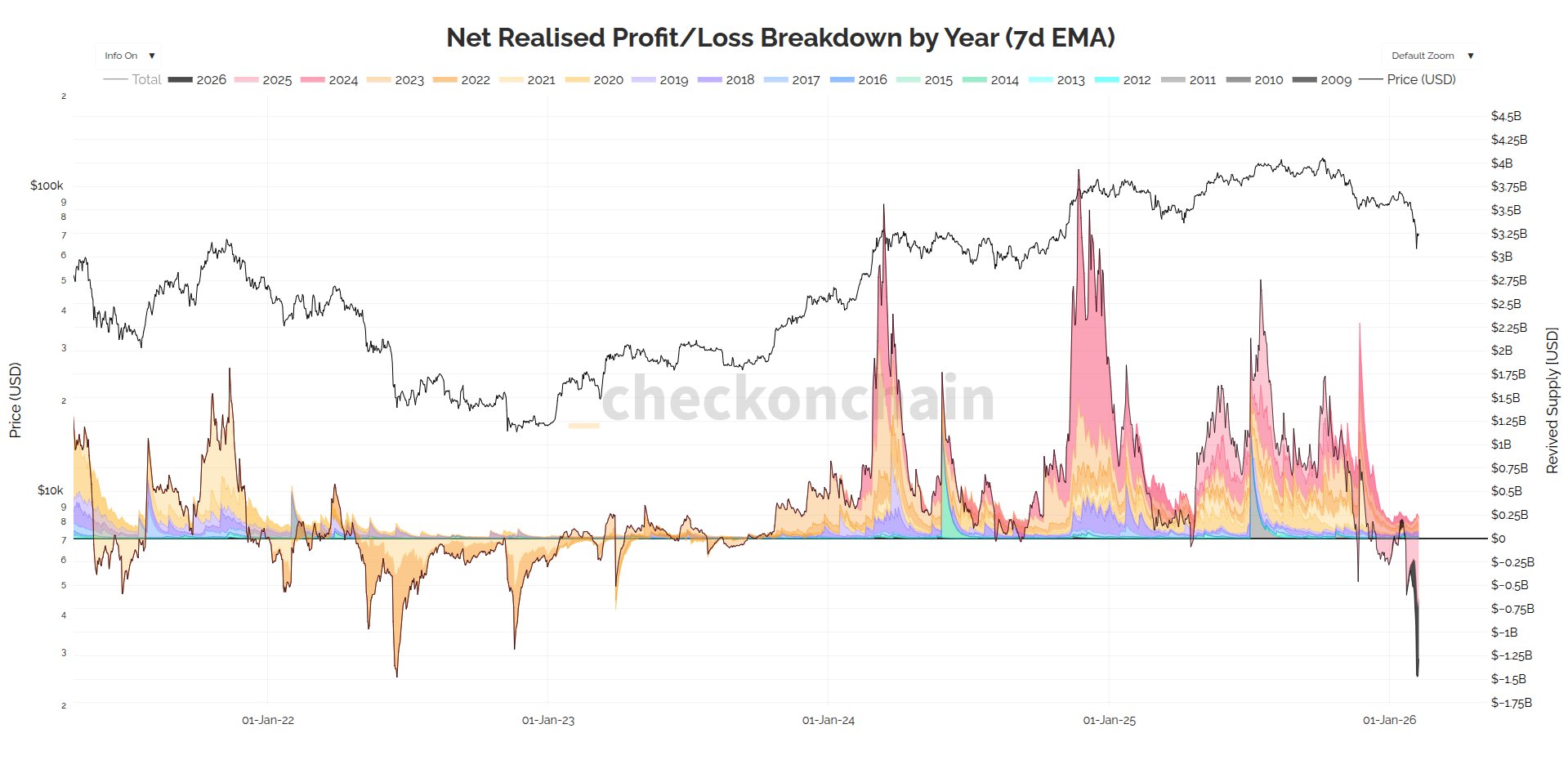
Now, here is the chart for the Ethereum Net Realised Profit/Loss shared by Checkmate that shows the trend in its 7-day exponential moving average (EMA) value separately for buyers from different years:

Looks like the value of the metric has plummeted into the loss zone for two cohorts | Source: @_Checkmatey_ on X

As displayed in the above graph, the Ethereum Net Realised Profit/Loss fell into the negative zone for the 2025 and 2026 buyers as the market crash took place. This suggests that buyers from the past year participated in loss realization.

“Class of 2025 and 2026 collectively puked out $1.5B/day in losses on the move lower, equivalent to the June 2022 low at $17.6k,” noted the analyst. Buyers from other years also participated in selling during the drawdown, but their distribution mostly involved profit-taking.

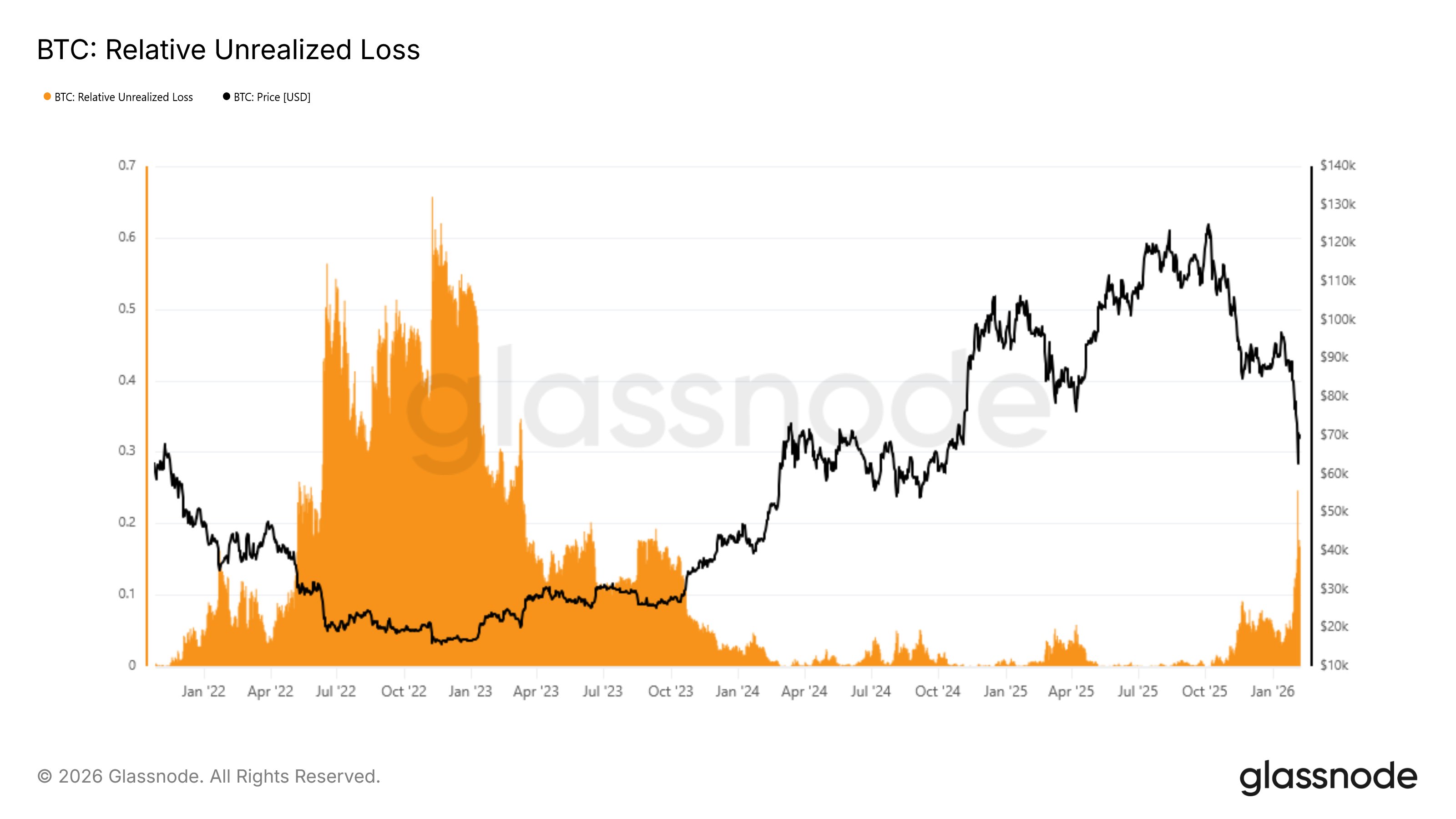
In related news, the unrealized loss in the market has also hit a value similar to that witnessed during the 2022 bear market, as on-chain analytics firm Glassnode has pointed out in an X post.

The trend in the BTC Relative Unrealized Loss over the last few years | Source: Glassnode on X

From the chart, it’s visible that the Relative Unrealized Loss, an indicator representing the unrealized Bitcoin loss as a percentage of the market cap, has risen to 16% recently. “Current market pain echoes a similar structure seen in early May 2022,” explained Glassnode.

BTC Price

At the time of writing, Bitcoin is trading around $69,300, down more than 11% over the past week.

The price of the coin appears to have gone down recently | Source: BTCUSDT on TradingView

Связанные с этим вопросы

QWhat does the 'Net Realised Profit/Loss' indicator measure in the context of Bitcoin transactions?

AThe 'Net Realised Profit/Loss' indicator measures the net amount of profit or loss that investors are realizing through their transactions by comparing the previous selling price of each coin to its latest spot price.

QWhich specific groups of Bitcoin buyers realized $1.5 billion in daily losses during the recent market crash?

ABuyers from the class of 2025 and 2026 collectively realized $1.5 billion in daily losses during the recent market crash.

QHow does the current market pain, as indicated by the Relative Unrealized Loss, compare to a previous period mentioned in the article?

AThe current market pain, with the Relative Unrealized Loss rising to 16% of market cap, echoes a similar structure seen in early May 2022.

QWhat was the significance of the June 2022 low at $17.6k mentioned by the analyst?

AThe June 2022 low at $17.6k is used as a benchmark, as the $1.5 billion/day in losses realized during this recent event was equivalent to the loss-taking seen at that previous market bottom.

QWhat was Bitcoin's price and weekly performance at the time the article was written?

AAt the time of writing, Bitcoin was trading around $69,300, down more than 11% over the past week.

Похожее

Why Is Nvidia Borrowing $20 Billion When It's Not Short of Cash?

Nvidia's recent announcement to issue at least $20 billion in senior notes, despite holding a strong cash position with over $48.6 billion in free cash flow last quarter, is not a sign of financial need. Instead, it represents a strategic move to leverage its high credit rating (recently upgraded to AA by S&P) to secure low-cost, long-term debt. This capital will support long-term AI infrastructure investments, data centers, R&D, supply chain prepayments, and strategic investments, while allowing the company to continue aggressive shareholder returns through stock buybacks and dividends. The decision reflects a mature capital management strategy: using debt to finance long-term growth assets is more efficient and less dilutive to shareholders than equity financing. It signals that Nvidia, like other tech giants (Alphabet, Meta, Amazon), is entering a new phase of heavy AI capital expenditure, shifting from a pure growth story to a story about capital allocation, credit strength, and long-term ecosystem positioning. The key question for investors is whether Nvidia can maintain its high cash flow generation and ensure that returns from these AI investments justify the cost of capital over the long term. The bond issuance amplifies its expansion capabilities but also ties its valuation more closely to the broader AI investment cycle's sustainability and profitability.

marsbit14 мин. назад

Why Is Nvidia Borrowing $20 Billion When It's Not Short of Cash?

marsbit14 мин. назад

How to Do Research Well: Deliberately Practice the Real Skills That Matter

No one truly teaches you how to do research. You're often given a desk, a pre-selected problem, and vague instructions to "create something new." Consequently, many people reverse-engineer the job based on visible outputs—papers, posts, announcements—learning only how to *appear* like a researcher rather than how to *become* one. True research capability is built from stacking small, trainable skills, nearly all of which can be developed through deliberate practice. **Pick Your Own Problem:** Most researchers absorb problems from advisors or trends, lacking the underlying reasoning. Choosing a problem you genuinely care about, as John Schulman advises, leads to original work. Develop "taste" like a muscle: predict experiment outcomes, guess paper results from methods, and track which findings remain important over time. **Upgrade Your Inputs:** Relying on shared reading lists (arXiv hot lists, filtered group chats) leads to unoriginal conclusions. Undervalued old literature often holds crucial insights (e.g., MoE, LSTM, backpropagation). Richard Sutton's "The Bitter Lesson" or Claude Shannon's 1952 talk on creative thinking are more predictive than lengthy modern surveys. Breadth matters as much as depth: draw from neuroscience, mechanism design, hardware knowledge, and honest statistics. Read papers directly, especially appendices and limitations sections. **Write Everything Down:** As Paul Graham noted, writing exposes flaws in seemingly mature ideas. Writing is the cheapest defense against self-deception. Following Feynman's principle, Darwin programmatically wrote down facts contradicting his theory to combat memory bias. Maintain a detailed log of hypotheses, setups, predictions, results, and updated understandings. Reviewing past logs fosters essential humility.

marsbit1 ч. назад

How to Do Research Well: Deliberately Practice the Real Skills That Matter

marsbit1 ч. назад

Following US Ban on Fable 5, Zhipu AI's Stock Soars 47%

On June 15th, shares of Zhipu AI surged dramatically on the Hong Kong stock market, peaking at a 47.6% gain before closing 32.82% higher. This sharp increase was directly triggered by two recent industry events. On June 12th, Anthropic announced it was suspending global access to its latest flagship models, Claude Fable 5 and Claude Mythos 5, to comply with a U.S. government export control order. The next day, Zhipu AI announced it would open access to its latest open-source flagship model, GLM-5.2, under the permissive MIT license. The Anthropic incident highlighted a critical issue beyond raw model capability: the risk of sudden, unpredictable loss of access to advanced AI models, especially for developers and enterprises deeply integrated with them. This has shifted industry and market focus toward factors like stability, sustainable access, and controllability. Zhipu's move, promoting "frontier intelligence for all," positions its openly available model as a reliable and accessible alternative. The GLM-5.2 model emphasizes "Long Horizon Task" capabilities with a 1M context window, targeting complex, multi-step coding and engineering workflows where maintaining context is crucial. Analysts note this event exposes the risk of dependency on closed-source models subject to single jurisdictional controls, potentially accelerating a shift toward domestic base models and localized deployments. The market's reaction signals a new valuation dimension in AI: providers who can offer stable, long-term, and sustainably accessible AI capabilities are gaining strategic importance.

marsbit2 ч. назад

Following US Ban on Fable 5, Zhipu AI's Stock Soars 47%

marsbit2 ч. назад

Торговля

Спот
Фьючерсы

Популярные статьи

Как купить S

Добро пожаловать на HTX.com! Мы сделали приобретение Sonic (S) простым и удобным. Следуйте нашему пошаговому руководству и отправляйтесь в свое крипто-путешествие.Шаг 1: Создайте аккаунт на HTXИспользуйте свой адрес электронной почты или номер телефона, чтобы зарегистрироваться и бесплатно создать аккаунт на HTX. Пройдите удобную регистрацию и откройте для себя весь функционал.Создать аккаунтШаг 2: Перейдите в Купить криптовалюту и выберите свой способ оплатыКредитная/Дебетовая Карта: Используйте свою карту Visa или Mastercard для мгновенной покупки Sonic (S).Баланс: Используйте средства с баланса вашего аккаунта HTX для простой торговли.Третьи Лица: Мы добавили популярные способы оплаты, такие как Google Pay и Apple Pay, для повышения удобства.P2P: Торгуйте напрямую с другими пользователями на HTX.Внебиржевая Торговля (OTC): Мы предлагаем индивидуальные услуги и конкурентоспособные обменные курсы для трейдеров.Шаг 3: Хранение Sonic (S)После приобретения вами Sonic (S) храните их в своем аккаунте на HTX. В качестве альтернативы вы можете отправить их куда-либо с помощью перевода в блокчейне или использовать для торговли с другими криптовалютами.Шаг 4: Торговля Sonic (S)С легкостью торгуйте Sonic (S) на спотовом рынке HTX. Просто зайдите в свой аккаунт, выберите торговую пару, совершайте сделки и следите за ними в режиме реального времени. Мы предлагаем удобный интерфейс как для начинающих, так и для опытных трейдеров.

1.5k просмотров всегоОпубликовано 2025.01.15Обновлено 2026.06.02

Как купить S

Sonic: Обновления под руководством Андре Кронье – новая звезда Layer-1 на фоне спада рынка

Он решает проблемы масштабируемости, совместимости между блокчейнами и стимулов для разработчиков с помощью технологических инноваций.

2.3k просмотров всегоОпубликовано 2025.04.09Обновлено 2025.04.09

Sonic: Обновления под руководством Андре Кронье – новая звезда Layer-1 на фоне спада рынка

HTX Learn: Пройдите обучение по "Sonic" и разделите 1000 USDT

HTX Learn — ваш проводник в мир перспективных проектов, и мы запускаем специальное мероприятие "Учитесь и Зарабатывайте", посвящённое этим проектам. Наше новое направление .

1.8k просмотров всегоОпубликовано 2025.04.10Обновлено 2025.04.10

HTX Learn: Пройдите обучение по "Sonic" и разделите 1000 USDT

Обсуждения

Добро пожаловать в Сообщество HTX. Здесь вы сможете быть в курсе последних новостей о развитии платформы и получить доступ к профессиональной аналитической информации о рынке. Мнения пользователей о цене на S (S) представлены ниже.

活动图片