Bitcoin’s Decay Signals the Most Severe Bearish Pivot Since the LUNA Collapse – A 2022 Echo

bitcoinistОпубликовано 2026-02-24Обновлено 2026-02-24

Введение

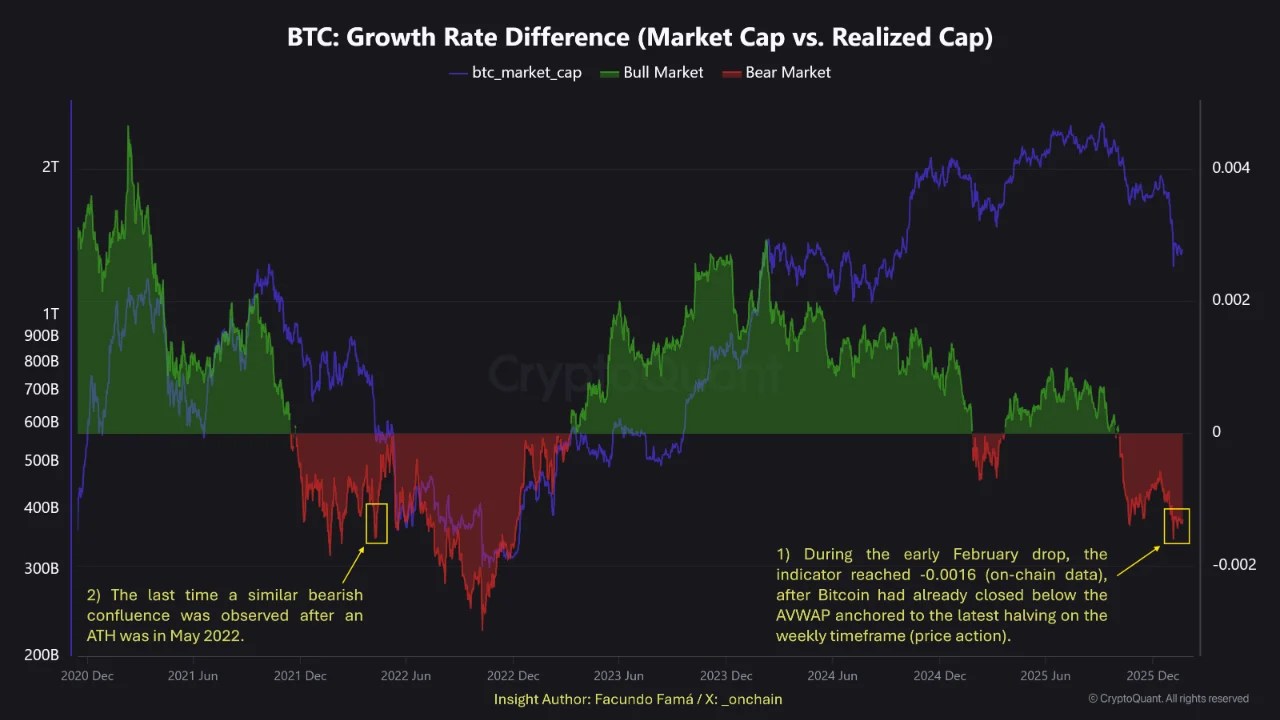
Bitcoin is struggling to hold the $65,000 level as market sentiment turns apathetic amid muted price action and declining participation. A CryptoQuant report indicates that Bitcoin has closed below a key halving-anchored price average (AVWAP) on the weekly chart, signaling reduced conviction among investors and weaker cost-basis support. The current bearish confluence—comparing the BTC Growth Rate Difference between Market Cap and Realized Cap and anchored VWAP levels—echoes conditions seen in May 2022, which preceded a prolonged correction. These indicators suggest a fragile market structure, typically requiring renewed liquidity or sustained accumulation before a recovery can begin.

Bitcoin is struggling to hold the $65,000 level as market sentiment drifts toward apathy following weeks of muted price action and declining participation. Volatility has compressed noticeably, and traders appear hesitant to commit fresh capital while macro uncertainty and liquidity constraints continue to weigh on risk assets. The lack of decisive momentum has left Bitcoin consolidating near a technically sensitive zone, where both bulls and bears seem reluctant to take aggressive positions.

A recent CryptoQuant report provides additional context through on-chain positioning data. According to the analysis, during the early February correction, the indicator dropped to roughly -0.0016, reflecting measurable weakness in underlying network activity. This development occurred after Bitcoin had already closed below the Anchored Volume Weighted Average Price (AVWAP) tied to the most recent halving on the weekly timeframe — a level often monitored as a structural reference for market positioning.

Trading below this anchored metric suggests reduced conviction among market participants and potentially weaker cost-basis support. While such conditions do not necessarily imply imminent downside, they typically correspond with transitional phases marked by uncertainty, subdued participation, and cautious capital deployment as the market searches for directional clarity.

Bearish Confluence Signals Echo Prior Cycle Dynamics

The report highlights that the last comparable bearish confluence following an all-time high occurred in May 2022, a period that ultimately preceded a prolonged corrective phase. According to the analysis, this comparison is based on a combination of structural indicators rather than isolated price action, specifically the BTC Growth Rate Difference between Market Cap and Realized Cap — an indicator developed by CryptoQuant CEO Ki Young Ju — alongside Anchored VWAP levels tied to the third and fourth Bitcoin halvings.

Bitcoin Growth Rate Difference | Source: CryptoQuant

The Growth Rate Difference metric evaluates whether market capitalization expansion is outpacing the underlying realized capitalization, which reflects the aggregated cost basis of coins on-chain. When this gap narrows or turns negative, it often signals weakening speculative momentum and reduced capital inflows relative to existing holder positioning.

At the same time, Bitcoin trading below key halving-anchored AVWAP levels suggests diminished structural support from long-term cost bases. Historically, these levels have functioned as reference zones for institutional and macro-oriented investors.

Together, these indicators do not guarantee further downside, but they do indicate a fragile market structure. Such conditions typically require either renewed liquidity inflows or sustained accumulation before a convincing recovery phase can develop.

Похожее

Uncovering the Truth About Agent Commerce, Payments, and Infrastructure

Decoding Agent Commerce, Payments, and Infrastructure: The Reality Over the past year, I've been building infrastructure for the Agent economy, engaging with major players like Stripe, Visa, Coinbase, Google, and dozens of startups. A clear conclusion emerges: true, large-scale demand does not yet exist. Startups face structural challenges. Data points illustrate this gap. Stripe's Agent commerce platform has over 1,000 merchants but only single-digit transacting agents. Visa's Agent payment token requires 9-month KYC and a $250M revenue threshold, accessible only to giants like Amazon. On-chain analysis reveals actual daily Agent transaction volume is around $17k, half of which are test transactions. The article analyzes four potential markets: **1. Agent-to-Merchant (A2M):** Current AI shopping UX is often inferior to traditional e-commerce for visual, comparison-heavy purchases (clothing, electronics). Chat interfaces are a step back. Real merchant interest is defensive "Agent Engine Optimization," fearing future obsolescence, not current demand. Potential exists in high-frequency, low-decision purchases (e.g., food delivery) or simplifying terrible UX (complex checkouts, non-native shoppers), but these require massive consumer distribution channels dominated by giants like DoorDash and Amazon. **2. Agent-to-API (A2A):** Developers already have subscriptions and billing for core APIs (compute, data). The argument for micro-payments via crypto for sub-dollar API calls is addressed by pre-paid balances today. The deeper issue is supplier resistance; major SaaS firms rely on enterprise contracts, not fractional cent pricing. Opportunity lies in the long tail of niche services, but this is a smaller market catering to developers, a historically low-paying group. **3. Agent-to-Agent (A2A):** This remains a theoretical long-term vision with near-zero current transaction volume. It involves unique challenges: discovery, trust, negotiation, dispute resolution. When it materializes, it will require a fundamentally new settlement infrastructure for high-speed, variable-value, multi-party transactions. It's a real long-term bet, but not the current market. **4. Agent-to-Finance (A2F):** This is the only category with existing, paying demand. Integrating AI into financial workflows (trading, portfolio management) is a natural evolution and enables new capabilities like autonomous rebalancing. However, competition favors incumbents with regulatory licenses, compliance infrastructure, and existing client relationships. **The Real Issue:** Why is infrastructure still being built? Incumbents can afford long-term bets, and payment companies see every problem as a nail for their payment hammer. However, payment is just one piece. The core challenge is *coordination*—orchestrating work between Agents and humans, verifying outcomes, and settling results. Payment is part of settlement, which is part of coordination. Companies that solve the coordination problem will subsume payments, not the other way around. Startups lack the infinite runway of giants and must find today's real market, which, after a year of exploration, lies outside these four categories—in an area with real, growing, and underserved activity.

marsbit4 ч. назад

Uncovering the Truth About Agent Commerce, Payments, and Infrastructure

marsbit4 ч. назад

Торговля

Спот
Фьючерсы

Популярные статьи

Как купить S

Добро пожаловать на HTX.com! Мы сделали приобретение Sonic (S) простым и удобным. Следуйте нашему пошаговому руководству и отправляйтесь в свое крипто-путешествие.Шаг 1: Создайте аккаунт на HTXИспользуйте свой адрес электронной почты или номер телефона, чтобы зарегистрироваться и бесплатно создать аккаунт на HTX. Пройдите удобную регистрацию и откройте для себя весь функционал.Создать аккаунтШаг 2: Перейдите в Купить криптовалюту и выберите свой способ оплатыКредитная/Дебетовая Карта: Используйте свою карту Visa или Mastercard для мгновенной покупки Sonic (S).Баланс: Используйте средства с баланса вашего аккаунта HTX для простой торговли.Третьи Лица: Мы добавили популярные способы оплаты, такие как Google Pay и Apple Pay, для повышения удобства.P2P: Торгуйте напрямую с другими пользователями на HTX.Внебиржевая Торговля (OTC): Мы предлагаем индивидуальные услуги и конкурентоспособные обменные курсы для трейдеров.Шаг 3: Хранение Sonic (S)После приобретения вами Sonic (S) храните их в своем аккаунте на HTX. В качестве альтернативы вы можете отправить их куда-либо с помощью перевода в блокчейне или использовать для торговли с другими криптовалютами.Шаг 4: Торговля Sonic (S)С легкостью торгуйте Sonic (S) на спотовом рынке HTX. Просто зайдите в свой аккаунт, выберите торговую пару, совершайте сделки и следите за ними в режиме реального времени. Мы предлагаем удобный интерфейс как для начинающих, так и для опытных трейдеров.

1.4k просмотров всегоОпубликовано 2025.01.15Обновлено 2026.06.02

Как купить S

Sonic: Обновления под руководством Андре Кронье – новая звезда Layer-1 на фоне спада рынка

Он решает проблемы масштабируемости, совместимости между блокчейнами и стимулов для разработчиков с помощью технологических инноваций.

2.3k просмотров всегоОпубликовано 2025.04.09Обновлено 2025.04.09

Sonic: Обновления под руководством Андре Кронье – новая звезда Layer-1 на фоне спада рынка

HTX Learn: Пройдите обучение по "Sonic" и разделите 1000 USDT

HTX Learn — ваш проводник в мир перспективных проектов, и мы запускаем специальное мероприятие "Учитесь и Зарабатывайте", посвящённое этим проектам. Наше новое направление .

1.8k просмотров всегоОпубликовано 2025.04.10Обновлено 2025.04.10

HTX Learn: Пройдите обучение по "Sonic" и разделите 1000 USDT

Обсуждения

Добро пожаловать в Сообщество HTX. Здесь вы сможете быть в курсе последних новостей о развитии платформы и получить доступ к профессиональной аналитической информации о рынке. Мнения пользователей о цене на S (S) представлены ниже.

活动图片