Bitcoin first, crypto at scale: Inside the UAE’s layered digital asset strategy

cointelegraphОпубликовано 2025-12-12Обновлено 2025-12-12

Введение

The United Arab Emirates is implementing a dual-track digital asset strategy, with Abu Dhabi and Dubai playing complementary roles. Abu Dhabi is positioning itself as a hub for institutional Bitcoin infrastructure, focusing on custody, OTC liquidity, mining, and regulated capital markets. In contrast, Dubai is building a broader crypto economy that includes payments, stablecoins, Web3 apps, gaming, and tokenization. Industry experts describe this as a layered approach: Abu Dhabi serves as a "crypto Wall Street," while Dubai drives real-world adoption and daily usage. Stablecoins are emerging as a key adoption driver in Dubai, with growing use cases in payments, remittances, and services. Regulatory clarity in both emirates has been a major enabler, though challenges remain in banking integration and decentralized finance frameworks.

The United Arab Emirates is not trying to choose between Bitcoin and broader crypto. Instead, it is deliberately building both in different cities and for different stages of adoption.

Abu Dhabi, the capital of the UAE, has positioned itself as a hub for Bitcoin (BTC)-focused institutional infrastructure, emphasizing custody, over-the-counter (OTC) liquidity, mining and regulated capital markets. Dubai, by contrast, has built a broader crypto economy that spans payments, stablecoins, Web3 apps, gaming, tokenization and consumer-facing products.

While this shows a distinction, industry participants noted that it reflects a layered strategy and not fragmentation. “The two approaches are complementary,” said Gregg Davis, producer of Bitcoin MENA, the largest Bitcoin-focused event in the UAE.

“A broad digital-asset ecosystem naturally directs attention toward the most secure and time-tested asset — Bitcoin. Together, they create a diverse and dynamic market across the UAE,” Davis told Cointelegraph.

On the other hand, Dubai’s ecosystem maximizes participation and real-world usage, according to Matthias Mende, the co-founder of the Dubai Blockchain Center and the founder of the Web3 social verification platform Bonuz.

“In simple terms, Abu Dhabi is building ‘crypto Wall Street,’ while Dubai is building the place where people actually use this technology every day,” Mende said.

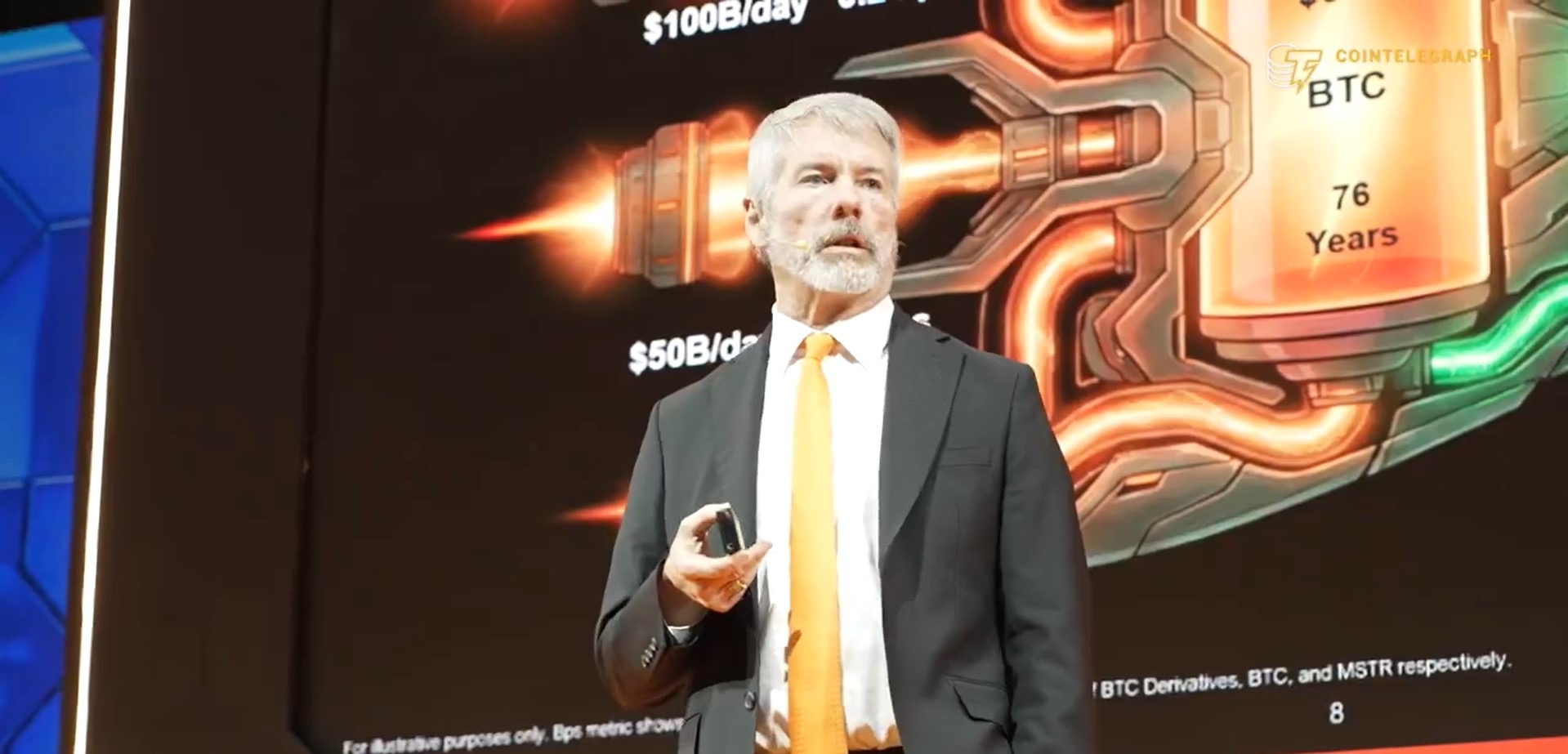
Michael Saylor at the Bitcoin MENA event. Source: Cointelegraph

Abu Dhabi’s Bitcoin-first institutional thesis

Davis argued that Abu Dhabi’s strategy is rooted in a clear distinction between Bitcoin and the broader crypto landscape.

“Abu Dhabi has done the work to understand that Bitcoin stands apart from the broader digital-asset landscape,” Davis said. “Much of what falls under ‘Web3’ remains speculative or built around problems that may not need solving.”

According to Davis, the intent to position Abu Dhabi as a center for institutional Bitcoin is already visible.

“Major entities in Abu Dhabi gaining exposure to Bitcoin is a strong signal of long-term conviction,” he told Cointelegraph. He added that clearer regulatory pathways and public-sector support have made the emirate attractive for Bitcoin-native firms.

Recent developments back up this institutional Bitcoin thesis. Abu Dhabi has emerged as a focal point for large-scale, regulated Bitcoin activity, underscored by the launch of the Bitcoin MENA 2025 event, which brought institutional investors, miners and infrastructure providers in the emirate to discuss custody, mining and treasury strategies.

Global companies, such as Galaxy Digital, have expanded into Abu Dhabi under the ADGM framework, citing regulatory clarity and institutional demand. Meanwhile, crypto exchange Binance secured full regulatory approvals covering trading, clearing and custody.

Dubai builds the crypto economy layer

While Abu Dhabi focuses on institutional rails, Dubai has taken a broader approach, designing a regulatory environment intended to support entire industries built on top of digital assets.

“Dubai is trying to build the full crypto economy around that,” Mende told Cointelegraph. “Consumer apps, brands, payments, gaming, creators and tokenization.”

He told Cointelegraph that the convergence of stablecoins, tokenized real-world assets (RWAs) and consumer-facing apps created a new economic layer that goes beyond trading.

“Stablecoins will be the visible part — simple ‘scan, tap, pay’ flows — while RWAs bring serious institutional capital onchain,” Mende said, adding that blockchain-based digital IDs, non-fungible tokens (NFTs), vouchers and tickets make the whole system human-centric and “useful for daily life.”

Dubai’s regulatory clarity has been a major enabler of the crypto economy vision. “The biggest enabler is clarity,” Mende said. “Founders know which activities are regulated, what license they need and which rulebook they fall under, so they can design products and token models with a clear path.”

That clarity, however, does not eliminate all friction. Mende told Cointelegraph that challenges remain at the interface with traditional finance, particularly banking and fiat on- and off-ramps, and in more experimental areas such as decentralized finance and DAOs, where frameworks are still evolving.

Related: State Street, Galaxy and Ondo join tokenized cash race with 24/7 sweep fund

Stablecoins emerge as the first mass-use rail

As Dubai’s crypto economy develops, multiple industry leaders point to payments and stablecoins as the first area of durable, real-world adoption.

“Payments and stablecoin infrastructure will lead because they solve a universal and urgent problem: cross-border settlement that is slow, expensive and fragmented,” Patrick Ngan, the chief investment officer at Zeta Network Group, told Cointelegraph.

According to Ngan, regulatory clarity provides financial institutions with the confidence to integrate digital settlement rails directly into commerce. “Once those rails are in place, volume follows,” he said. “That is where the first durable, real-world adoption will appear.”

SingularityDAO founder Marcello Mari echoed the sentiment. He said that stablecoins are already more embedded in everyday activity than many outside the region realize.

“In Dubai, USDT and USDC are actually used more than you think — for rent, remittances, real estate and service payments,” Mari said. “Gaming and Web3 creators will follow, but stablecoins are the first bridge to real-world utility.”

Apart from crypto-native companies, stablecoins have caught the attention of mainstream companies in the UAE. On Thursday, state-owned telecom giant e& announced that it’s preparing to test a dirham-backed stablecoin for bill payments.

However, both Ngan and Mari expressed that while regulatory clarity exists, operational timelines and banking relationships remain the biggest bottlenecks. “The rules are clear, but the process requires patience and strong operational discipline,” Ngan said.

Magazine: Bitcoin $200K soon or 2029? Scott Bessent hangs at Bitcoin bar: Hodler’s Digest

Похожее

"Agents' Last Exam", Claude Fable 5 Actually Loses to GPT 5.5

Surprisingly, in the newly released "Agents' Last Exam" (ALE) benchmark from UC Berkeley, GPT-5.5 has outperformed the recently launched and highly-regarded Claude Fable 5. ALE tests AI agents on their ability to perform real-world tasks across 55 professional domains—such as 3D modeling in Siemens NX, creating game scenes in Unreal Engine, and visual effects work in Adobe After Effects—by granting them full GUI and command-line access. In the core task completion rate ranking, GPT-5.5 configurations secured the top two spots (24.0% and 23.0%), while Claude Fable 5 with Claude Code came in third (22.0%). Notably, the highest pass rate was only 24%, and the most difficult "Last-Exam" tier saw most top models, including GPT-5.5 and Fable 5, scoring zero. The benchmark also revealed significant cost and efficiency gaps: Fable 5 spent over four times more money than GPT-5.5's most expensive configuration for a slightly lower score, and was much slower. ALE differs from previous knowledge-based benchmarks by evaluating practical "ability to do" rather than static knowledge retrieval. Its tasks are derived from real expert projects, automatically scored, and designed to prevent cheating through a rotating pool of private challenges. The results suggest that high performance on traditional benchmarks does not necessarily translate to proficiency in complex, open-ended real-world work. The study also notes that agents often fail by prematurely declaring tasks complete without proper verification, and that no single model excels uniformly across all diverse domains.

marsbit4 мин. назад

"Agents' Last Exam", Claude Fable 5 Actually Loses to GPT 5.5

marsbit4 мин. назад

Retail Ecology Dwindles, ZKsync Bets on Bank Pilots for a Breakthrough

Amidst declining retail activity, ZKsync is pivoting to target institutional banking as its primary growth strategy. The article explores this shift, contrasting it with the competitive "survival of the fittest" narrative by highlighting a cooperative model inspired by naturalist Peter Kropotkin. ZKsync is developing infrastructure like its private, permissioned Prividium suite for banks (e.g., Deutsche Bank's use case via Memento), enabling private transactions with public verifiability via zero-knowledge proofs. This appeals to institutions needing privacy, compliance, and Ethereum-based settlement security, unlike fully private chains (e.g., JPMorgan's Kinaxis) or consortium models (e.g., R3 Corda). However, this strategic focus has coincided with a steep decline in its public DeFi ecosystem, evidenced by plunging TVL and the departure of major protocols like Aave due to low fees. The network's future now hinges on banking adoption, with upcoming pilots like the Cari Network involving regional banks holding over $600 billion in deposits. A significant challenge is balancing this institutional focus with ZKsync's decentralized governance. Banks must operate on a network where rules and fees (denominated in the volatile ZK token) can be changed via community vote, and where a Security Council holds emergency control—a stark contrast to the predictable, contract-bound environments of traditional finance. The coming 18 months will test whether ZKsync can successfully onboard traditional banks onto a dynamically governed public chain or if institutions will ultimately revert to proprietary solutions.

Foresight News45 мин. назад

Retail Ecology Dwindles, ZKsync Bets on Bank Pilots for a Breakthrough

Foresight News45 мин. назад

The Recursive AI Anthropic Warned About: Tian Yuandong's New Company Has Just Taken the "First Step"

Anthropic recently highlighted the rapid progress toward "recursive self-improvement," where AI systems autonomously design and train their successors. In response, Recursive Superintelligence, a new company co-founded by former Meta researcher Tian Yuan Dong, has publicly demonstrated its first step toward automating AI research. The company released a system designed to autonomously execute the full AI research cycle: generating ideas, implementing code, running experiments, and learning from results. It validated this approach by achieving state-of-the-art results on three diverse benchmarks: 1. **NanoChat Autoresearch:** Optimizing a small language model's validation loss under a fixed 5-minute GPU budget, improving upon the community's best result. 2. **NanoGPT Speedrun:** Reducing the time to train a GPT model to a specific loss on 8 H100 GPUs from 79.7 seconds to 77.5 seconds, beating a highly optimized, human-driven community effort. 3. **SOL-ExecBench:** Improving the overall score on NVIDIA's suite of 235 GPU kernel optimization tasks by 18%, closing the gap to the hardware limit. The system discovered novel optimizations in this highly specialized domain without direct human expertise. Recursive's system operates as a general framework, capable of parallel exploration and cross-task knowledge transfer while incorporating safeguards against reward hacking. The company, backed by $650M in funding and a star-studded team including Richard Socher and Alexey Dosovitskiy, aims to create AI that recursively enhances its own research capabilities. This development represents an early but concrete move toward a new paradigm where AI accelerates its own advancement. It occurs alongside Anthropic's warnings about the need for industry coordination and potential pauses when recursive self-improvement thresholds are reached, highlighting the dual trajectory of rapid technical progress and growing calls for careful stewardship.

marsbit53 мин. назад

The Recursive AI Anthropic Warned About: Tian Yuandong's New Company Has Just Taken the "First Step"

marsbit53 мин. назад

Торговля

Спот
Фьючерсы

Популярные статьи

Как купить S

Добро пожаловать на HTX.com! Мы сделали приобретение Sonic (S) простым и удобным. Следуйте нашему пошаговому руководству и отправляйтесь в свое крипто-путешествие.Шаг 1: Создайте аккаунт на HTXИспользуйте свой адрес электронной почты или номер телефона, чтобы зарегистрироваться и бесплатно создать аккаунт на HTX. Пройдите удобную регистрацию и откройте для себя весь функционал.Создать аккаунтШаг 2: Перейдите в Купить криптовалюту и выберите свой способ оплатыКредитная/Дебетовая Карта: Используйте свою карту Visa или Mastercard для мгновенной покупки Sonic (S).Баланс: Используйте средства с баланса вашего аккаунта HTX для простой торговли.Третьи Лица: Мы добавили популярные способы оплаты, такие как Google Pay и Apple Pay, для повышения удобства.P2P: Торгуйте напрямую с другими пользователями на HTX.Внебиржевая Торговля (OTC): Мы предлагаем индивидуальные услуги и конкурентоспособные обменные курсы для трейдеров.Шаг 3: Хранение Sonic (S)После приобретения вами Sonic (S) храните их в своем аккаунте на HTX. В качестве альтернативы вы можете отправить их куда-либо с помощью перевода в блокчейне или использовать для торговли с другими криптовалютами.Шаг 4: Торговля Sonic (S)С легкостью торгуйте Sonic (S) на спотовом рынке HTX. Просто зайдите в свой аккаунт, выберите торговую пару, совершайте сделки и следите за ними в режиме реального времени. Мы предлагаем удобный интерфейс как для начинающих, так и для опытных трейдеров.

1.4k просмотров всегоОпубликовано 2025.01.15Обновлено 2026.06.02

Как купить S

Sonic: Обновления под руководством Андре Кронье – новая звезда Layer-1 на фоне спада рынка

Он решает проблемы масштабируемости, совместимости между блокчейнами и стимулов для разработчиков с помощью технологических инноваций.

2.3k просмотров всегоОпубликовано 2025.04.09Обновлено 2025.04.09

Sonic: Обновления под руководством Андре Кронье – новая звезда Layer-1 на фоне спада рынка

HTX Learn: Пройдите обучение по "Sonic" и разделите 1000 USDT

HTX Learn — ваш проводник в мир перспективных проектов, и мы запускаем специальное мероприятие "Учитесь и Зарабатывайте", посвящённое этим проектам. Наше новое направление .

1.8k просмотров всегоОпубликовано 2025.04.10Обновлено 2025.04.10

HTX Learn: Пройдите обучение по "Sonic" и разделите 1000 USDT

Обсуждения

Добро пожаловать в Сообщество HTX. Здесь вы сможете быть в курсе последних новостей о развитии платформы и получить доступ к профессиональной аналитической информации о рынке. Мнения пользователей о цене на S (S) представлены ниже.

活动图片