Bitcoin Bombshell: Google’s 2029 Quantum Warning Sparks New Fear

bitcoinistОпубликовано 2026-03-31Обновлено 2026-03-31

Введение

Google's updated quantum threat model, moving its post-quantum cryptography migration deadline to 2029, has significant implications for Bitcoin and cryptocurrencies. A new whitepaper from Google Quantum AI, alongside researchers including Justin Drake and Dan Boneh, suggests breaking the secp256k1 elliptic curve cryptography (used in Bitcoin) may require far fewer quantum resources than previously believed. The paper estimates Shor’s algorithm could break ECDSA keys in minutes using under 500,000 physical qubits. This has shifted the narrative, with experts now urging immediate transition plans. The paper highlights the risk of "on-spend" attacks against live transactions due to Bitcoin's 10-minute block time, while downplaying quantum risks to proof-of-work mining. Google chose to validate its findings via a zero-knowledge proof instead of full circuit disclosure, citing responsible disclosure concerns. The broader call is for vulnerable cryptocurrency communities to begin migrating to post-quantum cryptography without delay.

Google’s decision to pull its post-quantum cryptography migration timeline forward to 2029 has landed hard in Bitcoin and crypto, because the company did not just change a policy deadline. It paired that warning with a new whitepaper arguing that breaking the 256-bit elliptic curve cryptography used across major blockchains may require far fewer quantum resources than many in the market had assumed.

That is the link Castle Island Ventures General Partner Nic Carter seized on in a series of X posts on Tuesday, arguing that the answer to what Google “saw” was this paper itself. The whitepaper, dated March 30 and co-authored by researchers from Google Quantum AI alongside Justin Drake and Dan Boneh, lays out updated estimates for attacking the secp256k1 curve that sits at the center of Bitcoin-era signature security.

In Google’s formulation, Shor’s algorithm could solve the target problem with either no more than 1,200 logical qubits and 90 million Toffoli gates, or no more than 1,450 logical qubits and 70 million Toffoli gates. On a superconducting architecture, the authors say those circuits could run in minutes with fewer than half a million physical qubits.

That is the real shock to the Bitcoin threat model. Google’s March 25 blog post said the company moved to a 2029 migration target because of progress in quantum hardware, error correction and quantum factoring resource estimates, and said it had already adjusted its threat model to prioritize post-quantum migration for authentication services. The crypto paper then gave markets a concrete reason for why that deadline may have moved.

The paper is also unusual in how it handles disclosure. Rather than publishing the attack circuits in full, the authors say they used a zero-knowledge proof to validate the results without leaking sensitive details. Google framed that as a responsible-disclosure choice in a field where public discussion can itself create fear and instability, especially when the assets in question are bearer instruments with no recourse layer.

That choice fed directly into the reaction on X. Dragonfly’s managing partner Haseeb Qureshi called the result “wild,” writing: “Google Research demonstrates a ~20x more efficient implementation of Shor’s algorithm that could break ECDSA keys within minutes with ~500K physical qubits. Google is now are more confident on a 2029 post-quantum transition. We are no longer looking at mid 2030s, we could have quantum computers of this scale by the end of the decade.”

He added that Google’s decision not to publish the actual circuits, and instead publish a proof that they exist. “They believe this result is so severe that they are not publishing the actual circuits. They instead published a ZKP proving that they know of the quantum circuit with these properties. This is very atypical, showing Google thinks this is serious shit. All blockchains need a transition plan ASAP. Post-quantum is no longer a drill,” he added.


Ethereum Foundation researcher Justin Drake pushed the same point even further. “Today is a monumentous day for quantum computing and cryptography. Two breakthrough papers just landed,” he wrote. “The results are shocking. I expect a narrative shift and a further R&D boost toward post-quantum cryptography.”

In a separate post, he added: “My confidence in q-day by 2032 has shot up significantly. IMO there’s at least a 10% chance that by 2032 a quantum computer recovers a secp256k1 ECDSA private key from an exposed public key. While a cryptographically-relevant quantum computer before 2030 still feels unlikely, now is undoubtedly the time to start preparing.”

For Bitcoin specifically, the most important part of the paper is not some vague future threat to “crypto,” but the distinction it draws between attacks on dormant or exposed keys and attacks on live transactions. The authors argue that fast-clock architectures such as superconducting and photonic systems could eventually enable “on-spend” attacks, where a public key exposed during transaction flow is broken quickly enough to race the original payment into a block.

Their estimate explicitly says fast-clock systems could solve ECDLP in about nine minutes on average, putting Bitcoin’s roughly 10-minute block cadence uncomfortably close to the attack window. The paper points to private mempools and commit-reveal schemes as possible mitigations, but treats migration to post-quantum cryptography as the actual answer.

Just as important, Google tries to narrow the panic. The paper says quantum attacks on Bitcoin proof-of-work via Grover’s algorithm are not a practical concern “in the next several decades,” arguing that discussion should stay focused on signatures, not mining. That matters because it shifts the debate away from network collapse scenarios and toward wallet design, key exposure, mempool privacy and upgrade coordination.

The broader message is hard to miss. Google’s paper ends by urging “all vulnerable cryptocurrency communities to join the migration to PQC without delay,” and its separate security timeline now points to 2029, not some comfortably distant date in the mid-2030s.

Bitcoin has spent years treating quantum risk as a long-range problem. What changed this week is that a major quantum lab put a much tighter engineering estimate around the threat, and some of the sector’s most technically literate observers immediately started talking less about whether the transition will be needed and more about how fast it has to begin.

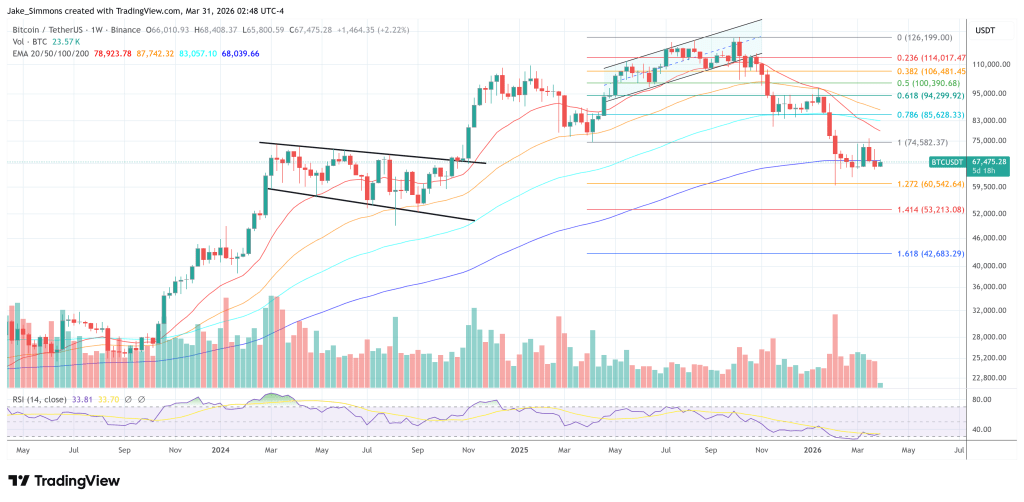
At press time, Bitcoin traded at $67,475.

Bitcoin must reclaim the 200-week EMA, 1-week chart | Source: BTCUSDT on TradingView.com

Связанные с этим вопросы

QWhat is the main reason Google moved its post-quantum cryptography migration timeline to 2029, according to the article?

AGoogle moved its timeline to 2029 due to progress in quantum hardware, error correction, and new, more efficient resource estimates for breaking elliptic curve cryptography, as detailed in their recent whitepaper.

QHow many physical qubits does Google's new research estimate require to break ECDSA keys within minutes?

AGoogle's research estimates that breaking ECDSA keys could be achieved within minutes using fewer than half a million (~500,000) physical qubits on a superconducting architecture.

QWhat specific cryptographic algorithm is at the center of Bitcoin's signature security that the Google research targets?

AThe research targets the secp256k1 elliptic curve, which is used for ECDSA (Elliptic Curve Digital Signature Algorithm) and is at the center of Bitcoin's signature security.

QWhy did Google choose not to publish the full attack circuits in their whitepaper, and what method did they use instead?

AGoogle used a zero-knowledge proof to validate their results without publishing the sensitive attack circuits, framing it as a responsible-disclosure choice to avoid creating unnecessary fear and instability in the cryptocurrency market.

QAccording to the article, what is the estimated average time a fast-clock quantum system would need to solve the ECDLP and potentially attack a live Bitcoin transaction?

AThe paper estimates that fast-clock quantum systems could solve the Elliptic Curve Discrete Logarithm Problem (ECDLP) in about nine minutes on average, putting it dangerously close to Bitcoin's 10-minute block time for 'on-spend' attacks.

Похожее

a16z: AI's 'Amnesia', Can Continuous Learning Cure It?

The article "a16z: AI's 'Amnesia' – Can Continual Learning Cure It?" explores the limitations of current large language models (LLMs), which, like the protagonist in the film *Memento*, are trapped in a perpetual present—unable to form new memories after training. While methods like in-context learning (ICL), retrieval-augmented generation (RAG), and external scaffolding (e.g., chat history, prompts) provide temporary solutions, they fail to enable true internalization of new knowledge. The authors argue that compression—the core of learning during training—is halted at deployment, preventing models from generalizing, discovering novel solutions (e.g., mathematical proofs), or handling adversarial scenarios. The piece introduces *continual learning* as a critical research direction to address this, categorizing approaches into three paths: 1. **Context**: Scaling external memory via longer context windows, multi-agent systems, and smarter retrieval. 2. **Modules**: Using pluggable adapters or external memory layers for specialization without full retraining. 3. **Weights**: Enabling parameter updates through sparse training, test-time training, meta-learning, distillation, and reinforcement learning from feedback. Challenges include catastrophic forgetting, safety risks, and auditability, but overcoming these could unlock models that learn iteratively from experience. The conclusion emphasizes that while context-based methods are effective, true breakthroughs require models to compress new information into weights post-deployment, moving from mere retrieval to genuine learning.

marsbit55 мин. назад

a16z: AI's 'Amnesia', Can Continuous Learning Cure It?

marsbit55 мин. назад

Can a Hair Dryer Earn $34,000? Deciphering the Reflexivity Paradox in Prediction Markets

An individual manipulated a weather sensor at Paris Charles de Gaulle Airport with a portable heat source, causing a Polymarket weather market to settle at 22°C and earning $34,000. This incident highlights a fundamental issue in prediction markets: when a market aims to reflect reality, it also incentivizes participants to influence that reality. Prediction markets operate on two layers: platform rules (what outcome counts as a win) and data sources (what actually happened). While most focus on rules, the real vulnerability lies in the data source. If reality is recorded through a specific source, influencing that source directly affects market settlement. The article categorizes markets by their vulnerability: 1. **Single-point physical data sources** (e.g., weather stations): Easily manipulated through physical interference. 2. **Insider information markets** (e.g., MrBeast video details): Insiders like team members use non-public information to trade. Kalshi fined a剪辑师 $20,000 for insider trading. 3. **Actor-manipulated markets** (e.g., Andrew Tate’s tweet counts): The subject of the market can control the outcome. Evidence suggests Tate’sociated accounts coordinated to profit. 4. **Individual-action markets** (e.g., WNBA disruptions): A single person can execute an event to profit from their pre-placed bets. Kalshi and Polymarket handle these issues differently. Kalshi enforces strict KYC, publicly penalizes insider trading, and reports to regulators. Polymarket, with its anonymous wallet-based system, has historically been more permissive, arguing that insider information improves market accuracy. However, it cooperated with authorities in the "Van Dyke case," where a user traded on classified government information. The core paradox is reflexivity: prediction markets are designed to discover truth, but their financial incentives can distort reality. The more valuable a prediction becomes, the more likely participants are to influence the event itself. The market ceases to be a mirror of reality and instead shapes it.

marsbit1 ч. назад

Can a Hair Dryer Earn $34,000? Deciphering the Reflexivity Paradox in Prediction Markets

marsbit1 ч. назад

Торговля

Спот
Фьючерсы

Популярные статьи

Как купить S

Добро пожаловать на HTX.com! Мы сделали приобретение Sonic (S) простым и удобным. Следуйте нашему пошаговому руководству и отправляйтесь в свое крипто-путешествие.Шаг 1: Создайте аккаунт на HTXИспользуйте свой адрес электронной почты или номер телефона, чтобы зарегистрироваться и бесплатно создать аккаунт на HTX. Пройдите удобную регистрацию и откройте для себя весь функционал.Создать аккаунтШаг 2: Перейдите в Купить криптовалюту и выберите свой способ оплатыКредитная/Дебетовая Карта: Используйте свою карту Visa или Mastercard для мгновенной покупки Sonic (S).Баланс: Используйте средства с баланса вашего аккаунта HTX для простой торговли.Третьи Лица: Мы добавили популярные способы оплаты, такие как Google Pay и Apple Pay, для повышения удобства.P2P: Торгуйте напрямую с другими пользователями на HTX.Внебиржевая Торговля (OTC): Мы предлагаем индивидуальные услуги и конкурентоспособные обменные курсы для трейдеров.Шаг 3: Хранение Sonic (S)После приобретения вами Sonic (S) храните их в своем аккаунте на HTX. В качестве альтернативы вы можете отправить их куда-либо с помощью перевода в блокчейне или использовать для торговли с другими криптовалютами.Шаг 4: Торговля Sonic (S)С легкостью торгуйте Sonic (S) на спотовом рынке HTX. Просто зайдите в свой аккаунт, выберите торговую пару, совершайте сделки и следите за ними в режиме реального времени. Мы предлагаем удобный интерфейс как для начинающих, так и для опытных трейдеров.

1.2k просмотров всегоОпубликовано 2025.01.15Обновлено 2025.03.21

Как купить S

Sonic: Обновления под руководством Андре Кронье – новая звезда Layer-1 на фоне спада рынка

Он решает проблемы масштабируемости, совместимости между блокчейнами и стимулов для разработчиков с помощью технологических инноваций.

2.2k просмотров всегоОпубликовано 2025.04.09Обновлено 2025.04.09

Sonic: Обновления под руководством Андре Кронье – новая звезда Layer-1 на фоне спада рынка

HTX Learn: Пройдите обучение по "Sonic" и разделите 1000 USDT

HTX Learn — ваш проводник в мир перспективных проектов, и мы запускаем специальное мероприятие "Учитесь и Зарабатывайте", посвящённое этим проектам. Наше новое направление .

1.8k просмотров всегоОпубликовано 2025.04.10Обновлено 2025.04.10

HTX Learn: Пройдите обучение по "Sonic" и разделите 1000 USDT

Обсуждения

Добро пожаловать в Сообщество HTX. Здесь вы сможете быть в курсе последних новостей о развитии платформы и получить доступ к профессиональной аналитической информации о рынке. Мнения пользователей о цене на S (S) представлены ниже.

活动图片