BIP-110 Could Split Bitcoin In New Soft Fork Fight, Jameson Lopp Warns

bitcoinistОпубликовано 2026-02-25Обновлено 2026-02-25

Jameson Lopp is escalating his criticism of BIP-110, arguing the proposal could trigger a disruptive Bitcoin chain split while failing to stop the behavior it is meant to curb. In a Feb. 23 post, Lopp frames the plan as a consensus-layer response to a policy and cultural dispute around transaction “spam,” with risks that extend well beyond mempool debates.

BIP-110 is pitched as a soft fork led by Luke Dashjr that would temporarily restrict arbitrary data in transactions. Lopp summarizes it as adding seven new transaction-validity restrictions, including limits on where data can be placed and constraints on certain script behavior, but says the tradeoffs are far more severe than supporters admit. He calls the proposal “reckless and doomed to fail,” setting the tone for a post that is less a technical explainer than a warning about governance and coordination risk.

Why Lopp Thinks The Activation Path Is Dangerous For Bitcoin

The core of Lopp’s argument is not just what BIP-110 changes, but how it tries to activate. He points to the proposal’s 55% miner-signaling threshold for a user-activated soft fork and says that low bar materially increases the probability of two competing chains if the ecosystem is not aligned.

He also stresses that BIP-110 nodes would reject non-compliant blocks outright, which raises coordination risk compared with soft forks that old nodes can continue to follow without enforcement conflicts.

Lopp is especially pointed on the mandatory activation posture at block height 961,632. In one of the sharpest passages, he writes: “This is not a neutral, low-drama deployment posture. It’s dogmatic bullying. [...] you cannot pretend it’s low-risk.” He ties that warning to a broader point: even if one views UASF tactics as legitimate, the proposal’s design increases the odds of a messy failure mode if miners, exchanges, wallets, and infrastructure providers do not converge in time.

He also pushes back on comparisons to 2017, noting that the UASF many people cite in the SegWit era never actually had to run to the edge because SegWit activated via miner signaling instead. That distinction matters in Lopp’s framing, because BIP-110 proponents are, in his view, leaning on a historical precedent that did not test the exact scenario they now describe as manageable.

Another major section of Lopp’s post targets the claim that BIP-110 has meaningful grassroots momentum. He argues that raw node counts (roughly 20% run Knots) are a weak proxy for consensus because signaling is cheap, node operation can be low-cost, and Tor addresses are “effectively zero” cost to create at scale. He publishes a breakdown of reachable nodes and highlights the higher Tor-to-IPv4 ratio among Knots and BIP-110 signaling nodes as a reason to treat node-count narratives cautiously.

On mining support, Lopp says the gap is more straightforward. At the time of publication, he writes miner signaling was “precisely [...] zero,” and he cites public opposition from F2Pool while arguing miners have limited incentive to back a proposal that could reduce fee revenue. That point reinforces his broader thesis that BIP-110 supporters are overestimating social signaling and underestimating the role of economically significant actors in Bitcoin upgrade politics.

Lopp’s post ultimately reads as a warning that the immediate issue is not simply whether BIP-110 activates, but what the campaign reveals about where Bitcoin’s internal dispute over neutrality, censorship resistance, and block-space usage is heading. Even a failed fork push, in his framing, can still impose real costs by forcing operators and businesses to plan around low-probability but high-impact coordination failure.

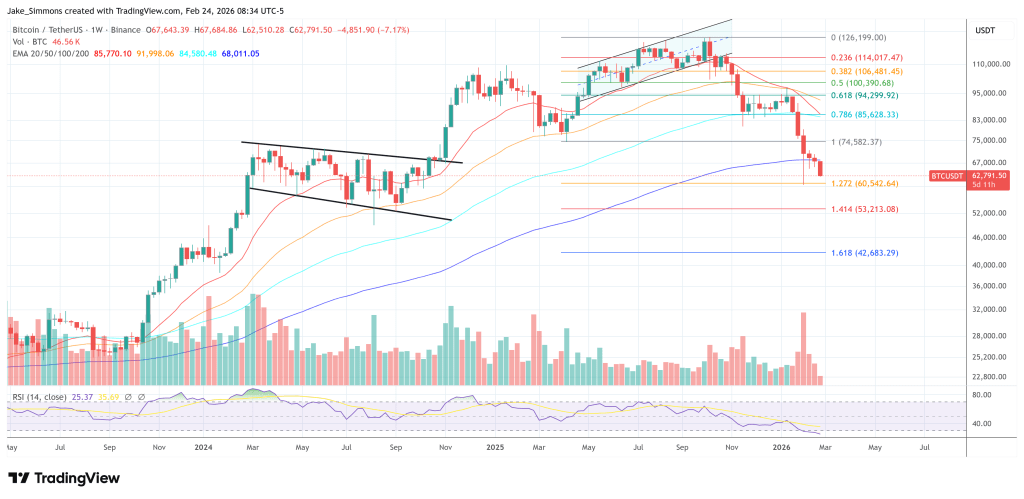
At press time, Bitcoin traded at $62,791.

Bitcoin falls below $63,000, 1-week chart | Source: BTCUSDT on TradingView.com

Связанные с этим вопросы

QWhat is the main concern Jameson Lopp raises about BIP-110?

AJameson Lopp's main concern is that BIP-110 could trigger a disruptive Bitcoin chain split due to its low 55% miner-signaling threshold for activation and its design that increases coordination risks, while failing to effectively stop the 'spam' behavior it aims to curb.

QHow does BIP-110 propose to activate, and why does Lopp find this dangerous?

ABIP-110 proposes a user-activated soft fork (UASF) with a 55% miner-signaling threshold. Lopp finds this dangerous because the low activation threshold and the node's policy of outright rejecting non-compliant blocks significantly increase the probability of creating two competing chains if the broader Bitcoin ecosystem is not fully aligned.

QWhat does Jameson Lopp say about the grassroots support for BIP-110?

ALopp argues that the raw node count signaling support for BIP-110 is a weak proxy for consensus. He highlights that a high percentage of these nodes are on the Tor network, which are cheap to create at scale, and cautions against overestimating this form of social signaling, especially since miner support was precisely zero at the time of his writing.

QAccording to Lopp, why is the comparison to the 2017 SegWit UASF flawed?

ALopp states the comparison is flawed because the 2017 SegWit UASF never actually had to run to its full extent; SegWit activated via miner signaling before the UASF was triggered. This means the historical precedent did not test the high-risk scenario of a contentious chain split that BIP-110 proponents are now describing as manageable.

QWhat is the broader implication of the BIP-110 debate, beyond the proposal itself?

AThe broader implication is that the debate reveals a deepening internal conflict within Bitcoin over core principles like neutrality, censorship resistance, and block-space usage. Even if BIP-110 fails, the campaign forces operators and businesses to incur real costs by having to plan for a low-probability but high-impact coordination failure.

Похожее

La Liga Team Bets $1 Million Against Themselves Before Match: Does Using Prediction Markets for Insurance Comply with Sports Regulations?

A Spanish La Liga club, reportedly Osasuna, purchased insurance against relegation and was linked to a transaction of over $1 million on the prediction market platform Kalshi, betting against its own victory in a crucial season-ending match. While Osasuna confirmed buying €1.2 million insurance for a potential €6 million payout in case of relegation through broker Howden, it did not confirm involvement with Kalshi. The reported trade involved intermediaries like Game Point Capital and Greenlight Commodities, with quant firm Susquehanna as the counterparty. This incident highlights the blurring line between financial hedging and gambling in prediction markets. Such markets allow trading on future event outcomes, like sports results. In the US, Kalshi operates as a regulated event contract market under the CFTC. However, Spanish authorities recently initiated penalties against Kalshi and Polymarket, considering their activities unlicensed gambling. The case raises core questions about prediction markets: who can trade, how insider information is handled, and whether participants can influence outcomes, especially in sports where results are human-driven. While leagues like La Liga and Serie A have partnered with Polymarket in North America, the regulatory clash and potential for conflicts of interest, as seen in this club's alleged transaction, present significant challenges as prediction markets evolve toward institutional risk management.

Foresight News6 мин. назад

La Liga Team Bets $1 Million Against Themselves Before Match: Does Using Prediction Markets for Insurance Comply with Sports Regulations?

Foresight News6 мин. назад

From Shouting 150 Dollars to Liquidating HYPE in Just Three Days, How Much Credibility Does Arthur Hayes Have Left?

How much of Arthur Hayes's market credibility remains? Recently, the "godfather of crypto perpetual swaps" and BitMEX co-founder has faced public criticism, including accusations from on-chain investigator ZachXBT about creating exit liquidity for his followers. Starting last week, Hayes executed multiple sudden sell-offs. He had repeatedly publicly predicted the HYPE token would reach $150. After a $100,000 bet defending Hyperliquid on June 1st, he announced just three days later that he had completely sold his HYPE and NEAR holdings, successfully exiting near the peak. He also sold ZEC and WLD. His sale of WLD appeared to be a classic "pump and dump" maneuver. On June 3rd, he publicly set a $10 target for WLD, causing its price to surge over 35%. By June 6th, he announced he had sold his WLD, citing "anomalous" SpaceX pre-IPO price action, which triggered a sharp price drop. On June 9th, Hayes published a lengthy article explaining his actions, citing factors like rising energy costs and a potential AI bubble burst. Consequently, his family office, Maelstrom, now holds positions in US energy producers and only core crypto assets BTC and ETH, having sold AI-related stocks and non-core cryptocurrencies. This pattern is not new. In 2025, he similarly touted HYPE before selling it at what turned out to be a cycle peak, only to repurchase it at the next cycle's low. Similar scenarios played out with tokens like ETHFI and ENA. Long-term observers have developed a strategy: ignore Hayes's public statements but closely monitor his on-chain actions—be cautious following his buys, but decisively follow his sells. If he continues these tactics, especially as seen with the WLD case, his market credibility risks being permanently damaged. As Hayes himself admitted in his latest article, "I remain an unapologetic gambler."

marsbit24 мин. назад

From Shouting 150 Dollars to Liquidating HYPE in Just Three Days, How Much Credibility Does Arthur Hayes Have Left?

marsbit24 мин. назад

Fundraising is Like a Strange Dance: The 'Absurd Drama' of Silicon Valley Founders' Capital Raises

The article details a series of absurd and revealing anecdotes shared by Silicon Valley founders about their venture capital fundraising experiences, sparked by Greg Isenberg's story of pitching to a sleeping a16z partner. Founders describe surreal pitch meetings: one faced a barefoot, peanut-eating investor who offered triple the requested amount after 30 seconds; another performed a pitch in a VC's parked car; a founder discovered his audience understood no English beyond "yes." These stories highlight the often irrational and performative nature of fundraising. Beyond the absurdity, darker power imbalances are exposed. Stories include investors suggesting founders fire co-founders for their equity, blatant market misjudgments, disrespectful behavior from LPs, and discriminatory remarks. A debate also emerges around "Sequoia's" practice of splitting a round into two valuations. However, the thread isn't solely critical. Positive counter-narratives celebrate supportive VCs who offered crucial advice during crises, respected founders' timelines, and showed simple gestures of respect—like a partner personally fetching coffee before a major pitch. Ultimately, the collective sharing acts as a pressure release, illustrating that fundraising is a complex dance of power, trust, and sometimes sheer theater. It underscores that beyond capital, mutual respect and integrity remain the most enduring foundations of the founder-investor relationship.

marsbit37 мин. назад

Fundraising is Like a Strange Dance: The 'Absurd Drama' of Silicon Valley Founders' Capital Raises

marsbit37 мин. назад

Торговля

Спот
Фьючерсы
活动图片