Binance let suspicious accounts move millions after $4.3B US plea deal: Report

cointelegraphОпубликовано 2025-12-22Обновлено 2025-12-22

Введение

Binance reportedly allowed 13 suspicious accounts to move approximately $1.7 billion in crypto, including $144 million after its November 2023 $4.3 billion plea deal with U.S. authorities. Internal documents show accounts from Venezuela, Brazil, Syria, Niger, and China exhibited red flags, such as a Venezuelan account receiving $177 million and changing bank details 647 times in 14 months. Another account, accessed from Caracas and Osaka within 10 hours—a physical impossibility—processed $93 million. The activity raises questions about Binance's compliance upgrades promised in its settlement, which included enhanced monitoring and due diligence. The report follows former President Trump’s pardon of Binance founder Changpeng Zhao in October.

Binance reportedly continued to allow suspicious accounts to move funds in crypto even after the exchange pledged to tighten controls as part of its $4.3 billion US criminal settlement in 2023.

According to internal data reviewed by the Financial Times, a network of 13 user accounts processed about $1.7 billion in transactions from 2021, including roughly $144 million after the November 2023 plea agreement.

​The files reportedly include Know-Your-Customer (KYC) documents, IP and device logs, and transaction histories for users in countries including Venezuela, Brazil, Syria, Niger and China.

Regulatory and AML specialists cited by the Financial Times said that the findings raise fresh questions about how effectively Binance has implemented the governance and surveillance upgrades promised US authorities after the settlement.

Binance did not provide a comment to Cointelegraph by press time.

Related: Binance alleges fake listing agents, offers up to $5M whistleblower reward

Suspicious account behaviors

In one case, a Binance account linked to a 25-year-old Venezuelan woman received more than $177 million over two years and changed its linked bank details 647 times in 14 months.

Former prosecutors told the Financial Times that such activity would normally be treated as highly suspicious and potentially consistent with an unregistered money-transmitting business.

​Another account, held by a junior bank employee living in a poor district of Caracas, saw about $93 million flow in and out between 2022 and May 2025. Internal logs showed the account was accessed from Caracas one afternoon and from Osaka, Japan, less than 10 hours later, a sequence experts told the FT was physically impossible and the type of anomaly that should automatically trigger review at a regulated institution.

Nick Heather, head of trading at ONE.io, a financial services company providing digital asset trading services, told Cointelegraph that such cases underline the importance of adaptive governance frameworks in digital asset markets.

“When accounts displaying repeated red flags remain active, that points to an escalation and oversight challenge rather than one of market structure. Robust governance, sanctions screening, and post-trade surveillance are of critical importance, and institutional and retail traders operating in regulated markets are already accustomed to these requirements,” Heather said.

​All 13 accounts shared markers of suspicious behavior and collectively received about $29 million in stablecoin USDt (USDT) from wallets later frozen by Israel under anti-terrorism laws.

Related: CZ pardon was considered with ‘utmost seriousness,’ White House says

​Plea deal promises and Trump pardon backdrop

Binance in its 2023 plea deal promised to implement real-time monitoring, enhanced due diligence and regular customer reviews to detect suspicious activities.
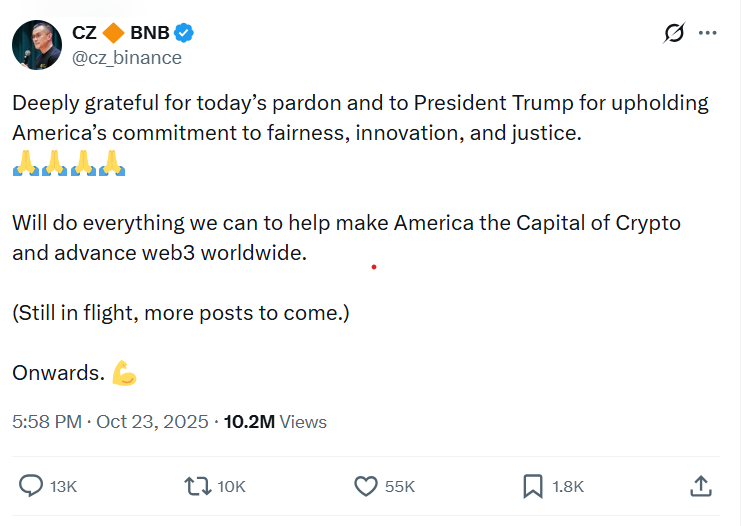
CZ announces his presidential pardon | Source: CZ_Binance

At the time, US authorities said Binance had failed to report more than 100,000 suspicious transactions involving activities including ransomware, child sexual abuse, narcotics trafficking and transfers linked to groups including al-Qaeda and ISIS.

​The Financial Times report comes after US President Donald Trump pardoned Binance founder Changpeng Zhao in October.


Связанные с этим вопросы

QWhat did Binance reportedly continue to do even after its $4.3 billion plea deal in 2023?

ABinance reportedly continued to allow suspicious accounts to move funds in crypto even after pledging to tighten controls as part of its settlement.

QHow much money did the network of 13 suspicious accounts process in total and after the plea agreement?

AThe network of 13 accounts processed about $1.7 billion in transactions from 2021, including roughly $144 million after the November 2023 plea agreement.

QWhat was one example of highly suspicious account behavior cited in the report?

AOne account linked to a 25-year-old Venezuelan woman received over $177 million and changed its linked bank details 647 times in 14 months, which former prosecutors said is consistent with an unregistered money-transmitting business.

QWhat did Binance plea deal promise to implement regarding surveillance?

ABinance promised to implement real-time monitoring, enhanced due diligence, and regular customer reviews to detect suspicious activities as part of its 2023 plea deal.

QWhat significant political event for Binance's founder occurred just before this Financial Times report?

AUS President Donald Trump pardoned Binance founder Changpeng Zhao in October, just before this report was published.

Похожее

Cryptocurrency & Stock Market Indicator丨SpaceX Discloses Holding 18,712 Bitcoins Worth $1.18 Billion; Strategy Spends $100 Million Two Weeks in a Row to Scoop Up BTC at Low Levels (June 16)

"Coin-Stock Barometer: SpaceX discloses holding 18,712 Bitcoin worth $1.18B; Strategy spends another $100M accumulating BTC (June 16) SpaceX has officially disclosed holding 18,712 Bitcoin in its S-1 filing, valued at ~$1.18B, becoming the 8th largest public company Bitcoin holder. Its average cost is ~$35,000 per BTC. In weekly BTC treasury news, Strategy (formerly MicroStrategy) purchased another 1,587 BTC (~$100M) last week, increasing its total to 846,842 BTC. Mara Holdings added 1,000 BTC. However, Metaplanet and others made no purchases. Nakamoto sold ~600 BTC to repay ~$45M in debt. Global public companies (excluding miners) now hold 1,121,341 BTC. In other crypto treasury developments: - Metaplanet acquired Siiibo Securities to build a Bitcoin-focused financial ecosystem in Japan. - Bitmine increased its ETH holdings by 76,881 last week. - SharpLink's cumulative ETH staking rewards surpassed 21,119 ETH. - Forward Industries' acquisition offers for two SOL treasury companies, including Brera Holdings (holding 2.1M SOL), were rejected. - Tron Inc.'s TRX holdings surpassed 700 million. - Avalanche Treasury Co. (AVAT) begins trading on Nasdaq. - AIFC detailed plans to use WLFI tokens for collateral/loans. Market perspectives on U.S. stocks vary. 'White-Haired Stock God' Serenity sees the current cycle as retail-to-institution transfers, where negative reports may signal institutional accumulation. Morgan Stanley suggests a rotation from tech to cyclical stocks could occur. Citrini believes the U.S. stock market hasn't peaked but expects frequent 10-15% pullbacks in the coming months."

marsbit6 мин. назад

Cryptocurrency & Stock Market Indicator丨SpaceX Discloses Holding 18,712 Bitcoins Worth $1.18 Billion; Strategy Spends $100 Million Two Weeks in a Row to Scoop Up BTC at Low Levels (June 16)

marsbit6 мин. назад

Do Robots Also Need Encrypted Wallets? Stablecoin Giant Tether Bets on German Company NEURA Robotics

Do Robots Need Crypto Wallets? Stablecoin Giant Tether Bets on German Firm NEURA Robotics German robotics company NEURA Robotics has secured up to $1.4 billion in what is claimed to be the largest-ever funding round in the full-stack robotics industry, valuing the company at $7 billion. The Series C round attracted major investors like Tether, Qualcomm, Amazon, NVIDIA, Bosch, and the European Investment Bank. NEURA, founded in 2019, initially focused on AI-powered collaborative robots (cobots) for industrial automation, later expanding to autonomous mobile robots, service robots, and humanoid robots. Its core strategy is evolving from a hardware manufacturer to the operator of "Neuraverse," a platform designed to enable different robots to share learned experiences and data, creating network effects. A key, crypto-focused aspect of this investment is Tether's involvement. Tether plans to integrate its open-source Wallet Development Kit (WDK) into NEURA's robot platforms. This would embed self-custody wallet functionality, allowing robots to autonomously handle payments and settlements for tasks under pre-set rules—envisioning use cases in logistics or Robotics-as-a-Service (RaaS) models. This move could position stablecoins and crypto wallets as potential "machine payment infrastructure." Additionally, the partnership will see Tether's QVAC (QuantumVerse Automatic Computer) edge-AI framework tested and deployed within Neuraverse. This aims to enable low-latency, offline-capable AI decision-making directly on robots, reducing reliance on cloud computing for critical, time-sensitive operations. The investment underscores Tether's broader ambition to expand beyond being just a stablecoin issuer into AI, energy, and digital infrastructure, with NEURA's robotics network serving as a testbed for merging crypto-based financial layers with edge-based intelligence for the future of automation.

marsbit23 мин. назад

Do Robots Also Need Encrypted Wallets? Stablecoin Giant Tether Bets on German Company NEURA Robotics

marsbit23 мин. назад

AMD Launches Compact AI Host, Directly Challenging NVIDIA DGX Spark

In June 2026, AMD announced the Ryzen AI Halo, a compact AI developer desktop to rival NVIDIA's DGX Spark. Both feature 128GB unified memory for running 200B+ parameter models locally. Priced from $2,949 to $3,999, AMD undercuts NVIDIA's $3,999+ DGX Spark. The core divergence lies in architecture and philosophy. Ryzen AI Halo uses an x86-based Ryzen AI Max+ 395 APU (CPU+GPU+NPU), runs standard Windows/Linux, and emphasizes general-purpose PC flexibility. DGX Spark uses an ARM-based Grace Blackwell Superchip, runs a custom DGX OS, and includes a high-speed ConnectX-7 NIC for cluster prototyping, anchoring it to NVIDIA's full-stack CUDA ecosystem. AMD's ROCm software has improved, with simpler installation and support for major frameworks, but still lags behind CUDA's 17-year maturity in community support and cutting-edge library availability. AMD's broader strategy focuses on becoming a viable second-source supplier. Key moves include acquiring design capabilities via ZT Systems (while outsourcing manufacturing) and securing two major 6GW GPU supply deals with OpenAI and Meta in late 2025/early 2026. These contracts validate AMD's role in diversifying the AI supply chain, rather than outright beating NVIDIA. NVIDIA counters with a tightly integrated stack from desktop (DGX Spark) to data center, emphasizing seamless scalability and enterprise software subscriptions (AI Enterprise). In summary, Ryzen AI Halo represents AMD's pragmatic path: offering a cost-effective, open-ecosystem alternative for developers wary of vendor lock-in, while its large data center contracts aim to capture share from customers seeking a second GPU supplier. The choice boils down to a familiar, flexible PC environment with potential software gaps (AMD) versus a premium, optimized, but locked-in ecosystem (NVIDIA).

marsbit23 мин. назад

AMD Launches Compact AI Host, Directly Challenging NVIDIA DGX Spark

marsbit23 мин. назад

Sharplink CEO: One Million Ethereum Developers, Who Can Compete?

Etherean Ecosystem: One Million Developers and a Formidable Moat The Ethereum network has surpassed a significant milestone: over one million unique lifetime developers, with approximately 232,000 active in the past year. This vast and growing talent pool is Ethereum's core advantage, far more critical than transient metrics like speed or transaction fees. The central question is not which blockchain is fastest, but where the best builders choose to build long-term. Ethereum's answer lies in a decade-long accumulation of infrastructure, standards, tools, liquidity, and collaborative culture that is exceptionally difficult to replicate. It has become the default operating system for programmable finance. This massive developer base is actively working on complex, high-risk challenges that deepen Ethereum's strategic moat: * **Glamsterdam Upgrade (2026):** Focused on core protocol scalability (ePBS, parallel execution) while preserving core values like credible neutrality. * **Synchronous Composability:** Aims to make numerous Rollups interoperate like a single chain, directly addressing fragmentation concerns. * **Quantum Resistance:** Ethereum leads mainstream ecosystems in coordinated preparation for post-quantum cryptography, with a targeted migration plan around 2029. This developer advantage is self-reinforcing, fueled by: * **Deep Composability:** Applications interact like interoperable financial Lego bricks via shared standards (e.g., EVM, Solidity). * **Credible Neutrality:** Secured by over 900,000 validators, making it trusted by major institutions. * **Modularity:** Rollups (Base, Arbitrium, etc.) expand, rather than fracture, the ecosystem into a tightly connected modular internet economy. * **Culture:** Attracts top-tier researchers and standard-setters who guide the entire industry. In essence, while other chains generate activity, Ethereum is consolidating as the trusted, long-term coordination layer for internet-native finance. Its future is being built now by the architects of the next-generation financial infrastructure.

Odaily星球日报1 ч. назад

Sharplink CEO: One Million Ethereum Developers, Who Can Compete?

Odaily星球日报1 ч. назад

Торговля

Спот
Фьючерсы

Популярные статьи

Как купить US

Добро пожаловать на HTX.com! Мы сделали приобретение Talus Network (US) простым и удобным. Следуйте нашему пошаговому руководству и отправляйтесь в свое крипто-путешествие.Шаг 1: Создайте аккаунт на HTXИспользуйте свой адрес электронной почты или номер телефона, чтобы зарегистрироваться и бесплатно создать аккаунт на HTX. Пройдите удобную регистрацию и откройте для себя весь функционал.Создать аккаунтШаг 2: Перейдите в Купить криптовалюту и выберите свой способ оплатыКредитная/Дебетовая Карта: Используйте свою карту Visa или Mastercard для мгновенной покупки Talus Network (US).Баланс: Используйте средства с баланса вашего аккаунта HTX для простой торговли.Третьи Лица: Мы добавили популярные способы оплаты, такие как Google Pay и Apple Pay, для повышения удобства.P2P: Торгуйте напрямую с другими пользователями на HTX.Внебиржевая Торговля (OTC): Мы предлагаем индивидуальные услуги и конкурентоспособные обменные курсы для трейдеров.Шаг 3: Хранение Talus Network (US)После приобретения вами Talus Network (US) храните их в своем аккаунте на HTX. В качестве альтернативы вы можете отправить их куда-либо с помощью перевода в блокчейне или использовать для торговли с другими криптовалютами.Шаг 4: Торговля Talus Network (US)С легкостью торгуйте Talus Network (US) на спотовом рынке HTX. Просто зайдите в свой аккаунт, выберите торговую пару, совершайте сделки и следите за ними в режиме реального времени. Мы предлагаем удобный интерфейс как для начинающих, так и для опытных трейдеров.

512 просмотров всегоОпубликовано 2025.12.11Обновлено 2026.06.02

Как купить US

Обсуждения

Добро пожаловать в Сообщество HTX. Здесь вы сможете быть в курсе последних новостей о развитии платформы и получить доступ к профессиональной аналитической информации о рынке. Мнения пользователей о цене на US (US) представлены ниже.

活动图片