Binance Dominates Trump’s USD1 Supply as Bitcoin Hyper Breaks Records

bitcoinistОпубликовано 2026-02-10Обновлено 2026-02-10

Введение

Binance holds 87% of the USD1 stablecoin supply, creating significant centralization and counterparty risks. This contradicts crypto’s decentralized ethos and highlights vulnerabilities in politically-linked assets. Meanwhile, capital is shifting toward fundamental infrastructure, particularly Bitcoin Layer 2 solutions. Bitcoin Hyper ($HYPER) is gaining attention by integrating the Solana Virtual Machine (SVM) to bring high-speed smart contracts to Bitcoin. It combines Bitcoin’s security with Solana’s performance, enabling Rust-based development and decentralized applications. The project has raised over $31.3M in its presale, with substantial whale accumulation, indicating strong institutional interest. This reflects a broader market move toward scalable, decentralized Bitcoin infrastructure rather than narrative-driven assets.

Trusted Editorial content, reviewed by leading industry experts and seasoned editors. Ad Disclosure

Quick Facts:

  • ➡️ Binance holding 87% of the USD1 supply introduces significant liquidity and counterparty risks, contradicting the decentralized ethos of crypto.
  • ➡️ Capital is rotating from narrative-driven assets into fundamental infrastructure, specifically Bitcoin Layer 2 solutions.
  • ➡️ Bitcoin Hyper utilizes the Solana Virtual Machine (SVM) to bring high-speed, programmable smart contracts to the Bitcoin network.
  • ➡️ With over $31.3M raised and verified whale accumulation of $1M+, smart money is aggressively positioning in the $HYPER presale.

The narrative of ‘freedom money’ often clashes with the reality of centralized custody, and nowhere is that conflict more glaring than in the recent metrics surrounding USD1.

According to reports citing Forbes and on-chain analysis, Binance now controls approximately 87% of the total supply of the Trump-affiliated stablecoin.

That concentration is alarming. When nearly nine-tenths of a stablecoin’s supply sits on a single centralized exchange, the asset behaves less like a decentralized currency and more like a closed-loop exchange token. It creates a massive single point of failure; if liquidity shifts or regulatory pressures squeeze the custodian, the peg’s stability rests entirely on one entity’s solvency.

The market’s reaction has been telling. While retail investors chase political narratives, institutional capital is quietly rotating. Smart money appears to be pivoting away from centralized stablecoin plays and toward infrastructure that solves the ‘scalability trilemma’, specifically within the Bitcoin ecosystem.

The logic is straightforward: political coins are volatile, but infrastructure that unlocks Bitcoin’s $1 trillion+ dormant liquidity is fundamental.

That capital rotation helps explain why alternative Bitcoin scaling solutions are seeing massive inflows. As concerns over USD1’s centralization mount, investors are hunting for yield in decentralized protocols.

This shift has created a perfect storm for Bitcoin Hyper ($HYPER), a project currently absorbing significant liquidity by promising to bring Solana-level speeds to the Bitcoin network.

Read more about $HYPER here.

Bridging Bitcoin Security With Solana Speed via SVM Integration

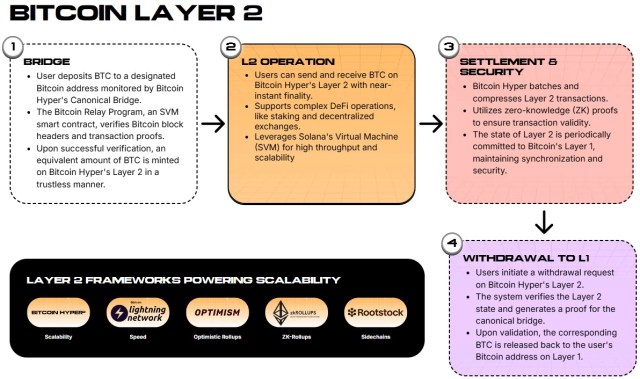
The core value proposition driving interest into Bitcoin Hyper is its technical architecture, which fundamentally differs from previous Layer 2 attempts like Stacks or Lightning. While older L2s often struggle with latency, Bitcoin Hyper ($HYPER) integrates the Solana Virtual Machine (SVM) directly as a Layer 2 execution environment.

Why does that matter? Because the SVM is widely regarded as the industry standard for high-throughput execution. By decoupling the settlement layer (Bitcoin) from the execution layer (SVM), the protocol offers a hybrid beast: Bitcoin’s immutable security and Solana’s sub-second finality.

This modular approach allows developers to build DeFi applications and high-frequency trading platforms using Rust, all while settling transactions on the world’s most secure blockchain.

The architecture relies on a Decentralized Canonical Bridge, which addresses the most common vulnerability in L2s, the bridge itself. Rather than relying on a multi-sig fed by a few signers, the network uses a trusted sequencer with periodic L1 state anchoring. This ensures that while execution happens at lightning speeds on the L2, the final truth always resides on the Bitcoin mainnet.

For developers, this removes the friction of learning niche languages like Clarity (sorry, Stacks). If you can build on Solana, you can build on Bitcoin Hyper. This compatibility is likely a primary driver behind the project’s massive presale figures, opening the Bitcoin ecosystem to thousands of existing Solana devs.

Get your $HYPER today.

Whale Accumulation Accelerates as Presale Crosses Major Milestones

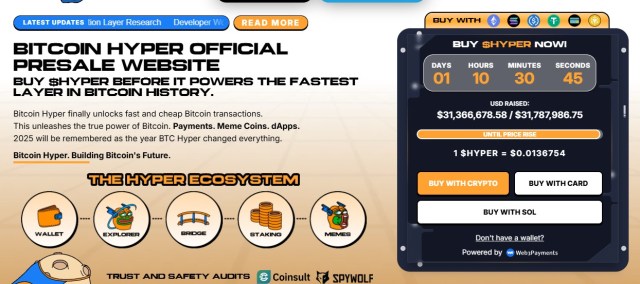
While the Binance-USD1 concentration paints a picture of centralized stagnation, the on-chain data for Bitcoin Hyper suggests a frenzy of accumulation. The project has raised an impressive $31.3M in its ongoing presale, a figure that eclipses most recent infrastructure raises.

The order flow indicates high-conviction buying rather than small retail speculation. A quick look at Etherscan records shows that 3 whale wallets have accumulated over $1M so far. The largest transaction of $500K occurred on Jan 15, 2026.

This specific timing, accumulating heavily well into the raise, suggests that large entities are positioning themselves before the Token Generation Event (TGE).

Investors are currently entering at a price of $0.0136754 per token. The economic model incentivizes early adoption through a high-yield staking program available immediately after purchase.

Notably, the project employs a 7-day vesting period for presale stakers. This short lock-up period is designed to mitigate the post-launch dump often seen in other ICOs, while still providing liquidity relatively quickly.

The sheer volume of capital raised, crossing the $31M mark, validates the market’s demand for a ‘Bitcoin with smart contracts’ solution. As liquidity leaves centralized stables like USD1, it’s finding a home in protocols that offer genuine yield through DeFi utility rather than custodial promises.

Buy $HYPER here.

Disclaimer: The content of this article is for informational purposes only and does not constitute financial advice. Cryptocurrency markets are highly volatile. Always conduct your own due diligence before making investment decisions.

Editorial Process for bitcoinist is centered on delivering thoroughly researched, accurate, and unbiased content. We uphold strict sourcing standards, and each page undergoes diligent review by our team of top technology experts and seasoned editors. This process ensures the integrity, relevance, and value of our content for our readers.

patrubogdan

Follow

Full Profile

Related Posts

Vitalik Buterin Outlines Ethereum’s AI Future, While SUBBD Token Targets the Creator Economy

Cathie Wood’s Ark Invest Buys More Bullish Assets Just Days After Last Purchase, While LiquidChain Turns Heads

Polymarket Sues Massachusetts Over Prediction Market Regulation – SUBBD Token Takes Advantage

Bitcoin Hyper Could Conquer 2026 if Bitcoin Regains Lost Ground

Tether Pushes for $1 Despite Market Crash, While Maxi Doge Reaches New Heights

Ethereum Holds Strong Above $2K, While $LIQUID Starts Turning Heads: Price Analysis & Outlook

Связанные с этим вопросы

QWhat percentage of the USD1 supply is currently held by Binance, and why is this concentration considered alarming?

ABinance currently holds approximately 87% of the total USD1 supply. This concentration is alarming because it creates a massive single point of failure, contradicting the decentralized ethos of cryptocurrency. The stability of the stablecoin's peg becomes entirely dependent on the solvency and liquidity of a single, centralized exchange, introducing significant counterparty and liquidity risks.

QWhat is the core technical innovation of Bitcoin Hyper ($HYPER) that differentiates it from other Bitcoin Layer 2 solutions?

AThe core technical innovation of Bitcoin Hyper is its integration of the Solana Virtual Machine (SVM) as a Layer 2 execution environment. This architecture decouples the settlement layer (Bitcoin) from the execution layer (SVM), combining Bitcoin's security with Solana's high-speed, sub-second finality. It allows developers to build using Rust and offers compatibility with the existing Solana developer ecosystem.

QHow much capital has the Bitcoin Hyper ($HYPER) presale raised, and what does the on-chain transaction data suggest about investor sentiment?

AThe Bitcoin Hyper presale has raised $31.3 million. On-chain data, including three whale wallets accumulating over $1 million each and a single transaction of $500,000, indicates high-conviction buying from large, smart-money investors. This suggests strong institutional interest and aggressive positioning ahead of the Token Generation Event (TGE).

QAccording to the article, what market trend is occurring as a reaction to the centralization risks of assets like USD1?

AThe market is experiencing a capital rotation from narrative-driven, centralized assets like the Trump-affiliated USD1 into fundamental infrastructure projects, specifically Bitcoin Layer 2 scaling solutions. Investors are pivoting towards protocols that solve the 'scalability trilemma' and offer genuine yield through DeFi utility rather than relying on custodial promises.

QWhat mechanism does Bitcoin Hyper use to address the common vulnerability of bridges in Layer 2 solutions?

ABitcoin Hyper uses a Decentralized Canonical Bridge that relies on a trusted sequencer with periodic L1 state anchoring. This mechanism ensures that while execution happens at high speeds on the Layer 2, the final truth and security of transactions always reside on the immutable Bitcoin mainnet, mitigating the risk associated with bridge hacks common in other L2s.

Похожее

Anthropic Cries Wolf: Is the AGI Threat Real, or Just an IPO Story?

Anthropic has published an article titled "When AI builds itself," discussing the emerging concept of "recursive self-improvement," where AI begins to actively participate in designing, training, testing, and optimizing its own subsequent versions. The company presents internal data showing that by May 2026, over 80% of code merged into its codebase was written by Claude, its AI model. Claude's capabilities have expanded to handling complex, open-ended engineering tasks, achieving a 76% success rate in such areas, and even contributing to research processes, such as optimizing code performance and conducting AI safety experiments. Anthropic outlines an evolution from human-driven development to AI-assisted workflows, culminating in the current stage where AI agents can autonomously write, run, and delegate code. The company cautions that the path toward a "closed loop," where AI continuously improves itself, is becoming visible. It calls for coordinated global mechanisms to potentially slow or pause frontier AI development to allow safety research and societal structures to catch up. However, the timing of this warning coincides with Anthropic's preparations for an IPO, framing the narrative not just as a safety concern but also as a demonstration of Claude's advanced capabilities and its integral role in accelerating Anthropic's own R&D—creating a potential "flywheel" effect for competitive advantage. This contrasts with OpenAI's recent, more policy-oriented discussion of the same risks, highlighting the competitive dynamics in the AI industry as companies position themselves in both the technological and regulatory landscape.

marsbit36 мин. назад

Anthropic Cries Wolf: Is the AGI Threat Real, or Just an IPO Story?

marsbit36 мин. назад

BIT Research: ETF Purchases Have Slowed, Strategy (MicroStrategy) Has Slowed, What Else Can Drive Bitcoin's Rise?

Market Refocus on Inflation and Rate Expectations Weighs on Bitcoin Currently, the market is in a phase of macro-repricing dominated by inflation and interest rate expectations. Bitcoin, which previously benefited from easy liquidity and low inflation, is seeing its core bullish drivers weaken. These drivers were market expectations for interest rate cuts and strong inflows from Bitcoin ETFs and institutions like MicroStrategy (referred to as "Strategy" in the text). The logic has shifted. Recent high inflation data (e.g., CPI hitting 3.8% in a May 2026 report) has caused the market to sharply reduce its rate cut expectations for 2025 and even price in potential hikes. This is a key constraint for Bitcoin, as it lacks cash flows and is highly sensitive to rate expectations. Concurrently, institutional capital flows have slowed significantly. Following the hot CPI data, Bitcoin ETFs saw accelerated outflows, with around $4.3 billion leaving over a period. MicroStrategy's ability to keep adding substantial Bitcoin to its balance sheet is also diminishing. Together, ETF and MicroStrategy holdings total roughly $110 billion, but their momentum as growth engines is cooling. In summary, Bitcoin's current pressure stems not from its own fundamentals but from a changing macro environment. As long as inflation stays elevated, Bitcoin is likely to remain in a consolidating phase. However, historically, inflation eventually peaks. Once it recedes and rate cut expectations rebuild, institutional capital could return, potentially fueling a new and more robust recovery phase for Bitcoin.

marsbit44 мин. назад

BIT Research: ETF Purchases Have Slowed, Strategy (MicroStrategy) Has Slowed, What Else Can Drive Bitcoin's Rise?

marsbit44 мин. назад

Earning 1000 Trillion in Half a Year, 'Pocketing' 20 Million per Capita: This Round of Wealth Creation in the Korean Stock Market is Unprecedented in Scale

The South Korean stock market is experiencing an unprecedented wealth surge in 2026, with household equity and fund asset values soaring by over 1,000 trillion KRW (~$730bn) year-to-date. This translates to an average per capita wealth increase of roughly 20 million KRW, fueled by a historic 109% rally in the KOSPI index. The boom is driven by three converging forces: an AI-driven semiconductor supercycle boosting giants like Samsung and SK Hynix; the government's "Value-Up" market reforms addressing long-standing corporate governance issues; and aggressive real estate regulations that have locked capital within financial markets, preventing profits from flowing back into property. This has triggered a wealth effect, boosting high-end consumption significantly. However, the gains are highly concentrated. The two semiconductor behemoths account for over half the index's value, but retail investors own relatively low stakes in them, systematically missing the biggest rallies. Wealth and consumption benefits are skewed towards luxury goods and imported cars, bypassing mainstream retail. Further risks stem from excessive leverage, with high trading volume in leveraged ETFs, and a market sentiment heavily reliant on the AI sector's fortunes and speculative rumors. While this cycle marks a potential shift from real estate to equities as a primary wealth generator for Koreans, its sustainability, amid structural imbalances and leverage, remains a critical test.

marsbit49 мин. назад

Earning 1000 Trillion in Half a Year, 'Pocketing' 20 Million per Capita: This Round of Wealth Creation in the Korean Stock Market is Unprecedented in Scale

marsbit49 мин. назад

Behind ZEC's Over 30% Plunge: An 'Unlimited Minting' Vulnerability with No Way to Prove if It Was Ever Exploited

A critical vulnerability was discovered in Zcash's Orchard privacy pool, allowing for the theoretical creation of undetectable counterfeit ZEC. Researcher Taylor Hornby found the flaw on May 29th, 2024, within the Orchard circuit's cryptographic constraints, which could let an attacker bypass asset conservation rules. Although a rapid emergency fix was deployed within days via a coordinated soft and hard fork, a core uncertainty remains: due to Orchard's privacy features, it is impossible to cryptographically prove whether this "unlimited mint" flaw was exploited in the nearly four years since the pool's 2022 launch. This uncertainty, rather than the patched flaw itself, triggered a market panic, causing ZEC's price to drop over 30%. While the Zcash Foundation stated no evidence of exploitation was found, independent entity Shielded Labs emphasized the impossibility of definitively proving no counterfeit ZEC was ever created. The incident highlights the unique trust challenge in privacy systems. To address this, developers are proposing a new network upgrade with enhanced auditing to allow verifiable proof of supply integrity. Notably, the researcher utilized the newly released AI model Claude Opus 4.8 as a tool during the security review, signaling the growing role of advanced AI in uncovering complex cryptographic vulnerabilities.

marsbit52 мин. назад

Behind ZEC's Over 30% Plunge: An 'Unlimited Minting' Vulnerability with No Way to Prove if It Was Ever Exploited

marsbit52 мин. назад

Торговля

Спот
Фьючерсы

Популярные статьи

Как купить S

Добро пожаловать на HTX.com! Мы сделали приобретение Sonic (S) простым и удобным. Следуйте нашему пошаговому руководству и отправляйтесь в свое крипто-путешествие.Шаг 1: Создайте аккаунт на HTXИспользуйте свой адрес электронной почты или номер телефона, чтобы зарегистрироваться и бесплатно создать аккаунт на HTX. Пройдите удобную регистрацию и откройте для себя весь функционал.Создать аккаунтШаг 2: Перейдите в Купить криптовалюту и выберите свой способ оплатыКредитная/Дебетовая Карта: Используйте свою карту Visa или Mastercard для мгновенной покупки Sonic (S).Баланс: Используйте средства с баланса вашего аккаунта HTX для простой торговли.Третьи Лица: Мы добавили популярные способы оплаты, такие как Google Pay и Apple Pay, для повышения удобства.P2P: Торгуйте напрямую с другими пользователями на HTX.Внебиржевая Торговля (OTC): Мы предлагаем индивидуальные услуги и конкурентоспособные обменные курсы для трейдеров.Шаг 3: Хранение Sonic (S)После приобретения вами Sonic (S) храните их в своем аккаунте на HTX. В качестве альтернативы вы можете отправить их куда-либо с помощью перевода в блокчейне или использовать для торговли с другими криптовалютами.Шаг 4: Торговля Sonic (S)С легкостью торгуйте Sonic (S) на спотовом рынке HTX. Просто зайдите в свой аккаунт, выберите торговую пару, совершайте сделки и следите за ними в режиме реального времени. Мы предлагаем удобный интерфейс как для начинающих, так и для опытных трейдеров.

1.4k просмотров всегоОпубликовано 2025.01.15Обновлено 2026.06.02

Как купить S

Sonic: Обновления под руководством Андре Кронье – новая звезда Layer-1 на фоне спада рынка

Он решает проблемы масштабируемости, совместимости между блокчейнами и стимулов для разработчиков с помощью технологических инноваций.

2.3k просмотров всегоОпубликовано 2025.04.09Обновлено 2025.04.09

Sonic: Обновления под руководством Андре Кронье – новая звезда Layer-1 на фоне спада рынка

HTX Learn: Пройдите обучение по "Sonic" и разделите 1000 USDT

HTX Learn — ваш проводник в мир перспективных проектов, и мы запускаем специальное мероприятие "Учитесь и Зарабатывайте", посвящённое этим проектам. Наше новое направление .

1.8k просмотров всегоОпубликовано 2025.04.10Обновлено 2025.04.10

HTX Learn: Пройдите обучение по "Sonic" и разделите 1000 USDT

Обсуждения

Добро пожаловать в Сообщество HTX. Здесь вы сможете быть в курсе последних новостей о развитии платформы и получить доступ к профессиональной аналитической информации о рынке. Мнения пользователей о цене на S (S) представлены ниже.

活动图片