Aster Chain mainnet debuts: Can it slow the DEX’s falling market share?

ambcryptoОпубликовано 2026-03-18Обновлено 2026-03-18

Введение

Aster Chain, a perpetual DEX backed by YZi Labs, has launched its mainnet. The new Layer 1 blockchain incorporates zero-knowledge proofs and stealth addresses to prevent "position hunting" and improve privacy for high-frequency traders, while maintaining a CEX-like user experience. Despite a strong initial debut in late 2025, Aster's trading volume and market share have significantly declined. Weekly volume dropped from a peak of $74 billion to under $10 billion, and its market share fell from 40% to 20%. Competitor Hyperliquid, which initially lost dominance to Aster, has since regained much of its market share. The native token, ASTER, fell 86% from its high but recovered 80% during a broader market bounce. The mainnet announcement caused a brief 10% price surge, but gains were not sustained. The token remains range-bound between $0.70 and $0.80, with a potential move to $0.95 if key resistance is broken. Future demand may depend on the success of planned staking features.

YZi Labs-backed perpetual DEX platform Aster has finally unveiled its Aster Chain mainnet. The new chain will adopt zero-knowledge proofs and stealth addresses in a bid to curb ‘position hunting,’ common on transparent public chains and platforms like Hyperliquid.

Initially, the DEX debuted on BNB Chain via a bridge and later extended to Ethereum [ETH], Solana [SOL], and Arbitrum [ARB] as a multi-chain dApp. While it will still support trading across these chains, it will transition into a sovereign Layer 1 ecosystem.

The move is aimed at achieving the privacy and other optimal features for high-frequency traders while maintaining a CEX-like user experience.

Aster’s market share falls

Although the DEX became an instant hit after its launch last September, the traction has waned significantly in 2026.

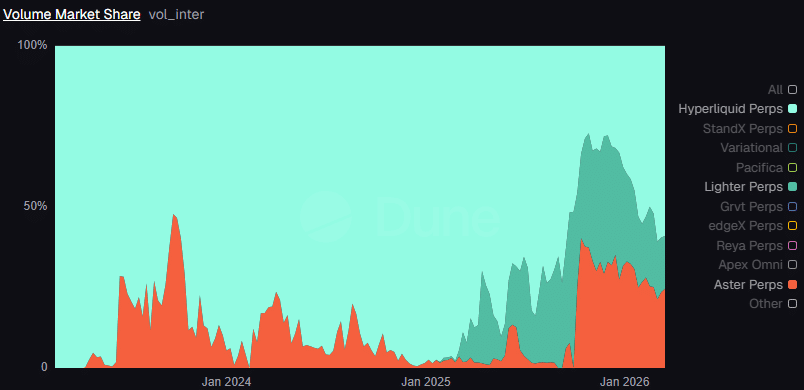
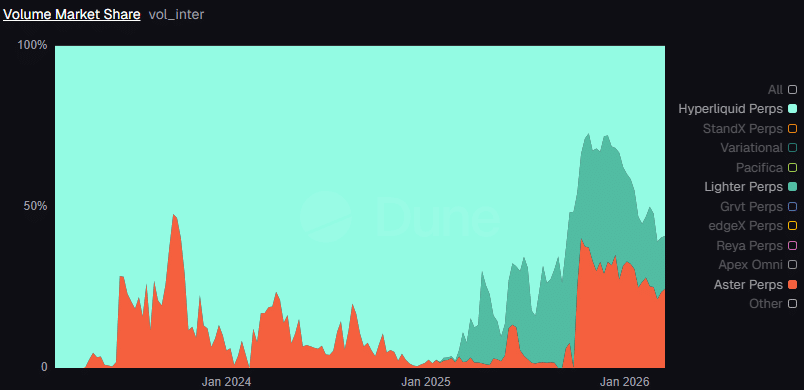
During its peak activity in October 2025, it handled nearly $74 billion in weekly trading volume. But its trading activity shrank to less than $10 billion as of mid-March 2026, following the broader crypto rout in the past few months.

Its overall market share in perps trading volume declined by half, from 40% to 20%, over the same period.

Source: Dune

Interestingly, Aster’s wild FOMO after launch clawed down Hyperliquid’s [HYPE] market share. Hyperliquid had over 60% dominance before Aster went live. Afterward, its dominance fell to 27% but began reclaiming it only after unveiling trading support for oil, gold, silver, and other commodities via HIP-3.

As of writing, Hyperliquid has regained most of its trading volume, while Aster’s steep decline has not abated.

ASTER price reaction

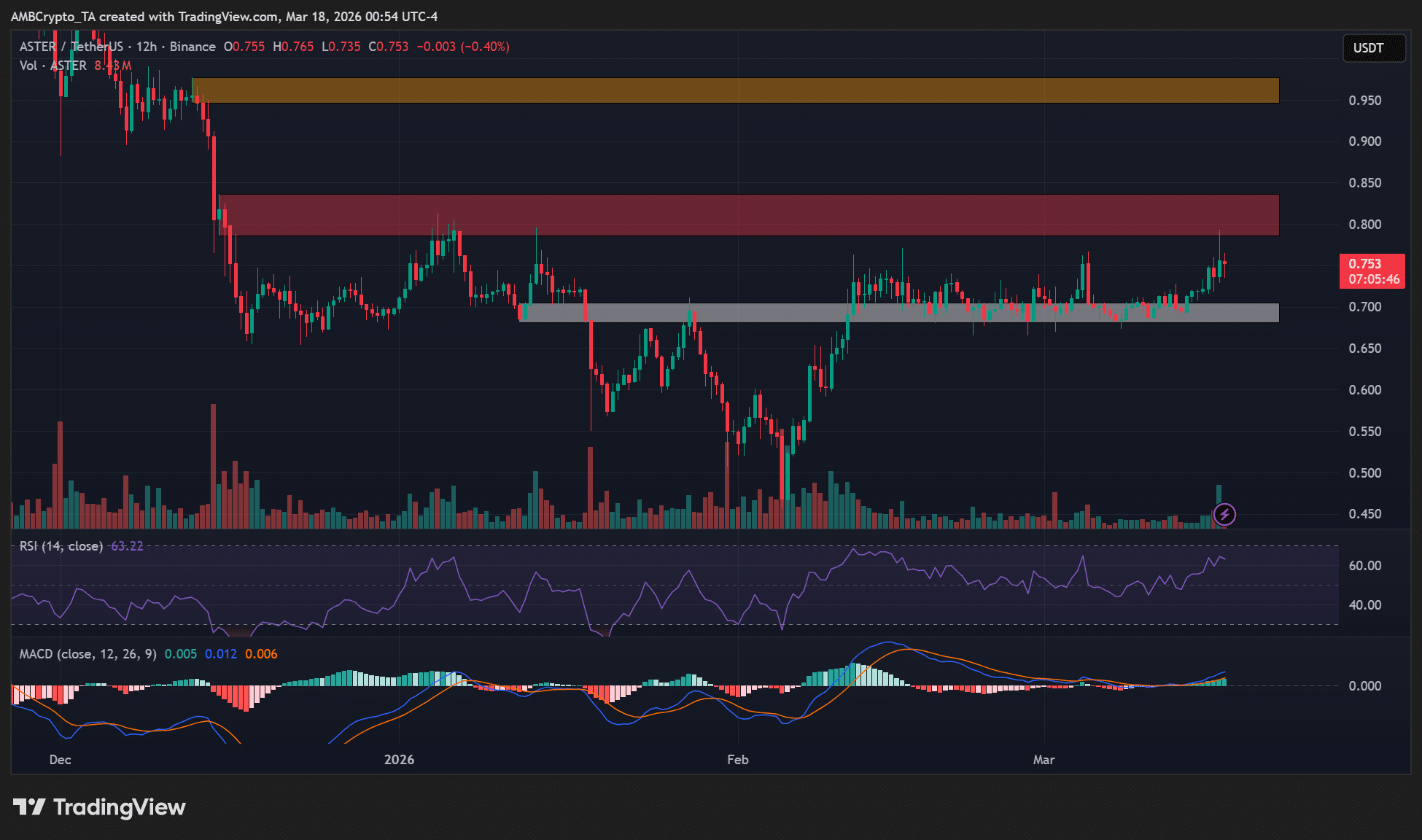
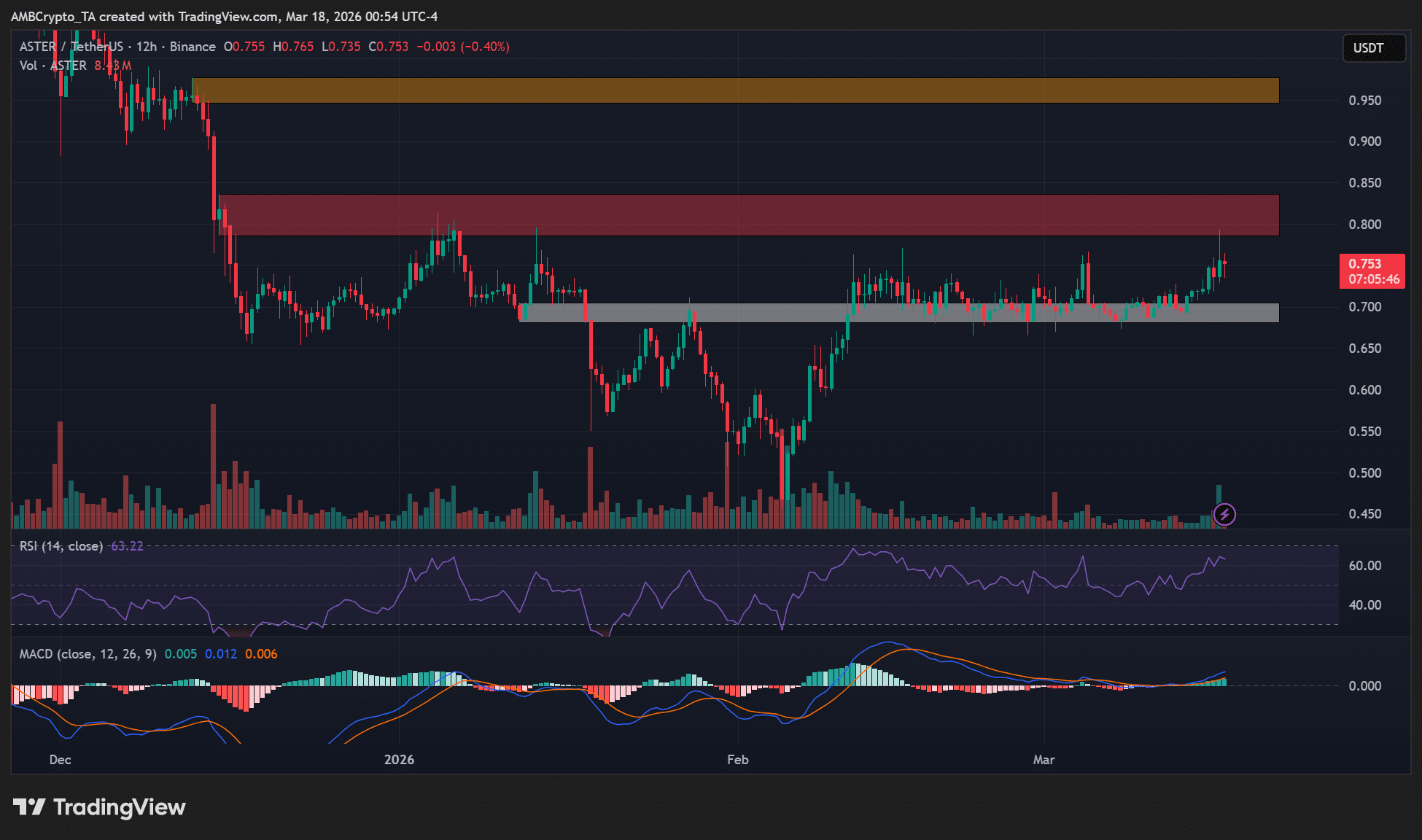
Likewise, its native token ASTER slumped 86% after a free fall from $3 to a low of $0.4. However, the broader market relief bounce from early February has boosted the altcoin’s recovery by 80%.

But the mainnet debut didn’t help bulls that much. After the update, ASTER swiftly rallied by nearly 10%, hitting $0.790, but had erased most of the gains at the time of writing.

When zoomed out, the altcoin was still stuck at its February tight price range of $0.70 and $0.80. The sideways structure may extend if there is no meaningful catalyst for a broader market extended recovery.

However, should the $0.80 price level be flipped to support, then retesting $0.950 could be feasible. It’s unclear whether the planned staking feature will induce demand for ASTER.

Source: ASTER/USDT, TradingView

Final Summary

  • Aster has unveiled its Aster Chain mainnet to double down on privacy and trading efficiency.
  • Still, the DEX’s traction remains in a downtrend while the ASTER price has been stuck in a tight range.

Связанные с этим вопросы

QWhat is the main purpose of the newly launched Aster Chain mainnet?

AThe Aster Chain mainnet aims to provide enhanced privacy and optimal features for high-frequency traders by adopting zero-knowledge proofs and stealth addresses to curb position hunting, while maintaining a CEX-like user experience.

QHow did Aster's market share in perpetual trading volume change from its peak to mid-March 2026?

AAster's market share in perpetual trading volume declined by half, from 40% at its peak to 20% by mid-March 2026.

QWhat was the impact of Aster's launch on Hyperliquid's market dominance?

AAster's launch reduced Hyperliquid's market dominance from over 60% to 27%, though Hyperliquid later regained most of its trading volume after introducing support for commodities like oil, gold, and silver via HIP-3.

QHow did the ASTER token price react to the mainnet debut?

AThe ASTER token initially rallied nearly 10% to $0.790 after the mainnet debut but erased most of those gains shortly after, remaining stuck in the $0.70 to $0.80 range.

QWhat chains did Aster initially support before transitioning to a sovereign Layer 1 ecosystem?

AAster initially debuted on BNB Chain via a bridge and later extended to Ethereum, Solana, and Arbitrum as a multi-chain dApp before transitioning to a sovereign Layer 1 ecosystem.

Похожее

$292 Million KelpDAO Cross-Chain Bridge Hack: Who Should Foot the Bill?

On April 18, 2026, an attacker stole 116,500 rsETH (worth ~$292M) from KelpDAO’s cross-chain bridge in 46 minutes—the largest DeFi exploit of 2026. The stolen assets were deposited into Aave V3 as collateral, causing $177–200M in bad debt and triggering a cascade of losses across nine DeFi protocols. Aave’s TVL dropped by ~$6B overnight. This legal analysis argues that KelpDAO and LayerZero Labs share concurrent liability, with fault apportioned 60%/40%. KelpDAO negligently configured its bridge with a 1-of-1 decentralized verifier network (DVN)—a single point of failure—despite LayerZero’s explicit recommendation of a 2-of-3 setup. LayerZero, which operated the compromised DVN, failed to secure its RPC infrastructure against a known poisoning attack vector. Both protocols’ terms of service cap liability at $200 (KelpDAO) or $50 (LayerZero), but these limits are likely unenforceable due to unconscionability, gross negligence exceptions, and potential securities law invalidation (if rsETH is deemed a security under the Howey test). Aave’s governance also faces fiduciary duty claims for raising rsETH’s loan-to-value ratio to 93%—far above competitors’ 72–75%—without adequately assessing bridge risks, amplifying the systemic fallout. Practical recovery targets include LayerZero Labs (a registered Canadian entity), KelpDAO’s founders, auditors, and identifiable Aave governance delegates. The incident underscores escalating legal risks for DeFi protocols, infrastructure providers, and governance participants.

marsbit32 мин. назад

$292 Million KelpDAO Cross-Chain Bridge Hack: Who Should Foot the Bill?

marsbit32 мин. назад

Insider Trading in War: 5 People Involved, the Highest Earner Was Arrested

On April 24, the U.S. Department of Justice arrested U.S. Army Special Forces Staff Sergeant Gannon Ken Van Dyke for insider trading related to the capture of Venezuelan President Nicolás Maduro on January 3. Van Dyke allegedly profited over $400,000 by placing bets on a prediction market, Polymarket, using insider knowledge of the covert operation. According to the indictment, Van Dyke registered an account (0x31a5) on December 26 and made a series of bets predicting Maduro’s capture and U.S. military involvement in Venezuela. He withdrew most of his funds on the day of the operation and attempted to obscure his tracks by transferring assets through crypto and brokerage accounts. This case marks the first time the DOJ has prosecuted insider trading on Polymarket. PolyBeats had previously identified five suspicious accounts, including Van Dyke’s—the highest earner—in January. The other accounts, with profits ranging from $34,000 to $145,000, remain under unofficial scrutiny but have not been charged. Their lower profits, indirect access to information, and unclear legal boundaries may complicate prosecution. Polymarket has since strengthened its market integrity rules, explicitly prohibiting trading based on confidential or insider information. Van Dyke’s arrest, nearly four months after his trades, signals increased regulatory attention and the persistent traceability of blockchain-based transactions.

marsbit34 мин. назад

Insider Trading in War: 5 People Involved, the Highest Earner Was Arrested

marsbit34 мин. назад

Bitwise: Bullish on Bitcoin's Performance in the Second Half of the Year, AI and Regulation Will Spark a New Altcoin Season

Bitwise CIO Matt Hougan and Research Lead Ryan Rasmussen express strong bullish sentiment on Bitcoin's long-term prospects, suggesting that its $1 million price target may be too conservative. They argue Bitcoin serves a dual role: as digital gold and a potential global settlement asset, especially amid declining trust in traditional monetary systems. Despite a weak Q1 2026 where nearly all crypto assets and prices saw double-digit declines, the analysts remain optimistic due to strong forward-looking catalysts, including institutional adoption via Bitcoin ETFs from major firms like Morgan Stanley and Goldman Sachs. Geopolitical instability, such as Iran’s mention of using Bitcoin for international payments, increases the value of Bitcoin’s “out-of-the-money call option” as a non-political, global settlement currency. This enhances its appeal beyond a mere store of value. . Additionally, Hougan highlights that a clearer regulatory token framework under current SEC leadership, combined with AI efficiency gains and high-performance blockchains, could fuel a new “altseason” by late 2026. This may lead to a wave of legitimate, value-capturing token projects, unlike the earlier ICO boom. . Bitwise also announced an Avalanche ETF, citing its unique architecture and rapid growth in real-world asset (RWA) tokenization, which has surged 10x to nearly $30 billion in two years. The firm believes Layer 1 blockchains are still early in their growth cycle, with significant potential ahead.

marsbit1 ч. назад

Bitwise: Bullish on Bitcoin's Performance in the Second Half of the Year, AI and Regulation Will Spark a New Altcoin Season

marsbit1 ч. назад

Торговля

Спот
Фьючерсы

Популярные статьи

Как купить ASTER

Добро пожаловать на HTX.com! Мы сделали приобретение Aster (ASTER) простым и удобным. Следуйте нашему пошаговому руководству и отправляйтесь в свое крипто-путешествие.Шаг 1: Создайте аккаунт на HTXИспользуйте свой адрес электронной почты или номер телефона, чтобы зарегистрироваться и бесплатно создать аккаунт на HTX. Пройдите удобную регистрацию и откройте для себя весь функционал.Создать аккаунтШаг 2: Перейдите в Купить криптовалюту и выберите свой способ оплатыКредитная/Дебетовая Карта: Используйте свою карту Visa или Mastercard для мгновенной покупки Aster (ASTER).Баланс: Используйте средства с баланса вашего аккаунта HTX для простой торговли.Третьи Лица: Мы добавили популярные способы оплаты, такие как Google Pay и Apple Pay, для повышения удобства.P2P: Торгуйте напрямую с другими пользователями на HTX.Внебиржевая Торговля (OTC): Мы предлагаем индивидуальные услуги и конкурентоспособные обменные курсы для трейдеров.Шаг 3: Хранение Aster (ASTER)После приобретения вами Aster (ASTER) храните их в своем аккаунте на HTX. В качестве альтернативы вы можете отправить их куда-либо с помощью перевода в блокчейне или использовать для торговли с другими криптовалютами.Шаг 4: Торговля Aster (ASTER)С легкостью торгуйте Aster (ASTER) на спотовом рынке HTX. Просто зайдите в свой аккаунт, выберите торговую пару, совершайте сделки и следите за ними в режиме реального времени. Мы предлагаем удобный интерфейс как для начинающих, так и для опытных трейдеров.

706 просмотров всегоОпубликовано 2025.09.25Обновлено 2025.09.25

Как купить ASTER

Обсуждения

Добро пожаловать в Сообщество HTX. Здесь вы сможете быть в курсе последних новостей о развитии платформы и получить доступ к профессиональной аналитической информации о рынке. Мнения пользователей о цене на ASTER (ASTER) представлены ниже.

活动图片