Analyst Reveals Accumulation Level For Dogecoin Before It Rallies To $2

bitcoinistОпубликовано 2026-04-25Обновлено 2026-04-25

Введение

A crypto analyst, Crypto Patel, predicts that Dogecoin (DOGE) could rally to $2, despite currently trading below $0.10. The analyst identifies a key accumulation zone between $0.07 and $0.09, where DOGE has repeatedly tested support without breaking down. Based on a bi-weekly chart using Elliott Wave theory, DOGE is in a Wave 4 consolidation phase within a descending channel. A bounce from this support is expected to trigger a Wave 5 rally, projecting a 2,767% surge toward $2. Price targets are set sequentially at $0.50, $1, and $2, with a stop-loss below $0.048. For a bullish trend reversal, DOGE must break above the $0.10 resistance level, which was recently rejected in April. Analysts emphasize that market conditions and a confirmed higher high are critical for the projected uptrend.

A crypto analyst is of the notion that the Dogecoin price will trade at $2, with this view being obvious, and most just can’t see it yet.

The meme coin is still pinned below the $0.10 threshold despite repeated attempts to break higher, but according to crypto analyst Crypto Patel, the chart is screaming for a breakout rally to $2. This prediction is based on a decades-long chart structure with a projection of DOGE bouncing off a strong accumulation zone.

Dogecoin Sitting Inside Accumulation Zone

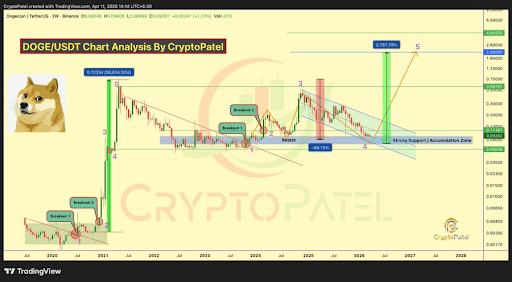
Crypto Patel pointed to a narrow range between $0.09 and $0.07 as the most important accumulation level for Dogecoin right now. This is based on technical observations showing that the meme coin is already trading within that band and repeatedly testing it as support.

His accompanying bi-weekly chart spanning DOGE’s full price history from 2019 through a projected 2027 peak maps an Elliott Wave structure across two complete market cycles.

Source: Chart from Crypto Patel on X

The previous cycle topped at $0.72334, representing a 26,834% gain from its base. The current setup shows Dogecoin in what Crypto Patel labels as Wave 4, which is a consolidation phase playing out within a support and accumulation zone.

Wave 4 has been playing out since the DOGE price topped out at $0.48 in December 2024. Since then, the price action has been characterized by lower highs and lower lows, and this has led to the formation of a parallel downward channel on the 2-week candlestick timeframe.

DOGE’s Projected Path To $2

This zone carries added significance because it corresponds with the lower boundary of the descending channel that has been guiding Dogecoin’s price structure for months. Notably, each retest within the $0.08 to $0.09 band has so far failed to produce a breakdown, and this means there are strong buy orders here.

The expected move here is a bounce from the lower trendline, with the green vertical arrow projecting a wave 5 extension that sees the Dogecoin price going on a 2,767% rally. This projected rally will see Dogecoin landing squarely around $2. Crypto Patel set his price targets at $0.50, $1, and $2 in that sequential order, with a stop-loss defined as a higher-timeframe close below $0.048.

Dogecoin is not in its breakout phase yet. Even with the larger bullish structure in place, Dogecoin’s broader outlook is dependent on market conditions.

The most important thing right now is breaking above $0.10. This price level was rejected on April 17, when Dogecoin reached as high as $0.102. A similar analysis from crypto analyst Trader Tardigrade interpreted this rejection as a clean retest after breaking out of a descending triangle on the daily timeframe. All that needs to happen now is the creation of a higher high that flips the downtrend into an uptrend.

DOGE trading at $0.09 on the 1D chart | Source: DOGEUSDT on Tradingview.com

Связанные с этим вопросы

QAccording to crypto analyst Crypto Patel, what is the key accumulation level range for Dogecoin before it rallies?

AThe key accumulation level range for Dogecoin is between $0.09 and $0.07.

QWhat is the analyst's projected price target for Dogecoin's potential rally?

AThe analyst's price target for the potential rally is $2.

QWhat specific Elliott Wave phase is Dogecoin currently in, according to the analysis?

ADogecoin is currently in Wave 4, which is a consolidation phase.

QWhat is the significance of the $0.10 price level for Dogecoin's price action?

AThe $0.10 level is a significant resistance point that needs to be broken for the price to establish a new uptrend, as it was rejected on April 17.

QWhat is the stop-loss level defined by Crypto Patel for this bullish setup?

AThe stop-loss is defined as a higher-timeframe close below $0.048.

Похожее

Standing in the Light: A Comprehensive Guide to the Optical Module and CPO Supply Chain

"Standing in the Light: Understanding the Optical Module and CPO Industry Chain" This article analyzes the critical role of optical communication technology, specifically optical modules and Co-Packaged Optics (CPO), as the "nervous system" for modern AI data centers. With exponential growth in AI computational demands (e.g., NVIDIA's Vera Rubin architecture), traditional electrical interconnects using copper cables face severe bottlenecks in bandwidth, power consumption, and signal integrity over distance. The core function of an optical module is to act as a "translator," converting electrical signals from chips into optical signals for transmission over fiber (and vice-versa). Key internal components include lasers, modulators, photodetectors, drivers, and DSP chips. The industry is currently transitioning from 800G to 1.6T modules. However, the future lies in CPO. This next-generation technology integrates the optical engine directly with the switch ASIC/XPU on the same package substrate, drastically reducing power consumption (by ~3.5x according to NVIDIA), overcoming bandwidth density limits, and minimizing signal attenuation compared to traditional pluggable modules. Key challenges for CPO include advanced packaging capacity (dominated by TSMC), thermal management, repairability, and standardization. The article details the broader technology landscape, including Near-Packaged Optics (NPO, a pragmatic intermediate step), Linear-drive Pluggable Optics (LPO), Optical I/O (OIO for chip-level integration), and Optical Circuit Switches (OCS). A comprehensive CPO industry chain is mapped, highlighting shifting power dynamics: * **Architecture Definers:** NVIDIA, Broadcom, and Marvell now hold greater influence. * **Advanced Packaging & Manufacturing:** TSMC is central; Fabrinet is a key EMS player. * **Lasers ("The Heart"):** A strategic bottleneck. EML lasers are led by Lumentum and Coherent (both receiving major NVIDIA investments). CW lasers, favored for CPO/silicon photonics, see strong Chinese players like Source Photonics and Sicoya. * **Silicon Photonics Chips:** The mainstream path for CPO engines, with key players like Broadcom, Intel, Marvell, and China's Accelink. * **Fiber Connectivity Components:** A major new, high-growth market created by CPO, including Fiber Array Units (FAU), Polarization-Maintaining Fiber (PMF), and MPO connectors. Companies like Tianfu Communication and US Conec are leaders. * **Fiber & Cable:** Experiencing a super-cycle (e.g., Corning, Yangtze Optical Fiber). * **PCB/Substrates:** Requiring advanced materials (e.g., Shengyi Tech). * **DSP & SerDes:** Functions are integrated into switch ASICs in the CPO era (e.g., Broadcom, Astera Labs). * **Optical Module Makers:** Transitioning from standalone module suppliers to providers of optical engines and NPO/LPO solutions while riding the current pluggable boom (e.g., Zhongji Innolight, Eoptolink). The investment timeline is segmented: Short-term (2026-2027) features the "last feast" for pluggable modules and CPO's initial rollout. Medium-term (2027-2029) will see CPO expand and NPO peak. Long-term (2029-2032+) involves CPO/OIO penetration into intra-rack scaling. In conclusion, optical interconnects are fundamental to AI infrastructure. The competitive landscape sees US firms leading in architecture and high-end chips, TSMC in advanced packaging, and Chinese firms holding strong positions in modules, connectivity components, CW lasers, and fiber/cable. The future belongs to companies that can navigate the technological shift from "selling shovels" (modules) to "building highways" (CPO/OIO infrastructure).

marsbit4 мин. назад

Standing in the Light: A Comprehensive Guide to the Optical Module and CPO Supply Chain

marsbit4 мин. назад

Торговля

Спот
Фьючерсы
活动图片