An AI Version of the 'Subprime Crisis'? A Hidden Debt of $1.8 Trillion is Accumulating in the Shadows Amid the Frenzy

marsbitОпубликовано 2026-06-15Обновлено 2026-06-15

Введение

Amidst the AI infrastructure construction boom, a massive debt expansion is forming, with the most dangerous portion remaining off-balance sheets. Morgan Stanley research reveals approximately $1.8 trillion in off-balance-sheet exposures, including nearly $1 trillion in purchase commitments and over $800 billion in non-active lease contracts. These future cash outflows are not recorded as liabilities. The leverage of hyperscale cloud companies has surged from 0.9x to 1.8x in just two quarters. Private credit firms like Apollo and Blackstone are shifting leverage into the supply chain through complex, opaque SPV (Special Purpose Vehicle) financing structures. Global AI-related bond issuance has skyrocketed, with annual volume projected to exceed $570 billion. However, capital expenditure growth is outpacing revenue and free cash flow. Major cloud providers may see free cash flow approach zero or turn negative in 2026. A significant 'depreciation cliff' looms as vast amounts of current capital spending, recorded as 'construction in progress,' have yet to begin depreciating, artificially inflating current profit margins. Future depreciation could severely pressure earnings. The core risk is identified as a series of timing mismatches, not an immediate solvency crisis. Investment is racing ahead of monetization, leverage is being obscured, and accounting classifications hinder comparability. The entire financing structure faces a fundamental stress test if AI commercialization ...

Amid the frenzy of AI infrastructure construction, an unprecedented debt expansion is quietly taking shape—with its most dangerous portion never appearing on any balance sheet.

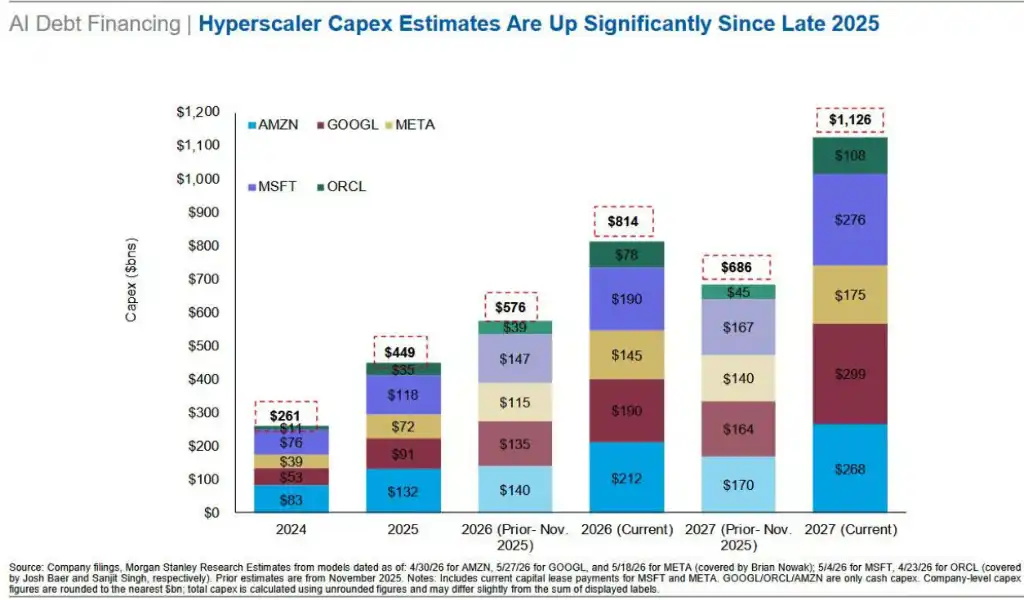
Goldman Sachs's latest report predicts that capital expenditures for hyperscale cloud companies will reach $1.1 trillion to $1.4 trillion by 2027, far exceeding market consensus. However, according to an in-depth study by Morgan Stanley, this already staggering figure is just the tip of the iceberg.
Nearly $1 trillion in purchase commitments, over $800 billion in unactivated lease contracts, and tens of billions of dollars in supplier financing arrangements collectively constitute an off-balance-sheet exposure of approximately $1.8 trillion—these liabilities exist outside the balance sheet but genuinely lock in future cash outflows.

The market has not yet fully priced in these risks.

Morgan Stanley warns that the leverage ratio of hyperscale cloud companies has surged from 0.9x to 1.8x in just two quarters, with capital expenditure growth continuing to outpace revenue and free cash flow growth, while the real impact of depreciation pressure has yet to arrive.

Meanwhile, private credit firms represented by Apollo and Blackstone are transferring leverage to the supply chain level through SPVs (Special Purpose Vehicles), creating a highly circular and difficult-to-penetrate financing structure. If AI commercialization falls short of expectations or enterprise customers shift en masse to cheaper alternatives, the fragility of the entire financing chain will be exposed.

Debt Issuance Frenzy: AI Has Become the Biggest Variable in Public Markets

According to Morgan Stanley's latest "AI Debt Financing Tracker Report," as of the end of May 2026, the scale of global AI-related bond issuance has reached $236 billion, a surge of 357% compared to the same period in 2025.

Morgan Stanley expects the total issuance of AI debt to exceed $570 billion for the full year, with the pace accelerating further in the second half of the year as capital expenditure financing needs are concentrated.
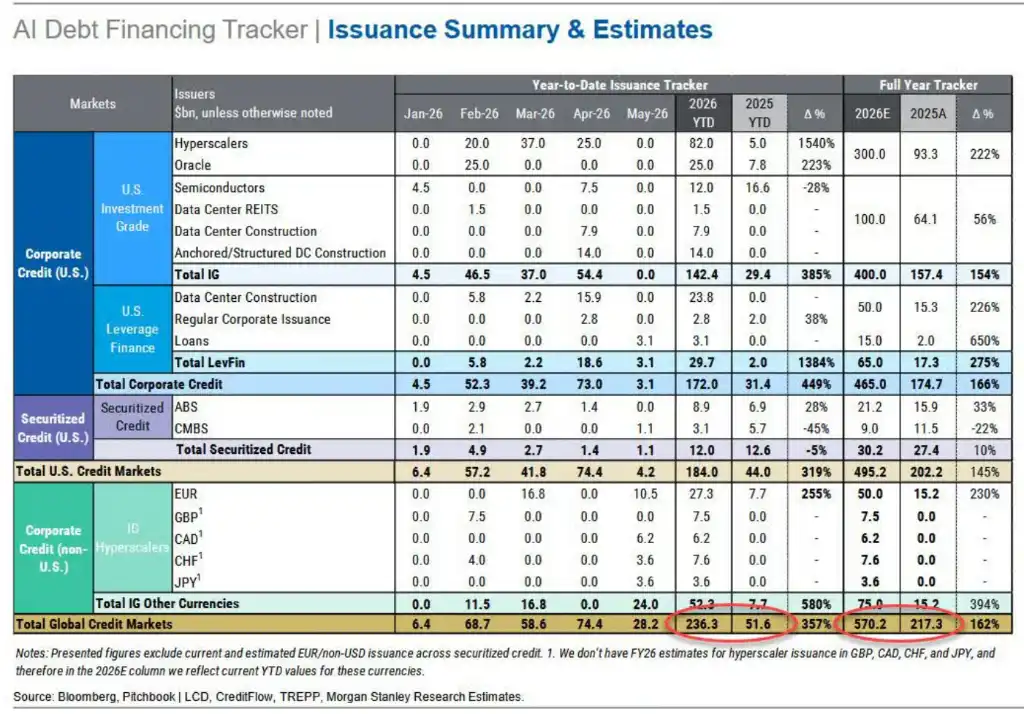
In April alone, AI-related bond issuance exceeded $74 billion, hitting a new high for the year, with project financing structures (for data center construction) accounting for 85% of high-yield bond supply and 40% of investment-grade bond supply. Meanwhile, the five hyperscale cloud companies—Amazon, Meta, Google, Microsoft, and Oracle—now account for 4% of the entire investment-grade bond index.

In terms of leverage, the gross leverage ratio for hyperscale cloud companies has risen from 0.9x in the third quarter of 2025 to the current 1.8x, increasing by approximately 0.3x per quarter, already surpassing the leverage level of the entire energy industry.
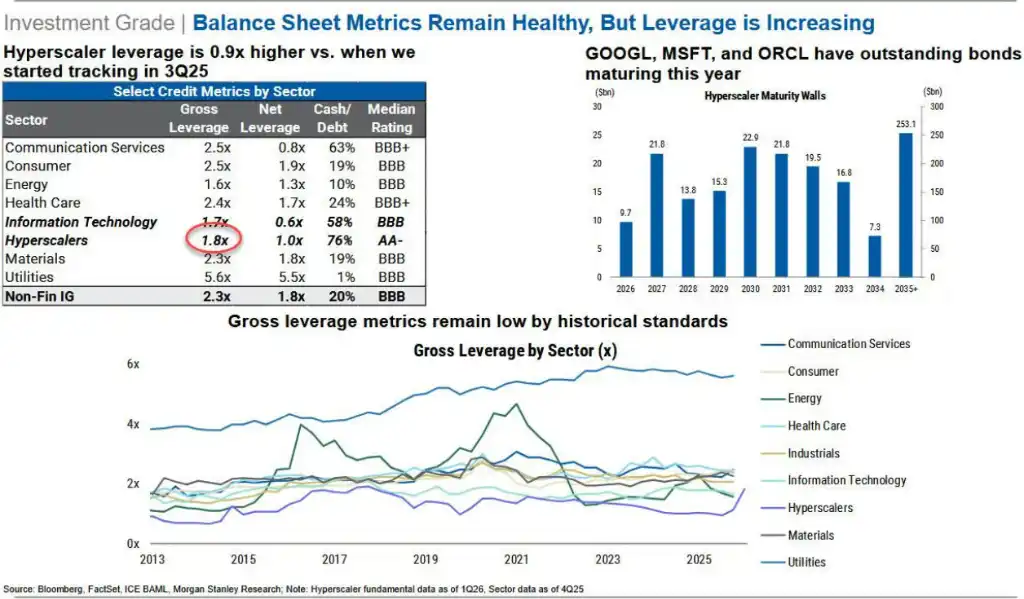
Morgan Stanley points out that, affected by supply pressure, related credit spreads have drifted from the AA range to the A range and may widen further. Meta's credit spread is currently wider than the CDX IG benchmark.

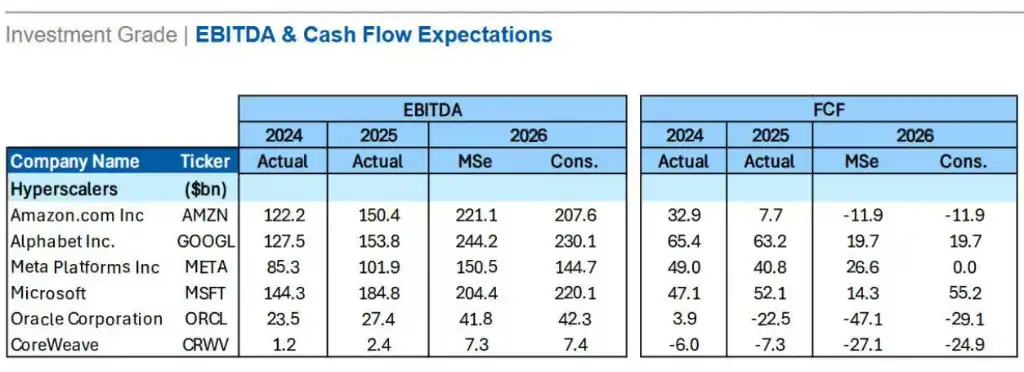
Regarding free cash flow, Morgan Stanley predicts that Amazon and Meta's free cash flow in 2026 will approach zero or even turn negative, at which point incremental financing will almost entirely rely on new debt.
$1.8 Trillion Off-Balance-Sheet Exposure: Invisible Liabilities, Locked-in Cash Outflows

Todd Castagno from Morgan Stanley's Global Valuation, Accounting & Tax team notes in the report that focusing solely on capital expenditure numbers would severely underestimate the true financial commitments of the AI construction cycle. Beyond the disclosed capital expenditures, there are three key types of off-balance-sheet exposure:

Purchase commitments of approximately $982 billion. The total value of long-term purchase contracts by hyperscale cloud companies and Nvidia is close to $1 trillion. Under accounting standards, these obligations are not recorded as liabilities until goods are delivered, unless the company expects a contract loss. Therefore, nearly $1 trillion in future cash outflows currently do not appear as liabilities on any balance sheet.

Notably, Nvidia's own inventory and purchase obligations have risen to about 32% of consensus revenue forecasts for fiscal year 2027, far above the historical range of 15% to 20%, indicating that supply chain commitment risks are extending to chip suppliers.

Unactivated lease commitments of approximately $822 billion. Over $800 billion in lease contracts have been signed but not yet activated and are not included in current lease liabilities. Additionally, arrangements such as variable lease payments, renewal options, and residual value guarantees also exist outside the balance sheet.
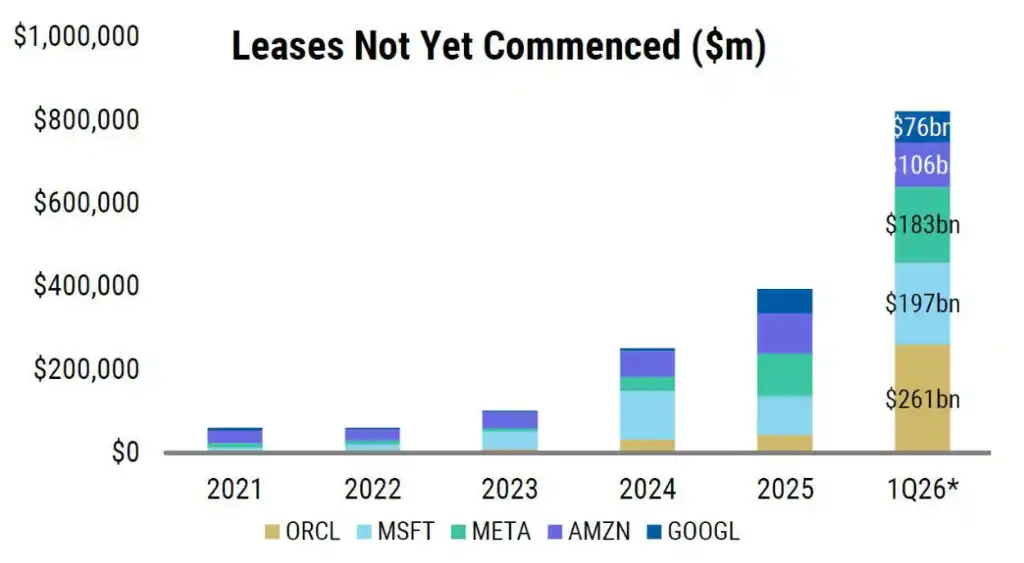
Morgan Stanley estimates that if finance leases were included in the calculation, Microsoft's capital expenditure-to-sales ratio would jump from 33%/50% (fiscal 2026/2027) to 44%/64%, while Oracle's could rise from 76%/115% to 101%/189%.

Unpaid capital expenditures in accounts payable of approximately $110 billion. The days payable outstanding (DPO) of hyperscale cloud companies have significantly lengthened—Oracle's increased by 370% year-on-year, Meta's by 73%, Microsoft's by 69%—meaning the entire supply chain is effectively financing AI construction, with suppliers bearing the liquidity pressure that should be carried by the buyers.

SPVs and Circular Financing: Leverage Moves to the Shadows

Another core dimension of off-balance-sheet risk is the circular financing structure built through SPVs.

A $35 billion "chip-collateralized" private credit deal completed this week by Apollo and Blackstone for Anthropic vividly illustrates the logic of this model:

Broadcom provides backing for this SPV; Anthropic uses the raised funds to purchase Google chips manufactured by Broadcom, with Google holding a 14% stake in Anthropic; Morgan Stanley, which arranged the deal, simultaneously provides loans to the investors participating in the transaction.

Morgan Stanley's AI ecosystem financing correlation map shows multiple circular relationships—customer, investor, supplier financing, and repurchase—among OpenAI, Oracle, Nvidia, Microsoft, CoreWeave, AMD, and Amazon. The same funds circulate repeatedly among a few key entities, with SPVs being the core tool enabling this circulation.
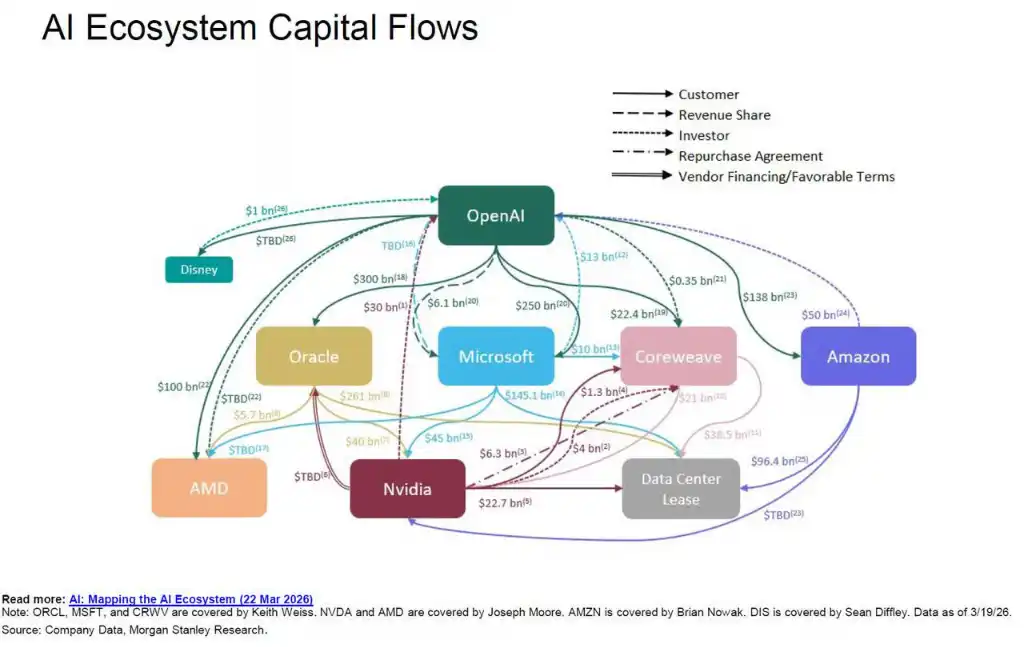
It is reported that Athene, the insurance subsidiary of Apollo, is particularly active in this structure—raising funds by selling annuities to retirees and then injecting the capital into SPVs to participate in AI infrastructure financing.

This model shifts leverage from the visible balance sheets of hyperscale cloud companies to suppliers and the private credit ecosystem, making the true systemic risk exposure difficult for external observers to identify and aggregate.

Depreciation Cliff and Monetization Gap: The Delayed Shock

Current financial data exhibits systematic optimism bias. A large amount of capital expenditure is currently booked as "construction in progress" (CIP) and has not yet begun to depreciate, artificially inflating reported profit margins and underestimating future expense pressure.

The CIP balances of Oracle, Meta, and Google have grown by approximately 200%, 90%, and 55% year-on-year, respectively.
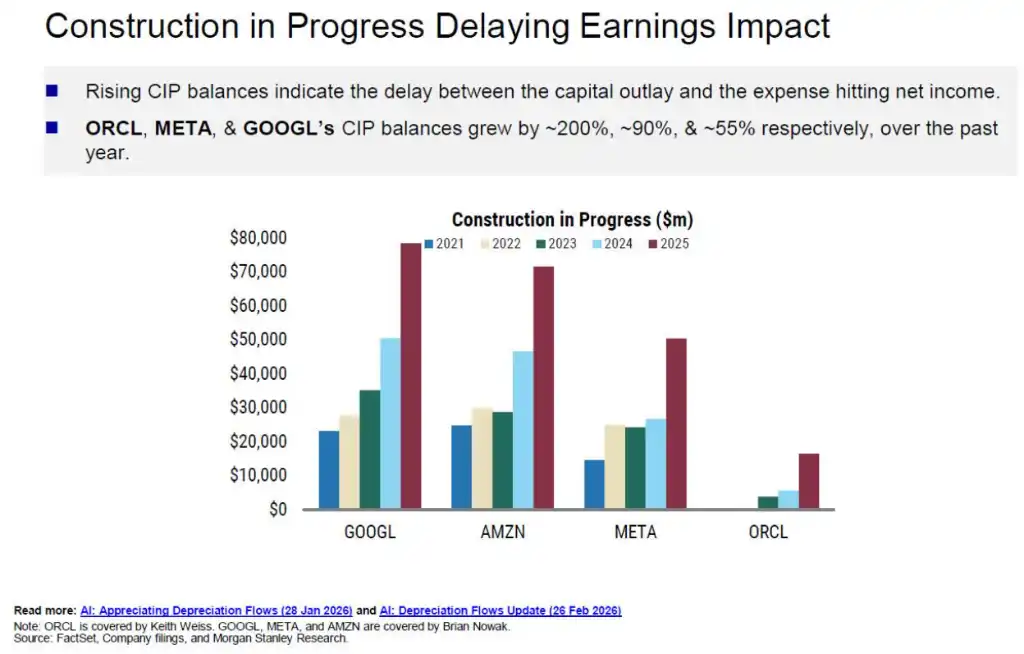
Once these assets gradually transition to depreciation, the impact will be concentrated.

Morgan Stanley predicts that the cumulative depreciation for Microsoft, Oracle, Meta, and Google over the next three years will exceed $520 billion. Taking Oracle as an example, depreciation as a percentage of revenue could rise from the current 7% to 28% in fiscal year 2028; Meta's could rise from 9% to 19%.

In this context, the only path to maintaining profit margins is for revenue to grow significantly in sync—yet the upward revisions to revenue forecasts currently lag far behind the upward revisions to capital expenditure forecasts.

Data shows that consensus capital expenditure forecasts for Google for 2026 have been raised by 139% compared to a year ago, while Meta's and Amazon's were raised by 85% and 81%, respectively. Oracle saw the largest increase, at 175%.

Meanwhile, revisions to revenue forecasts are noticeably lagging, revealing a clear structural mismatch where capital expenditure is outpacing commercialization.

Furthermore, over $2 trillion in remaining performance obligations (RPO) is highly concentrated in a few large, long-term contracts, presenting significant counterparty concentration risk—if any major participant in this circular system encounters problems, it could trigger a chain reaction.

Timing Mismatch Rather Than an Immediate Solvency Crisis

Morgan Stanley concludes that these risks do not currently constitute an imminent solvency crisis but rather a series of overlapping timing mismatches and information disclosure gaps: depreciation pressure is deferred, capital expenditure outpaces monetization, leverage shifts to suppliers and the private credit layer, and the comparability of capital intensity between different companies is significantly undermined by accounting classification differences.

Hyperscale cloud companies are clearly aware of the limited window of current market sentiment and are seizing the opportunity to maximize financing scale.

Goldman Sachs analyst Ryan Hammond points out that if AI infrastructure investment scales to 2% to 3% of GDP, analogous to historical construction cycles of railways and the automotive industry, capital expenditures could reach $1.1 trillion by 2027. In an extreme scenario, considering the cash flow of hyperscale cloud companies and the capacity of the investment-grade credit market, the upper limit might reach $1.4 trillion.

However, all of this hinges on the ability of large language models (LLMs) to continue increasing token pricing and maintain sufficient enterprise customer stickiness. A growing number of enterprises are turning their attention to AI products with comparable performance but significantly lower prices.

Should a structural shift occur on the demand side, the meticulously constructed financing system of today will face a fundamental stress test.


Связанные с этим вопросы

QWhat is the estimated scale of the off-balance-sheet exposure that is building up in the AI infrastructure boom, according to the article?

AThe total off-balance-sheet exposure is approximately $1.8 trillion, comprising nearly $1 trillion in purchase commitments, over $800 billion in non-activated lease contracts, and over $100 billion in supplier financing arrangements.

QHow has the leverage ratio of hyper-scale cloud companies changed recently, and what is it compared to?

AThe gross leverage ratio of hyper-scale cloud companies has surged from 0.9x in Q3 2025 to the current 1.8x, increasing by approximately 0.3x per quarter. This level has already exceeded the leverage of the entire energy sector.

QWhat are the three main types of off-balance-sheet commitments identified in the Morgan Stanley report?

AThe three main types are: 1) Purchase commitments of approximately $982 billion, 2) Non-activated lease commitments of about $822 billion, and 3) Unpaid capital expenditures within accounts payable, estimated at $110 billion.

QWhat is the core mechanism described for shifting leverage into the shadows of the AI ecosystem?

AThe core mechanism is the use of Special Purpose Vehicles (SPVs) to build circular financing structures. This transfers leverage from the visible balance sheets of hyper-scale cloud companies to suppliers and the private credit ecosystem, making systemic risk exposure difficult to observe.

QWhat is the primary nature of the financial risk highlighted by Morgan Stanley regarding the AI investment cycle?

AThe primary risk is not an imminent solvency crisis, but a series of timing mismatches and information gaps. These include deferred depreciation pressure, capital expenditures outpacing monetization progress, leverage shifting to suppliers and private credit, and a lack of comparability in capital intensity due to accounting differences.

Похожее

Криптоплатежи за пептиды с серого рынка выросли на 700% за год — Подробности

Согласно недавнему отчёту, в США наблюдается резкий рост использования криптовалют, в основном биткойна и стейблкоинов, для покупки пептидов на сером рынке. Эти соединения, продаваемые как средства для омоложения, наращивания мышц и похудения, часто находятся в правовой серой зоне. Из-за ужесточения банковских ограничений многие поставщики, особенно в Китае, начали принимать криптовалюты. По данным Chainalysis, в первом квартале 2026 года продавцы пептидов получили $32 млн в криптовалюте, что на 700% больше, чем годом ранее. Аналитики TRM Labs также отмечают подобный тренд. Эксперты подчёркивают, что современные покупатели — это часто обычные потребители, привлечённые доступностью и низкой ценой, а не участники теневых рынков. Этот всплеск использования криптовалют для кросс-бордерных платежей происходит на фоне общего снижения розничного участия на крипторынке в начале 2026 года.

ambcrypto16 мин. назад

Криптоплатежи за пептиды с серого рынка выросли на 700% за год — Подробности

ambcrypto16 мин. назад

human.tech запускает Clean SDK для приватных Web3-приложений

Компания human.tech представила Clean SDK — набор инструментов для разработки приложений в Web3, в которых по умолчанию соблюдаются конфиденциальность и прозрачная подотчетность. Этот комплект, выпущенный одновременно с версией 5 Aztec, предоставляет разработчикам готовые компоненты для внедрения в их приложения проверки личности с нулевым разглашением (zero-knowledge), скрининга санкционных списков и приватных транзакций, без необходимости самостоятельно работать с конфиденциальными пользовательскими данными или создавать инфраструктуру для соответствия нормативным требованиям. Clean SDK решает ключевую проблему Web3, сочетая приватность с подотчетностью. С помощью zero-knowledge доказательств и программируемой верификации приложения могут подтверждать легитимность пользователей и прохождение средств проверки на санкции, не раскрывая при этом личную информацию. Таким образом, разработчикам больше не нужно выбирать между конфиденциальностью пользователей и регуляторными требованиями. Первый продукт на основе SDK — приложение Shield (мост между Ethereum и Aztec), которое было запущено одновременно с ним. Shield позволяет пользователям и автономным агентам переводить активы в Aztec, сохраняя анонимность, но при этом криптографически доказывая, что за каждой операцией стоит уникальный реальный человек, а средства проверены. Аудит Nethermind в мае 2026 года подтвердил надежность смарт-контрактов Shield. Как отметил сооснователь human.tech Шади Эль Дамати, «приватность без подотчетности ведет к злоупотреблениям, а подотчетность без приватности превращается в слежку. Clean SDK устраняет этот ложный выбор». Комплект предлагает три основных метода верификации: скрининг санкций (Proof of Innocence), подтверждение личности человека (Proof of Personhood, в том числе через Human Passport) и верификация личности с нулевым разглашением для операций с высокой стоимостью (Proof of Clean Hands). Данные хранятся в зашифрованном виде вне блокчейна, а проверки происходят как при входе, так и при выходе средств. В целом, Clean SDK, предназначенный в первую очередь для разработчиков в экосистеме Aztec, призван стимулировать создание разнообразных приватных финансовых приложений и сервисов, которые обеспечивают видимую подотчетность с помощью криптографических доказательств, не требуя от разработчиков создания сложной инфраструктуры с нуля. Этот запуск отражает растущий спрос на институциональные решения, которые прозрачно балансируют между приватностью и соответствием требованиям.

TheNewsCrypto23 мин. назад

human.tech запускает Clean SDK для приватных Web3-приложений

TheNewsCrypto23 мин. назад

Высвобождение ликвидности на $100 млн? Новая политика Pump.fun тестирует «5-минутную накачку»

21 июля платформа Pump.fun объявила о запуске режима BOOST, ставшего новой стандартной механикой запуска токенов. Его цель — решить проблему «мёртвой ликвидности». Когда токен переходит с bonding curve в ликвидный пул PumpSwap, около 20% средств навсегда блокируются в LP, становясь недоступными. По оценкам платформы, это приводит к ежегодным потерям ликвидности на сумму более $1 млрд. Механика BOOST меняет это: вместо блокировки, эти 20% средств (например, ~17.6 SOL для SOL-пар) используются в первые 5 минут после миграции токена для его скупки по методу TWAP (средневзвешенная цена по времени). Все выкупленные токены немедленно сжигаются. Это создаёт кратковременный искусственный покупательский спрос и одновременно сокращает предложение токена. Режим автоматически применяется для всех токенов, мигрирующих после 21 июля. Ранее выпущенные токены и токены, запущенные через Mayhem (AI Agent Lab), не участвуют. Цель BOOST — оживить торговлю в критические первые минуты после выпуска, чтобы удержать трейдеров и повысить общий объём торгов на платформе. Однако критики отмечают риски: после 5-минутного «фейерверка» токен может резко обрушиться при крупных продажах, а упрощённый старт может поощрить выпуск более низкокачественных мем-токенов.

marsbit30 мин. назад

Высвобождение ликвидности на $100 млн? Новая политика Pump.fun тестирует «5-минутную накачку»

marsbit30 мин. назад

Продажа блочного пространства умерла: публичные блокчейны должны найти новый способ существования

Статья "Продажа блок-пространства мертва: публичным блокчейнам нужно найти новый путь" утверждает, что традиционная бизнес-модель публичных блокчейнов, основанная на продаже пространства в блоках, больше не работает. Из 14 криптокомпаний, заработавших более $200 млн за два года, только Hyperliquid является блокчейном, чей месячный доход ($58 млн) в 100 раз превышает доход Arbitrum ($430 тыс.). Чтобы выжить, блокчейны должны превращаться в продуктовые студии, агрегаторы приложений или вертикальные SaaS-решения, отходя от роли нейтральной инфраструктуры. В статье также разбираются три ключевых события: 1. **Взлом Ostium**: Атака на LP-пулы протокола привела к потере более 40% TVL ($23,7 млн) из-за уязвимости в офф-чейн инфраструктуре, поставляющей цены. Это подчеркивает критическую важность контроля для протоколов, работающих с офф-чейн активами. 2. **Будущее опционов**: Чтобы достичь массового принятия, мощные возможности опционов должны быть абстрагированы от сложной терминологии и представлены через понятные продукты: структурированные продукты, vaultы для получения дохода, бинарные опционы и прогнозные рынки. 3. **На радаре**: Отмечаются тренды, такие как фиксированные займы (Yearn's Flex), смена стратегии Base после неудач с социальными токенами, запуск перпетуальных контрактов на индекс доллара (Plether) и фокус Starknet на приватности и защите от квантовых угроз.

marsbit50 мин. назад

Продажа блочного пространства умерла: публичные блокчейны должны найти новый способ существования

marsbit50 мин. назад

Заметки подкаста|Диалог с управляющим активами GSR: Чтобы определить, настоящий ли этот крипто-ралли, просто взгляните на процентные ставки по кредитам на Aave

Заметки из подкаста: интервью с управляющим директором по управлению активами GSR Энди Бэром. В центре обсуждения — текущий крипторынок и его перспективы. Бэр описывает рынок как находящийся в состоянии «нерешительности» (ambivalence), где краткосрочные отскоки быстро теряют импульс. Для оценки истинной силы восстановления он предлагает три ключевых сигнала: 1. **Процентные ставки в DeFi (особенно на Aave):** Текущие ставки по USDC (~3,75%) близки к безрисковой ставке (SOFR), что указывает на отсутствие ажиотажного спроса на кредитное плечо. Устойчивый рост начнется, когда ставки резко вырастут, отражая всплеск спроса на заемные средства. 2. **Формирование консенсуса о «пике жесткости» ФРС:** Рынкам необходим четкий сигнал о том, где закончится цикл повышения ставок при новом председателе Кевине Уорше. Пока этой ясности нет, трудно ожидать устойчивого бычьего тренда. 3. **Закон CLARITY:** Его принятие до 7 августа, которое сейчас оценивается Polymarket менее чем в 40%, стало бы для рынка позитивным сюрпризом и могло бы дать импульс для роста. Бэр также отмечает, что фонды ETF не являются долгосрочным капиталом, а корпоративные казначейства (DAT) пока неактивны в покупках. Вместе с сокращением предложения стейблкоинов это лишает рынок структурных покупателей. В итоге, для подтверждения подлинности роста следует следить не только за макростатистикой (например, CPI), но и за цепной активностью, прежде всего за ставками кредитования в DeFi.

marsbit1 ч. назад

Заметки подкаста|Диалог с управляющим активами GSR: Чтобы определить, настоящий ли этот крипто-ралли, просто взгляните на процентные ставки по кредитам на Aave

marsbit1 ч. назад

Торговля

Спот
活动图片




