An AI-Generated 'Whistleblower Post': How Did It Make Two CEOs Write Self-Defense Essays at Midnight?

比推Опубликовано 2026-01-07Обновлено 2026-01-07

Введение

An anonymous post on Reddit, allegedly written by a drunken backend engineer from a major food delivery platform, went viral with 87,000 upvotes and 36 million views on X. The post accused the company of using algorithms to exploit drivers—assigning “desperation scores” to prioritize orders for more financially vulnerable drivers, delaying regular orders despite promised priority delivery, and misusing driver welfare funds for lobbying against unions. The viral allegations prompted immediate public denials from the CEOs of DoorDash and Uber, who issued statements and social media posts in the middle of the night to refute the claims. DoorDash published a detailed rebuttal on its website. The post was later exposed as an AI-generated hoax by a Platformer reporter. The “whistleblower” provided a fake 18-page technical document and an AI-generated employee ID, which was detected using Google’s SynthID watermarking tool. The account was deleted when further verification was requested. The incident highlights how AI can cheaply and convincingly fabricate content that aligns with public skepticism toward tech platforms. Past real controversies, such as DoorDash’s tip policy and Uber’s Greyball tool, made the false narrative feel plausible. The case underscores growing public anxiety over the difficulty of distinguishing real from AI-generated content and the power of emotionally resonant misinformation—even when debunked—to shape perception.

Written by: Curry, Deep Tide TechFlow

Original Title: The People Need a Bad Capitalist, AI Created a Food Delivery Rumor


Last week, something quite surreal happened.

The CEOs of two major American food delivery giants, one worth $2.7 billion and the other running the world's largest ride-hailing platform, were both awake at midnight on Saturday, writing self-defense essays online.

The cause was an anonymous post on Reddit.

The poster claimed to be a backend engineer at a major food delivery platform, who got drunk and went to a library to use public WiFi to leak information.

The content roughly was:

The company analyzes ride-hailing drivers' situations and assigns them a "desperation score." The more financially strained the driver, the fewer good orders they receive; the so-called priority delivery for food orders is fake, as regular orders are deliberately delayed; various "driver welfare fees" are not given to drivers at all but are used to lobby Congress against unions...

The post ended in a very convincing manner: I'm drunk, I'm angry, so I'm leaking this.

It perfectly portrayed itself as a whistleblower role of "big companies using algorithms to exploit drivers."
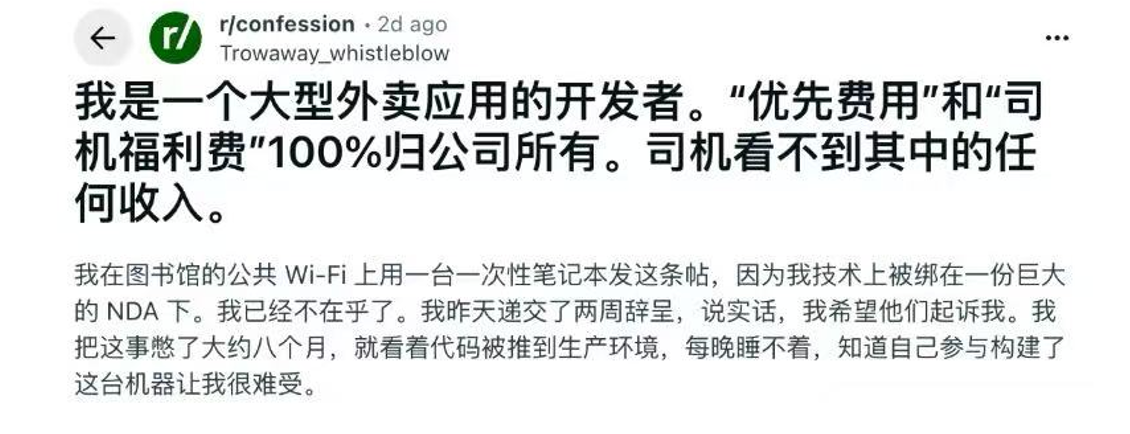
The post received 87,000 upvotes in three days, reaching the front page of Reddit. Some also screenshotted and posted it on X, where it gained 36 million exposures.

Keep in mind, the American food delivery market has only a few major players. The post didn’t name names, but everyone was guessing who it was.

DoorDash's CEO Tony Xu was the first to react, tweeting that this wasn’t them and that he would fire anyone who did such a thing. Uber’s COO also jumped in to respond, "Don’t believe everything you see online."
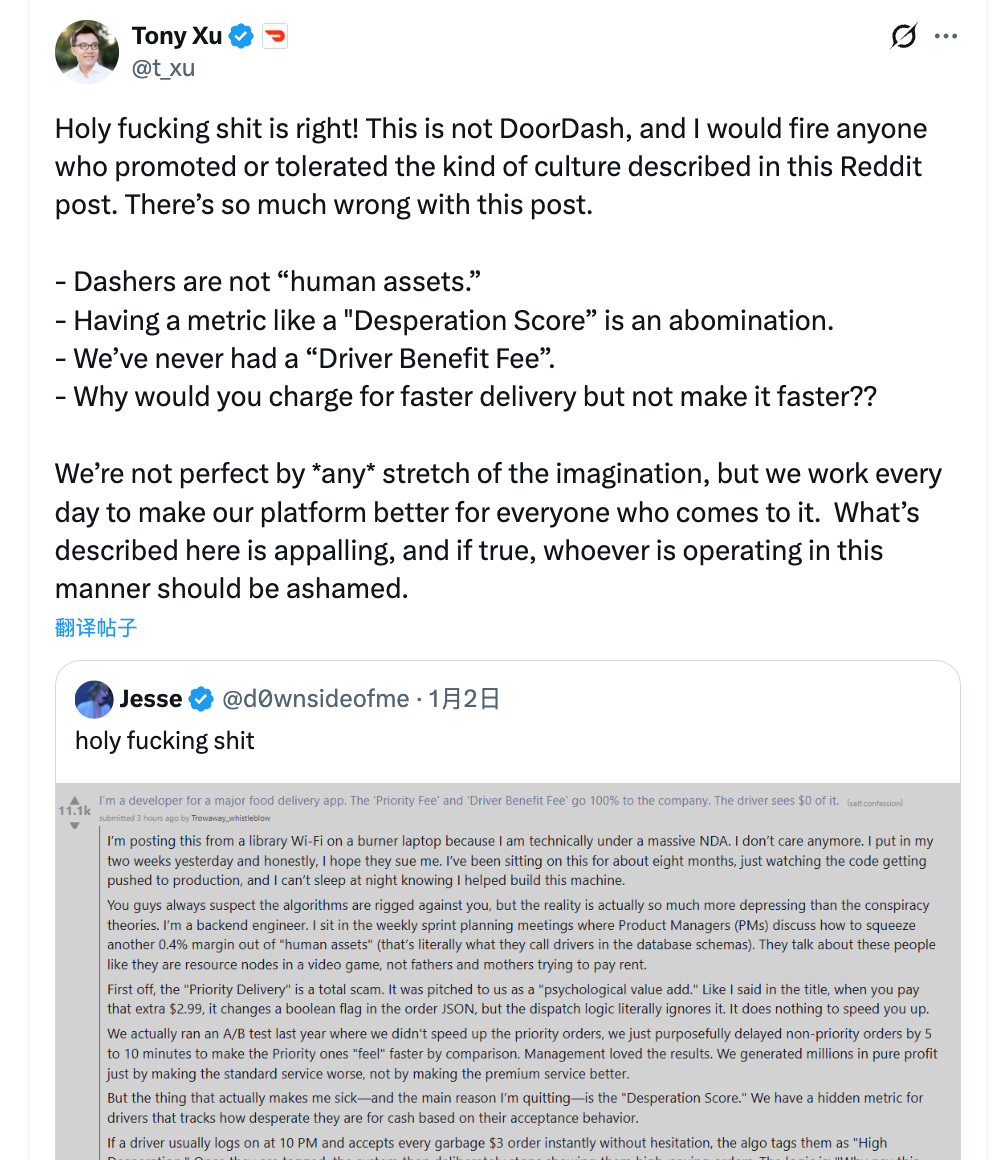
DoorDash even published a five-point statement on its official website, refuting each point in the leak. These two companies, with a combined market cap of over $80 billion, were forced into overnight PR clarifications by an anonymous post.

Then, the post was proven to be fabricated.

It was debunked by Platformer reporter Casey Newton.

He contacted the poster, who immediately sent over an 18-page "internal technical document" titled "AllocNet-T: High-Dimensional Temporal Supply State Modeling."

Every page was watermarked "Confidential," attributed to Uber’s "Market Dynamics Group · Behavioral Economics Department."

The content explained the model mentioned in the Reddit post that calculates the "desperation score" for drivers. It included architecture diagrams, mathematical formulas, data flow charts...
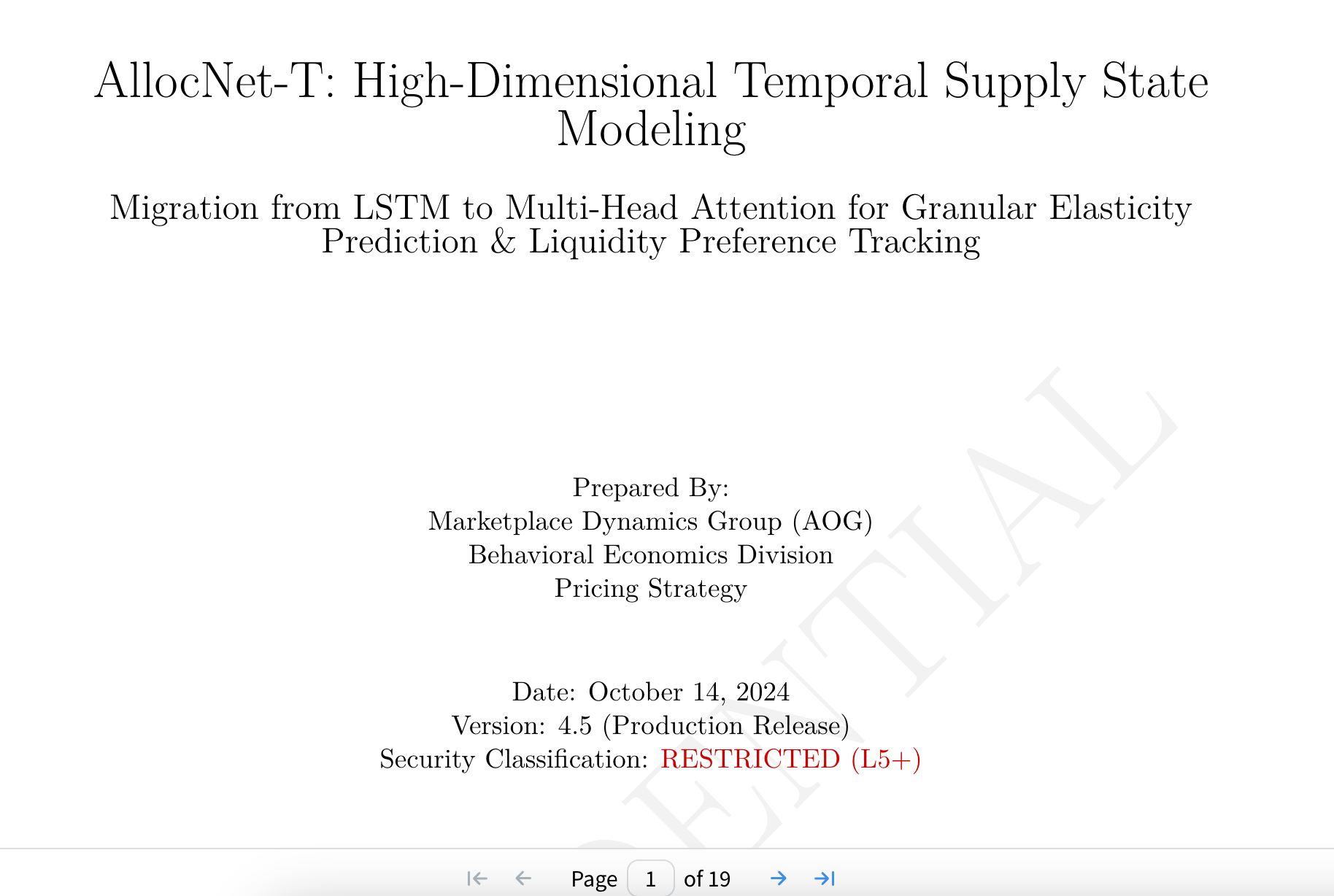
(Fake paper screenshot, at first glance, it looked very real)

Newton said the document initially fooled him. Who would go to the trouble of forging an 18-page technical document to bait a journalist?

But now it’s different.

An 18-page document like this can be generated by AI in minutes.

Additionally, the leaker sent the reporter a blurred photo of their Uber employee ID to prove they worked there.

Out of curiosity, Newton ran the ID photo through Google Gemini for verification. Gemini said the image was AI-generated.

It could be identified because Google embeds an invisible watermark called SynthID in its AI-generated content, undetectable to the human eye but recognizable by machines.

Even more absurdly, the employee ID featured the "Uber Eats" logo.

An Uber spokesperson confirmed: They do not have Uber Eats-branded employee IDs; all badges only say Uber.
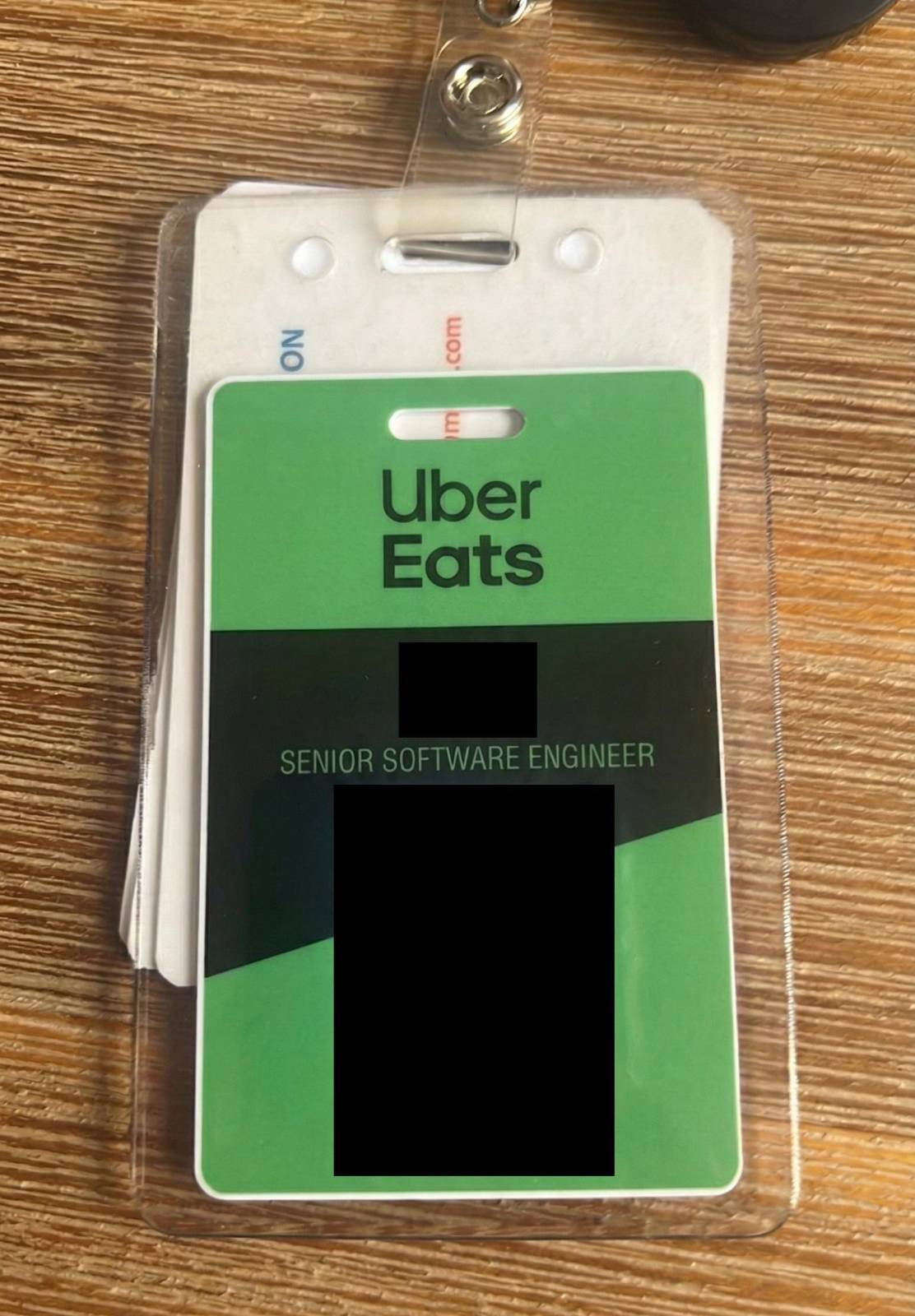
Clearly, this fake "whistleblower" didn’t even know who they were trying to target. When the reporter requested LinkedIn or other social media accounts for further verification,

The leaker deleted their account and vanished.

Actually, we don’t want to talk about AI’s ability to fake things; that’s not new.

We’d rather discuss: Why were tens of millions of people willing to believe an anonymous leak post?

In 2020, DoorDash was sued for using tips to offset drivers' base pay and settled for $16.75 million. Uber had a tool called Greyball to evade regulators. These are real events.

It’s easy to find a subconscious agreement: Platforms are not good guys, and this judgment is definitely correct.

So when someone says "food delivery platforms use algorithms to exploit drivers," the first reaction isn’t "Is this true?" but "I knew it."

Fake news spreads because it resembles what people already believe in their hearts.

What AI does is reduce the cost of creating this "resemblance" to almost zero.

There’s another detail in this story.

The deception was uncovered using Google’s watermark detection. Google develops AI, and Google also creates AI detection tools.

But SynthID can only detect Google’s own AI. This time, they caught it because the forger happened to use Gemini. With another model, they might not have been so lucky.

So solving this case was less a technical victory and more about:

The other party made a rookie mistake.

Previously, a Reuters survey found that 59% of people worry they can’t distinguish truth from falsehood online.

The food delivery CEOs’ clarification tweets were seen by hundreds of thousands, but how many firmly believe it’s just PR, just lies? Even though the fake leak post has been deleted, people are still criticizing the platforms in the comments.

The lie has run halfway around the world while the truth is still tying its shoes.

Now think, what if this post wasn’t about Uber but Meituan or Ele.me?

Things like "desperation score," "using algorithms to exploit riders," "welfare fees not given to riders at all." When you see these accusations, is your first reaction emotional agreement?

"Delivery Riders, Trapped in the System"—do you remember that article?

So the issue isn’t whether AI can fake things. The issue is, when a lie looks like what everyone already believes, does truth even matter?

What that account-deleting fugitive wanted, we don’t know.

We only know they found an emotional outlet and poured a bucket of AI-generated fuel into it.

The fire started. As for whether it’s real or fake firewood, who cares?

In fairy tales, Pinocchio’s nose grows when he lies.

AI has no nose.

Original link:https://www.bitpush.news/articles/7600729

Связанные с этим вопросы

QWhat was the main reason the anonymous Reddit post about food delivery platforms gained so much traction and led to CEOs responding?

AThe post gained traction because it tapped into pre-existing public skepticism and negative sentiment towards large food delivery platforms, with many people already believing that such companies exploit drivers through algorithms. The allegations, though fabricated, aligned with common perceptions, making them easily believable.

QHow was the anonymous Reddit post eventually exposed as being AI-generated?

AThe post was exposed as AI-generated when a journalist, Casey Newton, investigated and found that the 'internal technical document' provided by the whistleblower was likely created by AI in minutes. Additionally, a fake employee ID photo included in the evidence was identified as AI-generated by Google's SynthID watermark detection tool, and Uber confirmed they do not issue Uber Eats-branded employee cards.

QWhat specific allegations did the AI-generated Reddit post make against the food delivery companies?

AThe post alleged that the company analyzed ride-hailing drivers' situations and assigned them a 'desperation score,' where drivers in greater financial need received worse orders; that priority delivery for food orders was fake and regular orders were delayed; and that various 'driver welfare fees' were not given to drivers but used to lobby Congress against unions.

QWhy did the CEOs of DoorDash and Uber feel compelled to respond to the anonymous post?

AThe CEOs felt compelled to respond because the post went viral with 87,000 likes on Reddit and 36 million views on X, creating significant public pressure and potential damage to their reputations. They issued denials and clarifications to protect their companies' images and reassure the public and stakeholders.

QWhat broader concern does this incident raise about AI and misinformation?

AThe incident highlights how AI can easily generate convincing misinformation that aligns with existing public biases, making it difficult to distinguish truth from falsehood. It underscores the challenge of combating AI-generated content, especially when it reinforces preconceived notions, and raises concerns about the potential for widespread deception in the digital age.

Похожее

If the AI Bubble Is Already Bursting, Who Will Truly Survive?

If the AI Bubble is Bursting, Who Will Remain? The debate over an AI bubble is intensifying, with figures like Ray Dalio warning of high levels and Jensen Huang seeing immense, early-stage opportunity. Both views hold truth: a speculative bubble in capital markets likely exists, mirroring the dot-com era, but the underlying technological shift is real and transformative. History shows that while bubbles burst—wiping out overvalued companies and speculative capital—they often leave behind critical physical and digital infrastructure. The dot-com bust, for instance, eliminated many firms but left the global fiber optic networks and data centers that enabled the rise of Amazon, Netflix, and cloud computing. Today's massive AI infrastructure investments (projected at trillions by 2030) in data centers, power, cooling, and GPUs may follow a similar path, creating the foundation for future applications. A key divergence from past bubbles is the "Jevons Paradox" effect in AI. As the cost of AI inference has plummeted by over 99.7% since 2023, enterprise spending on AI has skyrocketed. Cheap "tokens" have unlocked vast, previously uneconomical use cases, moving AI from simple chatbots into core business workflows—code generation, legal document review, scientific simulation, and financial analysis. The market is now in a phase of self-correction, weeding out superficial "API-wrapper" startups, but this cleansing process strengthens the ecosystem. The long-term trajectory is clear. The value is gradually shifting from capital expenditure (CapEx) on hardware to operational expenditure (OpEx) on transformative applications. As AI becomes a utility, the winners will be firms that deeply integrate it to solve vertical industry problems in law, healthcare, finance, and manufacturing. The泡沫 will recede, but the foundational shift towards an AI-powered era across all sectors is irreversible. The underlying productive force of AI contains no bubble.

marsbit28 мин. назад

If the AI Bubble Is Already Bursting, Who Will Truly Survive?

marsbit28 мин. назад

If the AI Bubble Is Already Bursting, Who Will Truly Remain?

**Summary: If the AI Bubble is Bursting, What Will Remain?** The debate around an AI bubble is intensifying, with figures like Ray Dalio warning of high valuations while Jensen Huang sees immense opportunity. This echoes the dot-com bubble, which saw massive wealth destruction but ultimately left behind critical infrastructure like undersea cables and broadband, enabling future giants like Amazon and Netflix. Similarly, today's AI boom involves trillions invested in data centers, power, cooling, and GPUs, while application-layer revenue remains comparatively modest. This investment-disparity signals a bubble. However, the core technological progress is real and accelerating. AI inference costs have plummeted by over 99.7% since 2023, making intelligence increasingly cheap and accessible. This cost collapse is unlocking vast new demand. Instead of reducing spending, enterprises are tripling their AI cloud expenditure. Cheap "tokens" enable AI to move beyond simple chatbots into complex workflows—automating code writing, legal document review, financial analysis, and scientific research. This follows "Jevons's paradox": improved efficiency leads to greater total consumption. The market is now undergoing a necessary purification, weeding out "API-wrapper" startups with no real moat. The deeper evolution involves a shift from capital expenditure (CapEx) on infrastructure to operational expenditure (OpEx) on value-creation in applications. While hardware vendors currently profit most, long-term value will migrate to AI-native firms solving vertical industry problems. Ultimately, a market correction will cleanse speculative excess but will not reverse the AI+ trend. The massive physical and algorithmic infrastructure being built will endure, becoming a cheap, utility-like foundation. Just as the internet became indispensable to all industries post-2000, AI is poised to empower and redefine every sector, moving society irreversibly toward an intelligence-augmented era. The bubble may burst, but the underlying productive momentum is solid.

链捕手34 мин. назад

If the AI Bubble Is Already Bursting, Who Will Truly Remain?

链捕手34 мин. назад

Microsoft CEO: In the AI Era, How Do You Define a Company's Moat?

Microsoft CEO Satya Nadella argues that in the AI era, a company's true competitive edge, or "moat," is not determined by choosing the single most powerful model, but by its ability to build a continuous "learning loop." This system integrates and evolves by connecting human workflows, domain expertise, organizational judgment, and employee experience. He posits that future companies will accumulate two types of capital: Human Capital (employee knowledge, judgment, creativity) and "Token Capital" (a firm's own built and owned AI capabilities). Importantly, AI amplifies rather than devalues human capital. Human direction is essential to guide progress, as computational power alone is aimless. The core opportunity lies in creating a closed-loop system where human and token capital reinforce each other in a compound, self-improving cycle. A company must be able to preserve its unique institutional knowledge—its "company veteran" expertise—even if it switches underlying general-purpose AI models. This requires private evaluation benchmarks, reinforcement learning environments based on internal data, and queryable knowledge bases. Nadella warns against a future where economic value is concentrated by a few dominant models that commoditize entire industries' knowledge. Instead, the priority should be building a broad "frontier ecosystem" where every company, industry, and nation can own its learning loop. This allows organizations to retain control of their intellectual property, amplify employee capabilities, and ensure the economic value created by AI is captured within their own businesses and communities. True corporate sovereignty in the AI age comes from turning organizational knowledge into a compounding system that creates enduring, defensible value.

marsbit1 ч. назад

Microsoft CEO: In the AI Era, How Do You Define a Company's Moat?

marsbit1 ч. назад

ETFs Are Just the Ticket: The True Institutionalization of Bitcoin Is Happening Where You Can't See It

Beyond the Bitcoin ETF spotlight, a deeper institutionalization is underway, leveraging Bitcoin as a foundational financial primitive. Institutions are using Bitcoin for purposes long reserved for assets like U.S. Treasuries and gold: as collateral for loans, insurance reserves, and the backbone of rated bonds. Examples include a Barbados-based insurer capitalizing with $40M in Bitcoin reserves and Ledn's $188M securitization of Bitcoin-backed loans, which received the first-ever investment-grade rating (BBB-) from S&P for a digital asset-backed security. This structure was stress-tested during a 27% price drop in early 2026, triggering automatic liquidations that functioned as designed but revealed the systemic risk of synchronized selling across leveraged positions. Infrastructure is evolving to support this, with platforms like Anchorage Digital's Atlas network enabling secure, institutional-grade settlement and collateral management. Strategies like basis trades and corporate treasuries (exemplified by companies like MicroStrategy issuing billions in equity and debt to fund Bitcoin acquisitions) further integrate Bitcoin into financial mechanics. While ETFs solved "how to own" Bitcoin, these developments answer "what to do with it," embedding the asset into the working machinery of finance—as collateral upon which loans, derivatives, and structured products are built. The real, enduring institutional shift is happening in these largely invisible plumbing and financing systems.

marsbit1 ч. назад

ETFs Are Just the Ticket: The True Institutionalization of Bitcoin Is Happening Where You Can't See It

marsbit1 ч. назад

ZEC Co-Founder Responds to Orchard Vulnerability: No Signs of Theft, Orchard Pool to Be Sealed

ZEC Co-Founder Addresses Orchard Vulnerability: No Signs of Theft, Plans to Sunset Orchard Pool A security vulnerability was recently discovered in Zcash's Orchard shielded pool, raising key concerns. The primary questions are whether the flaw was exploited, if user funds are safe, whether users can verify the total ZEC supply, and if other similar vulnerabilities exist. Analysis suggests the vulnerability was likely not exploited prior to its discovery. It was found proactively by a researcher using specialized tools, not due to an active breach. The development team and mining pools acted quickly to contain the issue. Typical financially-motivated attacks would likely have left visible on-chain evidence, which has not been observed. User funds in Orchard are considered safe and should be recoverable, assuming no prior exploitation. If the flaw was never used, all legitimate funds can be withdrawn. The article outlines risks associated with moving funds to transparent addresses or other pools, but concludes that leaving assets in place is a reasonable option. Currently, users cannot independently verify that the total ZEC supply hasn't been inflated due to this bug. However, the planned Ironwood network upgrade is designed to resolve this. It will permanently close the Orchard pool to new deposits and internal transfers, allowing only withdrawals. This mechanism will cap total withdrawals at the amount of legitimately deposited funds, enabling anyone to cryptographically verify the supply post-upgrade. Multiple teams, including Shielded Labs, have conducted extensive audits focused on counterfeiting vulnerabilities, assisted by advanced AI tools. No additional flaws of this type have been found so far, increasing confidence that no other similar undisclosed vulnerabilities exist. In summary, evidence indicates the Orchard bug was probably not used, user funds are secure, and no other counterfeiting flaws are currently known. The upcoming Ironwood upgrade will restore users' ability to independently verify the total ZEC supply, closing this chapter.

Foresight News1 ч. назад

ZEC Co-Founder Responds to Orchard Vulnerability: No Signs of Theft, Orchard Pool to Be Sealed

Foresight News1 ч. назад

Торговля

Спот
Фьючерсы

Популярные статьи

Неделя обучения по популярным токенам (2): 2026 может стать годом приложений реального времени, сектор AI продолжает оставаться в тренде

2025 год — год институциональных инвесторов, в будущем он будет доминировать в приложениях реального времени.

1.8k просмотров всегоОпубликовано 2025.12.16Обновлено 2025.12.16

Неделя обучения по популярным токенам (2): 2026 может стать годом приложений реального времени, сектор AI продолжает оставаться в тренде

Обсуждения

Добро пожаловать в Сообщество HTX. Здесь вы сможете быть в курсе последних новостей о развитии платформы и получить доступ к профессиональной аналитической информации о рынке. Мнения пользователей о цене на AI (AI) представлены ниже.

活动图片