All about Solana’s liquidity situation after recent exploits – Where is the capital going?

ambcryptoОпубликовано 2026-04-07Обновлено 2026-04-07

Введение

Despite recent exploits, Solana's liquidity is showing resilience through internal capital rotation rather than mass outflows. SOL-denominated TVL has reached an all-time high of over 80 million SOL, and DEX volume hit $95 billion in February. While overall TVL declined to $5.55 billion after a $285 million hack, the net loss was only 8%, indicating funds are moving within the ecosystem to venues like Kamino, Raydium, and Jupiter rather than leaving the chain. This shift is reshaping DEX competition, with Jupiter's aggregator dominance slipping to 82% as alternatives like Titan gain traction. The internal flow and competitive routing help Solana absorb shocks, demonstrating a maturing structure where capital movement efficiency underpins stability.

Solana’s [SOL] liquidity behavior is shifting, as capital now moves within the ecosystem rather than exiting during stress. In fact, SOL-denominated TVL has exceeded 80 million SOL, reaching an all-time high despite broader market contraction. At the same time, DEX volume hit $95 billion in February, showing strong internal activity.

DeFiLlama data lends some nuance too, with $5.55 billion in TVL even after a 15% monthly decline – A sign of resilience rather than outflows. This happens because liquidity rotates across venues like Kamino, Raydium, and Jupiter, instead of leaving the chain. Daily volumes often exceed $900 million, reinforcing this internal flow.

Such a shift implies Solana’s structure may be maturing, where stability depends on capital movement efficiency and not just retention.

Solana’s DEX routing shifts from dominance to competition

This internal rotation of liquidity is now beginning to reshape how trades are routed across Solana, rather than where capital sits.

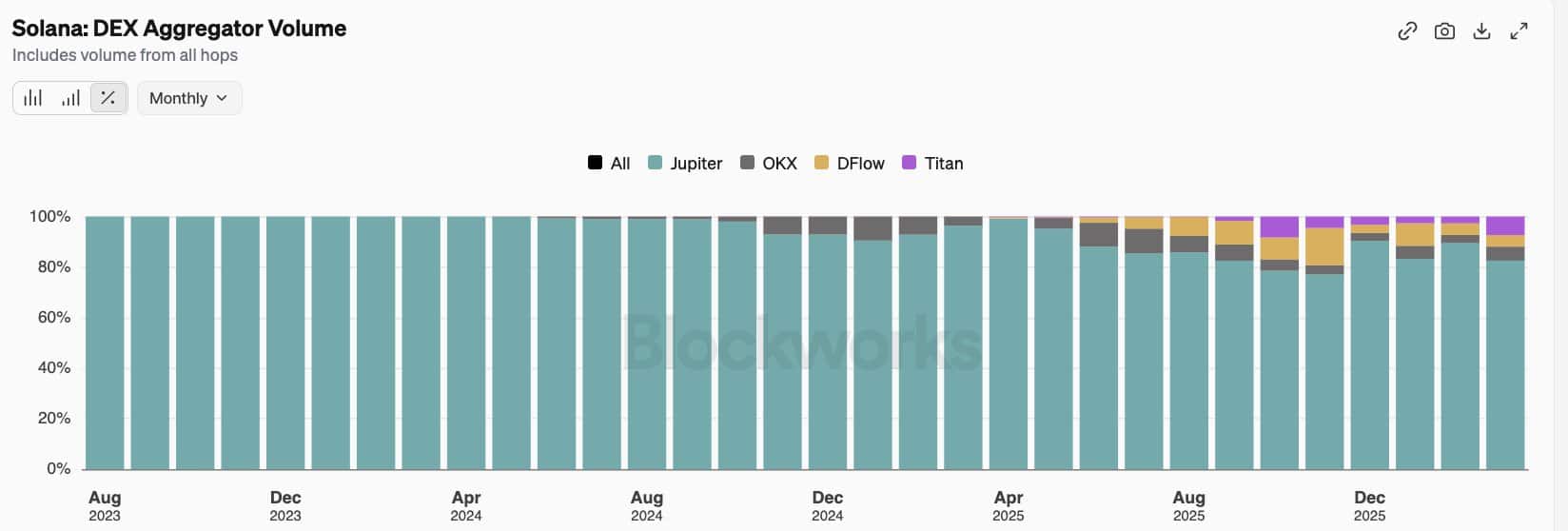
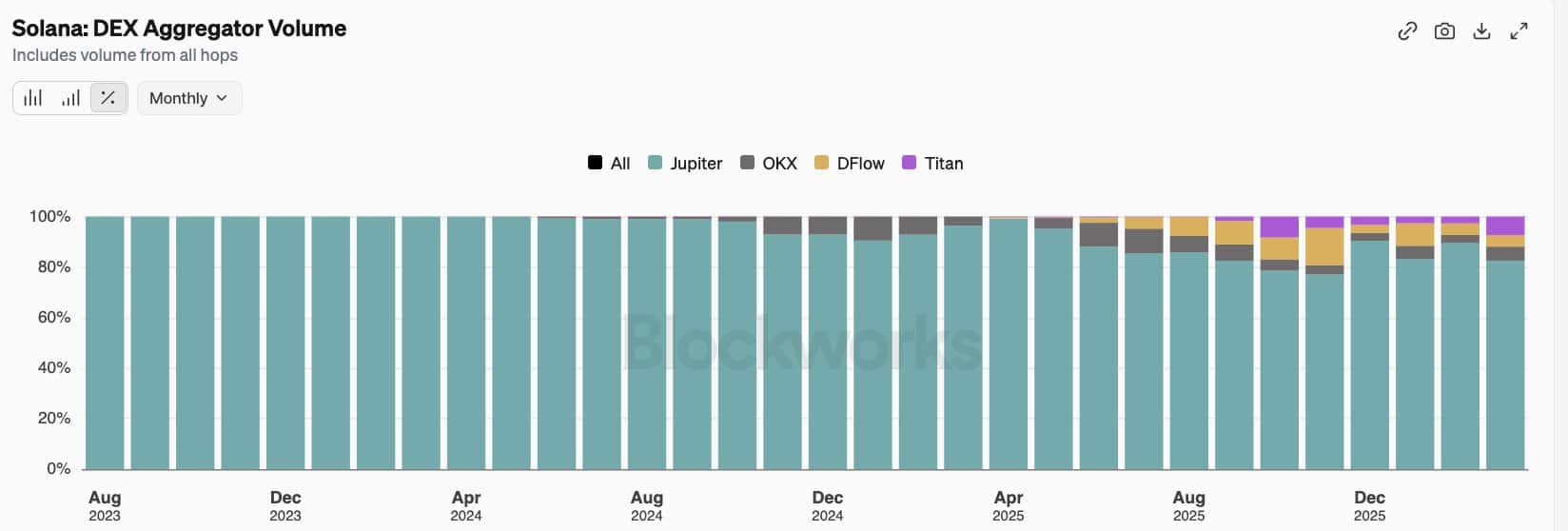
Jupiter controlled about 82% of aggregator flow in March, but its share slipped to the lowest level since November 2025 – Evidence of early pressure. Meanwhile, Titan rose to 7.3%, its highest since launch, showing that users have been starting to test alternatives.

Source: Blockworks

Such a shift happens because execution quality and pricing efficiency are becoming more important than brand dominance. As more routers compete, flows fragment slightly, but remain within the same ecosystem. Earlier, Jupiter held near-total control through 2023 and most of 2024, which limited competition.

Now, competition improves routing efficiency, yet also introduces fragmentation. This means users gain better execution while protocols face tighter margins and rising pressure to innovate.

Solana absorbs shock as liquidity rotates, not exits

This growing routing competition shows why Solana’s liquidity reacts differently during stress, as capital adjusts rather than exits.

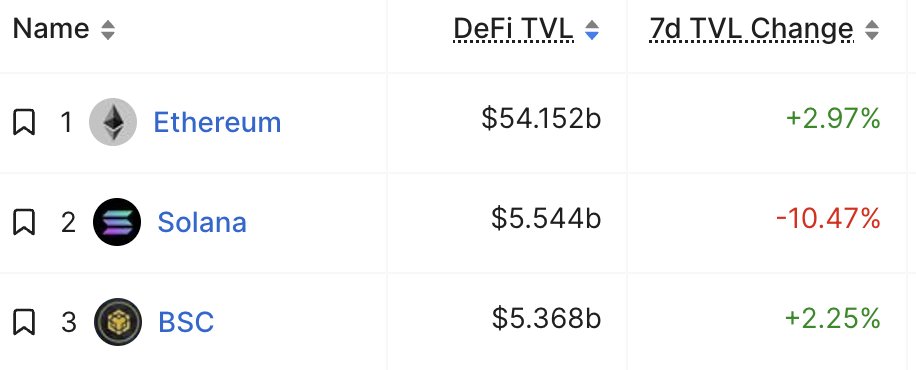
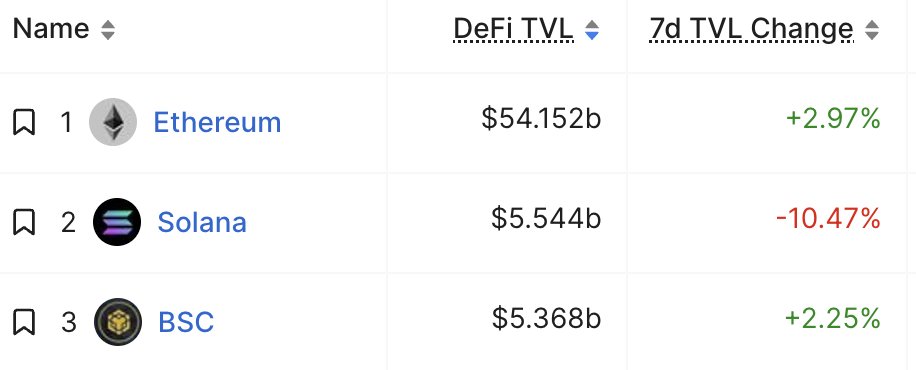
For instance – TVL fell to $5.55 billion, down 10.47% in seven days, after the $285 million Drift exploit. However, the drop has been contained since net losses excluding the hack sit near 8%, showing users did not broadly withdraw funds.

Ethereum [ETH] rose by 2.97% to $54.15 billion, while BSC gained by 2.25% to $5.36 billion, indicating capital shifts across ecosystems rather than leaving DeFi. This happens because users seek alternative venues when risk appears, not full exits.

Source: DeFiLlama

Solana still holds second place, which also means that liquidity remains within reach. This is also evidence of competitive routing and multiple venues helping absorb shocks, allowing users to reposition without abandoning the network.

Taken together, Solana’s liquidity now reflects internal competition as much as external shocks. Titan’s rise means rotation, rather than dominance, making venue dynamics central to resilience while exploit risk still defines trust limits.


Final Summary

  • Solana [SOL] has exhibited structural maturity as liquidity rotates across venues.
  • Competition has improved routing, allowing capital to reposition internally rather than exiting during stress.

Связанные с этим вопросы

QWhat key evidence suggests that Solana's liquidity is maturing despite recent market stress?

ASOL-denominated TVL has reached an all-time high of over 80 million SOL, and DEX volume hit $95 billion in February, indicating strong internal capital rotation rather than outflows.

QHow has the competitive landscape for DEX aggregators on Solana changed recently?

AJupiter's dominance has slipped from 82% in March to its lowest level since November 2025, while Titan's market share rose to 7.3%, its highest since launch, showing users are testing alternatives.

QHow did Solana's TVL react to the $285 million Drift exploit, and what does this indicate?

ATVL fell to $5.55 billion, down 10.47% in seven days, but net losses excluding the hack were only about 8%, showing users did not broadly withdraw funds and capital was contained within the ecosystem.

QWhat is the significance of liquidity rotating across venues like Kamino, Raydium, and Jupiter?

AIt shows that during stress, capital is moving efficiently within the Solana ecosystem rather than exiting, which is a sign of structural maturity and resilience.

QHow does the rise of competitive routing benefit users and challenge protocols on Solana?

AUsers gain better execution quality and pricing efficiency, while protocols face tighter margins and increased pressure to innovate due to the fragmentation of flows.

Похожее

The Age of Decoupling Has Arrived: Bitcoin is No Longer the Sole Compass of Crypto

The era of the cryptocurrency market moving in lockstep with Bitcoin is ending, as the industry splits into two distinct asset categories: endogenous and exogenous. Endogenous assets, like Bitcoin, derive value purely from the crypto market's cycles. Their narratives swing between being "interstellar money" in bull markets and "digital collectibles" in bear markets. Exogenous assets, however, are nominally crypto but operate with independent value drivers. Examples include: * **Venice:** An AI inference service using tokens for payments; its consumer-AI business model is decoupled from crypto price swings. * **Figure:** A fintech lender using blockchain to speed up loan approvals; its core value is in credit, not crypto. * **Stablecoin firms like BVNK:** Acquired by traditional finance giants (Mastercard, Stripe), their growth is tied to payment infrastructure, not market cycles. Hybrid projects like **Hyperliquid** (a decentralized exchange) show a shift, with a growing share of non-crypto trading (e.g., prediction markets). This divergence is fundamental. Endogenous assets remain highly correlated to Bitcoin, similar to gold miners to gold. Exogenous assets are evolving to have their own fundamentals, like the weak correlation between gold and the S&P 500. This changes investment analysis. Evaluating exogenous assets requires traditional fundamental research—assessing user bases, unit economics, and moats—more akin to fintech investing than charting Bitcoin. Promising exogenous sectors include: on-chain exchanges/brokers, AI-crypto fusion, privacy-focused digital banks, lending (institutional/private credit), stablecoins/real-world asset tokenization, payment rails, and non-financial crypto-consumer products. Currently, investing via equity is often safer than via tokens, as token value accrual mechanisms need further regulatory and industry development (e.g., the CLARITY Act). Nonetheless, the core trend is clear: crypto market drivers are diversifying from a single factor (Bitcoin) to multiple fundamentals, ending the era of uniform market moves.

marsbit41 мин. назад

The Age of Decoupling Has Arrived: Bitcoin is No Longer the Sole Compass of Crypto

marsbit41 мин. назад

Five Cryptos That Could Outperform Bitcoin Over the Next Cycle Due To Higher Growth Velocity

Bitcoin's growth often sets market trends, but analysts believe the next cycle's highest percentage gains may come from assets with greater growth velocity. While Bitcoin provides stability, several cryptocurrencies are positioned for stronger relative upside. This article highlights five such assets, with a particular focus on Ozak AI as the potential high-growth standout of the cycle. Ethereum (ETH) is noted for its ongoing evolution and institutional adoption. Solana (SOL) is recognized for its high throughput and history of sharp rallies. Chainlink (LINK) is highlighted as essential infrastructure for DeFi and AI applications. Avalanche (AVAX) is mentioned for its subnet architecture and enterprise potential. Ozak AI ($OZ) is presented as a distinct early-stage opportunity, currently in presale at $0.014 with a target listing price of $1.00. The project is building a full AI-native blockchain ecosystem, including prediction agents, a data stream network, and structured data vaults. Analysts suggest its early valuation stage and focus on AI infrastructure could allow for exponential growth velocity compared to more mature assets like Bitcoin, which requires massive capital inflows for significant price movement. The final takeaway positions Ozak AI as a high-asymmetry bet for investors seeking exponential upside alongside more stable assets.

TheNewsCrypto1 ч. назад

Five Cryptos That Could Outperform Bitcoin Over the Next Cycle Due To Higher Growth Velocity

TheNewsCrypto1 ч. назад

What's New in Jensen Huang's 'Agent Factory'?

In a keynote at COMPUTEX 2026, NVIDIA CEO Jensen Huang shifted the company's focus from hardware "full-stack" solutions to the era of AI Agents. The centerpiece is the Vera Rubin platform, now in production, which is designed specifically for Agent workloads and offers 10x the efficiency of its predecessor. The platform features the new Vera CPU, built for AI, and incorporates Spectrum-X Ethernet Photonics with CPO technology for improved networking and energy efficiency. NVIDIA introduced DSX, an integrated toolkit for designing, simulating, and operating AI data centers, aiming to streamline "AI factory" deployment and management. For end-user deployment, the company unveiled DGX Station for Windows, a desktop AI supercomputer for running Agents locally, and the RTX Spark SoC for AI PCs. On the software front, NVIDIA launched the 550B-parameter Nemotron 3 Ultra model for enterprise Agents and the Cosmos 3 foundation model for physical AI, unifying visual reasoning and action prediction. In robotics, a partnership with Unitree yielded the H2 Plus, a reference humanoid robot built on the Isaac GR00T platform to lower development barriers. Security was emphasized with enhanced confidential computing for Vera Rubin and new data path security features for the BlueField-4 STX storage platform. The presentation highlighted a strategic pivot: NVIDIA is reorganizing its entire technology stack—from chips and data centers to models, software, and robots—around the emerging ecosystem of autonomous, practical AI Agents.

marsbit1 ч. назад

What's New in Jensen Huang's 'Agent Factory'?

marsbit1 ч. назад

Торговля

Спот
Фьючерсы

Популярные статьи

Как купить S

Добро пожаловать на HTX.com! Мы сделали приобретение Sonic (S) простым и удобным. Следуйте нашему пошаговому руководству и отправляйтесь в свое крипто-путешествие.Шаг 1: Создайте аккаунт на HTXИспользуйте свой адрес электронной почты или номер телефона, чтобы зарегистрироваться и бесплатно создать аккаунт на HTX. Пройдите удобную регистрацию и откройте для себя весь функционал.Создать аккаунтШаг 2: Перейдите в Купить криптовалюту и выберите свой способ оплатыКредитная/Дебетовая Карта: Используйте свою карту Visa или Mastercard для мгновенной покупки Sonic (S).Баланс: Используйте средства с баланса вашего аккаунта HTX для простой торговли.Третьи Лица: Мы добавили популярные способы оплаты, такие как Google Pay и Apple Pay, для повышения удобства.P2P: Торгуйте напрямую с другими пользователями на HTX.Внебиржевая Торговля (OTC): Мы предлагаем индивидуальные услуги и конкурентоспособные обменные курсы для трейдеров.Шаг 3: Хранение Sonic (S)После приобретения вами Sonic (S) храните их в своем аккаунте на HTX. В качестве альтернативы вы можете отправить их куда-либо с помощью перевода в блокчейне или использовать для торговли с другими криптовалютами.Шаг 4: Торговля Sonic (S)С легкостью торгуйте Sonic (S) на спотовом рынке HTX. Просто зайдите в свой аккаунт, выберите торговую пару, совершайте сделки и следите за ними в режиме реального времени. Мы предлагаем удобный интерфейс как для начинающих, так и для опытных трейдеров.

1.4k просмотров всегоОпубликовано 2025.01.15Обновлено 2026.06.01

Как купить S

Sonic: Обновления под руководством Андре Кронье – новая звезда Layer-1 на фоне спада рынка

Он решает проблемы масштабируемости, совместимости между блокчейнами и стимулов для разработчиков с помощью технологических инноваций.

2.3k просмотров всегоОпубликовано 2025.04.09Обновлено 2025.04.09

Sonic: Обновления под руководством Андре Кронье – новая звезда Layer-1 на фоне спада рынка

HTX Learn: Пройдите обучение по "Sonic" и разделите 1000 USDT

HTX Learn — ваш проводник в мир перспективных проектов, и мы запускаем специальное мероприятие "Учитесь и Зарабатывайте", посвящённое этим проектам. Наше новое направление .

1.8k просмотров всегоОпубликовано 2025.04.10Обновлено 2025.04.10

HTX Learn: Пройдите обучение по "Sonic" и разделите 1000 USDT

Обсуждения

Добро пожаловать в Сообщество HTX. Здесь вы сможете быть в курсе последних новостей о развитии платформы и получить доступ к профессиональной аналитической информации о рынке. Мнения пользователей о цене на S (S) представлены ниже.

活动图片