AI Sweeps Everything, Why Are Crypto Builders the Most Secure?

marsbitОпубликовано 2026-03-20Обновлено 2026-03-20

Введение

In an era where AI is disrupting industries and causing widespread job displacement, crypto builders are uniquely positioned to thrive. While AI threatens to automate many white-collar and coding jobs, the crypto sector has forged individuals with exceptional adaptability, cross-domain expertise, and rapid learning capabilities. The real issue isn’t that crypto is dying—it’s that AI is commoditizing knowledge-based work globally. True value in AI is captured by infrastructure players like NVIDIA and OpenAI, not by those simply wrapping AI models. In contrast, crypto offers structural advantages: its community operates at high information density, tracks multiple innovation frontiers, and builds non-commoditizable tech like zero-knowledge proofs and quantum-resistant cryptography. Major players like Stripe, BlackRock, and Cloudflare are investing heavily in crypto infrastructure, signaling real-world demand. The future remains uncertain, but those who build through uncertainty—as seen in past technological revolutions—will define the next era. Crypto builders, equipped with a unique skill set and mindset, are among the best prepared to navigate and lead in the age of AI.

Written by: YQ

Compiled by: Chopper, Foresight News

A current point of debate on Crypto Twitter is: 'Should I stay, or should I go?' The question itself is wrong; it assumes there is a safe place to go, but in reality, there is none.

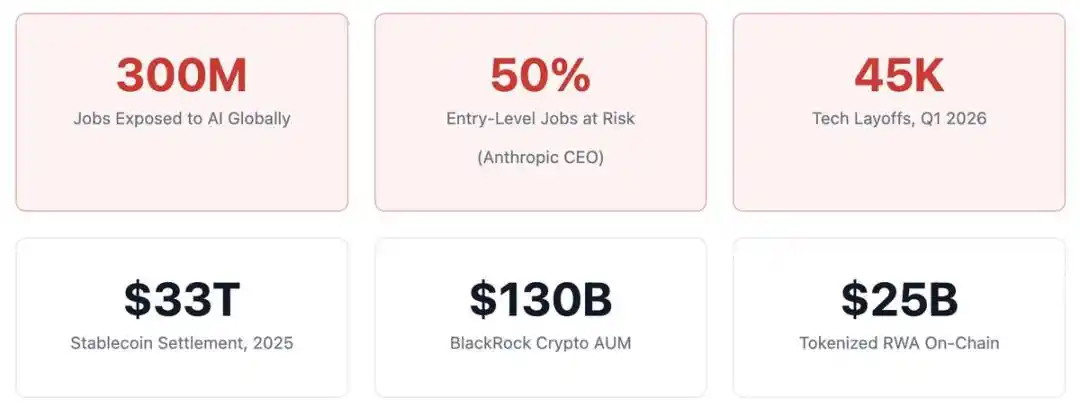
Goldman Sachs states that 300 million jobs globally will be impacted by AI. The CEO of Anthropic claims that 50% of junior white-collar jobs will disappear within five years. Just in Q1 2026, 45,000 tech workers were laid off.

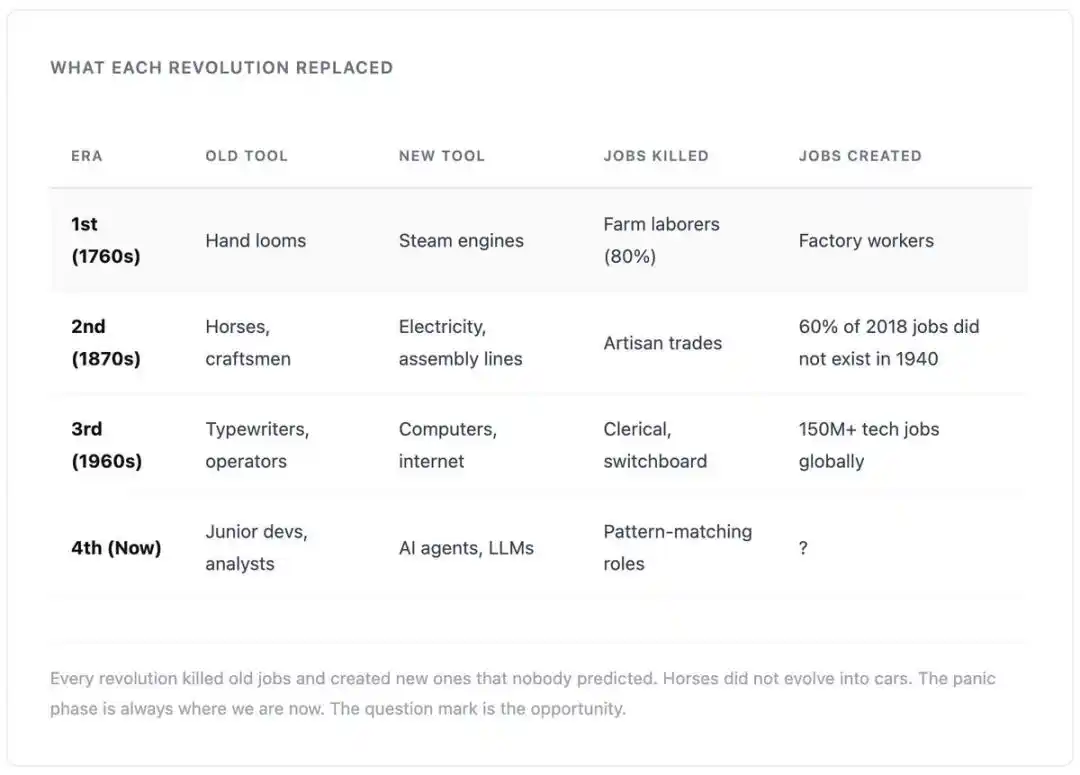
This is not a problem unique to the crypto industry; it is the Fourth Industrial Revolution arriving at everyone's doorstep.

The panic you feel is real and widespread. And those who find the next direction to build will define the next thirty years.

What I see is this: the crypto industry hasn't made you fragile; it has forged you into the fastest-learning, most cross-domain capable, and most adaptable builders on the planet. The real question is: will you use this ability, or will you discard it to chase a sense of security that simply doesn't exist.
Confronting the Real Problem

The statement 'Crypto is dead for builders' had some merit in 2022. It described a market that no longer exists today.

Behind the same anxiety lies a more brutal, yet more universal truth: AI is commoditizing all work based on existing knowledge and pattern matching.

This is the real fear, not 'crypto has no use cases.' What is truly unsettling is that Claude Code, Codex, Gemini Code Assist are already so powerful that most junior software development roles are being replaced.

Stanford University research confirms: since the launch of ChatGPT, the employment rate for developers aged 22-25 has fallen by 20%. 60% of companies plan to replace employees with AI in 2026. The marginal cost of a competent code agent is approaching zero.

This is not a cryptocurrency problem. This is a problem facing all of human civilization, and it is impacting every industry simultaneously.
Three Types of People Make Money, The Rest Panic

Stripping away the hype, who is *really* making money from AI right now?

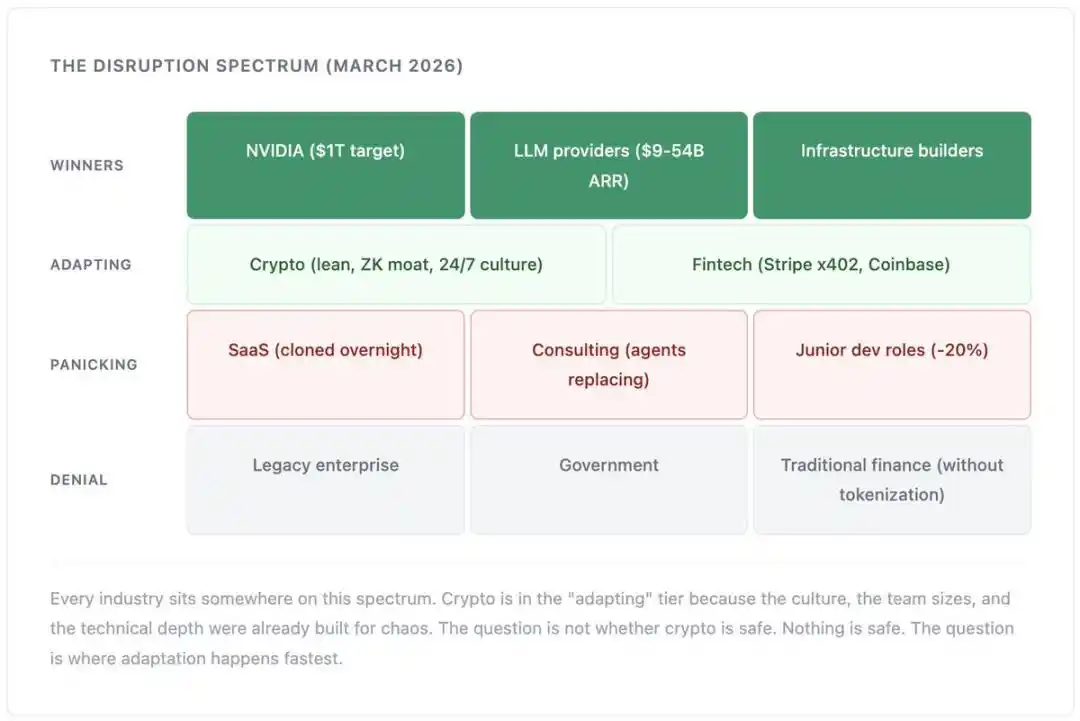
First Layer: NVIDIA. NVIDIA's annual revenue is $216 billion; Jensen Huang aims for $1 trillion in annual AI chip revenue by 2027. This is the classic 'selling shovels' logic, proven effective time and again in every transformation.

Second Layer: Major model vendors. OpenAI's annualized revenue is $12.7 billion, targeting $54 billion by 2027. Anthropic's annual recurring revenue is approaching $9 billion, targeting $20-26 billion in 2026. They sell API calls, have recurring revenue, and real profits.

Third Layer: Fearmongers. Short video creators, course sellers, make money by telling you 'AI will replace you.' The content is fear, the product is a $99 course, with extremely high profit margins.

Everyone else is searching for a moat, but finding none. A good idea gets copied by hundreds of companies within days of launch. If the profits are attractive enough, OpenAI, Anthropic, or Google will step in and launch their own version.

Manus was the first general AI agent, then Claude launched Cowork, followed by OpenClaw open-sourcing the entire concept, garnering 219k stars on GitHub. The window from 'innovation' to 'commoditization' is now measured in weeks.

A dangerous signal: if your moat is just 'a nice interface wrapped around a large model,' then you have no moat. The marginal cost of wrapping models is approaching zero. The real barrier in the AI field lies in controlling the infrastructure that large models rely on, not piling features on top of them.

Why Crypto Builders Actually Have a Unique Advantage

Set aside shallow narratives like 'crypto is dead' and ask: how much better off is any other field?

Compared to SaaS? All features will be copied by AI overnight. Compared to consulting? Agents are replacing analysts. Compared to junior dev roles? Employment has fallen 20% in two years.

Crypto builders possess structural advantages that other tech fields lack.
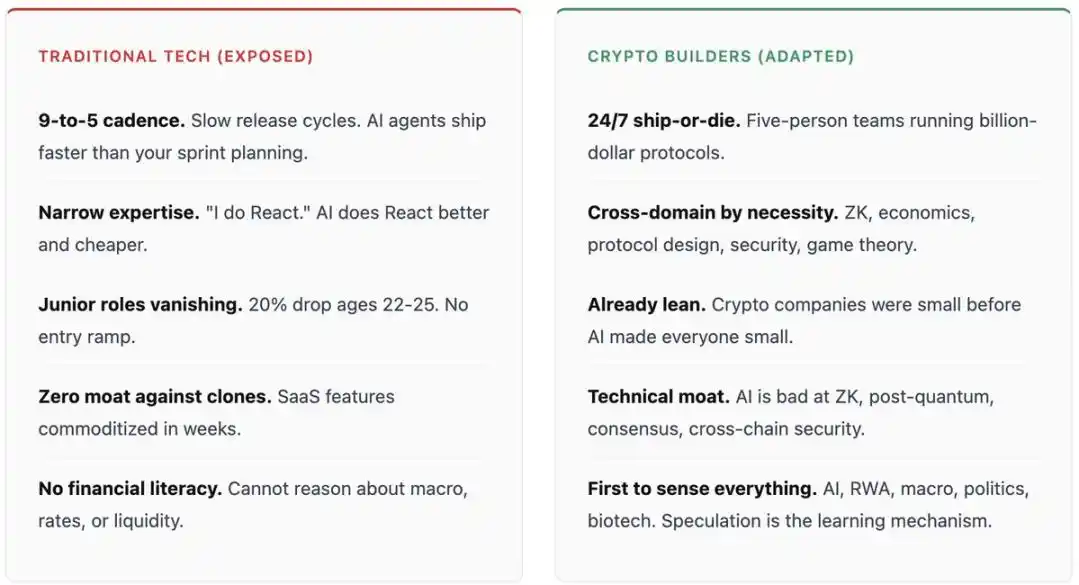
One point is particularly important: the crypto crowd has the highest information density in the tech circle. They track cryptography, distributed systems, macroeconomics, geopolitics, oil, gold, AI, biotech, longevity tech, SpaceX, and all cultural hotspots.

Why? Because they are betting on it. Meme coins, prediction markets, new token offerings... Speculation is not a flaw; it is the fastest learning mechanism humans have invented. By the time traditional industries catch on to a trend, crypto builders have already built the infrastructure for it and moved on to the next big thing.

And technical barriers aren't just talk; they are measurable. The Ethereum Foundation has elevated post-quantum cryptographic security to its highest strategic priority. Vitalik's 'Ethereum Simplification' roadmap places 'full quantum resistance' at its core. Zero-knowledge proof systems, Poseidon hash functions, lattice-based cryptography...

Claude Code can easily crush CRUD apps, but it's far less effective when writing recursive SNARK circuits or designing validator penalty mechanisms with game-theoretic guarantees.

The Fact Everyone is Ignoring

Watch actions, not sentiment. Those actually doing things are giving an answer completely opposite to the doomsayers on Crypto Twitter with their actions.
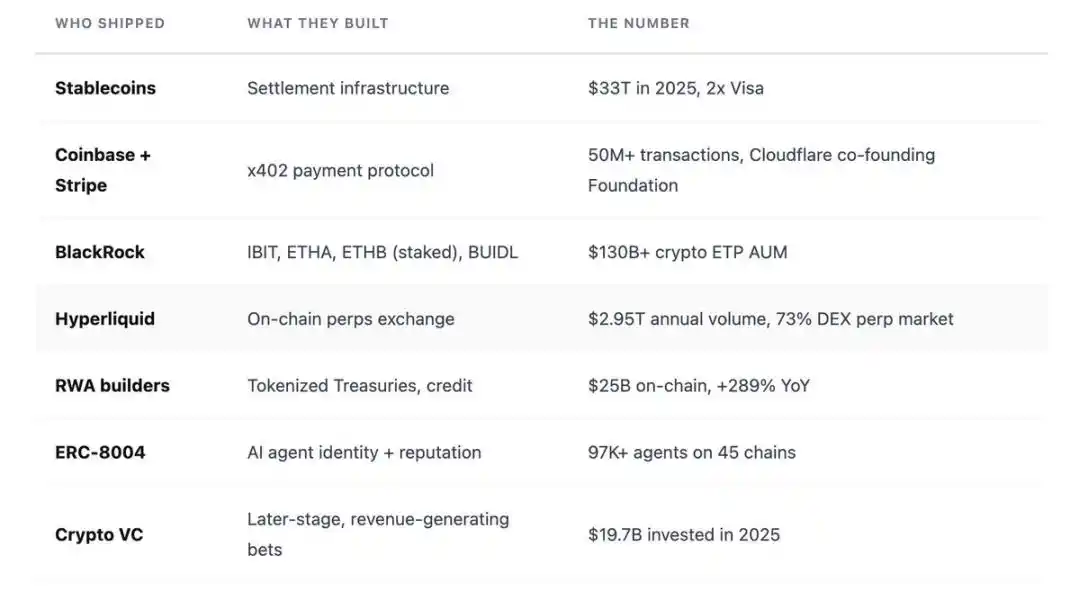
Stripe won't integrate a dying protocol. BlackRock won't issue a staked ETH ETF in a dead market. Cloudflare won't co-found a payments foundation for an industry with no future.

Hype is not demand; adoption is demand. These giants are voting with their feet.

Pandora's Box is Open

Sam Altman cannot predict what GPT-6 will bring. Dario Amodei built a lab focused on safety yet still admits half of junior jobs will disappear. Sundar Pichai reorganized all of Google to pivot entirely to AI.

The people building these technologies don't know what the future holds. No one knows.

Only three things are certain:

  • The box won't close. AI will get stronger, code agents will get better, white-collar automation will accelerate. We are not going back to an era of all hand-written code. The question is not how to escape, but how you position yourself.
  • New tools create new professions. In 1995, no one foresaw 'social media manager.' In 2005, no one foresaw 'cloud architect.' Today, no one can predict the AI-native professions of 2030. But every industrial revolution has created more jobs than it destroyed, without exception.
  • Builders during the panic will dominate the next era. Amazon was born amidst the skepticism of the dot-com bubble; Stripe was founded when payments were 'already solved'; Coinbase started when Bitcoin was a joke.

When everyone feels 'now is not the time to build,' it is precisely the signal that it is the best time to build.
Your Choice

For doing old things, this is the worst of times. For trying new things, this is the best of times.

Don't leave the industry just because Crypto Twitter is full of anxiety. *Everyone* is anxious. Financial analysts are anxious. SaaS founders are anxious. Junior engineers at Google are anxious.

The difference is: the crypto industry has endowed you with a set of capabilities most builders don't have: all-weather cross-domain pattern recognition, a permissionless innovation sandbox, lean teams that can launch quickly without approval, and the community that absorbs new technologies the fastest globally.

Follow your genuine interest. Not because it's a comforting platitude, but because in a world where no one knows the future, the only reliable signal is whether you genuinely care about this thing, whether you are willing to persevere through difficult times.

And difficult times will come for everyone, for every industry.

Pandora's box is open; it cannot be closed. Pick up the new tools and move to the frontier. Those who persist in building amidst the panic will ultimately define the next era.

Связанные с этим вопросы

QWhy does the article argue that crypto builders are uniquely positioned during the AI revolution?

AThe article argues that crypto builders possess structural advantages such as high information density, cross-domain adaptability, and experience in fast-paced, permissionless innovation. They are skilled in complex areas like cryptography and distributed systems, which are less easily automated by AI compared to routine coding tasks.

QAccording to the article, what are the three groups currently profiting from AI?

AThe three groups profiting from AI are: 1) Nvidia (selling AI chips), 2) Major model manufacturers like OpenAI and Anthropic (selling API calls with recurring revenue), and 3) Those selling fear, such as influencers and course sellers capitalizing on AI anxiety.

QWhat is the core fear that the article identifies, beyond the crypto-specific concerns?

AThe core fear identified is that AI is commoditizing all work based on existing knowledge and pattern matching, threatening to replace a vast number of white-collar and junior developer positions across all industries, not just crypto.

QWhat evidence does the article provide to counter the narrative that 'crypto is dead' for builders?

AThe article points to actions from major institutions like Stripe integrating crypto protocols, Blackrock issuing a staking ETH ETF, and Cloudflare co-founding a payment foundation as evidence of real-world demand and long-term confidence, contradicting the superficial narrative.

QWhat is the article's final advice to builders feeling anxiety about the future?

AThe article advises builders to leverage the unique skills they've developed in crypto, such as rapid learning and adaptation, and to continue building new things based on genuine interest, as periods of widespread panic are historically the best times for innovation and defining the next era.

Похожее

Should You Buy SpaceX Stock at $1.7 Trillion? Here's What the Market Is Worried About

SpaceX is preparing for a massive IPO aiming to raise around $75 billion at a valuation of approximately $1.75 trillion. While its achievements in reusable rockets and the profitable Starlink satellite internet service are clear, the market is concerned about the aggressive valuation. Key issues include: the current $1.75 trillion valuation, which is about 94 times 2025 revenue, seems to price in not just existing businesses but also unproven future ventures like AI infrastructure and orbital data centers. Financially, while Starlink is profitable, the AI division, bolstered by the acquisition of xAI, is incurring massive losses and consuming the majority of capital expenditures. This acquisition also introduced complex related-party financing arrangements and debt onto SpaceX's balance sheet. Furthermore, corporate governance poses a challenge. SpaceX's dual-class share structure ensures founder Elon Musk retains absolute control, limiting ordinary shareholders' influence over high-risk, long-term strategic decisions. The future success of ambitious projects like the Starship rocket—critical for lowering costs and enabling new services—remains a significant variable for the valuation. In summary, the market's apprehension (FUD) centers not on doubting SpaceX's past technological triumphs but on questioning how much premium public investors should pay for a future that combines proven profits with highly speculative and capital-intensive new ventures, all under a governance structure that offers limited shareholder oversight.

marsbit24 мин. назад

Should You Buy SpaceX Stock at $1.7 Trillion? Here's What the Market Is Worried About

marsbit24 мин. назад

Breaking the DeFi Cascading Liquidation Curse: Vitalik Proposes a New Solution

Vitalik Buterin has proposed a new DeFi design to eliminate the automatic liquidation mechanism that causes market instability during sharp downturns. The current system, used by protocols like Aave, triggers forced sales when collateral value falls below a threshold, often exacerbating price drops and creating systemic selling pressure. Buterin's alternative model is based on splitting an asset like ETH into two synthetic option-like tokens, P and N, pegged to a price index. Their combined value always equals one ETH. Instead of sudden liquidation, a position's value gradually drifts from its target peg if the market moves. Users must proactively rebalance their holdings to maintain their desired exposure, transferring the management burden from the protocol to the user or automated tools. A key advantage is the reduced reliance on real-time oracles. Pricing decisions are deferred until contract expiry, allowing for more robust, fault-tolerant oracle designs. This removes a clear liquidation threshold that speculators can target for manipulation or MEV extraction. However, significant challenges remain. Frequent rebalancing could incur high slippage and transaction costs, necessitating new liquidity provider models. The design is better suited for hedging instruments than for stablecoins requiring a rigid 1:1 peg. While not an immediate replacement for existing systems, the proposal challenges the foundational assumption that instantaneous forced liquidation is an unavoidable necessity in DeFi, opening the door for fundamentally different risk management architectures.

marsbit29 мин. назад

Breaking the DeFi Cascading Liquidation Curse: Vitalik Proposes a New Solution

marsbit29 мин. назад

The End of Single-Factor Cryptography

The article "The End of Single-Factor Crypto" posits a fundamental shift in the cryptocurrency ecosystem. It argues the era where crypto asset valuations were predominantly driven by, and correlated with, Bitcoin's price is ending. The space is bifurcating into two distinct economies: endogenous and exogenous. The endogenous economy represents traditional crypto, where token and project values are directly tied to crypto market prices. The emerging exogenous economy comprises projects and businesses that may utilize blockchain technology or tokens but derive their fundamental value from external, non-crypto factors like consumer demand, subscription revenue, or real-world utility. Examples include AI inference platforms like Venice, fintech lenders using blockchain for efficiency, and stablecoin/payment infrastructure companies acquired by giants like Mastercard and Stripe. This shift means investment analysis must change. For exogenous assets, evaluating traditional business fundamentals—such as revenue streams, unit economics, and competitive moats—becomes more critical than tracking Bitcoin charts. While endogenous assets like Bitcoin remain relevant, the growth of the exogenous category is driven by measurable demand independent of crypto price cycles, paving the way for a new, more diversified market phase. Consequently, crypto is evolving from a single-factor, reflexive asset class into a multifaceted ecosystem with varied drivers and investment theses.

marsbit29 мин. назад

The End of Single-Factor Cryptography

marsbit29 мин. назад

Morning Post | Bitmine Plans to Raise $300 Million Through Preferred Stock Issuance; Polymarket Accuses Kalshi of Commercial Espionage

ChainCatcher's Daily Crypto Brief: Key developments from the past 24 hours include significant funding moves, regulatory actions, and market predictions. Bitmine announced a $300 million preferred stock fundraising. Polymarket accused rival prediction platform Kalshi of corporate espionage, citing numerous suspicious coincidences in product launches, a claim Kalshi strongly denied. The U.S. Department of Justice, in a joint "Disruption Week" anti-fraud operation with companies like Coinbase and Meta, froze over $3.8 million in cryptocurrency linked to scams. In infrastructure news, Macau completed its integration with the multi-central bank digital currency bridge, mBridge, aiming to build efficient cross-border payment channels. Cosmos Labs acquired the block explorer Mintscan. Market-wise, Geoffrey Kendrick, Standard Chartered's Head of Digital Assets Research, stated Bitcoin is nearing a bottom around $63,000, maintaining a year-end target of $100,000. He noted stability in U.S. spot Bitcoin ETF holdings. Ahead of SpaceX's anticipated IPO, internal insiders at Rocket Lab (RKLB) sold over $18.41 million in stock. In tokenization, Goldman Sachs partnered with Apex and Archax to launch a tokenized real estate fund. The meme token tracker GMGN reported the top trending tokens: on Ethereum, HEX, SHIB, LINK, PEPE, mUSD; on Solana, TROLL, swarms, WORLDCUP, neet, Buttcoin; and on Base, PEPE, toby, ODDS, ELSA, SKI.

链捕手43 мин. назад

Morning Post | Bitmine Plans to Raise $300 Million Through Preferred Stock Issuance; Polymarket Accuses Kalshi of Commercial Espionage

链捕手43 мин. назад

Торговля

Спот
Фьючерсы
活动图片