After the UFO Files Are Made Public, Prediction Markets Only Price the Probability of Alien Existence at 20%?

Odaily星球日报Опубликовано 2026-05-09Обновлено 2026-05-09

Введение

The U.S. Department of Defense has launched a website declassifying UFO/UAP files, releasing an initial batch of over 160 documents. These include videos, photos, mission logs, sighting reports, and communications from agencies like NASA and the FBI, featuring unexplained incidents such as anomalous lights near Apollo missions and a "jellyfish"-shaped object over the UAE. Despite widespread public discussion, the prediction market predict.fun shows only a 20% probability that the U.S. government will officially confirm the existence of extraterrestrial life or technology by December 31, 2026. The market's focus is not on whether aliens exist, but on whether U.S. authorities will make a definitive, binding statement before the deadline. Analysts note the file release provides transparency and fuels debate but does not constitute an official confirmation. The 20% odds reflect a time-discounted assessment, acknowledging the possibility of future evidence while doubting a conclusive governmental stance within the current year. This event highlights how prediction markets translate speculative narratives into tradable contracts based on verifiable outcomes and specific timelines.

Original | Odaily Planet Daily (@OdailyChina)

Author | Asher(@Asher_ 0210)

Last night, the U.S. Department of Defense officially launched the UFO Archive Disclosure website, releasing the first batch of government documents related to UAPs, unidentified flying objects, and suspected extraterrestrial life. According to public reports, this initial release comprises over 160 documents, including videos, photos, mission records, sighting reports, communication logs, and historical archives from multiple U.S. federal agencies such as NASA, the FBI, and the Department of Defense.

These documents are not just abstract government reports; they contain a large amount of specific imagery and historical records. Among them, the Apollo mission spacecraft once captured three anomalous light points hovering above the Moon, and Apollo 17 communication logs also contain discussions among astronauts about mysterious objects approaching the spacecraft. Another batch of materials shows that unexplained objects have appeared in places like the United Arab Emirates, Greece, and Iraq.

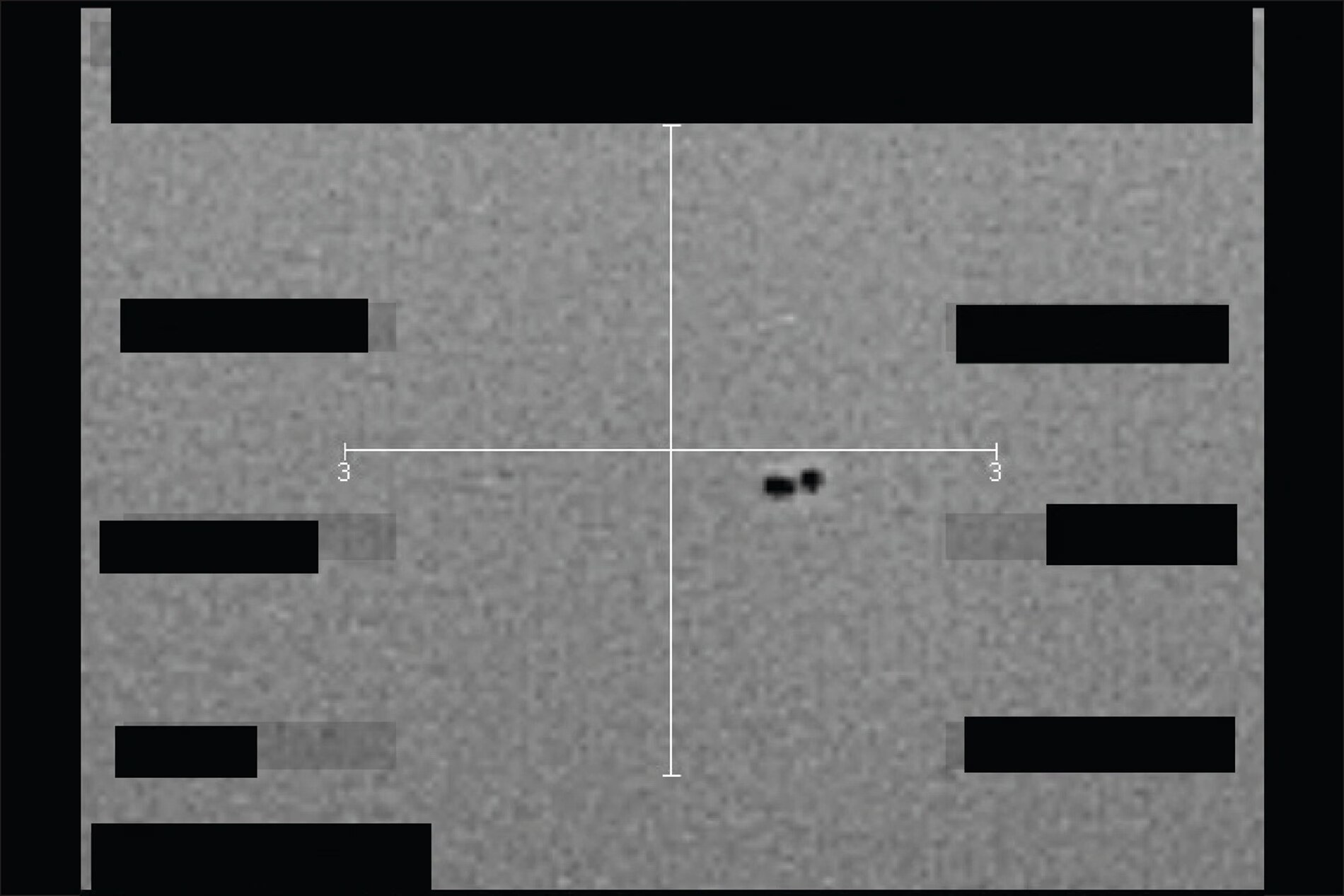
Even more viral are those unresolved cases in the files with visual details. A jellyfish-shaped object appeared over the UAE, some materials record unidentified flying objects resembling luminous spheres and objects with an octagonal star-like shape, and the FBI has also captured anomalous targets near U.S. military aircraft. An image released by the U.S. Department of Defense also shows an unidentified object appearing over the western United States in September 2025.

An image released by the U.S. Department of Defense claims to show an unidentified object appearing over the western United States in September 2025 (Source: U.S. Department of Defense)

Compared to mere text reports, this imagery and eyewitness testimony is more likely to cause UFO discussions to spread rapidly, making this disclosure seem more like a concentrated exhibition of "declassified archives."

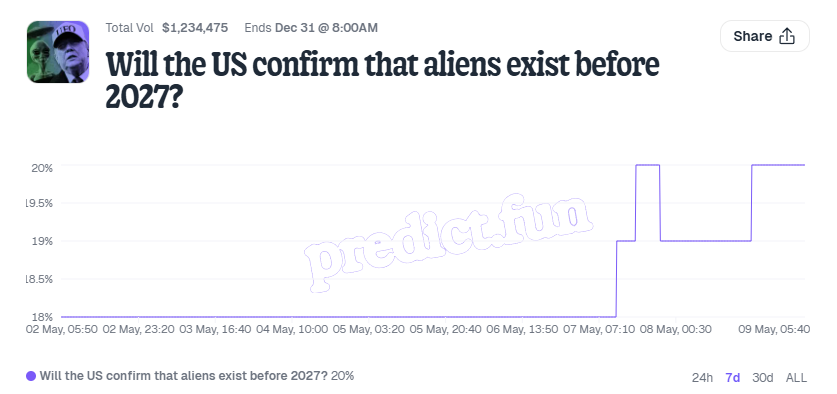
However, the answer from prediction markets is much more restrained than that of social media. After the first batch of UFO files was made public, the probability for the event "Will the US confirm that aliens exist before 2026-12-31 23:59:59 ET" on the prediction market predict.fun did not surge significantly because of this explosive news. The market did not directly interpret this disclosure as "the U.S. is about to confirm alien existence," and the probability remains at only 20%.

Source: https://predict.fun/market/will-the-us-confirm-that-aliens-exist-before-2027

So, why hasn't this UFO file disclosure significantly changed the judgment of the prediction markets?

Prediction Markets Are Not Betting on Whether Aliens Exist, But on Whether the U.S. Government Will Acknowledge It

Many people, upon seeing a 20% probability, might first think that the prediction market believes the probability of aliens existing is only 20%. But this actually misunderstands the market itself.

Markets like predict.fun are not truly trading on whether extraterrestrial life exists in the universe, but on whether the U.S. government will explicitly confirm the existence of extraterrestrial life or alien technology before 23:59 ET on December 31, 2026. According to the market's settlement rules, only if the U.S. President, a Cabinet member, a member of the Joint Chiefs of Staff, or a U.S. federal agency explicitly makes such a statement will the market settle as Yes; otherwise, it will settle as No. The primary settlement source is official U.S. government information, also referencing consensus formed by credible media reports.

This rule is crucial. It means that a video of an unidentified flying object is not enough, a blurry photo is not enough, an astronaut communication log is not enough, and the military admitting that some phenomena are temporarily unexplainable is also not enough. What can truly trigger a Yes is the U.S. government stating clearly enough, acknowledging that extraterrestrial life or alien technology indeed exists.

Disclosing files is merely placing more material before the public, while official confirmation means the government is backing a conclusion. The former generates discussion; the latter triggers settlement. Between them lies a line that is very difficult to cross.

Archive Disclosure Is Not an Answer Announcement

This UFO file disclosure is indeed not an ordinary information update. The U.S. Department of Defense released related materials in a centralized manner through a dedicated website and stated that more files will be released in batches continuously in the future. For the public, this means that UFO and UAP materials previously scattered across different agencies, eras, and archival systems are being reorganized into an official portal. It makes discussion more focused and makes it easier for the outside world to track what materials the U.S. government actually possesses.

However, judging from the currently disclosed content, this batch of files appears more like presenting historical sightings, anomalous imagery, mission records, and old archives to the public, rather than providing a unified explanation for these materials. The U.S. Department of Defense is not directly telling the world "what this is," but is releasing more unresolved cases, leaving the judgment space to the public.

This also puts this disclosure in a delicate position. It increases transparency but does not change the nature of the events. UFO discussions have thus gained more material, but this material primarily serves to expand the questions themselves rather than advancing unexplained phenomena to extraterrestrial confirmation.

For prediction markets, this file disclosure is more like a new starting point for observation, rather than evidence sufficient to rewrite the odds. It brings the UFO topic back to center stage and gives subsequent file updates transaction value; but the initial batch of materials still consists mainly of historical records, sighting reports, and unresolved imagery. What the market is truly waiting for is a higher-level, harder-to-ignore, and more official key signal.

Is 20% an Underestimation or an Overestimation?

From an emotional perspective, 20% might seem low. After all, UFO file disclosure has entered an official rhythm, and subsequent materials will continue to be released. If clearer military videos, higher-level internal records, or more direct assessments from federal agencies emerge in the future, the Yes price could still be rapidly revalued.

But from a market pricing perspective, 20% is not low. Because this market is not trading an open-ended question, but a question with a clear deadline. The market needs to judge not just whether the U.S. will confirm the existence of extraterrestrial life or alien technology, but also whether such confirmation will happen before the end of 2026.

Time itself is a barrier. Even if files continue to be released, even if more unresolved cases enter the public view, it does not mean the U.S. government will complete evidence review, internal coordination, political assessment, and provide a sufficiently clear conclusion within a few months. For an official system, continuing to disclose material is one thing; reaching a definitive conclusion in a short time is another.

Therefore, the current 20% probability is more like a tail-end pricing with a time discount. It does not deny that subsequent files may continue to create volatility, but it also shows that the market does not believe the initial disclosure has fundamentally changed the assessment of the event. For traders, the disclosure of files itself is not scarce; what is truly scarce is the key signal that could drive official confirmation before the end of this year. Before such a signal appears, the Yes price will find it difficult to be pushed higher solely by archival updates.

When UFOs Enter Prediction Markets, Truth Begins to Have a Price

The most noteworthy aspect of this event is no longer just a certain photo, a certain video, or a jellyfish-shaped object. UFO discussions have long remained in the realm of emotion, belief, and conspiracy narratives. Believers see more clues in every file disclosure, while skeptics continue to emphasize insufficient evidence, misidentification, and technical noise. Both sides have debated for years but find it hard to truly convince each other because they are often not discussing the same question.

Prediction markets pull this question one step closer to reality. They do not attempt to answer whether other life exists in the universe, but narrow the question down to a more specific level—will the U.S. government explicitly acknowledge the existence of extraterrestrial life or alien technology before the end of this year. They turn a previously hard-to-grasp imagination into an event that can be traded, settled, and constantly adjusted as information changes.

Therefore, this roughly 20% probability is not a final judgment on whether alien life exists, but the market's judgment on whether the U.S. government will concede by the end of this year. It truly reflects traders' comprehensive judgment of the evidence chain, official statements, and the time window.

When humanity's oldest puzzle enters prediction markets, truth is no longer just something to be awaited and discussed; it also begins to be priced. UFOs may still hang in the sky, but when they will be officially confirmed, when they will transition from unexplained phenomena to factual conclusions, has already landed in the market.

Связанные с этим вопросы

QWhat is the specific event being traded on predict.fun related to the UFO file release, and what is its current market probability?

AThe event being traded is whether the U.S. government will officially confirm the existence of extraterrestrial life or alien technology before 11:59 PM ET on December 31, 2026. Following the release of the UFO files, the current market probability for this event is approximately 20%.

QAccording to the article, why didn't the UFO file release significantly increase the market probability on predict.fun?

AThe file release did not significantly increase the probability because the market is trading on a specific event: an official U.S. government confirmation. The released files primarily present historical records, sightings, and unexplained materials without providing an official government conclusion or confirmation of extraterrestrial existence. The market views this as expanding the discussion, not as definitive evidence that will force an official acknowledgment within the given timeframe.

QWhat types of materials were included in the first batch of UFO files released by the U.S. Department of Defense?

AThe first batch included approximately 160 documents comprising videos, photos, mission logs, eyewitness reports, communication records, and historical archives. Examples include footage of three anomalous lights from the Apollo mission, communication from Apollo 17 discussing a mysterious object, records of jellyfish-shaped objects over the UAE, and images of unexplained objects over the western U.S. in September 2025.

QFrom a market pricing perspective, why does the article suggest the 20% probability is 'not low'?

AThe 20% probability is considered 'not low' because the market event has a strict deadline (end of 2026). This time constraint adds significant pressure. Even with ongoing file releases, the market judges it unlikely that the U.S. government will complete the necessary evidence review, internal coordination, and political assessment to make a definitive public confirmation within just a few months. The probability reflects a 'time-discounted' assessment of a low-probability, high-impact event.

QHow does the article describe the fundamental shift that prediction markets bring to the UFO discussion?

AThe article states that prediction markets shift the UFO discussion from abstract debates about belief, emotion, and conspiracy theories into a concrete, tradable event. Instead of arguing about whether aliens exist in the universe, the market prices the likelihood of a specific, verifiable action: the U.S. government officially confirming their existence by a set date. This means truth is no longer just waited for or discussed; it is given a price and continuously re-evaluated based on new information.

Похожее

IOSG Founder: Web3 Is 'Losing Blood,' How Can Practitioners Survive Better?

IOSG Founder: Web3 Is "Bleeding Out" – How Can Practitioners Survive Better? In a candid reflection, the founder of IOSG Ventures voices deep concerns about the current state of Web3, describing an ecosystem experiencing severe "blood loss." Despite the recent MuShanghai event showcasing a successful pivot towards a more diverse, global community, a somber reality persists: many crypto-native attendees were there exploring exits or new labels in biotech, AI, and robotics. The core issue is identified as a breakdown in the ecosystem's positive feedback loop. Alarmingly, underestimated "low-probability bad events" are occurring simultaneously: a significant brain drain of Chinese developers to AI, a lack of breakout applications despite massive funding, and a widening credibility gap for practitioners globally, often stigmatized as scam artists. This has created a dire接班人 (successor) problem, with the next generation seeing little professional prestige or financial upside in crypto compared to fields like AI. A significant portion of the critique focuses on Ethereum and Vitalik Buterin. While not pessimistic about Ethereum's technology, the founder worries that critical development windows were missed by focusing on niche technical narratives like ZK and L2 instead of mass-market applications. A more urgent concern is that Vitalik may be isolated in an "information bubble," shielded from the grassroots community's hardships by layers of intermediaries, preventing crucial feedback from reaching him. The call is for Vitalik to return to a founder's mindset, re-engage directly with the community, and rally efforts for the next decade. The divergence between U.S. and Chinese OG (Original Gangster) ecosystems is stark. While many U.S. builders reinvest their wealth into the ecosystem, the Chinese scene suffers from a severe lack of "造血能力" (blood-making ability), with most market-driven funds struggling and many early success stories cashing out entirely. This threatens the entire Asian Web3 ecosystem's survival. For individual practitioners, survival advice is pragmatic: find your core "why," maintain life balance beyond token prices, continuously learn new skills (like AI), form small, trusted alliances for mutual support, and practice self-compassion. The industry's greatest need is not money or tech, but lighthouses—individuals at all levels who offer mentorship, grants, referrals, and honest reflection to guide others. The piece concludes with a direct appeal: OGs must pay forward the opportunities the industry gave them; founders must not struggle alone; and builders must continue their work, ensuring it remains a viable profession. The survival of Web3's "cathedral" depends not on any single leader but on the collective responsibility of everyone who remains.

marsbit23 мин. назад

IOSG Founder: Web3 Is 'Losing Blood,' How Can Practitioners Survive Better?

marsbit23 мин. назад

Deficits, Inflation, and the New Fed: The Deep Logic Behind US Bond Yields Breaking 5% and the Market Reset

In the week of May 15-19, 2026, U.S. long-term Treasury yields surged to multi-year highs, with the 30-year yield hitting 5.2%, a level unseen since 2007, and the 10-year yield climbing to 4.687%. Equity markets declined in response. Four primary factors are driving the rise in yields. First, stubborn inflation persists, with April wholesale prices rising 6% year-over-year, fueling expectations of potential future Fed rate hikes instead of cuts. Second, newly confirmed Fed Chair Kevin Warsh inherits a complex inflation battle, with markets closely awaiting his first FOMC meeting. Third, deteriorating U.S. fiscal health, marked by large deficits and rising debt servicing costs, is eroding the traditional "safe-haven" premium for Treasuries. Fourth, the "One Big Beautiful Bill" tax cuts are projected to add trillions to the national debt, contributing to Moody's recent credit rating downgrade. Rising yields pressure stocks through several channels: a higher discount rate reduces the present value of future earnings (especially for growth stocks); rising risk-free rates compress equity risk premiums, making bonds relatively more attractive; higher borrowing costs impact consumers and corporations; and a stronger dollar affects multinational earnings. For investors, the environment favors value and financial stocks over long-duration growth stocks. Bond investors find attractive yields in short to intermediate maturities, while income investors see the best fixed-income opportunities in over a decade. Key developments to watch include Chair Warsh's first FOMC meeting, upcoming inflation data, Treasury auction demand, and whether the 30-year yield approaches 6%, a level that could trigger a more sustained equity valuation reset. The bond market's message is clear: the era of cheap government borrowing is over, posing a central challenge for markets in late 2026.

marsbit24 мин. назад

Deficits, Inflation, and the New Fed: The Deep Logic Behind US Bond Yields Breaking 5% and the Market Reset

marsbit24 мин. назад

Is MicroStrategy Selling Bitcoin Not a Bearish Signal? Deconstructing the 5 Financial Logics Behind Corporate Bitcoin Divestment

The article "Is Strategy Selling Bitcoin Not a Bearish Signal? Decoding 5 Financial Logics Behind Corporate Bitcoin Divestment" analyzes why companies might sell their bitcoin holdings, arguing it's not necessarily negative. It begins by noting the market's surprise at Strategy's potential sale, contrasting its previous "never sell" stance. The core argument is that corporate decisions prioritize shareholder value, and selling bitcoin can be a rational strategic choice. The article outlines five key financial reasons for such sales: 1. **Increase Bitcoin Holdings Per Share:** Companies can use proceeds from bitcoin sales to repurchase shares when the stock price is undervalued relative to its bitcoin assets. This reduces the outstanding share count, potentially increasing the bitcoin amount backing each remaining share. 2. **Optimize Capital Structure & Reduce Financing Costs:** Building cash reserves through bitcoin sales can improve credit ratings (as favored by agencies like S&P), leading to lower future borrowing costs. Repaying debt with sale proceeds also reduces financial leverage. 3. **Legitimate Tax Planning:** In the absence of wash-sale rules for bitcoin in the US, companies can sell to realize capital losses, then repurchase, lowering the tax basis of their holdings and creating tax offsets. 4. **Counter Negative Market Narratives:** A controlled, non-disruptive sale could demonstrate market resilience and disprove fears that corporate selling would crash the market, thereby normalizing bitcoin as a corporate treasury asset. 5. **Repurchase Preferred Stock at a Discount:** If a company's preferred stock trades significantly below its face value, using bitcoin sale proceeds to repurchase it can retire expensive liabilities at a profit, saving on future dividend payments. The conclusion emphasizes that bitcoin's monetary properties offer flexibility. Strategic sales can protect corporate and shareholder interests, making asset utilization more important than rigid "hold" mandates.

marsbit54 мин. назад

Is MicroStrategy Selling Bitcoin Not a Bearish Signal? Deconstructing the 5 Financial Logics Behind Corporate Bitcoin Divestment

marsbit54 мин. назад

Why Did Zhipu Surge Nearly 30% in a Single Day?

"Global AI Model Unicorn" Zhipu's stock surged nearly 30% in a single day, reaching a new market cap high. The catalyst was the launch of its GLM-5.1-highspeed API, boasting a generation speed of **400 tokens per second**, setting a new global benchmark. This speed, roughly 3-5 times faster than industry leaders like OpenAI's GPT-4o and Anthropic's Claude, is achieved **without compromising the full-scale model's capabilities**. In the era of AI Agents requiring dozens of self-calls, such latency reduction is critical, transforming speed from a system metric into a determinant of intelligence limits. The breakthrough stems from a three-layer technical overhaul: 1. **TileRT Inference Engine**: Compiles the entire model into a continuous, always-on computation pipeline using "Warp Specialization," minimizing GPU idle time by having different processor groups handle data loading, computation, and communication in parallel. 2. **Heterogeneous Parallelism for MLA**: To efficiently run the GLM-5.1 model using the MLA attention mechanism, TileRT employs a heterogeneous strategy. One GPU handles sparse indexing/routing, while the others perform dense computation, optimizing for MLA's unique workflow. 3. **ZCube Network Architecture**: Replaces the standard Spine-Leaf (ROFT) network topology with a flat, dual-group interconnect. This design creates a single optimal path between any two GPUs, eliminating network congestion at scale and reducing latency. The business impact is significant: a 15% increase in cluster throughput (free extra capacity), a 40.6% reduction in tail latency (improved stability), and a one-third cut in networking hardware costs. Long-term, this innovation challenges the dominance of NVIDIA's integrated hardware-software stack (GPU+NVLink+InfiniBand), potentially benefiting manufacturers of high-density Leaf switches and optical modules while lowering the software barrier for domestic AI chips like Huawei's Ascend. The innovation proves that more can be achieved with the same compute, reshaping the infrastructure beyond just GPUs.

marsbit2 ч. назад

Why Did Zhipu Surge Nearly 30% in a Single Day?

marsbit2 ч. назад

Торговля

Спот
Фьючерсы
活动图片