After the Fed Hits the Brakes, the Market Experiences 'Icy and Fiery Extremes'!

比推Опубликовано 2026-01-29Обновлено 2026-01-29

Введение

The Federal Reserve paused its rate-cutting cycle in its first 2026 meeting, keeping the benchmark rate unchanged at 3.5%–3.75%, a move widely anticipated by the market. However, two dissenting votes highlighted internal divisions. The central bank signaled a shift from active policy adjustment to a more cautious, data-dependent stance. Gold emerged as the standout performer, surging past $5,500/oz with a 10% weekly gain, driven by persistent inflation, geopolitical risks, and easing real-rate pressures. In contrast, other major assets—including U.S. stocks, the dollar, Treasuries, and cryptocurrencies like Bitcoin—showed limited movement, reflecting market uncertainty. Attention is now turning to potential leadership changes at the Fed, with market-based predictions favoring Rick Rieder (34%), Kevin Warsh (28%), and Christopher Waller (20%) as top contenders to shape future policy. Bitcoin faces caution as on-chain data indicates a rising share of supply in loss, suggesting structural softening though not yet full bearish momentum. The market remains in a wait-and-see mode, balancing macro uncertainty against evolving cycle signals.

After three consecutive interest rate cuts, the Federal Reserve finally pressed the "pause button" at its first policy meeting of 2026.

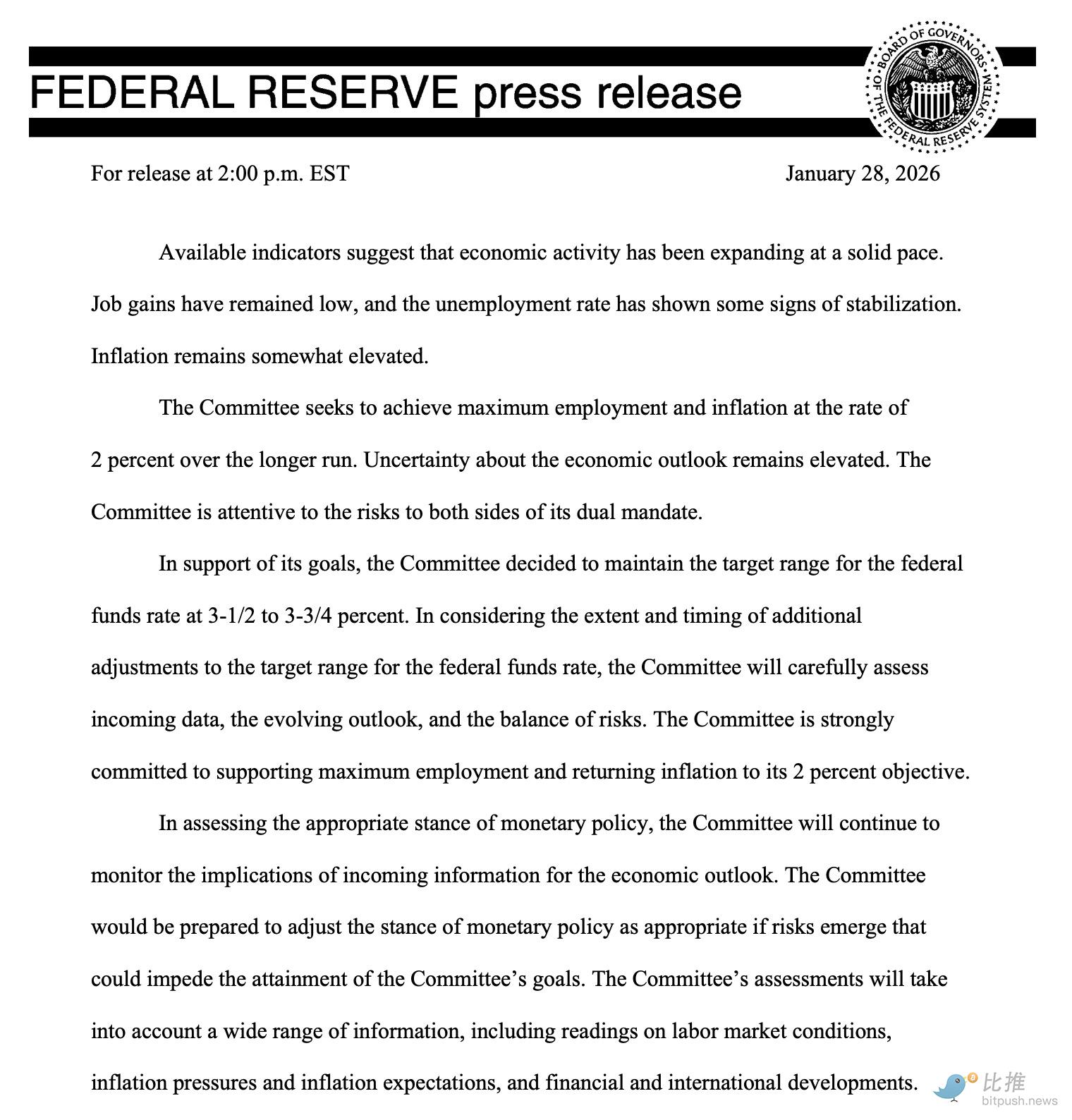
In the early hours of Thursday Beijing time, the Federal Reserve announced it would keep the benchmark interest rate unchanged in the range of 3.5% to 3.75%. This somewhat "uneventful" decision was in line with market expectations of over 97%, but it also revealed subtle internal policy cracks: two Fed governors voted against the decision, supporting a further 25 basis point rate cut.
The Shoe Has Dropped, But the Direction Remains Unclear

In its policy statement, the Fed maintained a relatively cautious tone: the economy is still "expanding robustly," inflation has "eased somewhat but remains above target," the labor market shows signs of cooling but does not yet constitute a systemic risk. The core message is very clear—monetary policy has transitioned from the "active adjustment" phase to the "observation and verification" phase.

It is worth noting that the Federal Open Market Committee (FOMC) is not monolithic. Two members voted in favor of continuing rate cuts, showing that policy preferences still diverge between falling inflation and a slowing economy. Overall, however, the Fed is unwilling to make new policy commitments in the current environment, instead choosing to hand the decision-making power back to subsequent data.

This stance sets the tone for the market: there will be no clear directional guidance in the short term, and asset pricing will revolve more around "changes in expectations" rather than "changes in policy."

Current federal funds rate market pricing shows that investors generally expect rates to remain unchanged this quarter, with the first rate cut now re-pointed to June of this year, and the market further expects a possible pause in the rate-cutting cycle by 2027.

However, regarding the interest rate path beyond this quarter, there are still significant differences among institutions: Morgan Stanley, Citigroup, and Goldman Sachs predict successive rate cuts in June and September; Barclays believes cuts are possible in June and December; while JPMorgan maintains its expectation for unchanged rates throughout the year.

Macro Markets: Gold Steals the Spotlight, Other Assets Remain Unfazed

If the Fed's decision itself did not cause waves, then the divergence in asset performance is the signal truly worth watching.

After the interest rate decision was announced, the spot gold price soared, breaking through the $5,500 per ounce mark for the first time. In just four trading days, the gold price rose from just below $5,000, breaking through multiple hundred-dollar thresholds, accumulating a gain of over $500, with a weekly increase of 10%. This speed and magnitude have made gold the undisputed protagonist of the current global market.
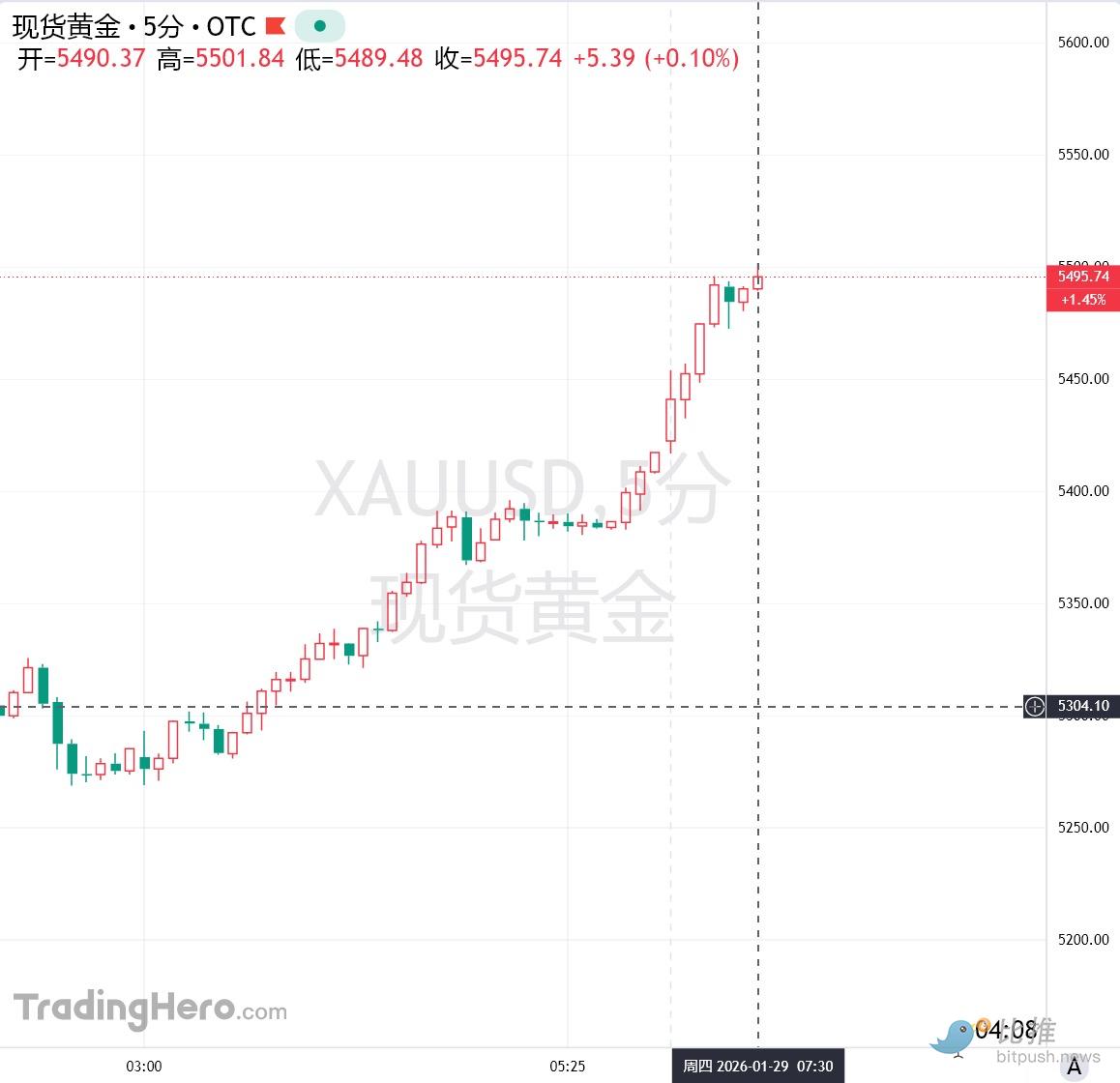
Gold's strength is not simply a matter of interest rate trading logic. Although the Fed has paused rate cuts, after successive rounds of easing, policy is nearing the neutral range, and the marginal constraint of real interest rates has eased somewhat; at the same time, resilient inflation, trade frictions, political uncertainty, and global policy games are intertwining, continuously amplifying safe-haven demand. Under the overlay of multiple uncertainties, capital has chosen the most traditional and consensus safe-haven asset.

In stark contrast to gold, other major assets overall reacted with restraint. US stocks maintained narrow fluctuations after the decision, showing no trend breakthrough; the US dollar index had limited volatility; US Treasury yields adjusted slightly but did not evolve into a systemic risk-off rally.

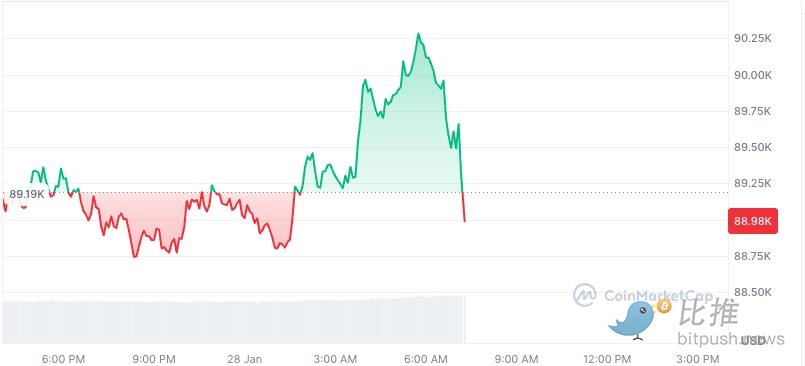
The same goes for crypto assets. After the news was announced, the Bitcoin price briefly dipped from $89,600 to the $89,000 level, then quickly pulling back to around $89,300. The fluctuation was less than 1%. Ethereum (ETH) hovered around the $3,000 mark, and mainstream altcoins like Solana and XRP also remained within their previous consolidation ranges.
The market gave the most intuitive answer: when the direction is unclear, gold is pushed back to the center of the stage, while other assets enter a waiting state.

A Question More Important Than Rate Cuts: Who Will Shape the Next Phase of the Fed?

After the interest rate decision landed, the market's focus quickly shifted. Compared to "whether there will be another rate cut," investors began to discuss another question more frequently: who will lead the next phase of the Federal Reserve?
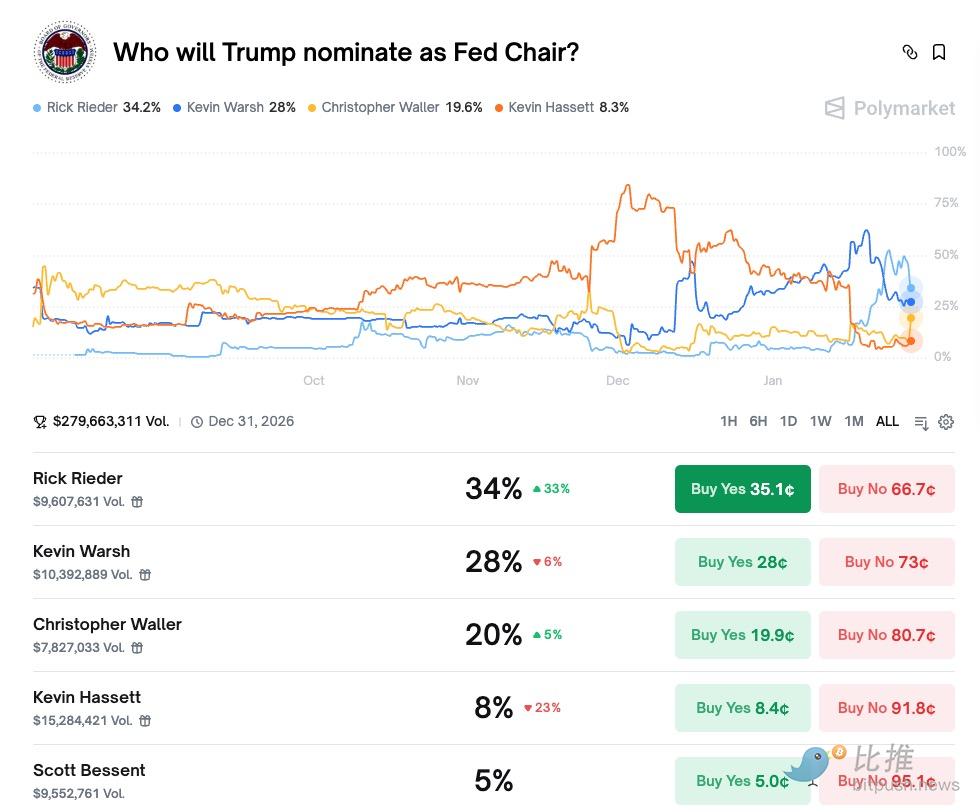
After the dust settled on the interest rate decision, the market's focus quickly shifted from "whether there will be another rate cut" to a question with longer-term implications—who will become the next Federal Reserve Chair.

This change is not accidental. As monetary policy gradually enters a sensitive range "close to neutral," the policy style for the next few years will largely depend on the leadership's understanding of inflation tolerance, financial stability, and market volatility. Against this backdrop, prediction markets provide a valuable window of reference.

According to the latest data from Polymarket, in the betting on "Who will Trump nominate as Fed Chair," the winning probabilities of several candidates have already formed a hierarchy:

Rick Rieder: The Market's Favorite "Pragmatist" (~34%)

Currently, the highest betting probability is for Rick Rieder, with a support rate of about 34%, which has risen significantly recently.

Rieder is currently BlackRock's Chief Investment Officer of Global Fixed Income, deeply involved in long-term bond market and macro asset allocation decisions, and is seen as one of the very few figures who truly straddles "policy-market-capital structure." His public views often emphasize financial market stability, policy transmission efficiency, and avoiding unnecessary systemic shocks.

From the market's perspective, if Rieder becomes Fed Chair, it would mean that central bank decisions would place greater importance on financial conditions and asset price signals, maintaining policy flexibility within the allowable range of inflation. This expectation explains why he is gaining increasing financial support in prediction markets—it is a bet on "predictability" and "market friendliness."

Kevin Warsh: Representative of Discipline and Credibility (~28%)

Ranked second is former Fed Governor Kevin Warsh, with a current betting probability of about 28%.

Warsh has always been known for his clear stance and tough style, emphasizing central bank credibility and long-term discipline on inflation issues. He has repeatedly expressed concerns about excessively loose policies and is also seen as an important representative of the traditional hawkish camp.

If Warsh ultimately wins, the market generally expects the Fed to be more cautious in its rate-cutting pace, tolerance for asset prices, and policy communication. This style typically helps suppress inflation expectations but also means risk assets need to adapt to a stricter financial environment.

Christopher Waller: The Academic Fed Governor (~20%)

The betting probability for current Fed Governor Christopher Waller is about 20%, placing him third.

Waller has a strong academic background and clear policy logic, and has long been regarded as the most influential "hawk" within the Fed (advocating high interest rates to suppress inflation). However, in this FOMC meeting, he cast a dissenting vote, supporting a continued rate cut, which means he either believes inflation is no longer the main threat or is feeling significant political/economic pressure.

If Waller takes over, the Fed may give more weight to employment and growth targets, with a relatively flexible policy pace, but whether he can maintain central bank independence in a highly politicized environment remains a focus of market attention.

Will Bitcoin Continue Its Bearish Trend?

While macro uncertainties intensify, on-chain data is beginning to release signals worth警惕 (being cautious about).

The latest analysis from CryptoQuant shows that the 365-day moving average of Bitcoin's "Supply in Loss" is starting to rise again. This metric measures the percentage of Bitcoin whose current price is below the price of its last on-chain transfer and is an important tool for observing changes in market structure.
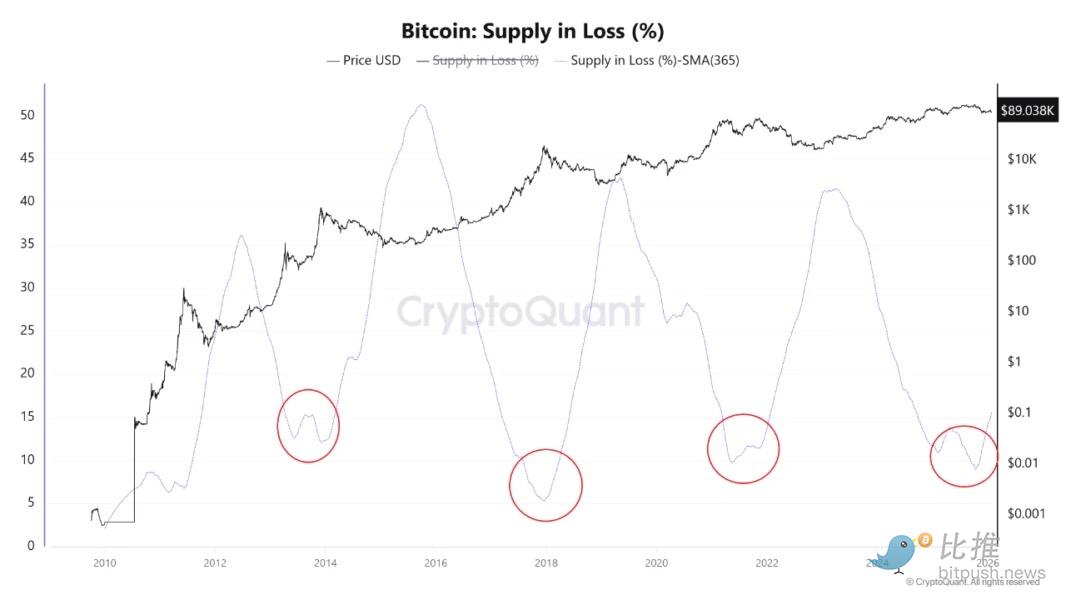
When Bitcoin hit its historical high of $126,000 last October, this indicator once fell to its lowest point this cycle, reflecting a market in a state of high profitability. But as the price fell, Supply in Loss began to rise continuously, showing that losses are gradually spreading from short-term traders to longer-term holders.

Historical experience shows that this directional change often appears in the early stages of bull-to-bear transitions. However, it is important to emphasize that this indicator has not yet reached the typical "capitulation zone"; it is more like a risk signal than a trend confirmation.

This means that Bitcoin's current state is closer to high-level digestion and structural reorganization rather than having already entered a clear main bear market decline phase. Whether it evolves into a deeper adjustment still highly depends on macro liquidity and subsequent capital flows. Gabe Selby, Research Head at CF Benchmarks, said: "Short-term bullish catalysts for Bitcoin still exist, but they are increasingly偏向 (leaning towards) political factors rather than monetary factors."

Summary: Macro Uncertainty, Structural Changes, the Market is Waiting for Answers

Overall, this round of market changes is not driven by a single event but is the result of multiple factors acting together. The Fed's choice to pause sends a signal of "caution rather than a pivot"; capital embraces gold amidst uncertainty, pushing risk aversion to the forefront; Bitcoin, while fluctuating at high levels, gradually reveals structural characteristics of the latter half of the cycle.

Before the direction becomes clear, the market seems more like it is conducting a patience test. Gold has already made its choice, while Bitcoin's next step still needs to wait for further convergence of macro and cyclical signals.

Author: seed.eth


Twitter:https://twitter.com/BitpushNewsCN

Bitpush TG Discussion Group:https://t.me/BitPushCommunity

Bitpush TG Subscription: https://t.me/bitpush

Original link:https://www.bitpush.news/articles/7606809

Связанные с этим вопросы

QWhat did the Federal Reserve decide regarding interest rates in its first meeting of 2026?

AThe Federal Reserve decided to maintain the benchmark interest rate unchanged in the range of 3.5% to 3.75%.

QWhich asset experienced a significant price surge following the Fed's decision, and what was its performance?

ASpot gold prices broke through the $5,500 per ounce mark, rising over $500 in just four trading days with a weekly gain of 10%.

QAccording to the Polymarket betting data, who is the current frontrunner to be nominated as the next Fed Chair, and what is their perceived policy style?

ARick Rieder is the current frontrunner with approximately 34% probability, and he is viewed as a 'pragmatist' whose decisions would place greater emphasis on financial market stability and policy transmission efficiency.

QWhat concerning signal is the Bitcoin on-chain metric 'Supply in Loss' (365-day moving average) currently indicating?

AThe 365-day moving average of Bitcoin 'Supply in Loss' is trending upwards again, signaling that losses are spreading from short-term traders to longer-term holders, which often occurs in the early stages of a bull-to-bear transition.

QHow did other major assets like U.S. stocks, the U.S. dollar, and cryptocurrencies generally react to the Fed's announcement?

AOther major assets reacted with restraint. U.S. stocks traded in a narrow range without a breakout, the U.S. Dollar Index saw limited movement, and major cryptocurrencies like Bitcoin and Ethereum experienced minimal volatility, staying within their previous trading ranges.

Похожее

Обязательно ли ФРС повысит ставки в сентябре? Как это повлияет на криптовалюты и фондовый рынок?

За последнюю неделю рыночные ожидания повышения ставки ФРС в сентябре резко выросли с менее чем 50% до более чем 80%, что оказало давление на криптовалюты и связанные с ними акции. Ключевой причиной стал рост цен на нефть из-за эскалации геополитической напряженности вокруг Ормузского пролива, что усилило опасения по поводу инфляции. На июльском заседании ФРС сохранила ставку, но расклад голосов 9-3 в пользу сохранения показал усиление позиций сторонников ужесточения политики. Следующим важным ориентиром станут данные по инфляции (CPI) за июль, публикация которых 12 августа может существенно скорректировать ожидания. Для крипторынка, в частности для Bitcoin, усиление ожиданий повышения ставок создает краткосрочное давление, поскольку активы, не приносящие доход, становятся менее привлекательными. Однако исторически Bitcoin демонстрировал устойчивость, когда траектория повышения ставок уже была учтена рынком. Решающим фактором часто является не сам факт повышения, а изменение ожиданий относительно будущего цикла монетарной политики. Акции компаний, связанных с криптоиндустрией, такие как Coinbase и MicroStrategy, обычно демонстрируют более высокую волатильность в ответ на изменение ожиданий по ставкам. Для рынка акций в целом, особенно для технологического сектора с высокими оценками, рост стоимости заимствований может увеличить давление на мультипликаторы. Это совпадает с сезоном отчетности, когда инвесторы начали более пристально оценивать, приводят ли высокие капитальные затраты компаний на ИИ к реальному росту выручки и денежных потоков. Если ФРС повысит ставки в сентябре, толерантность рынка к "историям роста" за счет "сжигания денег" может снизиться, что усилит волатильность.

marsbitТолько что

Обязательно ли ФРС повысит ставки в сентябре? Как это повлияет на криптовалюты и фондовый рынок?

marsbitТолько что

Биткоин-майнеры массово сдаются, но их акции растут

Автор: Matt Crosby Хэшрейт сети Биткоин продолжает снижаться несколько месяцев подряд, а сложность майнинга зафиксировала одно из самых резких падений в истории. Обычно это означает, что майнеры отключают оборудование из-за нерентабельности. Однако в этот раз акции публичных майнинговых компаний демонстрируют один из лучших результатов за последние годы, в то время как цена BTC значительно снизилась. Исторически давление на майнеров и падение цены происходили синхронно, но сейчас наблюдается их расхождение, и рынок, возможно, ещё не полностью оценил долгосрочные последствия этого для хэшрейта. **Ключевые моменты:** * Хэшрейт сигнализирует об одной из самых продолжительных фаз капитуляции майнеров. * Сложность майнинга упала на 19,9% от пика, что является третьим самым глубоким снижением с эпохи ASIC-майнеров. * Акции майнинговых компаний значительно опередили BTC по доходности за год, несмотря на продажу тысяч биткоинов. * Доход от вознаграждения за блок в пересчёте на BTC достиг рекордно низкого суточного уровня. * Средний доход от комиссий за последние 28 дней даже не покрывает субсидию за один блок. Майнеры действительно капитулируют. Снижение сложности на 19,9% — это механизм протокола, работающий как задумано. Лишь два аналогичных периода были глубже, один из которых последовал за запретом майнинга в Китае. При этом акции крупнейших публичных майнеров выросли на 430% за год, тогда как BTC упал примерно на 46%. Это резкий отход от их традиционной роли "BTC с левериджем". Основной драйвер роста — нарратив об искусственном интеллекте (ИИ), который изменил корреляцию между этими активами. Доход майнеров от вознаграждения за блок (субсидии) в биткоинах достиг исторического минимума. Это следствие предсказуемого механизма халвинга, сокращающего эмиссию каждые четыре года. Хотя пока рост цены BTC компенсировал это снижение в долларовом выражении, показатель Puell Multiple (около 0,75) указывает, что текущий ежедневный доход (~$30 млн) ниже годового среднего (~$40 млн). В долгосрочной перспективе субсидию должны заменить комиссии. Однако сейчас они составляют лишь около $200 тыс. в день против $30 млн от субсидий. Среднесуточных комиссий за месяц не хватает даже на покрытие одного блока, в то время как сеть создаёт около 144 блоков в день. Эта фаза капитуляции отличается от предыдущих. Майнеры нашли более прибыльное применение своему оборудованию (ИИ) на фоне падения цены BTC, сокращения субсидий и стагнации комиссий. Хотя непосредственных рисков для безопасности сети нет, текущая ситуация highlights структурные вопросы激励机制 майнеров, которые в медвежьем рынке требуют большего внимания, чем в условиях бычьего тренда.

marsbit1 мин. назад

Биткоин-майнеры массово сдаются, но их акции растут

marsbit1 мин. назад

ФРС в сентябре точно повысит ставки? Как криптовалюты и американские акции справятся с давлением?

За последнюю неделю рыночные ожидания повышения ставки ФРС в сентябре резко выросли с менее чем 50% до более чем 80%, что оказало давление на крипторынок и связанные с ним акции. Ключевым фактором стала эскалация геополитической напряженности вокруг Ормузского пролива, что привело к росту цен на нефть и опасениям по поводу инфляции. Инфляционные данные за июль, которые будут опубликованы 12 августа, станут следующим важным ориентиром. Для криптоактивов, таких как биткоин, рост ожиданий повышения ставки создает краткосрочное давление, поскольку они по-прежнему демонстрируют черты рискованных активов, чувствительных к ликвидности. Однако исторически цена биткоина не всегда линейно реагировала на уже учтенные рынком действия ФРС. Акции компаний, связанных с криптовалютами, такие как Coinbase и MicroStrategy, обычно испытывают более сильную волатильность в условиях роста процентных ставок. На общий рынок акций, особенно на высокотехнологичные компании с высокими оценками, также может повлиять повышение стоимости заемного финансирования, что особенно актуально в сезон отчетности, когда инвесторы сосредоточены на окупаемости крупных капитальных затрат. Таким образом, сентябрьское решение ФРС остается неопределенным. Дальнейшая динамика будет зависеть от данных по инфляции, ситуации на нефтяном рынке и сигналов от представителей Федрезерва.

Odaily星球日报5 мин. назад

ФРС в сентябре точно повысит ставки? Как криптовалюты и американские акции справятся с давлением?

Odaily星球日报5 мин. назад

Забытое крупное событие на рынке: Совместное вмешательство США, Японии и Южной Кореи, «редкое» участие Минфина США, тихое «спасение рынка» Безентом?

Авторы: Ли Цзя, источник: Wall Street News На этой неделе США, Япония и Южная Корея провели крупнейшую за последние три десятилетия скоординированную валютную интервенцию. Действия были направлены против давления на обесценивание иены и воны, а также рассматриваются как важная мера США по стабилизации финансовых рынков союзников и предотвращению перелива рисков. В операции были задействованы как японские и южнокорейские власти, продававшие доллары для поддержки национальных валют, так и Министерство финансов США, которое впервые за почти 30 лет напрямую участвовало в поддержке иены, продавая евро и покупая иену через ФРС Нью-Йорка и инвестиционные банки. Такой подход позволил снизить давление на иену, не усиливая нагрузку на доллар. Интервенция последовала на фоне сильного давления на рынки Японии и Южной Кореи: индекс KOSDAQ упал до минимума с октября 2022 года, а курсы иены и воны значительно ослабли. Аналитики отмечают, что эта акция выходит за рамки простой стабилизации обменных курсов и представляет собой операцию по «спасению рынка» («Price Keeping Operation»), цель которой – поддержать стабильность активов в странах, являющихся ключевыми звеньями полупроводниковой и ИИ-цепочки поставок США, и предотвратить распространение финансового стресса. Таким образом, скоординированные действия трех стран направлены не только на валютные курсы, но и на сдерживание волатильности на ключевых союзных рынках для защиты стратегических технологических цепочек.

marsbit5 мин. назад

Забытое крупное событие на рынке: Совместное вмешательство США, Японии и Южной Кореи, «редкое» участие Минфина США, тихое «спасение рынка» Безентом?

marsbit5 мин. назад

Совместное вмешательство США и Японии: новое «Соглашение Плаза», начало Бреттон-Вудской системы 2.0 и конец эры йеновых арбитражей

Мероприятие по совместной поддержке иены США и Японией, впервые за десятилетия, заставляет рынки переоценить глобальные модели движения капитала, долгое время зависевшие от дешевого финансирования в иенах. Аналитики полагают, что это может означать поворотный момент для торговли на разнице процентных ставок с использованием иены (йеновый кэрри-трейд) и привести к более глубокой перестройке глобальных финансовых потоков. Министр финансов США Бессент и президент Трамп подтвердили активное участие США. Бессент заявил о готовности к дальнейшим совместным интервенциям для коррекции «серьезной недооценки» иены. Трамп подчеркнул, что это демонстрация союзнических отношений, и ожидает финансовой выгоды для Вашингтона. Интервенция вызвала резкий рост курса иены до 157,40 за доллар. Анализ рынка указывает, что действия альянса выходят за рамки обычного управления валютным курсом. Если Японии для защиты иены придется продавать свои валютные резервы (включая казначейские облигации США), это может привести к переоценке долгосрочных доходностей американских госдолга и запустить реорганизацию глобальной ликвидности. Этот сдвиг потенциально сигнализирует о конце эры йенового кэрри-трейда, которая десятилетиями поддерживала глобальную ликвидность и низкие процентные ставки. Дополнительное давление на долгосрочные ставки создает изменение роли крупных технологических компаний, которые теперь активно выпускают облигации для финансирования инвестиций в ИИ, превращаясь из поглотителей сбережений в крупных заемщиков. Некоторые наблюдатели видят в этих событиях признаки формирования нового международного порядка в духе «Бреттон-Вудс 2.0» или нового «Соглашения Плаза». США, делая ставку на экономику предложения, стремятся к ускорению роста, в то время как Япония, возможно, стоит на пороге реструктуризации своей экономической и геополитической роли. Независимо от того, окажется ли интервенция разовой мерой или началом долгосрочной координации, она уже заставляет рынки пересматривать устоявшиеся модели глобальных капиталов.

marsbit44 мин. назад

Совместное вмешательство США и Японии: новое «Соглашение Плаза», начало Бреттон-Вудской системы 2.0 и конец эры йеновых арбитражей

marsbit44 мин. назад

Торговля

Спот
活动图片