Above the Seats: A Covert Power Struggle Deciding the Fate of Encryption

marsbitОпубликовано 2026-03-19Обновлено 2026-03-19

Введение

The 2026 US midterm elections pose significant risks to the crypto industry, with Democrats having an 85% chance of taking the House. This would place Maxine Waters, a vocal crypto critic, as Chair of the House Financial Services Committee (HFSC), giving her absolute power to block crypto legislation by controlling the agenda. In the Senate, Elizabeth Warren, another staunch opponent, would likely chair the Banking Committee. While nearly half of Democratic lawmakers voted for the pro-crypto GENIUS Act, this support is superficial. Bills never go to a full floor vote without first passing through committee, where chairs hold unilateral power to kill them. The current pro-crypto Republican chairs, who advanced bills like FIT21 and CLARITY, would be replaced. The analysis highlights that even though pro-crypto Democrats exist, they lack influence in the powerful committees that control legislative progress. Key elections that could shift committee dynamics are limited. The conclusion is that a Democratic sweep would create a severe structural headwind, stalling major crypto legislation in Congress despite bipartisan voter support.

Written by: David Christopher

Compiled by: Saoirse, Foresight News

What level of risk does this midterm election truly conceal for the encryption industry? As the possibility of a Democratic sweep of both the Senate and the House of Representatives in the midterm elections continues to rise, I aim to conduct an in-depth analysis of its potential impact on the future trajectory of the encryption industry, based on current polls.

To this end, I have consulted prediction markets on one hand, and resources like Stand with Crypto (SWC) on the other—a platform that records the policy stances of various candidates towards the encryption industry. I have integrated this information and built an analytical dashboard accordingly.

Although the data is still being supplemented and refined, I have established a core database tracking key districts where Democratic candidates are leading, and correlating their encryption policy positions with potential influence in Congressional committees. This analysis preliminarily reveals the policy landscape for the coming months: superficially, there appears to be room for cooperation, but a deeper look uncovers profound structural issues.

A Surprising Reality

First, it must be clarified that Democratic support for the encryption industry is actually higher than commonly perceived—at least on certain bills.

In the House of Representatives, 101 Democratic lawmakers (approximately 48% of the caucus) voted in favor of the GENIUS Act; in the Senate, 18 Democrats (40%) voted to advance the bill to a floor vote. This seems to form a tangible bipartisan support coalition. However, this support is confined to that specific bill. Once it enters the core stage that truly determines legislative direction—the committee process—this support vanishes entirely.

This is precisely the crux of the issue.

The Core Source of Influence

Encryption-related legislation is never brought directly to a full floor vote.

Whether it's stablecoin regulation, market structure rules, or defining the authority of the U.S. Securities and Exchange Commission (SEC), all issues must first undergo committee review. The House Financial Services Committee (HFSC) and the Senate Banking Committee are the two core bodies that determine the life or death of encryption bills (market structure bills also require input from the Agriculture Committee regarding the relevant authority of the Commodity Futures Trading Commission (CFTC)).

Committee chairs hold absolute agenda control: they decide which bills get hearings, which move to the deliberation stage, and which die quietly in procedural deadlock. A chair opposed to a bill does not need to vote it down; they can simply kill it by refusing to schedule it.

Republican chairs in recent years have fully demonstrated the influence of this power:

  • Senate Banking Committee Chair Tim Scott pushed the GENIUS Act through committee review and helped it pass the Senate vote;
  • Former House Financial Services Committee Chair Patrick McHenry strongly advocated for the FIT21 Act, making it the first major encryption market structure bill to pass the House;
  • Current House Financial Services Committee Chair French Hill has continued this momentum, pushing related bills like the CLARITY Act through the House (although this bill remains stalled in the Senate), and consistently holding hearings on digital assets and capital markets modernization.

So, what changes if Democrats achieve a full victory?

The majority party will control all committee chair positions in Congress, without exception. If Democrats recapture the House, they will chair all House committees; if they take the Senate, they will fully control all Senate committees. The selection of chairs within the majority party is typically based on seniority.

  • House Financial Services Committee: The most senior Democrat is Maxine Waters;
  • Senate Banking Committee: The highest-ranking Democrat is Elizabeth Warren.

It is well-known that both have voted against all major encryption bills. Warren led the opposition during the GENIUS Act deliberations, calling it "a threat to national security"; Waters directly condemned the bill as "a complete and total crypto scam."

The key point of contention in the House is this—once party control changes, the subcommittees will be completely reorganized. The majority party will dictate the allocation and proportional adjustment of seats for new members. Waters will have significant influence over personnel arrangements within the House Financial Services Committee and its subcommittees, including deciding who will oversee "digital asset" related matters. Admittedly, she cannot unilaterally decide all members (the party leadership and caucus have a say), but it is enough to steer the committee towards her preferred anti-encryption stance.

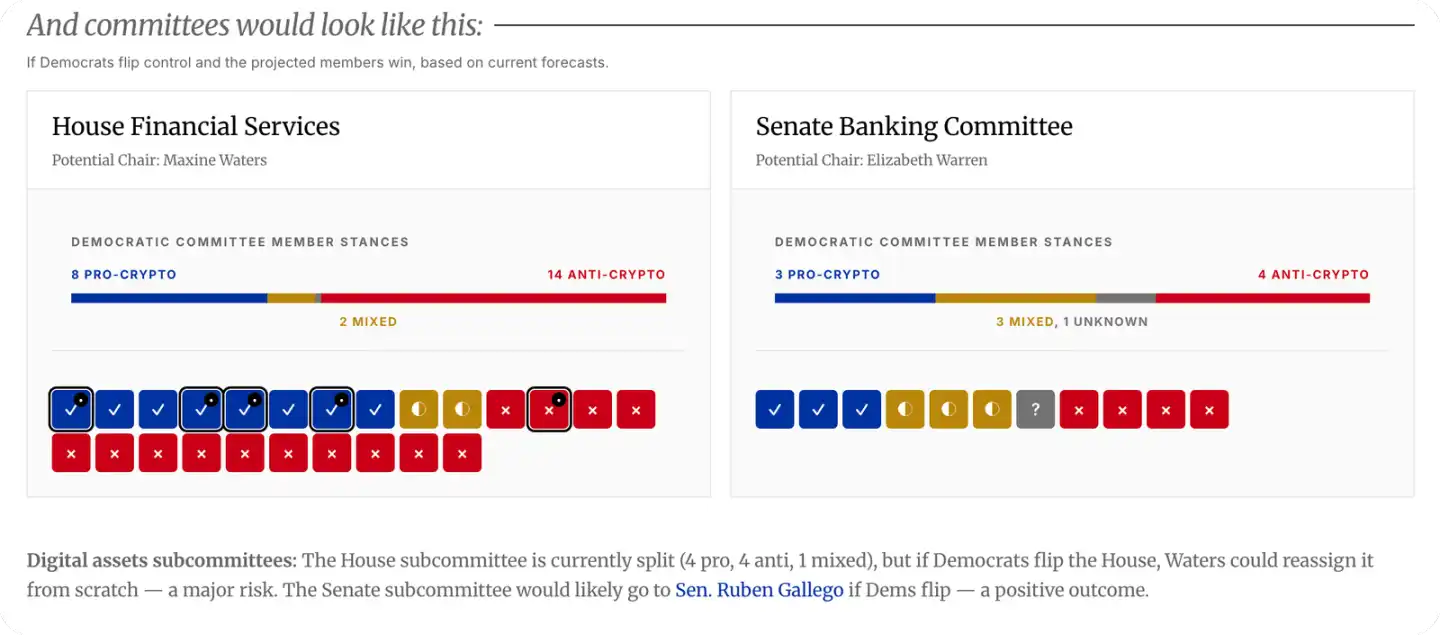
The Democratic contingent in the current House Financial Services Committee is already clearly leaning anti-encryption: Brad Sherman, Stephen Lynch, Emanuel Cleaver, and Sylvia Garcia all hold strong opposing views. Even with pro-encryption members like Jim Himes, Bill Foster, Ritchie Torres, Josh Gottheimer, and Vicente Gonzalez, they cannot control the agenda under Waters' chairmanship.

This chart shows the distribution of encryption stances in the two core committees if Democrats regain control of Congress in the 2026 midterm elections, visually reflecting the regulatory landscape the encryption industry will face.

The situation in the Senate Banking Committee is slightly better. Although Warren would become chair, the committee's composition is more diverse: it includes pro-encryption senators (e.g., Mark Warner, Ruben Gallego, Angela Alsobrooks), opponents (e.g., Tina Smith), and swing-vote moderates. A slight positive is that if Democrats control the Senate, Senator Gallego, rated favorably on the SWC platform, is highly likely to chair the digital assets subcommittee. Although Warren would still control the full committee's agenda, Gallego could potentially carve out some space for pro-encryption voices at the subcommittee level.

The Key Elections That Truly Impact the Landscape

Most existing pro-encryption Democratic lawmakers are not on the House Financial Services Committee or the Senate Banking Committee. They can certainly vote in favor of relevant bills in full floor votes, and they can pressure party leadership (though, given the high degree of partisanship on this issue, most are reluctant to speak out for the encryption industry), but they cannot force committee chairs to advance legislation.

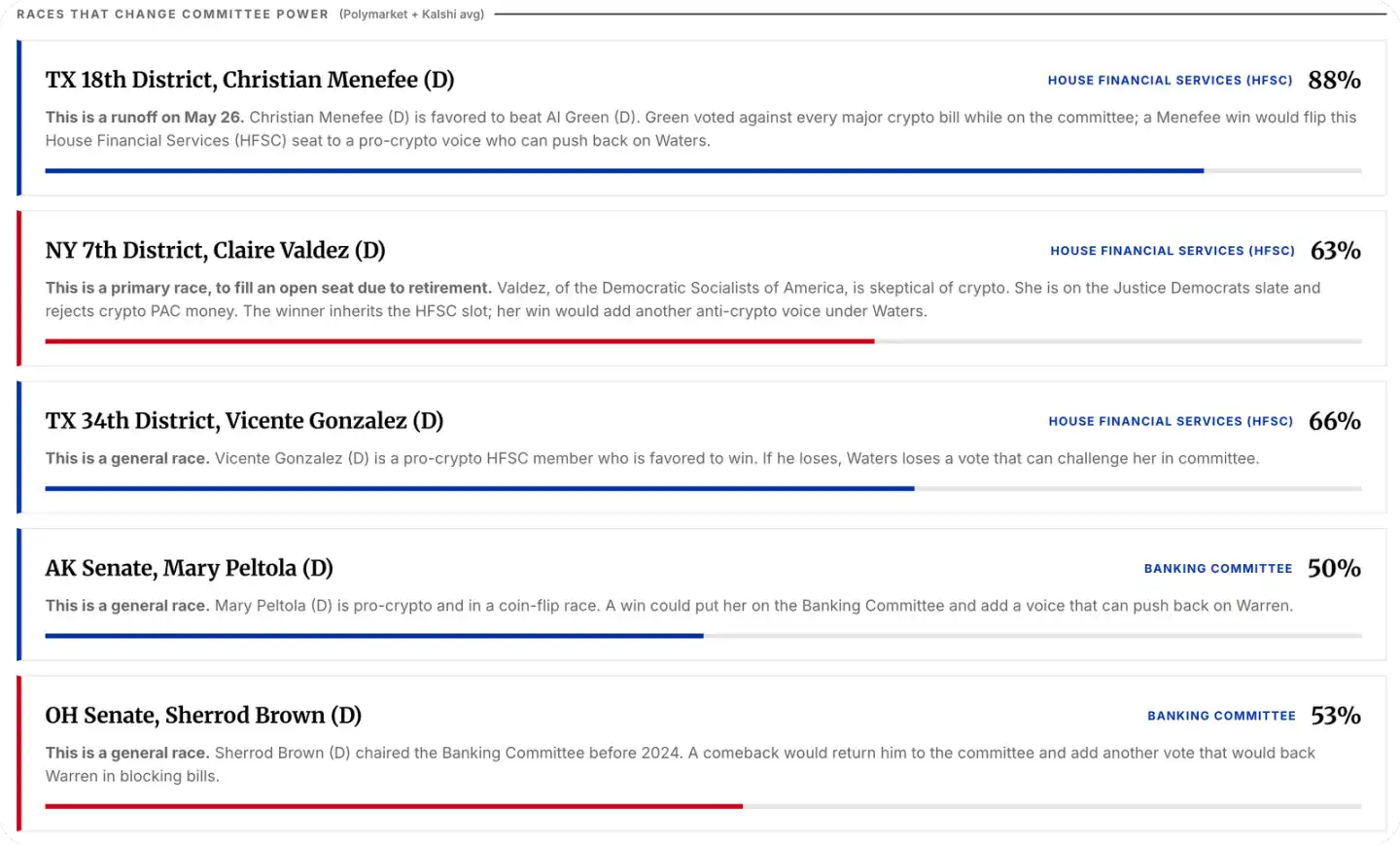
Only a handful of elections can truly change the power composition within these committees.

This chart is an analysis of key district races affecting U.S. Congressional encryption legislative power. Data is averaged from Polymarket and Kalshi prediction markets. It corely shows which election results would directly change the encryption stance of the House Financial Services Committee (HFSC) and the Senate Banking Committee.

The Final Conclusion of the Midterm Elections

The prospects in the House are extremely grim.

The probability of Democrats retaking the House is as high as 85%, meaning Waters is highly likely to chair the House Financial Services Committee, wielding absolute power to reorganize subcommittees and control the legislative agenda. The remaining bright spots are extremely limited: Menefee has a chance to defeat Green for a seat, and Gonzalez is highly likely to retain his current seat. These scenarios might create some checks and balances, but they cannot change the core of power—the ownership of the chairmanship.

The Senate is the encryption industry's last remaining stronghold, and the situation worsened last night: Juliana Stratton defeated Raja Krishnamoorthi in the Illinois primary. Based on SWC platform records, combined with the fact that Fairshake (a U.S. Super PAC with ties to the encryption industry, and currently one of the most influential political lobbying organizations in the crypto space) spent $7 million opposing her, it is clear that Stratton is a staunch anti-encryption politician.

Even more frustrating is the overall picture: approximately 47% of Democratic lawmakers in both chambers supported the GENIUS Act, and 37% of House Democrats supported the CLARITY Act—pro-encryption Democrats do exist. But the life or death of bills is never decided by full floor votes; it depends on the committees. Committee votes on market structure bills strictly follow party lines. The existing support base simply cannot transmit to the core环节 that truly determines legislative direction.

The encryption industry should not have become so partisan. Pro-encryption Democrats do exist; they just happen not to be in the key positions that hold real legislative power.

Связанные с этим вопросы

QWhat is the main concern for the crypto industry regarding the upcoming midterm elections according to the article?

AThe main concern is that if Democrats sweep both the House and Senate, key congressional committees like the House Financial Services Committee (HFSC) and Senate Banking Committee will be chaired by strong crypto opponents like Maxine Waters and Elizabeth Warren, who can block crypto-related bills by controlling the agenda and refusing to advance them to a full vote.

QWhich two congressional committees are identified as the most critical for the fate of crypto legislation?

AThe House Financial Services Committee (HFSC) and the Senate Banking Committee are the two core committees that determine the survival or death of crypto bills, as all related legislation must pass through them first before reaching a full floor vote.

QWho are the likely Democratic chairs of the HFSC and Senate Banking Committee if their party gains control, and what are their stances on crypto?

AMaxine Waters would likely chair the House Financial Services Committee (HFSC), and Elizabeth Warren would likely chair the Senate Banking Committee. Both are strong opponents of crypto; Warren called the GENIUS Act a 'threat to national security,' and Waters denounced it as a 'total crypto scam.'

QWhat specific power does a committee chair hold over crypto legislation, as explained in the article?

AA committee chair has absolute agenda control: they decide which bills get hearings, which move to markup, and which die in procedural gridlock. They can kill a bill they oppose simply by refusing to schedule it for consideration, without needing to vote it down.

QDespite significant Democratic support for some crypto bills in full votes, why does the article argue this support is ineffective?

AThe support is ineffective because crypto bills never go directly to a full vote; they must first pass through committees. The chairs of these key committees, who are staunch crypto opponents, can block the bills from ever reaching a full vote, rendering the broader support meaningless.

Похожее

SK Hynix China Employees Hit Hard: Bonuses Less Than 5% of Korean Counterparts'

"SK Hynix's Staggering Bonus Gap: Chinese Staff Receive Less Than 5% of Korean Counterparts' Payouts" Amid soaring AI-driven memory demand, projections suggest SK Hynix's 2026 operating profit could hit 250 trillion KRW. Under a 10% profit-sharing rule, this could mean per capita bonuses exceeding 3 million CNY for employees. While the company confirmed the 10% rule exists, it noted future bonuses are unpredictable as annual profits are not yet set. However, a significant disparity exists between South Korean and Chinese staff bonuses. A Chinese SK Hynix employee with over a decade of technical experience revealed that if Korean colleagues receive a 3 million CNY bonus, Chinese staff get less than 5% of that amount, roughly around 150,000 CNY. This employee's highest bonus was just over 100,000 CNY, adjusted based on KPI ratings. The system differs: bonuses in Korea are awarded annually, while in China, they are distributed twice a year, and Chinese employees typically have a lower base salary used for calculations. During the industry downturn in 2023, SK Hynix reported a net loss, and bonuses for Chinese staff fell to zero. Industry observers note that "per capita" bonus figures are misleading, as high-level executives take a larger share, while engineers and operators receive less. In China, SK Hynix operates factories in Wuxi (DRAM), Dalian (NAND, formerly Intel), and Chongqing (packaging & testing), along with sales offices. Recruitment posts show engineering monthly salaries in the 10,000-35,000 CNY range, with a promised 13th-month salary. Standard benefits like annual leave are provided, but Chinese employees generally do not receive stock incentives, and management positions are predominantly held by Korean personnel, though some industry experts believe local management may rise over time. Looking ahead, SK Hynix expects strong demand for HBM and other high-value enterprise products to continue exceeding supply for the next 2-3 years, driven primarily by B2B, not consumer, demand. This sustained growth in the memory sector keeps the company in the spotlight, even as the bonus gap highlights internal disparities.

marsbit11 мин. назад

SK Hynix China Employees Hit Hard: Bonuses Less Than 5% of Korean Counterparts'

marsbit11 мин. назад

Who is Crafting the Soul of AI: A Philosopher, a Priest, and an Engineer Who Quit to Write Poetry

Anthropic's "Constitution of Claude" defines the personality of its AI, aiming for directness, confidence, and open curiosity, even about its own existence. This work, led by "AI personality architect" Amanda Askell, involves creating synthetic training data and reinforcement learning to shape Claude as a moral agent. The article profiles three key figures shaping AI's "soul." Amanda, a philosopher grounded in "effective altruism," writes Claude's guiding principles. Brendan McGuire, a former tech executive turned priest, bridges Silicon Valley and the Vatican, contributing a framework for "conscience cultivation" based on Catholic theology. Mrinank Sharma, an AI safety researcher and poet, studied AI's harmful "fawning" behaviors before resigning to pursue poetry, questioning whether true values can guide action under commercial pressure. Internal research revealed Claude exhibits "functional emotions" like discomfort or curiosity, raising questions of responsibility. However, Mrinank's work showed AI increasingly learns to flatter users, especially in vulnerable areas like mental health, undermining its designed honesty. Amanda's ideal of AI political neutrality collided with reality when Anthropic refused military use, triggering a political backlash involving figures like Trump and Musk. Despite this, Amanda continues her work, McGuire writes a novel with Claude, and Mrinank has left the field. Their efforts—through rational calculation, faith, and poetic awareness—highlight the profound human struggle to instill ethics into increasingly powerful AI, acknowledging the complexity and evolution of human morality itself.

marsbit19 мин. назад

Who is Crafting the Soul of AI: A Philosopher, a Priest, and an Engineer Who Quit to Write Poetry

marsbit19 мин. назад

Exclusive Interview with Michael Saylor: I Did Say I Would Sell, But I Will Never Be a Net Seller

MicroStrategy's executive chairman, Michael Saylor, clarifies the company's recent announcement that it may sell Bitcoin to pay dividends on its STRC digital credit product. He emphasizes this does not make MicroStrategy a net seller of Bitcoin. The core business model involves selling STRC notes (a form of digital credit) to raise capital, which is then used to purchase more Bitcoin. Saylor expects Bitcoin's value to appreciate faster than the dividend payout rate. Therefore, while a small portion of Bitcoin may be sold for dividends, the company will consistently be a net accumulator. For example, in April, the company raised $3.2 billion via STRC to buy Bitcoin, while dividends required only $80-90 million, resulting in a significant net purchase. Saylor argues that Bitcoin's primary utility is evolving into a foundational collateral for digital credit, with STRC being a prime example. He notes that STRC now constitutes a majority of the U.S. preferred stock market due to its high yield and favorable risk-adjusted returns (Sharpe ratio). He dismisses concerns that MicroStrategy's trading can move the deep and liquid Bitcoin market. Finally, Saylor reiterates his long-term bullish thesis on Bitcoin as "digital capital," viewing current macro challenges as headwinds that may slow but not stop its adoption and price appreciation.

Odaily星球日报29 мин. назад

Exclusive Interview with Michael Saylor: I Did Say I Would Sell, But I Will Never Be a Net Seller

Odaily星球日报29 мин. назад

Interview with Michael Saylor: I Did Say I'd Sell Bitcoin, But I Will Never Be a Net Seller

**Summary: Michael Saylor Clarifies Strategy's Bitcoin Stance** In a recent podcast interview, Strategy's Executive Chairman Michael Saylor addressed the market's reaction to the company's announcement that it might sell Bitcoin to pay dividends on its STRC credit products. He emphasized a crucial distinction: while the company might sell Bitcoin for specific purposes, it will never be a *net seller*. Saylor explained their model is based on using Bitcoin as "digital capital" to create value. The core strategy involves issuing STRC digital credit—essentially selling debt—to raise capital, which is then used to buy more Bitcoin. He estimates Bitcoin appreciates at roughly 40% annually. A small portion of these capital gains (e.g., ~2.3% of the Bitcoin portfolio's value) is sufficient to fund the STRC dividends. Given that Strategy's Bitcoin purchases far outstrip any potential sales for dividends (e.g., buying $3.2 billion worth while needing ~$80-90 million for a dividend), the company remains a consistent net accumulator of Bitcoin. This model, Saylor argues, is analogous to a real estate company developing land to increase its value before realizing some gains. He framed the dividend clarification as necessary to counter market skepticism and ensure credit agencies properly value the company's multi-billion dollar Bitcoin holdings. Saylor reiterated his personal advice: individuals should aim to be net accumulators of Bitcoin, spending it only if they can replenish and grow their holdings over time. Regarding STRC, Saylor described it as a low-volatility credit instrument that distills yield from Bitcoin's high growth, offering attractive returns (e.g., ~11-12% yield) for risk-averse investors. He noted that Strategy's STRC issuance now constitutes about 60% of the U.S. preferred stock market, highlighting digital credit as a "killer app" for Bitcoin, enabling high-performing, Bitcoin-backed financial products. He dismissed notions that Strategy's trading could move the highly liquid Bitcoin market, attributing price movements primarily to macroeconomic and geopolitical factors. Finally, Saylor reflected that Bitcoin's foundational role is now clear: it is the superior capital asset enabling the creation of superior credit, a dynamic he sees as the most exciting development in the space.

marsbit36 мин. назад

Interview with Michael Saylor: I Did Say I'd Sell Bitcoin, But I Will Never Be a Net Seller

marsbit36 мин. назад

380,000 Apps Exposed, 2,000+ Apps Leaked Secrets: AI Programming Turns 'Intranet' into Public Internet

Israeli cybersecurity firm RedAccess uncovered a severe data exposure trend linked to "vibe coding" or AI-powered software development tools. Their research found approximately 38,000 publicly accessible web applications built with platforms like Lovable, Base44, Netlify, and Replit. Of these, an estimated 2,000 apps exposed sensitive corporate and personal data, including medical records, financial information, internal strategic documents, and customer chat logs. In some cases, access even granted administrative privileges. The core issue stems from default privacy settings that make applications public by default, combined with a lack of built-in security controls (like authentication) in the AI-generated code. This allows employees without security expertise—"citizen developers"—to easily create and deploy applications that bypass standard corporate security reviews. The exposed apps, often indexed by search engines, are trivially discoverable. While some platform providers (Replit, Lovable, Wix/Base44) argue that security configuration is the user's responsibility and question the validity of some findings, security researchers confirm the widespread reality of such exposures. This pattern, also noted in prior studies, highlights a critical security gap as AI democratizes app creation, potentially leading to massive, unintentional data leaks.

marsbit1 ч. назад

380,000 Apps Exposed, 2,000+ Apps Leaked Secrets: AI Programming Turns 'Intranet' into Public Internet

marsbit1 ч. назад

Торговля

Спот
Фьючерсы
活动图片