A Repeat Of February? Watch Out For These Bitcoin Price Levels In March

bitcoinistОпубликовано 2026-02-28Обновлено 2026-02-28

Введение

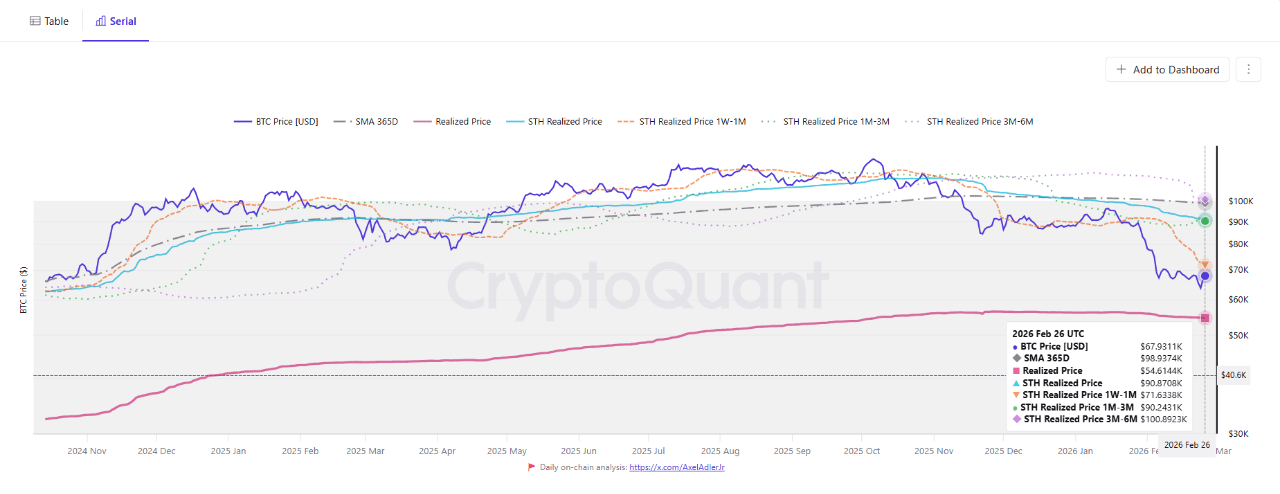
The Bitcoin price had a disappointing performance in February, struggling to sustain a break above the $70,000 level and facing sharp reversals after briefly reaching $71,000. A market analyst highlights several key price levels to watch in March. The strongest support is the realized price at approximately $54,600, which has historically acted as a critical floor. On the upside, significant resistance levels include the 1-4 Week Realized Price at $71,600, where recent buyers may look to exit at break-even. A decisive break above the Short-Term Holder Realized Price (STH RP) at $90,800 could signal a shift from a bearish to a bullish trend. Further resistance exists at the 365-day Simple Moving Average ($98,900) and the 3-6 Month Realized Price (~$100,800). Bitcoin is currently in a bearish phase and must overcome these resistance levels for a meaningful recovery. As of the time of writing, BTC is trading around $63,696, down over 5% in 24 hours.

The Bitcoin price performance was quite disappointing over the past month. The flagship cryptocurrency has struggled to break sustainably above $70,000 throughout February, with prices only reaching $71,000 before facing sharp reversals.

It, then, becomes intuitively evident that this price region might be a key level acting as resistance to Bitcoin’s bullish attempts. Below are some other crucial levels to watch for in March and what they could potentially mean for the Bitcoin price.

BTC Realized Price Sits At $54,600 – What This Means

In a Quicktake post on the CryptoQuant platform, market analyst Burak Kesmeci highlighted five “cost clusters” that might reveal the next move for the Bitcoin price. For context, Cost clusters are essentially price levels that represent the average acquisition price of an asset (Bitcoin, in this case) by different investor cohorts

To start with, Kesmeci immediately revealed Bitcoin’s surest support price — the realized price — to be around the $54,600 mark. The realized price is a strong support region because it reflects the average cost basis of all the BTC in circulation.

Source: CryptoQuant

Also, realized prices have historically served as long-term price support during bear phases. As a result, when the Bitcoin price trades above this level, it is often a sign of extant structural strength, while a break beneath the realized price is usually a sign of impending doom.

Bitcoin Could Switch Bullish In March — But On This Condition

While the Bitcoin price may be displaying its higher timeframe backing, it is also true that the world’s leading cryptocurrency has a series of battles to fight as it ascends. According to the crypto pundit, four resistance zones lie in wait to reject possible upward recovery.

The first of these zones is the 1 – 4-Week Realized Price, which reveals the average price at which recent buyers entered the BTC market. According to the highlighted CryptoQuant data, this cost basis stands at around the $71,600 level.

When the Bitcoin price trades beneath this level, it signals that the latest participants are under severe heat. Hence, recovery attempts towards this price level would typically be met with significant resistance, as this cohort would want to exit at break-even.

The analyst further highlighted that the Short-Term Holder Realized Price (STH RP) is around $90,800; this concerns investors who have held BTC for less than 155 days. If the Bitcoin price manages to overcome the evident resistance at this level, it could signal a change in Bitcoin’s trend from bearish to bullish.

Beyond the STH RP, the 365-day Simple Moving Average sits, occupying the $98,900 price level; then, a little more up North, the 3–6 Month Realized Price stands around $100,800. These metrics reflect the activity of Bitcoin’s medium-term holders, showing their realized price and average closing prices over the past year.

In the grand scheme, Bitcoin is clearly in a bearish phase. Thus, before March can stand as the pivotal month for market participants, BTC has to overcome those critical resistance levels. As of this writing, Bitcoin is valued at around $63,696, reflecting an over 5% decline in the past 24 hours.

The price of BTC on the daily timeframe | Source: BTCUSDT chart on TradingView

Связанные с этим вопросы

QWhat is the realized price of Bitcoin and why is it considered a strong support level?

AThe realized price of Bitcoin is around $54,600. It is considered a strong support level because it reflects the average cost basis of all the BTC in circulation and has historically served as long-term price support during bear phases.

QWhat is the four resistance zones that Bitcoin needs to overcome for an upward recovery according to the analyst?

AThe four resistance zones are: the 1-4 Week Realized Price at ~$71,600, the Short-Term Holder Realized Price (STH RP) at ~$90,800, the 365-day Simple Moving Average at ~$98,900, and the 3-6 Month Realized Price at ~$100,800.

QWhat could a break above the Short-Term Holder Realized Price (STH RP) signal for Bitcoin's trend?

AIf the Bitcoin price manages to overcome the resistance at the Short-Term Holder Realized Price (~$90,800), it could signal a change in Bitcoin's trend from bearish to bullish.

QWhy would the 1-4 Week Realized Price level act as significant resistance for Bitcoin's price?

AThe 1-4 Week Realized Price (~$71,600) reveals the average price at which recent buyers entered the market. When the price is below this level, these buyers are at a loss, so they are likely to sell at break-even, creating significant selling pressure and resistance.

QWhat was the Bitcoin price performance like in February and what is its value as of the writing of the article?

AIn February, Bitcoin struggled to break sustainably above $70,000, only reaching $71,000 before facing sharp reversals. As of the writing of the article, Bitcoin is valued at around $63,696, reflecting an over 5% decline in the past 24 hours.

Похожее

The Value Distribution of Stablecoins

**Summary: The Value Distribution of Stablecoins** The article argues that stablecoins are evolving from mere trading tools into broader channels for dollar access. It divides the stablecoin ecosystem into four layers to analyze how value is distributed: 1. **Issuance Layer:** Mints stablecoins, holds reserve assets, and captures the spread between reserve yield and user costs (e.g., Tether, Circle). This layer currently earns the largest profit margin. 2. **Infrastructure Layer:** Connects stablecoins to the traditional financial system, handling fiat on/off-ramps, banking integration, compliance (KYC/AML), and asset management (e.g., Bridge, BVNK). This is the "unglamorous" but critical work, building the essential bridges between crypto and real-world finance. 3. **Acquiring/Distribution Layer:** Integrates stablecoins into merchant systems, manages payment flows, and provides enterprise financial software (e.g., Stripe, Coinbase). They act as the access point for businesses. 4. **Application Layer:** The end-users and businesses that ultimately use stablecoins for payments, settlements, or as a store of value. They benefit from convenience but have little pricing power. The core thesis is that while the issuance layer currently dominates profits, the often-overlooked **infrastructure layer holds significant long-term potential**. The real challenge and barrier to mass adoption is not the on-chain transfer of stablecoins (which is simple), but the complex "last mile" integration into existing business workflows, banking systems, and regulatory frameworks across different countries. Companies in this layer are currently in a "land grab" phase, investing heavily to build networks, secure bank partnerships, and establish compliance pathways. While their position is currently pressured by the profitable issuers above and distribution platforms below, the article suggests that if stablecoins become a default financial rail for businesses, the infrastructure providers who have done the hard work of integration will ultimately gain strong pricing power and become entrenched, essential players.

marsbit15 мин. назад

The Value Distribution of Stablecoins

marsbit15 мин. назад

The Value Distribution of Stablecoins

The Value Distribution of Stablecoins The article argues that stablecoins are evolving from a mere trading tool into a broad "dollar channel." It analyzes the industry's value chain through four layers: 1. **Issuance Layer (e.g., Tether, Circle):** The top layer that mints stablecoins, holds reserve assets, and captures the thickest interest rate spread. 2. **Infrastructure Layer (e.g., Bridge, BVNK):** Connects stablecoins to the traditional financial system, handling critical but complex "dirty work" like fiat on/off-ramps, banking integration, compliance (KYC/AML), and cross-border settlement. 3. **Acquiring/Distribution Layer (e.g., Stripe, Coinbase):** Embeds stablecoins into merchant systems, manages payment flows, and integrates with enterprise software. 4. **Application Layer:** End-users and businesses that ultimately use stablecoins for payments, settlement, or storing value. The author posits that while the issuance layer currently captures the most profit, the most overlooked and potentially critical layer is infrastructure. The core challenge for stablecoin adoption isn't the on-chain transfer (which is simple), but bridging the gap between blockchain and the real-world financial system. This involves solving practical problems for businesses: fiat conversion, reconciliation, tax handling, and user onboarding. Infrastructure companies are currently in a difficult "land-grab" phase—building networks, securing banking relationships, and achieving compliance country-by-country. They face pressure from both the profitable issuance layer above and distribution platforms below. However, the author suggests this layer is building a crucial moat. Once stablecoins become a default business rail, the infrastructure players who have done the hard work of integration may gain significant, durable value and pricing power.

链捕手18 мин. назад

The Value Distribution of Stablecoins

链捕手18 мин. назад

Why Is Nvidia Borrowing $20 Billion When It's Not Short of Cash?

Nvidia's recent announcement to issue at least $20 billion in senior notes, despite holding a strong cash position with over $48.6 billion in free cash flow last quarter, is not a sign of financial need. Instead, it represents a strategic move to leverage its high credit rating (recently upgraded to AA by S&P) to secure low-cost, long-term debt. This capital will support long-term AI infrastructure investments, data centers, R&D, supply chain prepayments, and strategic investments, while allowing the company to continue aggressive shareholder returns through stock buybacks and dividends. The decision reflects a mature capital management strategy: using debt to finance long-term growth assets is more efficient and less dilutive to shareholders than equity financing. It signals that Nvidia, like other tech giants (Alphabet, Meta, Amazon), is entering a new phase of heavy AI capital expenditure, shifting from a pure growth story to a story about capital allocation, credit strength, and long-term ecosystem positioning. The key question for investors is whether Nvidia can maintain its high cash flow generation and ensure that returns from these AI investments justify the cost of capital over the long term. The bond issuance amplifies its expansion capabilities but also ties its valuation more closely to the broader AI investment cycle's sustainability and profitability.

marsbit54 мин. назад

Why Is Nvidia Borrowing $20 Billion When It's Not Short of Cash?

marsbit54 мин. назад

How to Do Research Well: Deliberately Practice the Real Skills That Matter

No one truly teaches you how to do research. You're often given a desk, a pre-selected problem, and vague instructions to "create something new." Consequently, many people reverse-engineer the job based on visible outputs—papers, posts, announcements—learning only how to *appear* like a researcher rather than how to *become* one. True research capability is built from stacking small, trainable skills, nearly all of which can be developed through deliberate practice. **Pick Your Own Problem:** Most researchers absorb problems from advisors or trends, lacking the underlying reasoning. Choosing a problem you genuinely care about, as John Schulman advises, leads to original work. Develop "taste" like a muscle: predict experiment outcomes, guess paper results from methods, and track which findings remain important over time. **Upgrade Your Inputs:** Relying on shared reading lists (arXiv hot lists, filtered group chats) leads to unoriginal conclusions. Undervalued old literature often holds crucial insights (e.g., MoE, LSTM, backpropagation). Richard Sutton's "The Bitter Lesson" or Claude Shannon's 1952 talk on creative thinking are more predictive than lengthy modern surveys. Breadth matters as much as depth: draw from neuroscience, mechanism design, hardware knowledge, and honest statistics. Read papers directly, especially appendices and limitations sections. **Write Everything Down:** As Paul Graham noted, writing exposes flaws in seemingly mature ideas. Writing is the cheapest defense against self-deception. Following Feynman's principle, Darwin programmatically wrote down facts contradicting his theory to combat memory bias. Maintain a detailed log of hypotheses, setups, predictions, results, and updated understandings. Reviewing past logs fosters essential humility.

marsbit2 ч. назад

How to Do Research Well: Deliberately Practice the Real Skills That Matter

marsbit2 ч. назад

Торговля

Спот
Фьючерсы

Популярные статьи

Как купить F

Добро пожаловать на HTX.com! Мы сделали приобретение Synfutures (F) простым и удобным. Следуйте нашему пошаговому руководству и отправляйтесь в свое крипто-путешествие.Шаг 1: Создайте аккаунт на HTXИспользуйте свой адрес электронной почты или номер телефона, чтобы зарегистрироваться и бесплатно создать аккаунт на HTX. Пройдите удобную регистрацию и откройте для себя весь функционал.Создать аккаунтШаг 2: Перейдите в Купить криптовалюту и выберите свой способ оплатыКредитная/Дебетовая Карта: Используйте свою карту Visa или Mastercard для мгновенной покупки Synfutures (F).Баланс: Используйте средства с баланса вашего аккаунта HTX для простой торговли.Третьи Лица: Мы добавили популярные способы оплаты, такие как Google Pay и Apple Pay, для повышения удобства.P2P: Торгуйте напрямую с другими пользователями на HTX.Внебиржевая Торговля (OTC): Мы предлагаем индивидуальные услуги и конкурентоспособные обменные курсы для трейдеров.Шаг 3: Хранение Synfutures (F)После приобретения вами Synfutures (F) храните их в своем аккаунте на HTX. В качестве альтернативы вы можете отправить их куда-либо с помощью перевода в блокчейне или использовать для торговли с другими криптовалютами.Шаг 4: Торговля Synfutures (F)С легкостью торгуйте Synfutures (F) на спотовом рынке HTX. Просто зайдите в свой аккаунт, выберите торговую пару, совершайте сделки и следите за ними в режиме реального времени. Мы предлагаем удобный интерфейс как для начинающих, так и для опытных трейдеров.

528 просмотров всегоОпубликовано 2024.12.21Обновлено 2026.06.02

Как купить F

Обсуждения

Добро пожаловать в Сообщество HTX. Здесь вы сможете быть в курсе последних новостей о развитии платформы и получить доступ к профессиональной аналитической информации о рынке. Мнения пользователей о цене на F (F) представлены ниже.

活动图片