A Quick Look at the Latest Portfolio of the 24-Year-Old 'AI Stock God': 60% Allocation Hedges Against Semiconductor Downturn

Odaily星球日报Опубликовано 2026-05-18Обновлено 2026-05-18

Введение

Summary: The article analyzes the latest 13F filing from "AI stock prodigy" Leopold Aschenbrenner's fund, Situational Awareness LP, for Q1 2026. The fund's holdings surged to $13.7 billion, with a significant 32.5% net inflow. Key portfolio adjustments reveal a dual strategy: * **Hedging Semiconductor Downturn:** Over 60% of the fund's *notional value* is allocated to massive put options on major AI semiconductor and hardware stocks (e.g., NVDA, AVGO, AMD, SMH ETF). This acts as a high-leverage hedge against potential short-term volatility or correction in the chip sector. * **Long-term Bullishness on AI Infrastructure:** Alongside the hedges, the fund maintains and increases core long positions in companies providing critical AI infrastructure. This includes substantial equity stakes in CoreWeave (GPU cloud services), Bloom Energy (on-site power), and various power/electrical/data center firms (KEEL, IREN, etc.). Other notable moves include switching Intel exposure from high-leverage calls to minimal stock, exiting optical networking stocks (LITE, COHR), and taking profits in some positions like Bloom Energy and CoreWeave calls. The analysis concludes that Aschenbrenner is not simply turning bearish on AI. Instead, the strategy reflects a nuanced view: extreme caution toward near-term "chip maker" valuations deemed potentially frothy, coupled with strong conviction in the long-term scarcity and value of the underlying *infrastructure* (power, data centers, cloud capac...

Original | Odaily Planet Daily (@OdailyChina)

Author | Azuma (@azuma_eth)

No confidentiality request! No complete liquidation! The newly crowned "AI Stock God," Leopold Aschenbrenner, and his fund Situational Awareness LP officially released their 13F filing this evening.

  • Odaily Note: For details on Leopold Aschenbrenner's personal story, please refer to "SBF's Junior, Turned $225 Million into $5.5 Billion in One Year."

This means our first hypothesis from this morning's article, "Could Be Revealed Today, the Internet is Awaiting the Version Answer from the 24-Year-Old 'AI Stock God'," is confirmed. Situational Awareness LP submitted its filing quite late on the May 15th deadline, preventing the SEC from publishing it on its website that day. As a result, the market had to endure another weekend, finally seeing the fund's holdings disclosure after the SEC resumed work on Monday.

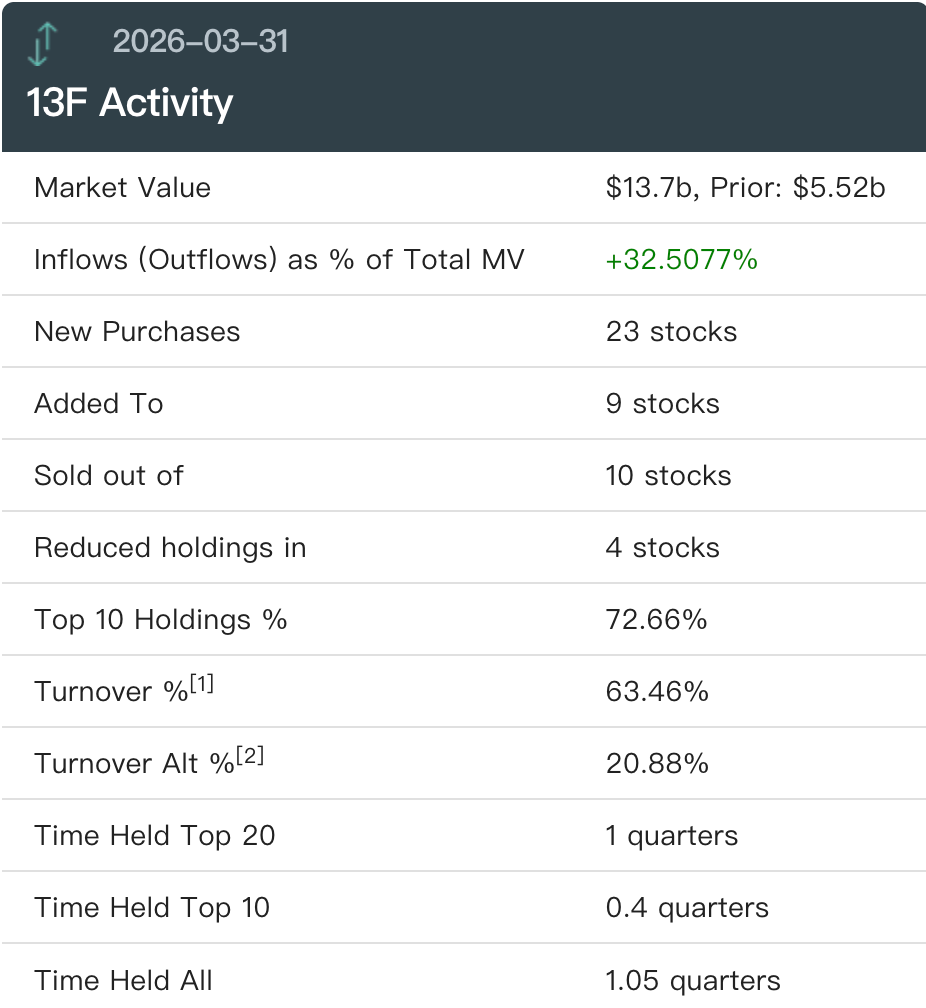
According to this latest 13F filing, as of March 31, 2026, the nominal total value of Situational Awareness LP's holdings has increased to $13.7 billion, more than doubling (up 148%) from $5.52 billion on December 31 of last year.

  • Odaily Note: It's important to note that in the statistical methodology of US stock 13F filings, the market value displayed for option assets is typically the "notional value" of the underlying stocks, not the actual premium cost paid by the fund. This means that although the fund has built a "semiconductor hedge wall" with nominal assets of hundreds of billions of dollars, the actual cash cost (maximum potential loss) consumed is much smaller, representing a typical high-leverage macro hedge.

Additionally, this quarter, net capital inflows accounted for 32.51% of the fund's total holding value, indicating that the fund's explosive growth is not only due to portfolio appreciation but also involves substantial external new capital subscriptions (i.e., fresh capital injections).

Frenetic Portfolio Adjustment in Progress

The filing also shows that Situational Awareness LP executed substantial portfolio adjustments in the first quarter of this year.

  • New Purchases: 23 stocks (including options);
  • Added To: 9 stocks;
  • Sold Out Of: 10 stocks (including options);
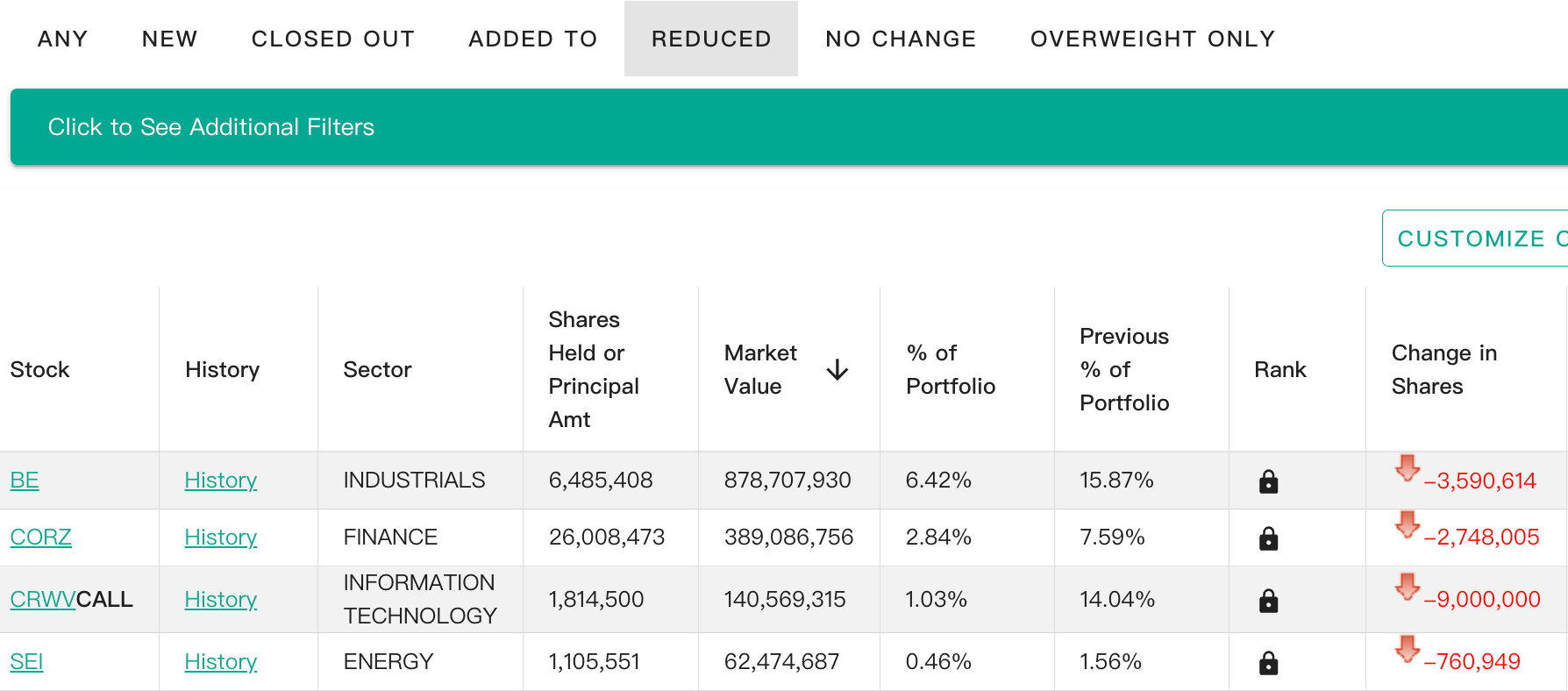
  • Reduced Holdings In: 4 stocks (including options).

New Purchases: 60% Allocation Hedges Semiconductor Downturn

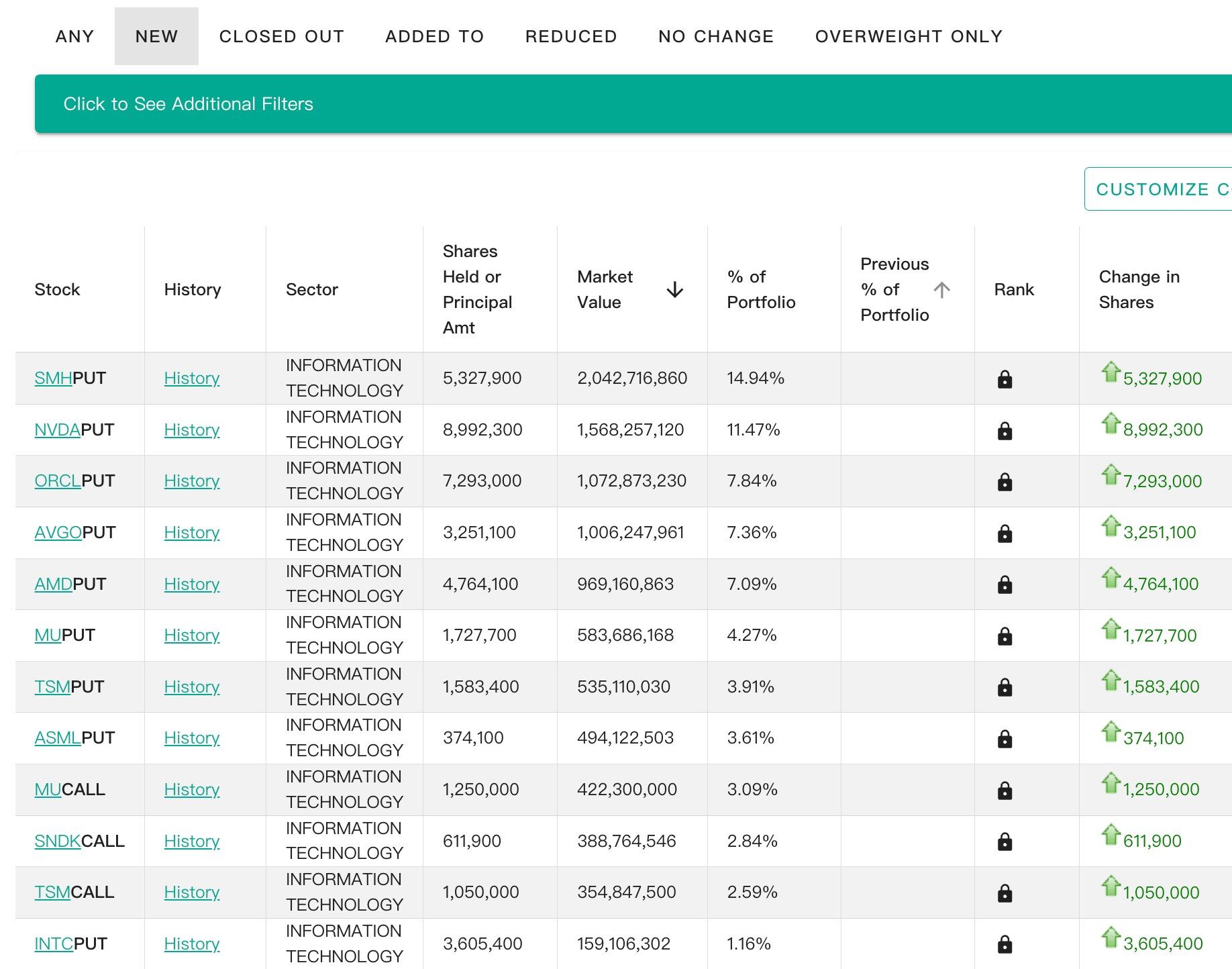
  • Odaily Note: The chart above only covers new stock purchases with values exceeding $100 million. For the complete list of all 23 new purchases, click the "Portal."

First, looking at the new purchase actions, this is the most shocking information in Situational Awareness LP's entire 13F report — in the first quarter, the fund systematically hedged risks for the AI semiconductor and computing hardware sector through large-scale put option positions.

Looking directly at the data:

  • SMH PUT (VanEck Semiconductor Core ETF Put Options): 14.94% of portfolio (market value $2.04 billion) — Largest new position;
  • NVDA PUT (NVIDIA Put Options): 11.47% (market value $1.56 billion) — Second largest new position;
  • ORCL PUT (Oracle Put Options): 7.84%;
  • AVGO PUT (Broadcom Put Options): 7.36%;
  • AMD PUT (AMD Put Options): 7.09%;

Just these top five put option holdings account for 48.7% of Situational Awareness LP's $13.7 billion nominal total holding value. Adding subsequent put options on Micron (MU), TSMC (TSM), ASML (ASML), and Intel (INTC), the fund has over 60% of its nominal portfolio betting on or hedging against declines or severe volatility in core AI hardware stocks.

It's also notable that Situational Awareness LP purchased both call and put options on the same stock, such as buying Micron put options (MU PUT, 4.27%) while also buying MU CALL (3.09%), and buying TSMC put options (TSM PUT, 3.91%) while also buying TSM CALL (2.59%).

This is a two-way bet strategy commonly used by hedge funds. It suggests the fund believes that Micron (memory chips) and TSMC (foundry) could experience stock price volatility far exceeding market expectations in upcoming 2026 earnings or industry cycles, possibly due to geopolitics or extreme supply-demand imbalances — profits can be made on both sides as long as the unidirectional move is large enough.

Increased Holdings: Common Stock Still Favors SanDisk, CRWV

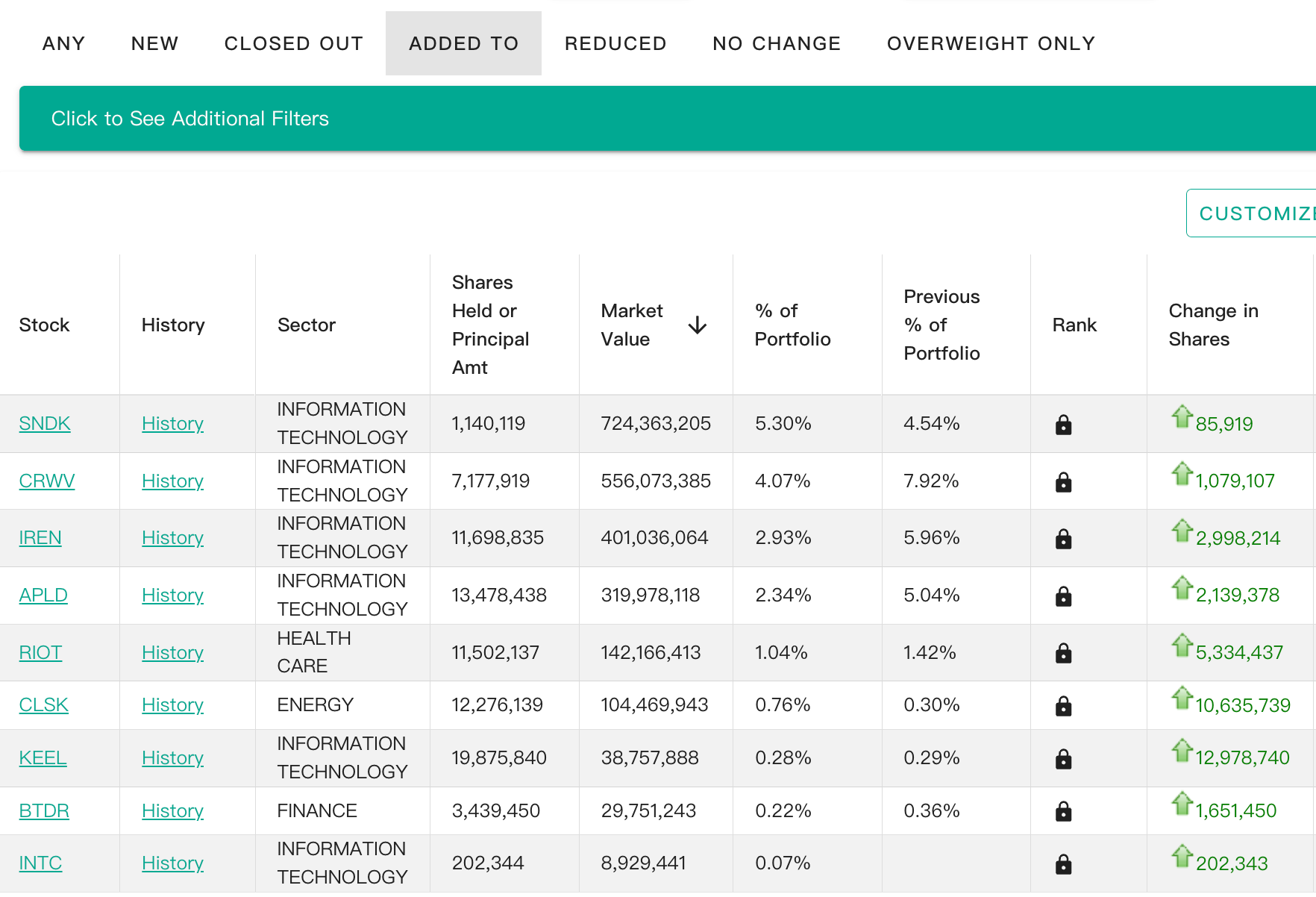
Regarding increased holdings, Situational Awareness LP chose not to use options but rather added to 9 stocks via common shares.

In Q1, Situational Awareness LP slightly increased its position in SanDisk (SNDK) by 85,000 shares, bringing its total holdings to 1.14 million shares, with a holding value of $724 million, accounting for 5.30% of the entire investment portfolio. This is one of the very few super-heavyweight holdings in Situational Awareness LP's portfolio that exists entirely in common stock form.

Another noteworthy move is that Situational Awareness LP significantly increased its position in CoreWeave (CRWV) by over 1.07 million shares in Q1, pushing the holding value to $556 million, representing 4.07% of the portfolio. CoreWeave is one of the most closely watched infrastructure companies in the current AI GPU cloud services field and a key partner in the NVIDIA ecosystem. Shortly after its IPO, Situational Awareness LP swiftly incorporated it into its core portfolio and aggressively increased its position. This indicates that while the fund is short-term bearish on NVIDIA's valuation (via PUTs), it remains wildly optimistic about cloud giants that directly convert GPUs into computing power for leasing to large models.

Furthermore, Situational Awareness LP also increased holdings in KEEL, IREN, APLD, RIOT, CLSK, BTDR, and other computing or power infrastructure companies, continuing the logic advocated by Leopold Aschenbrenner that "electricity is the new oil."

Liquidated Holdings: Unloading Intel Call Leverage, Exiting Optical Communications

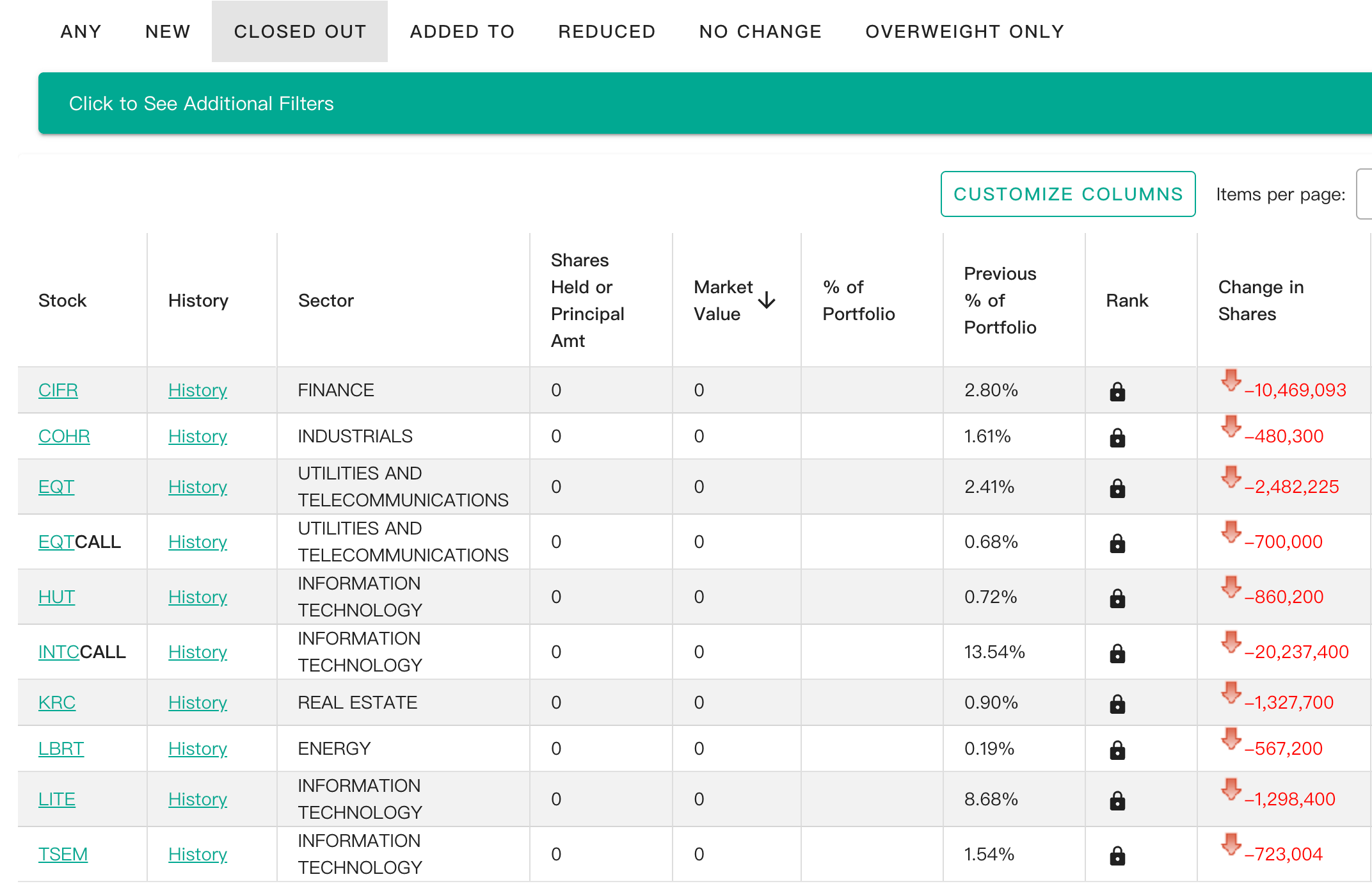
Regarding liquidated holdings, Situational Awareness LP's most significant move was completely unwinding the leverage on Intel call options (INTC CALL). In the previous disclosure period, Situational Awareness LP had allocated over 13% of its portfolio to Intel call options (a staggering 2.023 million option contracts), representing an extremely high-leverage directional bet. This quarter, it liquidated this position entirely, shifting to holding a minimal common stock position in Intel (0.07%).

Additionally, Situational Awareness LP completely liquidated its positions in LITE (previous weight 8.68%) and COHR (previous quarter weight 1.61%) in Q1. LITE and COHR are among the world's leading optical communication chip and optical transceiver module giants. This liquidation suggests Situational Awareness LP is exiting the AI optical module/network hardware sector.

Situational Awareness LP also liquidated its positions in CIFR (previous weight 2.80%) and HUT (previous weight 0.72%) in Q1. Both are cryptocurrency mining companies (including CORZ, which was reduced in the next section). Considering the increased holdings in similar companies like RIOT, CLSK, and BTDR, this might just be a routine portfolio adjustment.

Reduced Holdings: Significant Profit-Taking on BE

Finally, looking at the reduced holdings, Bloom Energy (BE) was the top holding disclosed in Situational Awareness LP's previous 13F filing. In Q1, the fund reduced its position by 3.59 million shares, with the portfolio weight plummeting from 15.87% last quarter to 6.42%.

Bloom Energy focuses on solid oxide fuel cell technology and is a key player in providing "on-site power" for data centers, bypassing traditional power grids for direct supply. Considering the retained position is still substantial, the reduction likely does not mean Situational Awareness LP is no longer bullish on the company, but rather appears to be a routine profit-taking move.

CoreWeave call options (CRWV CALL) were Situational Awareness LP's second-largest reduction (portfolio weight plummeted from 14.04% to 1.03%). As mentioned earlier, the fund has shifted to holding CRWV via common stock, so this is more of a de-leveraging operation.

Situational Awareness LP also reduced its position in Core Scientific (CORZ) by 2.74 million shares, lowering the portfolio weight from 7.59% to 2.84%. CORZ is a leading Bitcoin mining company transitioning to AI computing power hosting. However, given that Situational Awareness LP increased holdings in other mining companies still in the transition phase with more attractive valuations this quarter, reducing CORZ seems more like partial profit-taking.

What Exactly Is the 'AI Stock God' Thinking?

Looking only at the surface data of this 13F, many might draw a simple, crude conclusion — Leopold Aschenbrenner, who once proclaimed "AGI by 2027," has turned bearish on AI.

But the reality is clearly not that simple. Within Situational Awareness LP's portfolio structure, there simultaneously exist two seemingly contradictory yet highly unified main themes.

  • On one side, there is extreme vigilance toward short-term valuation bubbles in the "chip sector." Situational Awareness LP has used a shockingly large nominal allocation of PUTs (put options) to essentially "buy crash insurance" for nearly the entire AI semiconductor industry chain, including NVIDIA, Broadcom, and others;
  • On the other side, there is an almost obsessive optimism about the long-term demand for AI infrastructure. Whether it's CoreWeave, Bloom Energy, or a series of companies related to electricity, transformers, and data centers, they all essentially point to the same deterministic logic — the war for AI computing power has entered a deep-water phase.

This is perhaps Situational Awareness LP's most core judgment at present. What will truly be scarce in the future may not necessarily be GPU chips themselves, but rather the energy, power systems, and data center infrastructure required to sustain these GPUs' continuous operation. GPU production can scale, and advanced process technology will eventually ramp up, but megawatt-level power supply capacity, transformers, transmission systems, and large-scale data center construction cycles are difficult to replicate simultaneously in a short time. Compared to the "selling shovels" logic already fully priced in by the market, Leopold Aschenbrenner seems more focused on where the real potential bottlenecks might emerge in the next stage of the AI industry.

This also explains why Situational Awareness LP would simultaneously buy large-scale semiconductor put options to hedge against severe volatility risks in the AI hardware sector while continuing to heavily invest in GPU cloud services, power, and computing infrastructure assets.

In a sense, this 13F is less a simple holdings disclosure and more like Leopold Aschenbrenner's directional roadmap judgment for the next stage of evolution in the AI industry chain.

When a genius investor who rose to fame by going all-in on AI begins to deploy multi-billion-dollar nominal positions to buy insurance for the AI sector, it at least indicates one thing — even the most steadfast AI bulls of this era have begun to take volatility itself seriously.

Связанные с этим вопросы

QWhat is the total nominal value of Situational Awareness LP's holdings as of March 31, 2026, and how does it compare to the previous quarter?

AAs of March 31, 2026, Situational Awareness LP's total nominal holdings value was $13.7 billion. This represents an increase of 148% from the $5.52 billion reported on December 31, 2025.

QWhat is the most significant new position taken by Situational Awareness LP in Q1, and what does it consist of?

AThe most significant new position was a large-scale hedge against the AI semiconductor and computing hardware sector using put options. Notably, the top five put option holdings (on SMH, NVDA, ORCL, AVGO, and AMD) alone accounted for 48.7% of the fund's total nominal value.

QHow did Situational Awareness LP adjust its holdings in CoreWeave (CRWV) during Q1?

ASituational Awareness LP significantly increased its holdings in CoreWeave by over 1.07 million shares, bringing the position's value to $556 million (4.07% of the portfolio). It also drastically reduced its position in CRWV call options, lowering their weight from 14.04% to 1.03%, suggesting a move away from leverage into direct stock ownership.

QWhat major sector did Situational Awareness LP exit from in Q1, and which stocks were sold?

AThe fund exited from the AI optical module/network hardware sector. It completely sold out of its positions in LITE (which had an 8.68% weight previously) and COHR (which had a 1.61% weight previously).

QAccording to the article's analysis, what is the seemingly contradictory but unified core investment thesis behind Situational Awareness LP's Q1 portfolio adjustments?

AThe fund's strategy reflects two unified lines of thought: 1) Extreme caution towards short-term valuation bubbles in the 'chip' end of the AI sector, hedging with massive put options. 2) Persistent, almost obsessive optimism about the long-term demand for AI infrastructure, particularly the underlying energy, power systems, and data center facilities needed to power GPUs, which are seen as the next potential bottleneck.

Похожее

A Nation Blocks Chips, a Giant Buys a Nuclear Power Plant: Why It's Time to Seriously Consider DeAI

**Title: Great Powers Blockade Chips, Giants Buy Nuclear Plants: Why It's Time to Seriously Consider DeAI** In May 2026, the US closed loopholes for Chinese firms to acquire advanced NVIDIA chips via overseas subsidiaries. That same month, Kenya halted a $1B geothermal data center project involving Microsoft, fearing its immense energy consumption. Meanwhile, Huawei announced mass production of its Ascend AI chip. These disparate events underscore a new reality: the competition for computing power ("compute") has escalated beyond the tech industry, becoming a geopolitical and infrastructural battleground. A new era of oligopoly is forming, with control over the AI stack—from GPU chips (NVIDIA) and cloud platforms (AWS, Azure, Google Cloud) to foundational models (OpenAI, Anthropic)—concentrating in a few Western "AI Octopus" corporations. This centralization creates systemic risks: pricing power and platform lock-in for users, infrastructure fragility, and a widening "compute divide" that threatens to marginalize nations without independent AI capacity. An "AI Iron Curtain" is deepening through export controls. In response, some nations like Saudi Arabia and the UAE are investing heavily to buy compute power, aiming to transition from oil to AI economies. The EU seeks to triple its compute capacity by 2030 to reduce dependency. However, the spending gap is vast, with four US tech giants alone planning ~$750B in AI capex for 2026. The race is increasingly constrained by energy, with AI tasks consuming up to 1000x more power than web searches, pushing firms to even acquire nuclear plants. This landscape is fueling interest in Decentralized AI (DeAI). It proposes a third way: using open protocols to coordinate a global network of idle GPUs, independent developers, and data centers, creating an AI infrastructure without a single controlling entity. Leveraging blockchain and cryptographic verification, DeAI aims to break market concentration, disperse energy demands, reduce geopolitical dependencies, and enhance transparency. While still nascent in performance and stability, DeAI's core promise is not immediate superiority but providing a crucial alternative architecture to resist monopoly, censorship, and centralized power. As specialized AI hardware costs fall and open-source models flourish, the window to build this foundation is open. The very existence of such competition serves as a vital check against the inevitable abuse of concentrated power.

marsbit33 мин. назад

A Nation Blocks Chips, a Giant Buys a Nuclear Power Plant: Why It's Time to Seriously Consider DeAI

marsbit33 мин. назад

Outpoll Review: A Prediction Market Platform Built for Active Traders

Outpoll Review: A Prediction Market Platform Built for Active Traders In recent years, prediction markets have grown from a niche sector to a mainstream arena, attracting billions in trading volume and institutional capital. However, the user experience and tools for traders have not kept pace. Outpoll, a new global prediction market platform, aims to fill this gap by providing enhanced trading infrastructure for active and professional traders. Built on standard prediction market principles, Outpoll allows users to trade on the outcome of specific events. It uses fully collateralized contracts with USDC settlement, charges a competitive 0.1% fee per trade, and provides clear settlement rules upfront to minimize disputes. A key focus for Outpoll is its professional-grade trading tools. The platform supports limit and market orders, as well as take-profit and stop-loss orders for open positions—features uncommon in prediction markets. For automated trading, Outpoll offers comprehensive REST and WebSocket APIs, enabling portfolio management, price arbitrage, and integration with existing tools. The platform also features a creator-led market model, where approved experts and community leaders can create and manage markets for niche topics under platform supervision. Its integrated interface combines news feeds directly with trading functions, allowing users to monitor events and manage positions seamlessly. Outpoll launched with a native Android app (available on Google Play) and plans an iOS version later this year. In summary, Outpoll distinguishes itself with trader-focused tools, practical APIs, transparent and collateralized markets, integrated news, and an expanding creator program. For active traders, its advanced order types and API access alone make it a platform worth watching. Outpoll is now globally accessible via outpoll.com and Google Play.

marsbit41 мин. назад

Outpoll Review: A Prediction Market Platform Built for Active Traders

marsbit41 мин. назад

Bitwise: Crypto Becomes a Contrarian Investment, Three Logics to Understand the Current Market

**Summary** Matt Hougan, Bitwise's CIO, analyzes the current crypto market through three key lenses, arguing it has shifted from a momentum-driven to a contrarian investment. **1) Crypto Becomes a Contrarian Play:** The market is weak, with major assets like Bitcoin and Ethereum down significantly. Capital has moved to hot sectors like AI, leaving crypto as an "unloved" asset class. This transforms crypto investing from trend-following to a test of patience and fundamental analysis. Investors now favor projects with solid fundamentals (e.g., Hyperliquid) over speculative ones. **2) Regulatory Overhang:** The uncertain fate of the U.S. CLARITY Act, a major crypto regulatory framework, is a key headwind. With its passage in 2024 seen as far from guaranteed (estimates range from 30-55%), institutional capital remains on the sidelines, choosing less risky alternatives like AI stocks. The market needs clarity—whether the bill passes or fails—more than any specific outcome to move decisively. **3) Capital Rotates to New Fundamentals:** This cycle differs from past bear markets where money fled to Bitcoin. Now, capital seeks smaller assets with strong use cases. While major cryptos fell in May 2024, tokens like Hyperliquid (+72%), Zcash (+50%), and XLM (+44%) rallied on their specific fundamentals. This rotation confirms the new contrarian, fundamentals-driven logic and signals the bear market may be in its later stages. **Conclusion:** Short-term pressure persists due to regulatory uncertainty and competition from AI narratives. Investing in crypto now requires a contrarian mindset—acting against the crowd and focusing on fundamental value. Patience and targeting high-quality projects based on their merits are essential for capturing long-term gains.

marsbit1 ч. назад

Bitwise: Crypto Becomes a Contrarian Investment, Three Logics to Understand the Current Market

marsbit1 ч. назад

ChatGPT Might Be Disappearing Soon

OpenAI announced at its "Intelligence at Work" event that its coding assistant, Codex, will be fully integrated into the ChatGPT app within weeks. This move marks a strategic shift from a conversational AI (Chat) towards a unified "agentic" platform capable of execution. Codex, originally launched to compete with Anthropic's Claude Code, has grown rapidly to 5 million weekly active users, with 20% being non-developers like analysts and designers. Its enterprise revenue now constitutes 40% of OpenAI's total. The integration is the first step in creating a super-app combining ChatGPT (interface), Codex (execution engine), and the Atlas browser (web access). OpenAI also unveiled new Codex features: specialized Agent plugins for six professional roles, an "Annotations" tool for direct document editing, and a "Sites" function to turn work into shareable web apps. Internally, this reflects a power shift; the Codex team now leads core product strategy. While the ChatGPT brand remains for its vast user base, the platform's future is focused on autonomous agents that perform tasks, not just chat. The article notes that competition with Claude Code pushed OpenAI's development, with Codex competing on cost-effectiveness and accessibility rather than raw coding quality. It concludes that the essence of "ChatGPT" is evolving from a chatbot into an AI agent platform, with the name potentially becoming a legacy symbol of its original function.

marsbit1 ч. назад

ChatGPT Might Be Disappearing Soon

marsbit1 ч. назад

Торговля

Спот
Фьючерсы

Популярные статьи

Неделя обучения по популярным токенам (2): 2026 может стать годом приложений реального времени, сектор AI продолжает оставаться в тренде

2025 год — год институциональных инвесторов, в будущем он будет доминировать в приложениях реального времени.

1.8k просмотров всегоОпубликовано 2025.12.16Обновлено 2025.12.16

Неделя обучения по популярным токенам (2): 2026 может стать годом приложений реального времени, сектор AI продолжает оставаться в тренде

Обсуждения

Добро пожаловать в Сообщество HTX. Здесь вы сможете быть в курсе последних новостей о развитии платформы и получить доступ к профессиональной аналитической информации о рынке. Мнения пользователей о цене на AI (AI) представлены ниже.

活动图片