Grok's Latest Model Gets a 'Bonus' from Cursor, Musk: Significant Improvement in Coding

marsbitОпубликовано 2026-05-26Обновлено 2026-05-26

Введение

Elon Musk announced that xAI's new Grok foundation model, V9-Medium (1.5T), has completed training and is expected to launch in 2-3 weeks. Key improvements focus on programming capabilities, achieved by supplementing the model's training with substantial data from Cursor. Musk emphasized a "huge improvement" in coding performance. Concurrently, xAI's new AI programming agent tool, Grok Build, has entered an early beta testing phase. It functions as a CLI tool/agent for developers, featuring planning modes, parallel subagents, and integration capabilities. This move aligns with xAI's broader push into the AI coding space, following its $60 billion acquisition of Cursor last month and the recruitment of key Cursor engineering talent. The integration of Cursor's data and expertise is seen as a major boost for Grok's real-world engineering and coding proficiency.

You guys have been making coding products so competitive, forcing me, old Musk, to step in again!

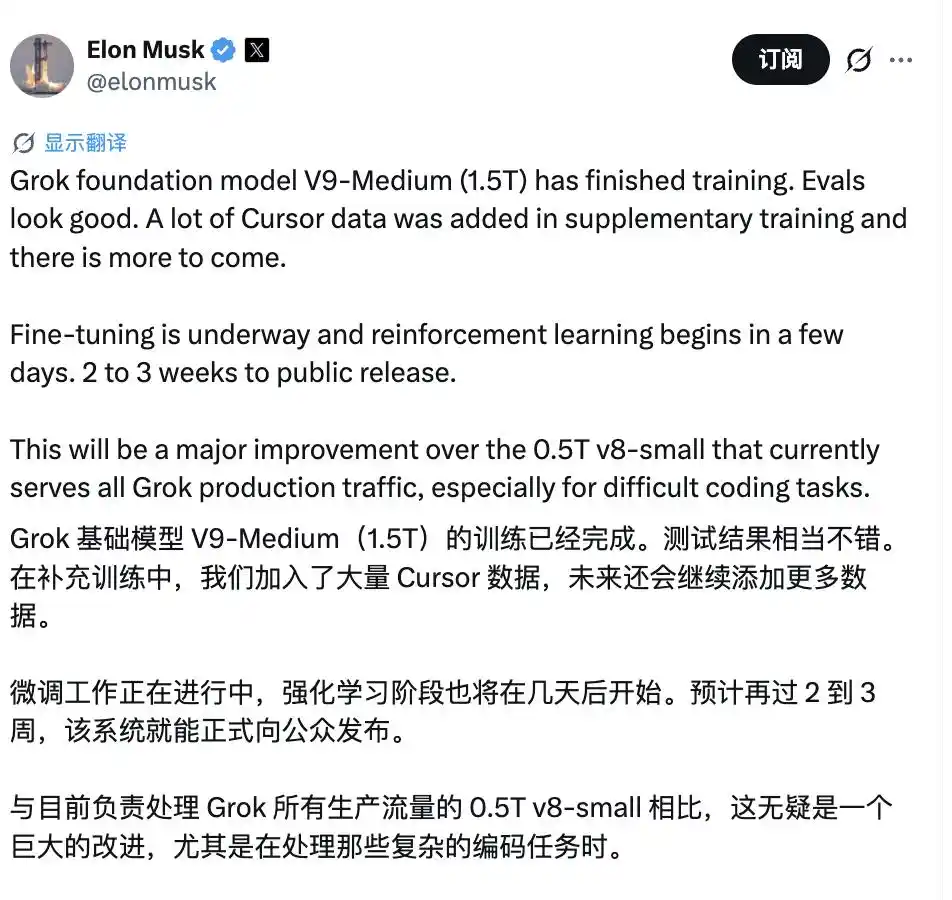
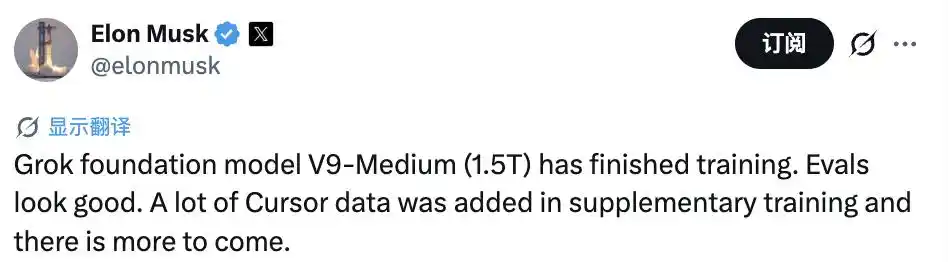
Musk posted on X, revealing that xAI's own Grok foundation model V9-Medium (1.5T) has completed training.

It is expected to be officially released in about 2 to 3 weeks:
Yes, this new model is clearly making a big push towards programming capabilities.

Musk specifically mentioned that a large amount of Cursor data was added to the supplementary training of V9-Medium, with more to be added later.

What does this mean—

(Probably suggesting, 'Look beyond the neighbors when it comes to coding, check out my house too~')

While hyping the new model, their own new programming product isn't idle either.

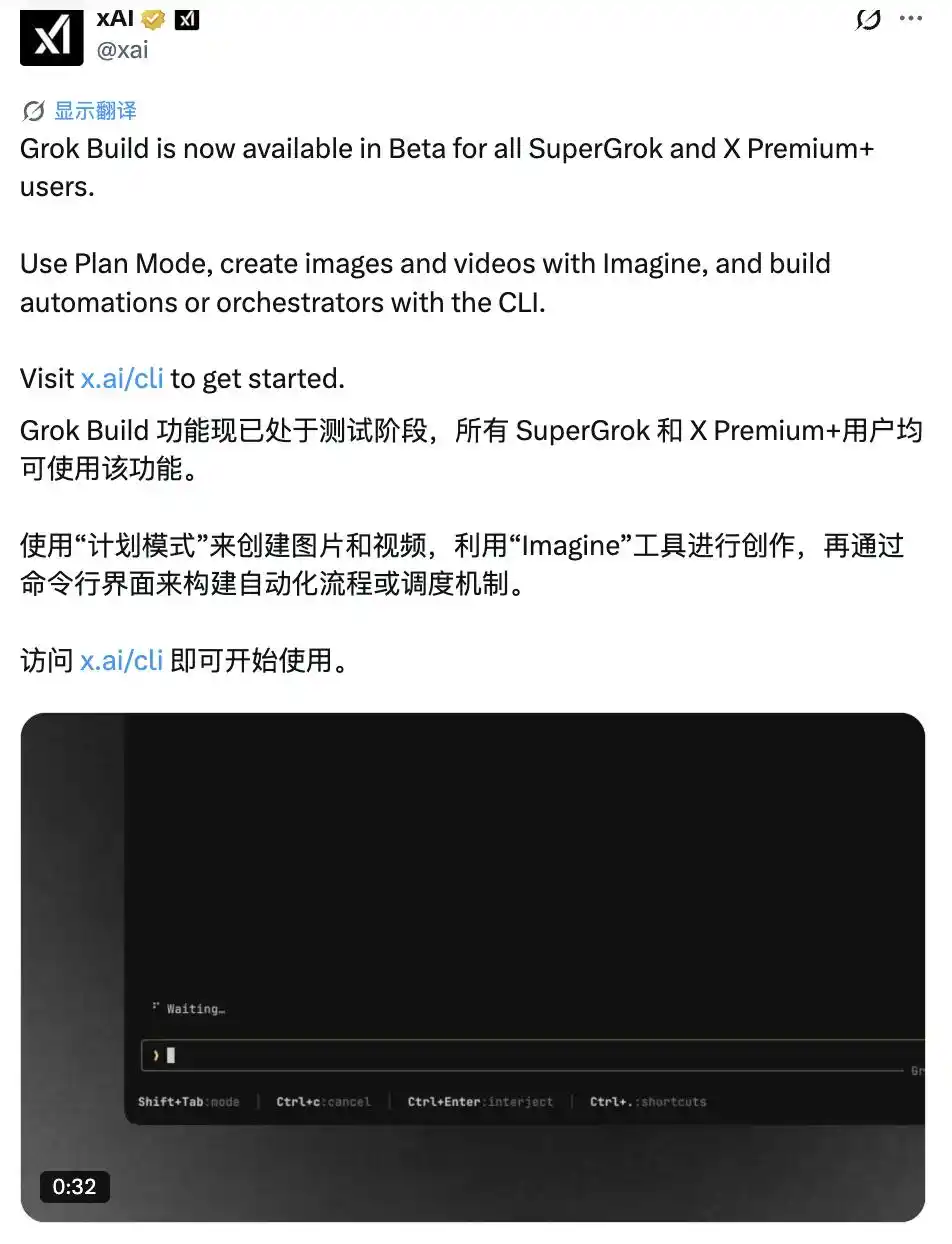
xAI's newly released AI programming agent tool Grok Build has also entered the early Beta testing phase, and some users can use it now~
Emm...

It's only been just over a month since acquiring Cursor, and Grok has already started getting its 'bonus meal'.

On one hand, feeding the new model with Cursor data; on the other hand, pushing their own AI programming Agent.

Anyway, Old Musk's Code, better late than never!

Grok's New Model Training is Complete!

Ultimately, this coding stuff is just too competitive...

Looking at the timeline, it's been almost a year since the Grok 4 series, based on the v8-small foundation model, was released.

Actually, the programming capabilities improved a bit with the last generation model, but they just couldn't keep up with how fast the neighbors are iterating!

So, this time xAI didn't choose incremental updates, but saved up for a big move~

Grok's new foundation model, V9-Medium (1.5T), is directly targeting programming capabilities and the developer market.

Even Musk himself couldn't wait to say: The coding ability is much stronger. (doge)

In terms of parameters, V9-Medium has directly reached a scale of 1.5T.

You know, currently all Grok's production traffic is carried by the 0.5T v8-small model, which is only 0.5T in size.

So calculating this way, it's a direct jump to three times the parameters???

The significant increase in parameter scale, of course, also means the model is expected to make considerable progress in deep reasoning capabilities and knowledge reserves.

A larger model capacity often allows it to better understand complex contexts, perform longer chain-of-thought reasoning, and handle more challenging real-world development tasks~

However!

The most interesting part of this new model isn't in the parameters, but in its programming prowess—

Old Musk specifically mentioned: xAI intentionally added a large amount of 'Cursor data' to the training of V9-Medium (1.5T).

Everyone should know that Cursor's data isn't an ordinary code repository; it's the real workflow of millions of developers.

Cursor data is more likely to tell the model how developers describe requirements, locate problems, have AI read context, modify files, fix errors, and continue asking questions in real projects.

Consider it a big boost of 'real-world engineering feel' for Grok......

As for when the model will be released?

The official word is that the foundation training of V9-Medium has been fully completed.

Fine-tuning work is in full swing, and the reinforcement learning phase will also start in a few days.

According to xAI's plan, this new model can be officially released to the public in 2 to 3 weeks.

Additionally, it's worth noting—

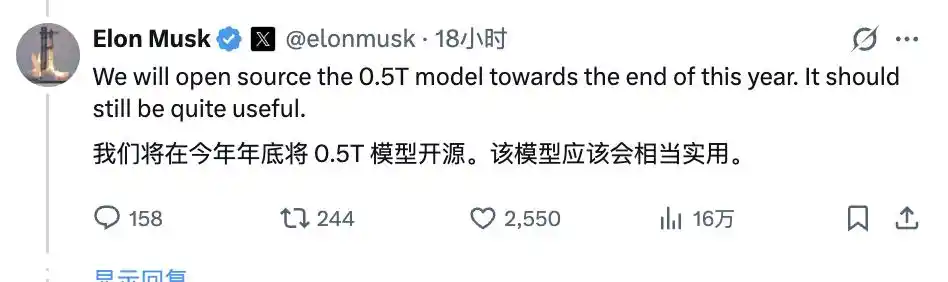
While promoting their new model, Musk also left an Easter egg in the comments:

The 0.5T model will be open-sourced by the end of this year, it's very practical too!
(You can look forward to it a little~)

AI Programming Tool Grok Build Also Starts Testing

Besides the new model, xAI's own new AI programming tool product has also made new progress.

Currently, the AI programming agent tool Grok Build has entered the early Beta testing phase.

Let me briefly introduce, Grok Build is xAI's own programming Agent and CLI tool.

In form, it's actually closer to terminal programming products like Claude Code, Codex CLI.

Developers can invoke it in a local project directory, letting the AI directly read the project, understand the context, plan changes, modify code files, and so on.
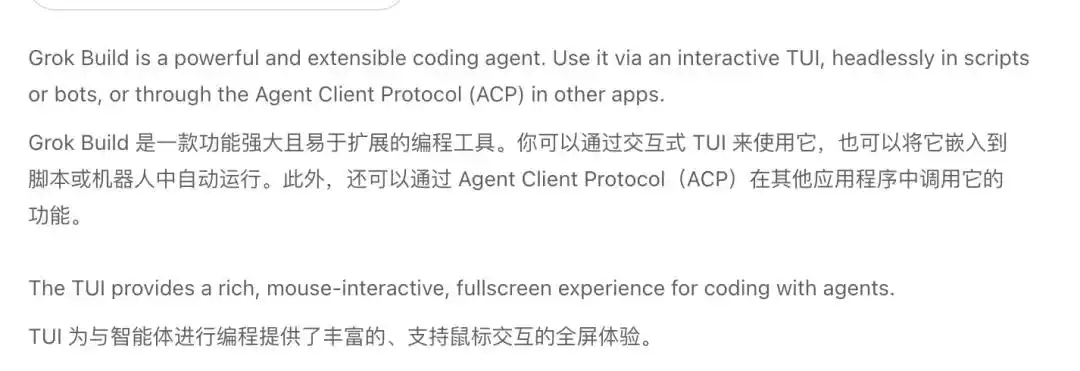
Judging from the official demo video, Grok Build's main promoted capabilities have a strong AI Coding flavor:

Plan Mode: After the user inputs a requirement, Grok Build won't act immediately. Instead, it first formulates a detailed execution plan, lets the user confirm, and then proceeds.

Multiple Subagents Working in Parallel: For large, complex tasks, Grok Build will delegate work to Subagents that run in parallel.

Skills, Marketplace, MCPs Integration: We can easily extend Grok Build's capabilities, invoking various ready-made tools and plugins.

Other Mentioned Capabilities: Supports creating images and videos, building automated workflows, etc.

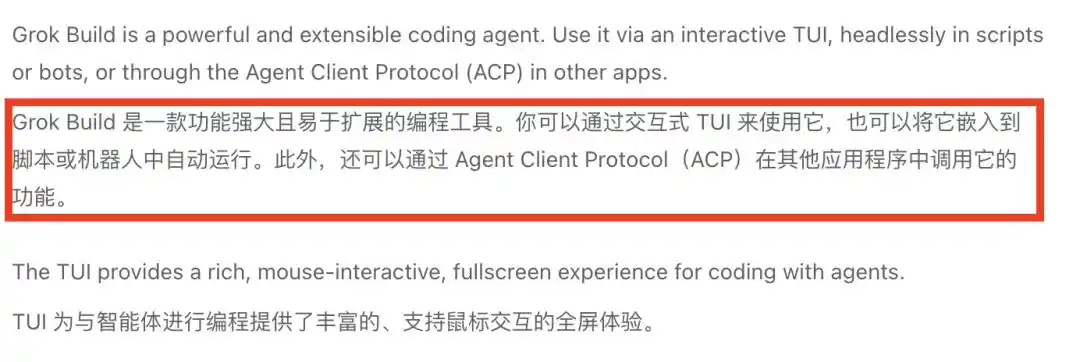
Regarding specific usage methods, xAI's official documentation also provides three entry points—

One is Interactive TUI.

That is, opening a full-screen interactive interface in the terminal where developers can directly converse back and forth with Grok Build, view plans, and execute tasks.

One is Headless Mode.

More suitable for being embedded into scripts, bots, or automated processes, letting it run tasks in the background according to instructions.

Another is through the Agent Client Protocol to integrate with other applications.

Turning Grok Build into a programming Agent that can be called by external tools.

(Many ways, no shortage of choices~)
On one side, xAI is strengthening the new generation foundation model's code capabilities with Cursor data.

On the other side, launching a programming Agent like Grok Build to directly enter the AI Code tool battlefield.

It seems Musk isn't planning to just compete with Grok in the chatbox this time. (doge)

After Acquiring Cursor, Musk Races to Catch the Coding Tailwind

Old Musk's move of feeding the new model with Cursor data and starting Grok Build testing isn't too sudden.

After all, a few months ago, while xAI was conducting internal layoffs and adjustments, they started heavily engaging with and bringing in Cursor's talent and experience—

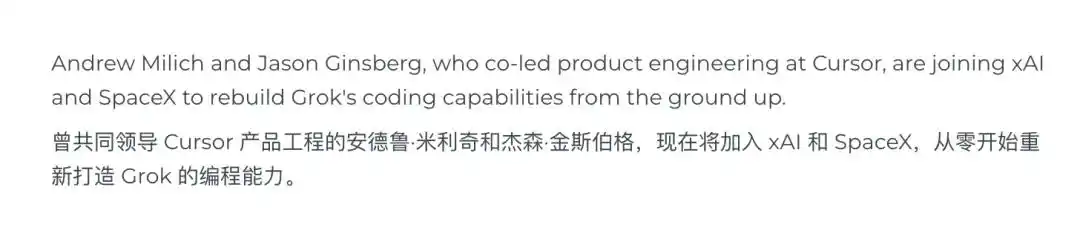
Andrew Milich and Jason Ginsberg, Cursor's two core engineering leads who helped grow Cursor from 0 to a valuation of tens of billions of dollars.

Joined xAI one after another, reporting directly to Musk, with the core task of rebuilding Grok's coding capabilities from the ground up.
Then came last month.

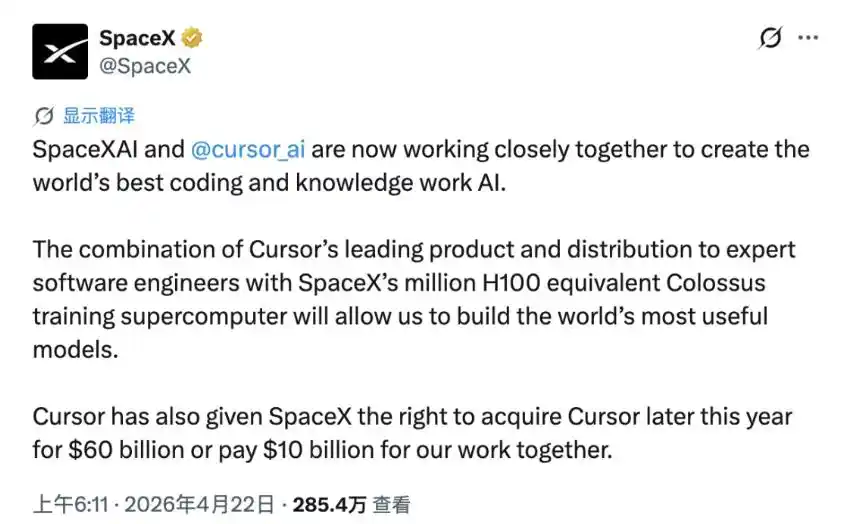
Musk stopped playing the talent poaching game and directly targeted Cursor the company itself.

Acquiring Cursor for a price of $600 billion. You should know, this number is more than double Cursor's valuation from November last year…
So looking back, in just one month, Old Musk's Cursor 'stock-up' has already started showing effects on Grok:

Just half a month ago, Grok Build was only just appearing, now it's already starting broad testing in developers' hands.

As for V9-Medium, it was personally named by Musk, stating that a large amount of Cursor data was added to its supplementary training, with more to be added later.

Not only that, in between, Musk also revealed that the new Grok model is being trained normally on the Colossus 2 cluster.

So many actions, so much code vibes.

Therefore, when we look back at the phrase 'more to come' in V9-Medium, it now seems quite thought-provoking.
Translated, I guess it means—

Every extra day Cursor serves customers, Grok gets an extra day of bonus meals.

Next, let's see how Old Musk leads Grok formally into the Code fight, looking forward to it~

References:

[1]https://openrouter.ai/x-ai/grok-build-0.1?utm

[2]https://x.com/elonmusk/status/2058787384364265734

[3]https://x.com/JasonBud/status/2058974659648123084

[4]https://x.com/xai/status/2058973760708091907

This article is from the WeChat public account "Quantum Bit", author: Meng Yao

Связанные с этим вопросы

QWhat is the name and key specification of Grok's new base model mentioned in the article, and when is its expected release?

AThe new base model is Grok's V9-Medium (1.5T). It is expected to be publicly released in about 2 to 3 weeks.

QAccording to the article, what specific type of data was added to the training of the V9-Medium model to enhance its programming capabilities?

AThe training of the V9-Medium model incorporated a large amount of 'Cursor data', which consists of real developer workflows and interactions.

QWhat is the name of xAI's new AI programming agent tool, and what is its current development status?

AThe new AI programming agent tool is called Grok Build. It is currently in an early Beta testing phase, available to some users.

QHow does the parameter size of the new V9-Medium model compare to the previous v8-small model that powers the current Grok?

AThe V9-Medium model has a parameter size of 1.5 trillion (1.5T), which is three times larger than the 0.5 trillion (0.5T) parameters of the previous v8-small model.

QWhat significant business move did Elon Musk's xAI make regarding Cursor, and how is it already benefiting Grok according to the article?

AxAI acquired the company Cursor. The benefits are already showing as Cursor's data is being used to train the new V9-Medium model, and Cursor's engineering talent has joined xAI to help rebuild Grok's coding capabilities from the ground up.

Похожее

A History of Technological Evolution Powered by Electricity: Aluminum, Bitcoin, and AI

The journey from the Rockdale aluminum smelter in Texas to space-based data centers illustrates a core economic principle: whoever controls the cheapest electricity dictates the use of computing power. The evolution is clear. Old industrial sites with pre-existing, high-capacity power grids are being repurposed. In Rockdale, a former Alcoa plant now houses vast Bitcoin mining rigs, which are increasingly being replaced by AMD chips for AI training. The logic is purely financial: while smelting aluminum yields $0.17–0.27 per kWh and Bitcoin mining $0.05–0.11, AI inference on H100 GPUs generates $1.27–3.67 per kWh. Recent deals confirm the rush for power infrastructure. Riot Platforms leases space to AMD; TeraWulf bought an old Kentucky aluminum plant for its grid; NYDIG secured a New York site for its cheap hydropower to mine Bitcoin. As AI giants like Anthropic, Microsoft, Google, and Amazon aggressively expand, they now directly compete with crypto miners for the same industrial power resources, often outbidding them. This has led to a decline in Bitcoin's global hash rate and a wave of miner conversions to AI data centers. This "digital resource curse" extends globally. Gulf nations, long offering subsidized power to attract heavy industry like aluminum, are now pivoting to become AI and cloud computing hubs—exporting computational power instead of physical commodities. Similarly, Bhutan halted its sovereign Bitcoin mining to sell hydropower directly to India for a steadier return. The frontier is space. Projects like Starcloud plan orbital solar-powered data centers, leveraging constant sunlight and natural cooling, with Bitcoin mining as a secondary use for surplus power. Even consumer brands are transforming; Allbirds shifted from footwear to AI infrastructure, causing its stock to surge. Meanwhile, crypto projects like Bittensor, Render, and Akash propose a decentralized alternative, creating markets to aggregate distributed, idle computing resources from individual hardware. The underlying infrastructure—the power grid—remains constant. As profit margins shift, the facilities built upon it will continue to evolve, from aluminum to Bitcoin to AI and beyond, always chasing the highest yield per kilowatt-hour, whether in Texas, Abu Dhabi, or low Earth orbit.

marsbit7 мин. назад

A History of Technological Evolution Powered by Electricity: Aluminum, Bitcoin, and AI

marsbit7 мин. назад

Conquering is easy, governing is hard: Polymarket must bow to regulations to plant its flag globally

Polymarket, a decentralized prediction market platform, faces significant regulatory hurdles in its global expansion. Its "permissionless" model, which bypasses traditional identity and financial controls, has led to widespread crackdowns. India recently blocked the site, categorizing it as illegal online gambling under new 2025 laws. Brazil also banned it and similar platforms, though it simultaneously authorized a regulated, investor-only version on its national exchange. Across Europe, countries like France, Portugal, and the Netherlands are enforcing bans based on existing gambling and financial regulations. To enter key markets, Polymarket is adopting a pragmatic, compliant approach. In the U.S., it paid a $1.12 million fine, acquired a CFTC-licensed exchange, and now operates a regulated, KYC-mandatory platform for American users. It also secured a major investment from Intercontinental Exchange (ICE), which will distribute its prediction data to institutional investors. In Japan, where gambling laws are strict, Polymarket has begun a long-term lobbying effort, aiming for legalization by 2030 through building institutional partnerships and community presence. Despite these challenges, the prediction market industry is booming, with global volume projected to surge from $51 billion to potentially $1 trillion by 2030. Polymarket's core dilemma remains: adapting its decentralized, anonymous model to fit within sovereign regulatory frameworks focused on licensing, consumer protection, and anti-money laundering rules. Its survival in each market depends on navigating this complex political and legal landscape.

marsbit10 мин. назад

Conquering is easy, governing is hard: Polymarket must bow to regulations to plant its flag globally

marsbit10 мин. назад

It's Easier to Conquer than to Govern: Polymarket Must Bend to Every Rule to Plant Its Flag Globally

Polymarket, a decentralized prediction market platform, is facing significant regulatory hurdles as it expands globally, illustrating the tension between permissionless, crypto-native platforms and national legal frameworks. The platform, which allows users to bet on event outcomes, was recently blocked in India under new online gambling laws and faces similar outright bans in Brazil and Ukraine, the latter citing moral objections to wagering on active war events. In Europe, countries like France, the Netherlands, and the UK are restricting access by enforcing existing gambling and financial derivatives regulations, forcing Polymarket to geo-block users or operate in view-only modes. To navigate this complex landscape, Polymarket is adopting a market-by-market, compliant strategy. In the U.S., it paid a $1.4 million CFTC fine, acquired a licensed exchange (QCEX) for $112 million, and now operates a regulated U.S. entity with strict KYC, abandoning anonymity. It also secured a major investment from Intercontinental Exchange (ICE), which will distribute its prediction data to institutional investors. In Japan, a high-potential market, it has begun a long-term lobbying effort aiming for legalization by 2030, acknowledging the country's strict anti-gambling laws and slow regulatory processes. The article concludes that while the global prediction market is growing rapidly—projected to reach $2.4 trillion by 2030—Polymarket's core challenge is transforming its decentralized model to fit sovereign regulatory systems built on licensing, consumer protection, and anti-money laundering rules. Its survival depends on proving its legitimacy in each jurisdiction.

链捕手15 мин. назад

It's Easier to Conquer than to Govern: Polymarket Must Bend to Every Rule to Plant Its Flag Globally

链捕手15 мин. назад

Торговля

Спот
Фьючерсы

Популярные статьи

Как купить S

Добро пожаловать на HTX.com! Мы сделали приобретение Sonic (S) простым и удобным. Следуйте нашему пошаговому руководству и отправляйтесь в свое крипто-путешествие.Шаг 1: Создайте аккаунт на HTXИспользуйте свой адрес электронной почты или номер телефона, чтобы зарегистрироваться и бесплатно создать аккаунт на HTX. Пройдите удобную регистрацию и откройте для себя весь функционал.Создать аккаунтШаг 2: Перейдите в Купить криптовалюту и выберите свой способ оплатыКредитная/Дебетовая Карта: Используйте свою карту Visa или Mastercard для мгновенной покупки Sonic (S).Баланс: Используйте средства с баланса вашего аккаунта HTX для простой торговли.Третьи Лица: Мы добавили популярные способы оплаты, такие как Google Pay и Apple Pay, для повышения удобства.P2P: Торгуйте напрямую с другими пользователями на HTX.Внебиржевая Торговля (OTC): Мы предлагаем индивидуальные услуги и конкурентоспособные обменные курсы для трейдеров.Шаг 3: Хранение Sonic (S)После приобретения вами Sonic (S) храните их в своем аккаунте на HTX. В качестве альтернативы вы можете отправить их куда-либо с помощью перевода в блокчейне или использовать для торговли с другими криптовалютами.Шаг 4: Торговля Sonic (S)С легкостью торгуйте Sonic (S) на спотовом рынке HTX. Просто зайдите в свой аккаунт, выберите торговую пару, совершайте сделки и следите за ними в режиме реального времени. Мы предлагаем удобный интерфейс как для начинающих, так и для опытных трейдеров.

1.4k просмотров всегоОпубликовано 2025.01.15Обновлено 2025.03.21

Как купить S

Sonic: Обновления под руководством Андре Кронье – новая звезда Layer-1 на фоне спада рынка

Он решает проблемы масштабируемости, совместимости между блокчейнами и стимулов для разработчиков с помощью технологических инноваций.

2.3k просмотров всегоОпубликовано 2025.04.09Обновлено 2025.04.09

Sonic: Обновления под руководством Андре Кронье – новая звезда Layer-1 на фоне спада рынка

HTX Learn: Пройдите обучение по "Sonic" и разделите 1000 USDT

HTX Learn — ваш проводник в мир перспективных проектов, и мы запускаем специальное мероприятие "Учитесь и Зарабатывайте", посвящённое этим проектам. Наше новое направление .

1.8k просмотров всегоОпубликовано 2025.04.10Обновлено 2025.04.10

HTX Learn: Пройдите обучение по "Sonic" и разделите 1000 USDT

Обсуждения

Добро пожаловать в Сообщество HTX. Здесь вы сможете быть в курсе последних новостей о развитии платформы и получить доступ к профессиональной аналитической информации о рынке. Мнения пользователей о цене на S (S) представлены ниже.

活动图片