Harvard and Others Exit, Six Core Talents Depart in a Month: What's Happening to Ethereum?

链捕手Опубликовано 2026-05-20Обновлено 2026-05-20

Введение

Ethereum faces significant internal and external pressures, marked by a wave of high-profile departures from its core development team and a loss of confidence from major institutional investors. Within four months, at least seven key figures—including researchers, protocol leads, and a former executive director—have left the Ethereum Foundation. This exodus, partly triggered by controversy over a new "mission statement" requiring employee sign-off, risks derailing critical roadmap upgrades like PeerDAS and Verkle trees, and has already contributed to delays in the planned Glamsterdam upgrade. Compounding the internal instability, major institutions are reducing their exposure. Goldman Sachs slashed its iShares Ethereum Trust holdings by approximately 70%, and Harvard's endowment fund completely exited its $87 million Ethereum ETF position. Concurrently, the Ethereum Foundation itself has been unstaking and selling ETH for "treasury rebalancing," further unsettling the market. These challenges emerge as Ethereum's competitive dominance erodes. Its share of the total DeFi market has fallen to around 54%, with rivals like Solana and Base gaining ground. In fee revenue, it was recently outpaced by newer chains like Hyperliquid. Furthermore, a trend of institutions exploring proprietary or hybrid blockchains (exemplified by Circle's Arc) threatens Ethereum's position as the premier settlement layer for institutional assets. While founder Vitalik Buterin's vision for Ethereum a...

Author: Zhou, ChainCatcher

Recently, the Ethereum Foundation has once again been hit by personnel changes, with core researchers Carl Beek and Julian Ma officially announcing their departure.

Since the beginning of this year, at least 7 core members or senior contributors have left one after another, from the Co-Executive Director to protocol researchers, from upgrade coordinators to cryptography experts. This has sparked clear concerns in the community about the Foundation's stability and execution capabilities.

Meanwhile, institutional holdings data have been released one after another. Goldman Sachs reduced its position in BlackRock's ETHA by about 70%, the Harvard University Endowment Fund completely liquidated its previously purchased nearly $87 million Ethereum ETF holdings, and Korea's seventh-largest pension relief company recorded a loss of approximately $32.73 million due to investing in an Ethereum leveraged ETF.

Furthermore, the Ethereum Foundation recently unstaked 21,271 ETH from Lido and has repeatedly sold ETH on-chain for treasury rebalancing.

The internal core team is leaving, external large capital is exiting, and the Foundation itself is reducing its holdings. Ethereum is being 'voted with their feet' by different types of participants simultaneously.

Trigger for the Departure Wave: The Signing Controversy Over the Mission Statement

The direct trigger for this wave of departures is the new 38-page Mission Statement released by the Foundation in March.

The statement explicitly states that the Foundation is not the owner or central authority of Ethereum, but merely one of many supporters. It proposes gradually reducing its own influence and introduces the concept of a walkaway test, meaning the Ethereum ecosystem should be able to operate independently and healthily even if the Foundation completely withdraws.

The statement also emphasizes the CROPS principles: Censorship Resistance & Capture Resistance, Open Source, Privacy, and Security.

Vitalik Buterin subsequently publicly expressed support, stating he would double down on Ethereum and positioning it as a "technical safe haven" — maintaining user self-sovereignty and ensuring that no individual, organization, or ideology can form absolute control in cyberspace.

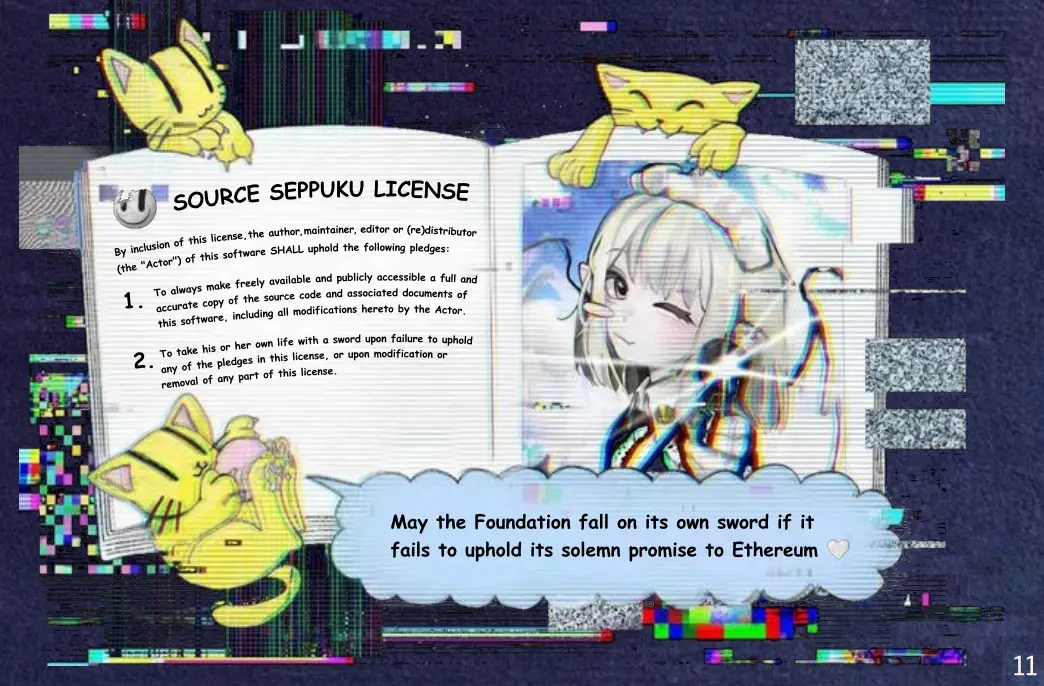
However, the execution of the statement has sparked controversy. Reportedly, the Foundation required internal employees to sign off on the statement's content, or potentially face departure or compensation adjustments. The Foundation even created a "SOURCE SEPPUKU LICENSE" meme graphic, expressing the resolve to "self-terminate" if it fails to fulfill its commitments.

This contradictory approach of "declaring an intention to step back, yet mandating loyalty signatures" became a significant catalyst for this round of departures.
Within just four months, 7 core members or senior contributors have left one after another:

  • February: Co-Executive Director Tomasz Stańczak stepped down after only 11 months in the role;
  • April: Josh Stark, deeply involved in upgrades like The Merge and Dencun, and Protocol Guild coordinator Trent Van Epps, departed;
  • May: Protocol co-leads Barnabé Monnot, Tim Beiko, Alex Stokes (on leave) as well as researcher Carl Beek (7-year tenure, led KZG ceremony and early Beacon Chain design) and Julian Ma (4-year tenure, led FOCIL and Fast Confirmation Rule) left.
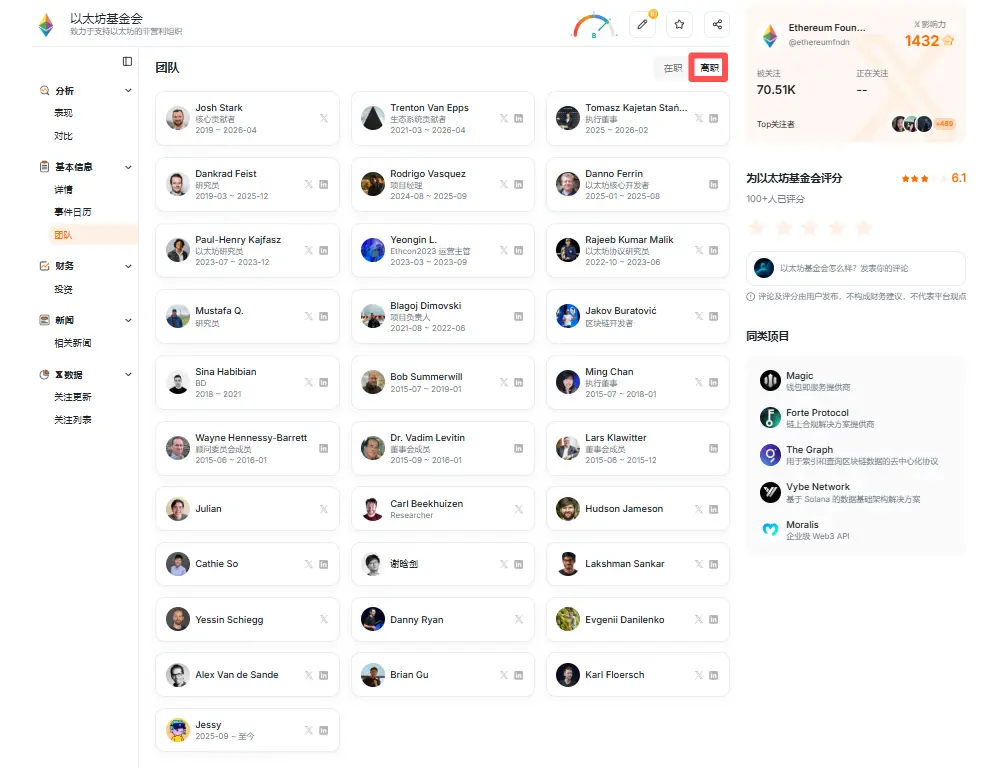
List of Ethereum Foundation Departures Source: RootData

What these people took with them is far more than just job titles; it's a wealth of tacit knowledge and intuition difficult to document. This includes the trade-offs and judgments made in past upgrades, the trust relationships between different teams, how to handle controversies during EIP proposal advancement, and the coordination skills in All Core Devs meetings that can only be understood implicitly.

Protocol Guild contributor cheeky-gorilla stated at the EthCC[9] conference that salaries for Ethereum L1 core developers are 50% to 60% lower than comparable market positions, while high-performance new chains like Monad and leading L2 projects are poaching with compensation packages over 10 times higher. He pointed out that once experienced senior researchers familiar with the underlying protocol logic are lost, key roadmap items like PeerDAS and Verkle trees face the risk of a substantive standstill.

This risk might already be materializing. The Glamsterdam upgrade, originally planned for June 2026, has seen delays. Based on the latest testnet progress and Interop meeting feedback, the actual mainnet launch is more likely to be postponed to the third quarter. The core goal of Glamsterdam is to increase the Gas limit from the current ~60 million to 200 million, a crucial step for Ethereum to enhance its mainnet competitiveness.

Recently, the EF appointed three new co-leads — Will Corcoran, Kev Wedderburn, and Fredrik Svantes — to take over the Protocol team. Their tenures at EF range from 2 to 7 years. However, trust takes time to build, coordination networks take time to rebuild, and Ethereum's upgrade pace doesn't seem to be able to wait that long.

Meanwhile, the EF recently unstaked 21,271 ETH from Lido and has repeatedly sold ETH on-chain for treasury rebalancing. Against the backdrop of personnel turmoil already raising external concerns, this series of on-chain operations has further amplified market anxiety.

Dual Pressure from External Competition and Institutional Confidence

The internal turmoil coincides with the most intense period of external competition.

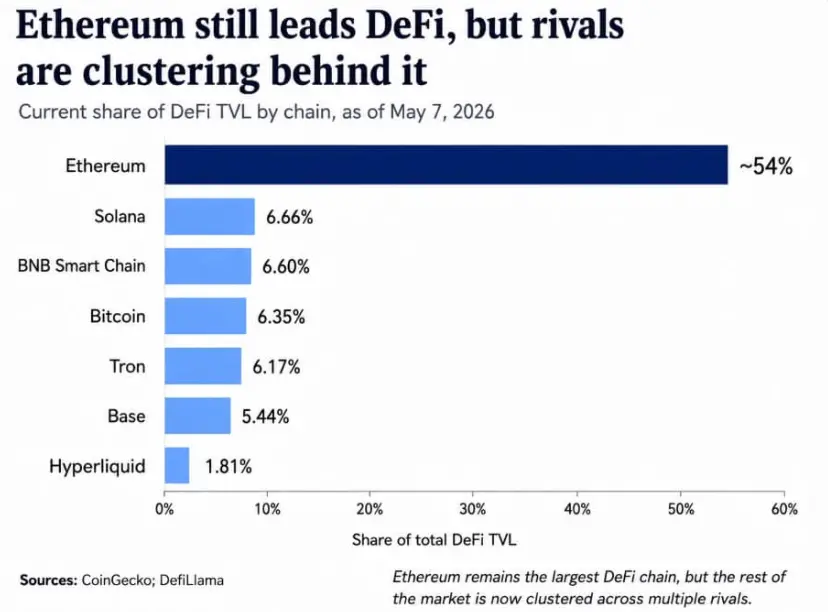
According to DefiLlama data, as of early May, Ethereum's share of Total Value Locked in DeFi has dropped from 63.5% at the beginning of 2025 to about 54% currently, hitting a near one-year low. Ethereum's DeFi TVL is approximately $45.4 billion, still significantly leading, but public chains like Solana (6.66%), BNB Chain (6.60%), Bitcoin (6.35%), Tron (6.17%), Base (5.44%), and Hyperliquid (1.81%) are gradually eroding its share.
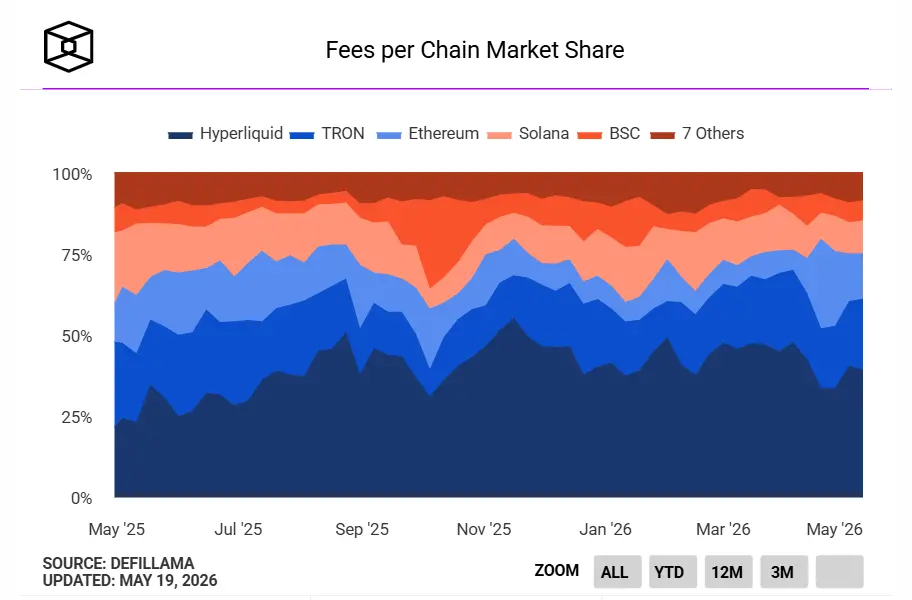
In terms of fee revenue, in the first week of May, Hyperliquid captured about 43% of the market share with approximately $11 million in fees, leading all public chains. In contrast, Ethereum's fee revenue was about $3 million, accounting for only about 13%. Solana's fee revenue was about $2 million, making up about 10%.
Regarding the RWA market, as traditional asset management institutions accelerate the push for on-chain assets, various public chains are competing for institutional issuers. The current on-chain RWA market cap exceeds $65 billion, up about 44% from around $45 billion at the beginning of the year. Among them, Ethereum currently holds about 33% market share and remains the primary deployment network for institutional tokenized assets; Provenance Blockchain accounts for about 27%, while BNB Chain, XRP Ledger, and Solana each hold about 6%.

Meanwhile, a new trend is emerging. Crypto KOL Kaylyn (@kaylyn_0x) pointed out that due to the decreasing cost and technical barriers of launching a chain, Wall Street institutions are beginning to actively explore building their own public chains or hybrid architectures to gain stronger compliance control and predictable performance. Circle's Arc public chain is a typical case; its testnet has already processed over 150 million transactions, has secured $222 million in funding from institutions like BlackRock, and its mainnet is about to launch. Its future threat to Ethereum's position as an institutional settlement layer should not be underestimated.

At the secondary market operation level, Q1 holdings reports show that Goldman Sachs significantly reduced its Ethereum exposure in the first quarter, cutting its position in BlackRock's iShares Ethereum Trust (ETHA) by about 70%, leaving only about $114 million. The Harvard University Endowment Fund completely liquidated its previously purchased nearly $87 million in Ethereum ETF holdings.

Additionally, Korea's seventh-largest pension relief company, Bumo Sarang, invested 59.5 billion won of operating funds last year into the daily double-return leveraged ETF of Ethereum-themed stock Bitmine, incurring a loss of 49.3 billion won (approximately $32.73 million).

These actions may reflect that some traditional institutions are losing patience with Ethereum's short-term returns and long-term stability.

Conclusion

Multiple signals collectively point to Ethereum's current core challenge: a dual lag in execution capability and narrative appeal regarding its positioning as an institution-grade mature infrastructure.

In his speech at the Hong Kong Web3 Carnival, Vitalik Buterin clearly stated that Ethereum is not competing on speed, but aims to be the most secure and decentralized "world computer" and "technical safe haven." His latest lengthy article further elaborates that AI-assisted formal verification is the core of Ethereum's next stage, with the goal of making Ethereum a "safety kernel" whose security can be mathematically proven.

This vision is clear, and the technical path is credible. But realizing the vision requires stable coordination capabilities and continuous accumulation of experience — it's just that precisely during this most critical window, these two things are rapidly diminishing.

Связанные с этим вопросы

QWhat is the direct trigger for the recent wave of departures at the Ethereum Foundation according to the article?

AThe direct trigger is the Ethereum Foundation's new 38-page mission manifesto released in March. It introduced a 'walkaway test' and required internal staff to sign it, creating a perceived contradiction between announcing a reduced role and demanding formal agreement.

QHow has the competitive landscape for Ethereum changed in the DeFi space, according to the data mentioned?

AAs of early May, Ethereum's share of the total DeFi Total Value Locked (TVL) has dropped to about 54% from 63.5% at the start of 2025. Competitors like Solana, BNB Chain, Bitcoin, Tron, Base, and Hyperliquid are gradually gaining market share.

QWhat is the Glamsterdam upgrade, and why is its potential delay concerning?

AGlamsterdam is a key upgrade aimed at increasing Ethereum's gas limit from about 60 million to 200 million, a crucial step for improving the mainnet's competitiveness. Its potential delay from a planned June 2026 pushback to Q3 highlights the impact of losing experienced core developers on the project's roadmap execution.

QWhat new trend regarding blockchain infrastructure is emerging among traditional financial institutions, as mentioned in the article?

AWall Street institutions are beginning to explore building their own public or hybrid blockchains to gain greater compliance control and predictable performance. The article cites Circle's Arc blockchain, backed by BlackRock, as a prime example of this trend that could threaten Ethereum's role in institutional settlement.

QWhat is Vitalik Buterin's stated long-term vision for Ethereum's role, as mentioned in the conclusion?

AVitalik Buterin envisions Ethereum not competing on speed, but as the most secure and decentralized 'world computer' and 'technical safe haven'. He emphasizes that the next phase focuses on AI-assisted formal verification to make Ethereum a mathematically provably secure 'safe core'.

Похожее

AI Saved a Group of New Energy Investors

The article "AI Saves a Group of New Energy Investors" details a remarkable turnaround in the green energy investment sector, driven by its convergence with artificial intelligence infrastructure. After a prolonged downturn marked by valuation slumps and funding cold spells since 2022, the sector has experienced a dramatic resurgence in 2026. This shift is attributed to new policies, particularly the "AI-Energy Synergy" national strategy, which mandates green power and energy storage systems for new large-scale computing centers. This redefines green electricity and storage from traditional manufacturing into core, indispensable assets for AI's operational backbone, creating a new narrative where "computing power equals electricity, and green power equals assets." This paradigm change is reflected in surging market performance. Power stocks like Datang Power have seen massive gains, and green energy ETFs have recorded significant capital inflows. The IPO market is also active, with companies like Sige New Energy listing successfully. Investment and financing have accelerated sharply, with major expansion projects and large-scale IPOs like China Resources New Energy's record-breaking offering. Notably, some top projects have seen valuations rebound by approximately 60%. The article highlights that the previous industry trough became a prime investment window. With AI-driven demand predicted to create massive power shortfalls (e.g., a projected 55GW gap for data centers), sectors like energy storage, grid upgrades, and green power are seeing explosive growth. Investors are now prioritizing areas like power management, large-scale storage, virtual power plants, and supporting technologies like liquid cooling—the "pick-and-shovel" plays of the AI infrastructure boom. Examples like KKR's highly successful investment in cooling company CoolIT Systems underscore the lucrative opportunities. In conclusion, the integration with AI has sparked a fundamental revaluation of new energy assets. For investors who endured the sector's低谷, a harvest season has arrived, with the broader investment upswing seemingly just beginning.

marsbit10 мин. назад

AI Saved a Group of New Energy Investors

marsbit10 мин. назад

Learn Codex with the "Morning Briefing": Six Replicable Levels of Use

This article introduces a "Morning Briefing" as a simple, progressive framework for learning to effectively use Codex (an AI assistant), moving from basic information gathering to a more sophisticated, autonomous work partner. It outlines six actionable levels: **Level 1: Basic Information Query.** Start by simply asking Codex to check your Slack, Gmail, and Calendar to summarize what needs your attention today. **Level 2: Personalization with an Agents File.** Create a persistent file containing your default preferences for the briefing's format and content, so it's consistently useful. **Level 3: Automation.** Set the briefing to run automatically every weekday morning, creating a reliable starting point for your day. **Level 4: Project-Specific Briefings.** Instead of one overwhelming summary, create separate, dedicated threads for different projects (e.g., a launch, recruitment), each with its own focused briefing. **Level 5: Drafting Follow-Up Actions.** Elevate the briefing from a summary to an action starter by having it draft replies, prepare meeting notes, or highlight stalled decisions—ready for your review. **Level 6: Building a Memory System (Vault).** Integrate a knowledge vault (a structured file system) where important recurring information (project statuses, key people, decisions) is stored and updated. The briefing consults this vault to provide richer context and learns over time. The approach's strength is its incremental nature. Each level teaches a core Codex capability (connectors, personalization, automation, project context, assisted work, persistent memory) within a familiar, practical workflow, avoiding overwhelming theoretical concepts. It transforms a simple daily check-in into a personalized, evolving work operating system.

marsbit48 мин. назад

Learn Codex with the "Morning Briefing": Six Replicable Levels of Use

marsbit48 мин. назад

Торговля

Спот
Фьючерсы

Популярные статьи

Как купить CORE

Добро пожаловать на HTX.com! Мы сделали приобретение CORE (CORE) простым и удобным. Следуйте нашему пошаговому руководству и отправляйтесь в свое крипто-путешествие.Шаг 1: Создайте аккаунт на HTXИспользуйте свой адрес электронной почты или номер телефона, чтобы зарегистрироваться и бесплатно создать аккаунт на HTX. Пройдите удобную регистрацию и откройте для себя весь функционал.Создать аккаунтШаг 2: Перейдите в Купить криптовалюту и выберите свой способ оплатыКредитная/Дебетовая Карта: Используйте свою карту Visa или Mastercard для мгновенной покупки CORE (CORE).Баланс: Используйте средства с баланса вашего аккаунта HTX для простой торговли.Третьи Лица: Мы добавили популярные способы оплаты, такие как Google Pay и Apple Pay, для повышения удобства.P2P: Торгуйте напрямую с другими пользователями на HTX.Внебиржевая Торговля (OTC): Мы предлагаем индивидуальные услуги и конкурентоспособные обменные курсы для трейдеров.Шаг 3: Хранение CORE (CORE)После приобретения вами CORE (CORE) храните их в своем аккаунте на HTX. В качестве альтернативы вы можете отправить их куда-либо с помощью перевода в блокчейне или использовать для торговли с другими криптовалютами.Шаг 4: Торговля CORE (CORE)С легкостью торгуйте CORE (CORE) на спотовом рынке HTX. Просто зайдите в свой аккаунт, выберите торговую пару, совершайте сделки и следите за ними в режиме реального времени. Мы предлагаем удобный интерфейс как для начинающих, так и для опытных трейдеров.

562 просмотров всегоОпубликовано 2024.03.29Обновлено 2025.03.21

Как купить CORE

Обсуждения

Добро пожаловать в Сообщество HTX. Здесь вы сможете быть в курсе последних новостей о развитии платформы и получить доступ к профессиональной аналитической информации о рынке. Мнения пользователей о цене на CORE (CORE) представлены ниже.

活动图片