Author: Alan, Biteye Content Team
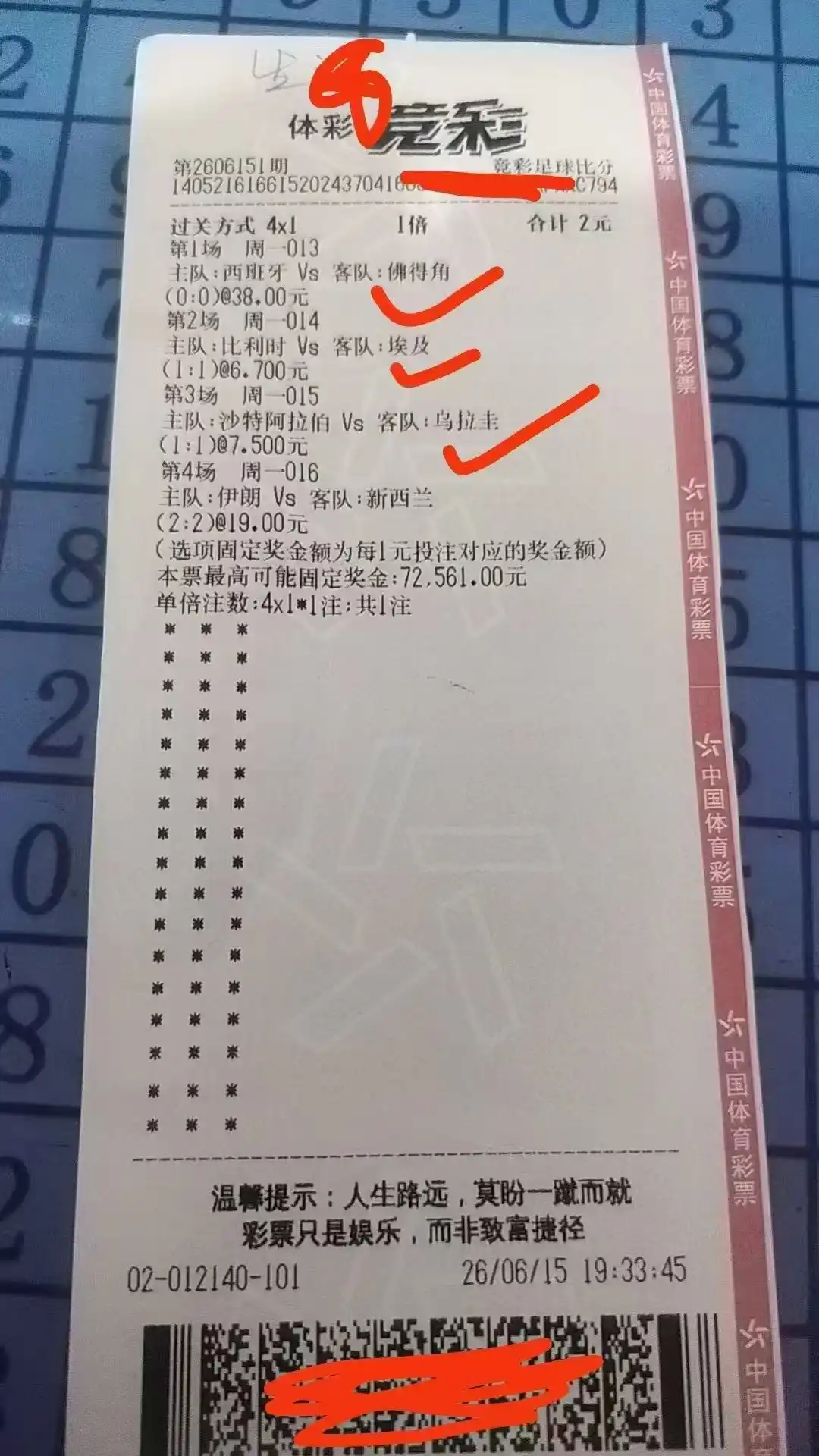
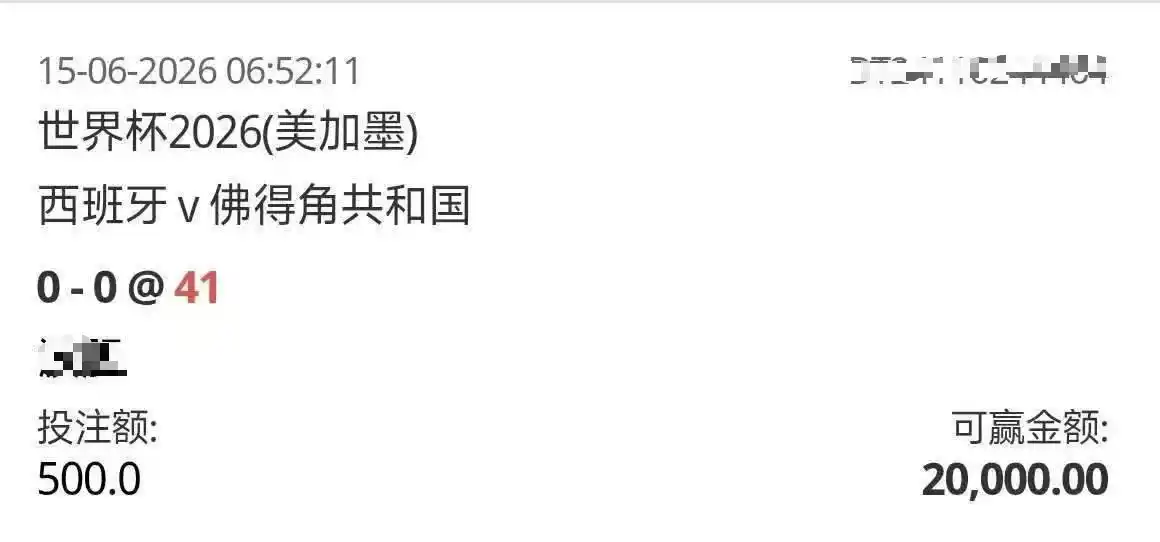
Today is the fifth day of the 2026 FIFA World Cup in the USA, Canada, and Mexico, and the tournament has witnessed its first major upset. The heavily favored Spanish team, with a squad valued at 500 million euros, was held to a 0-0 draw by the 40-year-old goalkeeper from Cape Verde, whose market value is a mere 50,000 euros. Netizens joked: How can human feet possibly compete with 'Buddha's feet' (a pun on Cape Verde's name in Chinese)?
To the friends who bet on Spain, the championship favorite, we ask: How are your heart and wallet holding up?
Unstable favorites, dark horses emerging, dramatic injury-time goals—the 48-team World Cup has barely begun, yet it has already dealt a resounding slap to the 'on-paper strength' theory. In other words, the true charm of sports competition might just be the possibility of the underdog triumphing over the top dog.
So here's the question: Have you ever supported a team or predicted scores in a group chat with friends? Have you ever participated in predictions, whether offline or on compliant platforms?
In fact, the kickoff of the World Cup isn't just about the battle of 48 teams on the pitch; it's also a face-off between several prediction products.
If you open Polymarket, you'll find it has prominently added a World Cup entry with a golden football icon to its top navigation bar. Click further, and the entire tournament's matches, betting options, brackets, and map are laid out clearly.
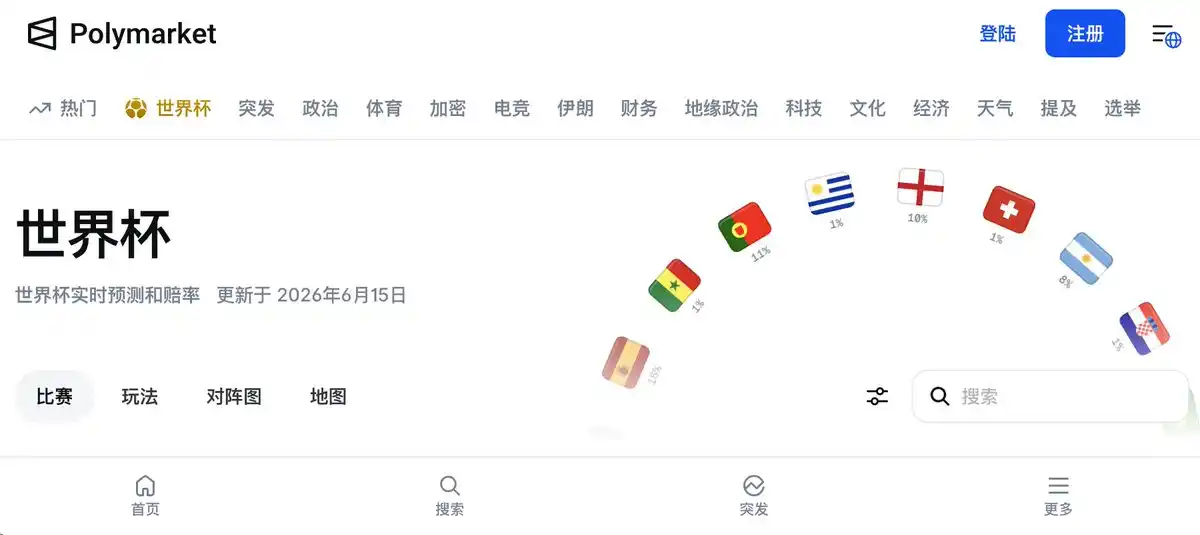
Currently, there are roughly three different categories of prediction methods for the World Cup: first, traditional official sports lotteries; second, traditional online gambling platforms; and third, emerging crypto prediction markets. The latter can be further divided into more established platforms like Polymarket @Polymarket .fun and Kalshi @Kalshi, and new blockchain contenders like Opinion @opinionlabsxyz and Predict.fun @predictdotfun.
On the surface, all of these are answering the same question: Who will win? But the underlying product logic, transparency, compliance paths, and user experience differ significantly and cannot be lumped together.
Next, Biteye will provide a sharp review, ranking from 'Solid' to 'Meh', of the overall betting experience across four different channels and multiple platforms for the 2026 World Cup.
First, the 'From Solid to Meh' Table
To prevent everyone from getting lost in jargon like odds, contracts, and dividend indices, let's first rank them directly from best to worst across five dimensions:
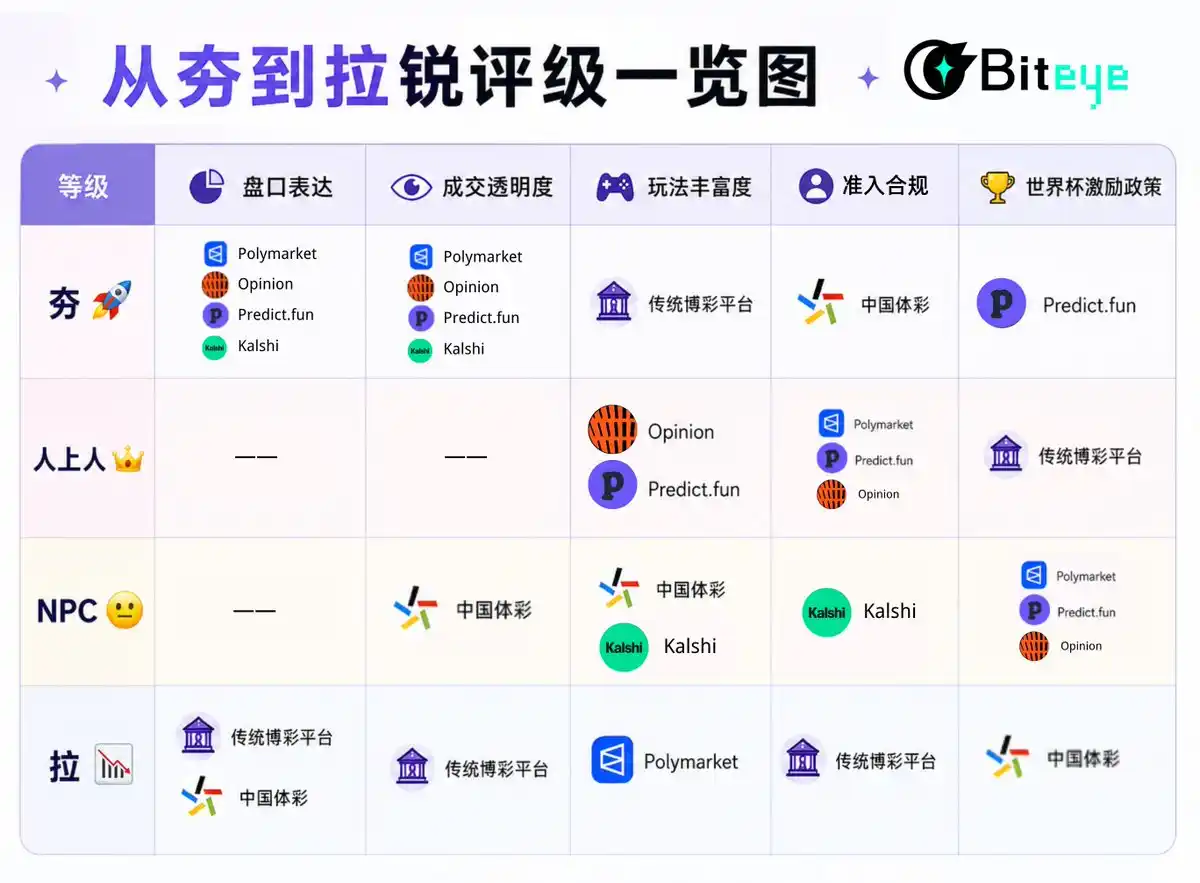
A one-sentence sharp review:
Polymarket is the World Cup betting market trending chart, with Opinion close behind. Predict.fun is the best at throwing money around with World Cup events on BNB Chain. Kalshi is the stock exchange in a suit watching the game. Traditional gambling platforms are feature-packed, enduring gambling supermarkets. The official sports lottery is the officially-sanctioned side dish for watching matches.
Market Expression: Do I Understand What It's Selling?
If you're new to World Cup betting, the odds on traditional gambling platforms might be confusing.
Traditional platforms use the classic language of odds, like +450, +850, +1000. Veterans might understand instantly, but newcomers might stare blankly for three seconds. The numbers look tempting, but why the complicated math? Similarly, the payout calculations for China's sports lottery are essentially odds-based menus that require conversion, rather than an easily understandable market price.
In contrast, whether it's the veteran prediction platforms Polymarket and self-styled event contract exchange Kalshi, or the newcomers Opinion and Predict.fun, the communicative advantage of prediction markets lies in not needing to convert odds or understand a bunch of betting terminology. They turn the World Cup into a visible, real-time probability curve.
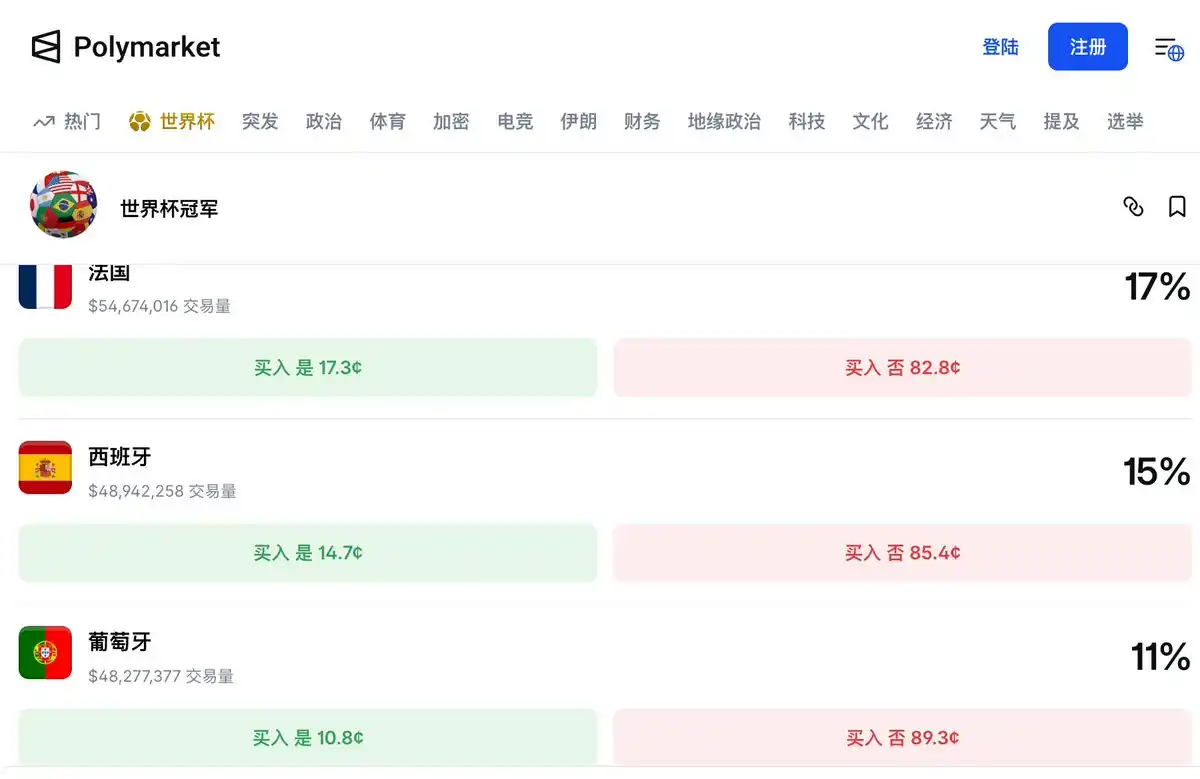
For example, Spain at 16¢, France at 16¢, Portugal at 11¢ corresponds to the market estimating their championship probability at roughly 16%, 16%, and 11%. If your supported Spain wins, you'll capture the multiple increase from 16% to 100%, about a 6.17x return.
This market language is very friendly for newcomers wanting to participate in World Cup predictions. It's not necessarily about making betting easier, but about making it easier to gauge the direction of market sentiment.
Simultaneously, such prediction market data is naturally suitable for media citation because it turns the subjective judgment of 'which team is stronger' into a real-time price voted on with money.
This round is more complex and heavily depends on user habits. Ranking based on communicative properties:
- Solid: Polymarket / Kalshi/Opinion/Predict.fun. Probability is price, most suitable for communication.
- Upper Class:/
- NPC:/
- Meh: Traditional gambling platforms / Sports lottery. Odds menus are not friendly to newcomers.
Transaction Transparency: Can I See How Others Are Betting?
Understanding the price is just the first step. The real key is: How is this price determined?
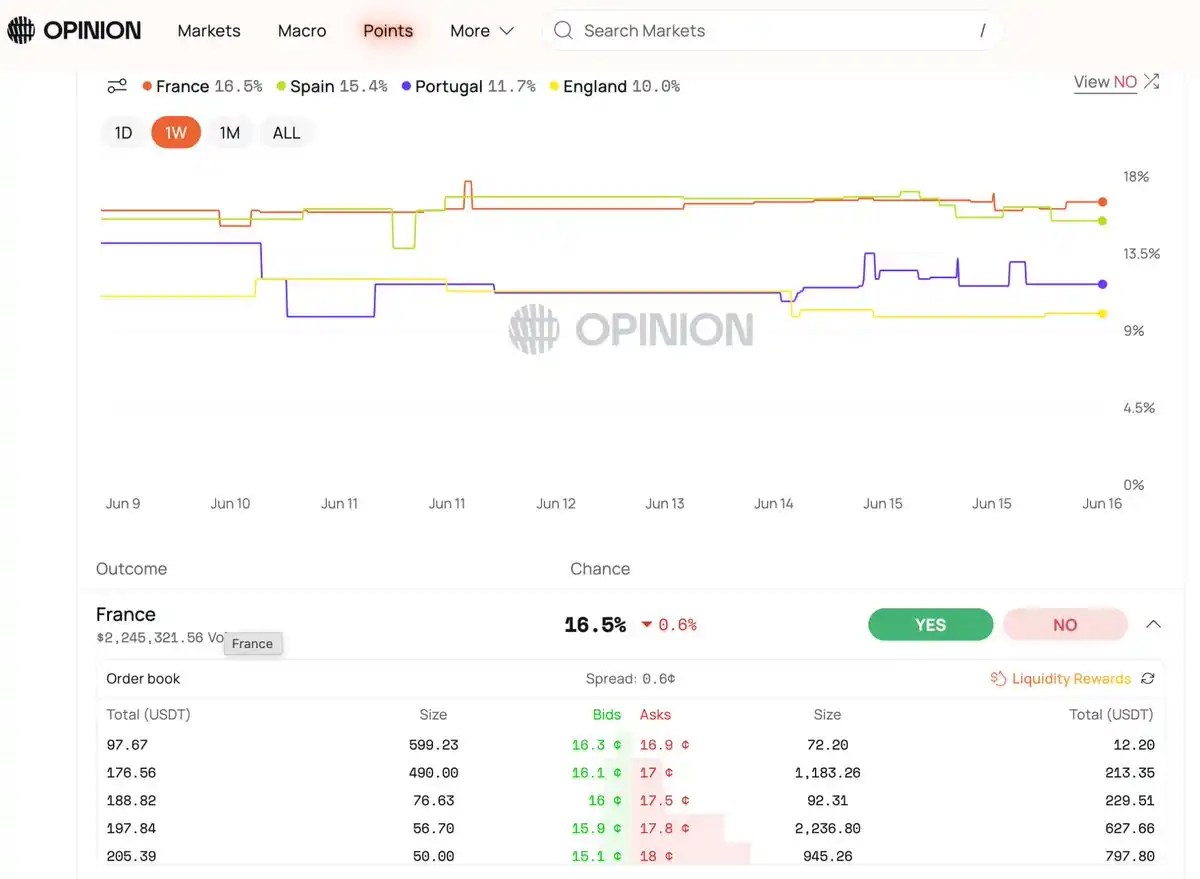
This is also the most fatal blow that emerging prediction markets deliver to the traditional bookmaker model. While prediction market data doesn't necessarily represent the 'truth', at least we can intuitively see how the market is trading.
Polymarket discloses price, trading volume, order book, liquidity, price curves, and market heat. Kalshi, Opinion, and Predict.fun are similar, displaying market data, trades, and price changes. In comparison, Kalshi's data, due to compliance requirements, resembles formal financial reports, while Opinion and Predict.fun resemble complete event-focused pages within new blockchain projects.
Traditional gambling platforms are different. Bettors can see the payout index or odds, but it's difficult to see the real volume behind a specific market, how funds flow, or the actual market depth. Traders primarily bet by trusting the platform's reputation. This isn't to say they lack liquidity, but the real issue is: this liquidity isn't transparent to ordinary users. It's like enjoying delicious braised chicken but worrying if it's frozen pre-made food.
China's sports lottery, under macro-level regulation, generally doesn't see extreme market manipulation, but behind each set of odds, there's an opaque, uncertain black box.
So this round's review is simple:
- Solid: Polymarket / Kalshi/Opinion/Predict.fun. The foundation of prediction markets.
- Upper Class:/
- NPC: China Sports Lottery. Officially endorsed, large scale, but the process is invisible.
- Meh: Traditional gambling platforms. Complete black box.
Variety of Betting Options: Can I Choose to Bet on Details I Like?
When it comes to who's best at creating diverse options, traditional gambling platforms are the seasoned veterans.
Outright winner, handicap, over/under, correct score, half-time/full-time, corners, yellow cards, player to score, golden boot, accumulators, same-match combos, live betting, cash-out... Traditional platforms have turned almost every detail of a World Cup match into products on the shelves of a gambling supermarket, dazzling to the eye.
This is also the strongest and most dangerous aspect of traditional platforms: the more options, the easier it is for users to think 'there must be one angle I understand'. But for the platform, the more detailed the options, the longer users stay, the higher the trading frequency, and the greater the profit.
China's sports lottery also offers a fair variety. During the World Cup, options like outright winner, finalists, win/draw/loss, correct score, total goals, and half-time/full-time basically cover the most familiar betting needs for Chinese users.
In comparison, Kalshi is catching up in this direction, starting to offer more single-match, over/under, both teams to score, and other event contracts.
Polymarket is more restrained, focusing on core markets like outright winner, advancement, and match winner. For instance, as of June 15th, trading volume for the World Cup winner prediction on Polymarket has exceeded $20 billion. In contrast, liquidity for split markets like over/under or handicap for individual matches is generally lower, and there are rarely corresponding markets for the traditional accumulator bets involving multiple matches.
Opinion and Predict.fun are more aggressive among new blockchain platforms, both offering markets for champion, group stage, knockout stage, golden boot, top assist provider, etc.
So this round:
- Solid: Traditional gambling platforms. The gambling buffet.
- Upper Class: Opinion / Predict.fun. Actively capturing the market.
- NPC: Kalshi, adding more dishes / Sports Lottery, the official menu is sufficient.
- Meh: Polymarket. The signature dishes are strong, but the menu isn't extensive.
User Access & Compliance: How Do I Get In & Can I Get Out?
This point is especially important for users in Chinese-speaking regions.
The advantage of the sports lottery is its clear legal status and familiarity within the Chinese context—you often see stores with 'Sports Lottery' signs just a few steps from your daily life. But its drawback is also obvious: it's not something you can participate in by casually opening a webpage; formal channels still emphasize offline physical outlets.
Polymarket, Opinion, and Predict.fun operate on a more Web3 access logic. Wallets, stablecoins, on-chain assets—these are relatively straightforward for those with a crypto background; but for average soccer fans, wallets, private keys, USDC, and regional restrictions are all barriers. Simultaneously, all three face the challenge of compliance for crypto prediction markets.
In contrast, Kalshi leans more towards a US-compliant financial account logic. Its rules are clear, positioning itself on the regulated event contract path, but KYC, regional, and account requirements mean it's not a product for all global users.
Traditional gambling platforms may seem to have many entry points in many regions, but they also have the most issues: regional restrictions, deposit/withdrawal risks, account risk controls, and inconsistent platform compliance. Even though some European and American markets have mature licensing systems, users in Chinese-speaking regions need to be cautious.
Therefore, the most important question isn't which platform offers the most exciting bets, but:
Where does the money go in? How are results settled? Can the money come out? Who do you turn to if the platform has a problem?
This round:
- Solid: China Sports Lottery. The most legitimate and familiar in Chinese-speaking regions, but requires offline channels.
- Upper Class: Polymarket/Opinion/Predict.fun. Friendly for crypto users, with barriers for average users, but compliance needs testing.
- NPC: Kalshi. Access limited primarily to US users, compliance is clear.
- Meh: Traditional gambling platforms. Deposit/withdrawal and compliance risks require the most vigilance.
Incentive Activities: Should I Bet More for the Rewards?
As a new contender in on-chain prediction markets, Predict.fun has launched a $2 million special incentive campaign for the World Cup. It has created the Predict Cup on BNB Chain, offering a rich prize pool, and built a series of on-chain World Cup activities with Fan Points, team lineups, leaderboards, and round rewards.
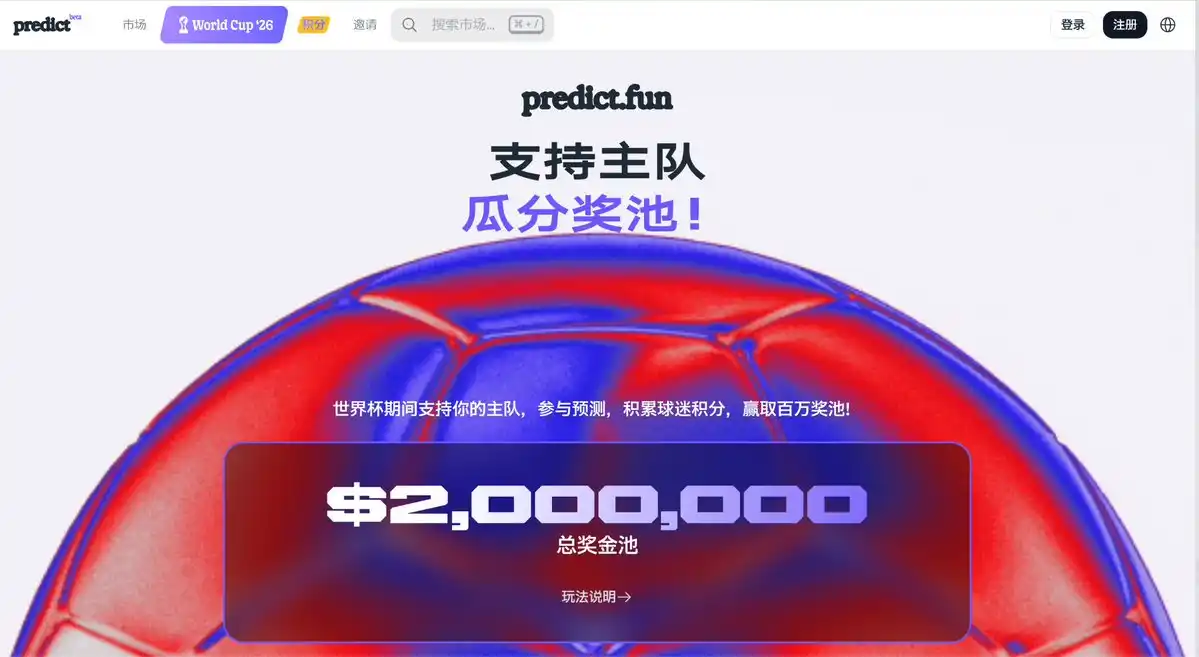
This is very attractive to users: you're not just predicting match outcomes; you're also competing for points, climbing the rankings, and earning rewards.
Traditional gambling platforms are also going all out for the World Cup; after all, this is the quadrennial fan frenzy, and traffic almost equals revenue.
Polymarket, Kalshi, and Opinion, however, still focus on the markets themselves: price, volume, market depth, communication—they haven't created separate incentive schemes for the World Cup.
The sports lottery emphasizes public welfare and rational purchasing; while it often has promotions, in the Chinese context, it's not appropriate to expand on them as traffic-driving introductions.
But amidst the excitement, it's also worth asking: Am I enjoying the match, or am I trading for points? Am I looking at odds, or am I being pushed along by the leaderboard?
This round:
- Solid: Predict.fun. The most aggressive with World Cup-specific operations.
- Upper Class: Traditional gambling platforms. The golden period of the World Cup.
- NPC: Polymarket / Kalshi/Opinion. Incentives are not the main selling point.
- Meh: Sports Lottery. Emphasizes rationality and public welfare attributes.
Conclusion
The 2026 World Cup has placed several product logics on the same table.
- China's Sports Lottery says: The match can be a viewing interaction within the framework of an official public welfare lottery.
- Traditional gambling platforms say: The match is a highly mature entertainment product.
- Polymarket says: The match is a real-time, fluctuating probability market.
- Kalshi says: The match is a regulatable event contract.
- Opinion says: On-chain prediction markets can also be built like complete event-focused pages.
- Predict.fun says: The World Cup isn't just about markets; it can also be an on-chain points game.
But perhaps what's truly worth noting is not who can replace whom, but how World Cup betting markets are shifting from closed, odds-based products into open, real-time, communicable information markets.
Sports are just the stage. The bigger business is humanity's eternal desire to price the future, to price its own judgment.