Hello everyone, welcome to Money in Motion. This is a podcast focused on "How Money Moves." Money in Motion aims to deconstruct seemingly complex financial and payment issues back into real transactions, real needs, and real business models.
In this episode, we are very fortunate to have invited Teacher Jia Hang. His over twenty-year career has practically involved him in multiple key stages of Chinese payment going global/internationalization:
• In 2006, he joined UnionPay International, and in 2009, he launched UnionPay USA from scratch in the US, inserting a Chinese card into the domestic acceptance network that Visa and Mastercard had been operating for decades.
• In 2015, he joined Ant Group, leading Alipay+, personally building a monetary network connecting local wallets in various countries, bypassing card schemes.
• At the end of 2025, he left Alibaba to take the helm at Singapore's DCS—a long-established Diners Club financial company, operating on both traditional clearing and blockchain networks, and launching a series of stablecoin payment products.
These appear to be three different explorations: UnionPay (card scheme), Alipay+ (wallet), stablecoin (blockchain). But looking back, they have actually been answering the same question: How to build the next global payment network? And what is the true moat of this network?
We will explore the answers in this interview.
| Guest in This Episode: Jia Hang (Nickname "Panda", former Head of UnionPay International Americas, former Head of Ant Group's Alipay+, Executive Chairman of Singapore DCS) Hosts: Will & Yuki (Co-founders of Money in Motion) The views expressed in the article represent only the personal opinions of the guest and do not represent the views of the guest's organization or this media outlet. |
I. The Moat of Card Schemes: Not Standards, but Profit-Sharing Rules
What exactly allows card schemes to stand firm? Teacher Jia Hang first spent ten years at UnionPay, trying to insert Chinese cards into the global acceptance network; then went to Ant to work on Alipay+, trying to use wallets to bypass card schemes. Both paths were half-successful, yet both stopped at the same wall.
1.1 The Core of Card Schemes
Host: Looking back today, how has your view of card schemes changed compared to the beginning?
Jia Hang: I joined UnionPay in 2006 and then studied Visa and Mastercard. At that time, in my eyes, a card scheme, or a global payment network using cards as the medium, its core capability was standardization—standardization of technical rules and business rules—a globally unified set of standards allowing different payment and acceptance ends to interact. Visa and Mastercard did this very well; UnionPay was essentially a student then.
But the problem is, after so many years of effort, UnionPay still hasn't become a truly global card scheme today—it remains a card scheme heavily dependent on the Chinese market and Chinese users. This is not a problem of standards or rules.
| Now, looking at card schemes, I believe that above standardization, its most core aspect is actually pricing and profit-sharing. |
In other words, what is a card scheme?
A card scheme is essentially an interest alliance organizing participants like issuing banks and acquiring institutions. Standards are just the connection method; what truly binds everyone together is the profit-sharing mechanism. Although a card scheme is a centralized network structure, in profit-sharing, it has considerable democratic elements. This is where Visa and Mastercard succeeded, and what I eventually found impossible to copy during my time at UnionPay.
1.2 A Mansion Built on Quicksand
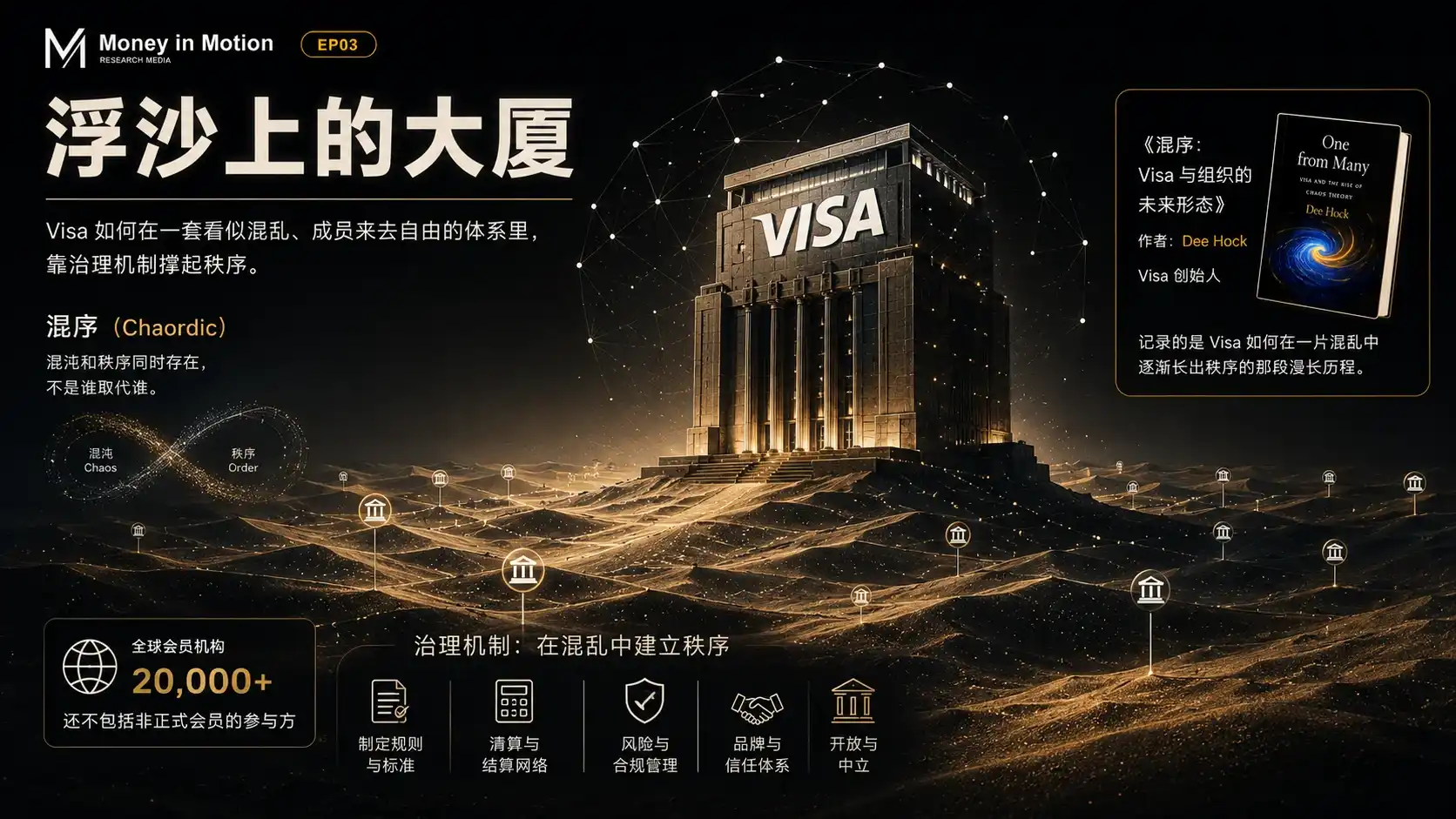
Host: This set of rules lies more at the governance level and isn't something that can be built in a year or two. Visa founder Dee Hock wrote a book called "One from Many: VISA and the Rise of Chaordic Organization," recording how Visa maintained order within a seemingly chaotic, member-free-to-come-and-go system through governance mechanisms—this is called "Chaordic," where chaos and order coexist, not one replacing the other.
From your perspective, at what stage is UnionPay's development now?
Jia Hang: I've read that book, and I think it very accurately summarizes Visa's business model. I once had a personal description for the Visa/Mastercard model, calling it "A Mansion Built on Quicksand."
The so-called quicksand means Visa has over twenty thousand member institutions globally, not including informal participants. Any institution can freely join or leave—you can join Visa, and you can exit. But Visa has built a stable mansion on this quicksand, relying precisely on this governance mechanism.
First, this governance mechanism is difficult to replicate. The first principle of this mechanism is reverse shareholding—members hold the majority of Visa's shares, many decisions are voted on by members, not a truly top-down pyramid structure. This fundamental spirit is, from the roots, quite difficult for many practitioners living in China to understand and truly appreciate.
The second reason is that the time window is gone. Before Visa appeared, there was no cross-border, universally accepted payment method in the world, so there was an extremely strong commercial driving force pushing everyone towards the same network; by the time Visa and Mastercard had maturely covered the globe, when UnionPay entered, the incremental value had already been taken.
Where UnionPay is today is actually not an isolated case. JCB, which rode the wave of Japan's economic and financial glory, surged once but is now gradually retreating globally; Diners Club, Discover, even American Express are gradually waning.
| Because, given the same user value and the same solution, everyone will gradually converge under the one or two networks with the widest coverage and highest standardization, leaving little room for the rest. This is the nature of network businesses—the strong get stronger. To overthrow this strong player, you must find your own commercial driving force in a more fundamental, more basic place. |
1.3 Scale You Can't Beat, Acceptance Network You Can't Bypass
Jia Hang: We used to do differentiated operations. The so-called differentiated operation meant American Express would boast about specializing in high-end clients, while UnionPay would say we specialize in low-end debit cards and Chinese clients. But you eventually find that for Visa and Mastercard, after grabbing the mid-market, pushing into the high-end and low-end markets isn't difficult for them—their economies of scale give them strong advantages in price and cost competition, making it impossible for you to compete.
| Ultimately, we are still the same species. To compete with it, you must jump out of the concept of "the same species." |
This leads to a crucial question: What is the biggest value point for Visa and Mastercard today? They have incorporated many institutional members into their network through a good governance mechanism, but those are all traditional Web2 issuing banks and acquiring banks. Today, the Web3 ecosystem, including these new players, hasn't been incorporated by Visa; Visa is also unwilling to let them become real members because it also worries about associated risks.
But these Web3 institutions still ultimately turn around to issue Visa cards. Why not issue Discover cards, not JCB cards? Because today, the biggest value of Visa and Mastercard is their acceptance network—the acceptance network built up and solidified over years of continuous expansion, allowing you to use a Visa card globally, with a highly consistent user experience.
| What's truly difficult to replicate for a card scheme has never been payment standards, but the network effect formed by interests, governance, and time. |
II. UnionPay Americas: An Acceptance Network Swept Out with a Little Notebook
From 2008 to 2013, Teacher Jia Hang worked in the Americas region for UnionPay International, launching UnionPay USA from zero in 2009. This was the earliest and most hardcore form of Chinese payment going global: not serving outbound tourists, but building an acceptance network for a Chinese card scheme in the domestic markets where Visa and Mastercard had operated for decades.
2.1 First the Sons, Then the Father
Host: Back to that era—what exactly was UnionPay International's strategy and mission at the time?
Jia Hang: UnionPay was first born in 2002, starting international business in 2004. It was born to achieve "one-card universal use" within China. Before that, each bank's cards could only be used on its own POS machines and ATMs, making cross-bank use difficult. Later, a group of "UnionPay"-style institutions emerged nationwide, like Shenzhen UnionPay, where Shenzhen first achieved cross-bank use of bank cards, forcibly establishing a standard allowing interconnection.
There's an old saying in UnionPay's history: "First the sons, then the father"—first, eighteen city-level bank card information exchange centers achieved interconnection, then a "father" was imposed on top, saying these companies were its subsidiaries in various provinces.
By 2004, when UnionPay proposed internationalization, the goal was already clear: Benchmark JCB, build UnionPay into the world's third-largest card scheme. The logic was clear: first occupy the entire Chinese market—this was achievable because UnionPay itself was a state-backed enterprise, taking the domestic market was not a problem; then uniformly extend this standard overseas—something only state administrative power could achieve.
2.2 Northern Card Southern Use: A Little Notebook, Sweeping Through One by One
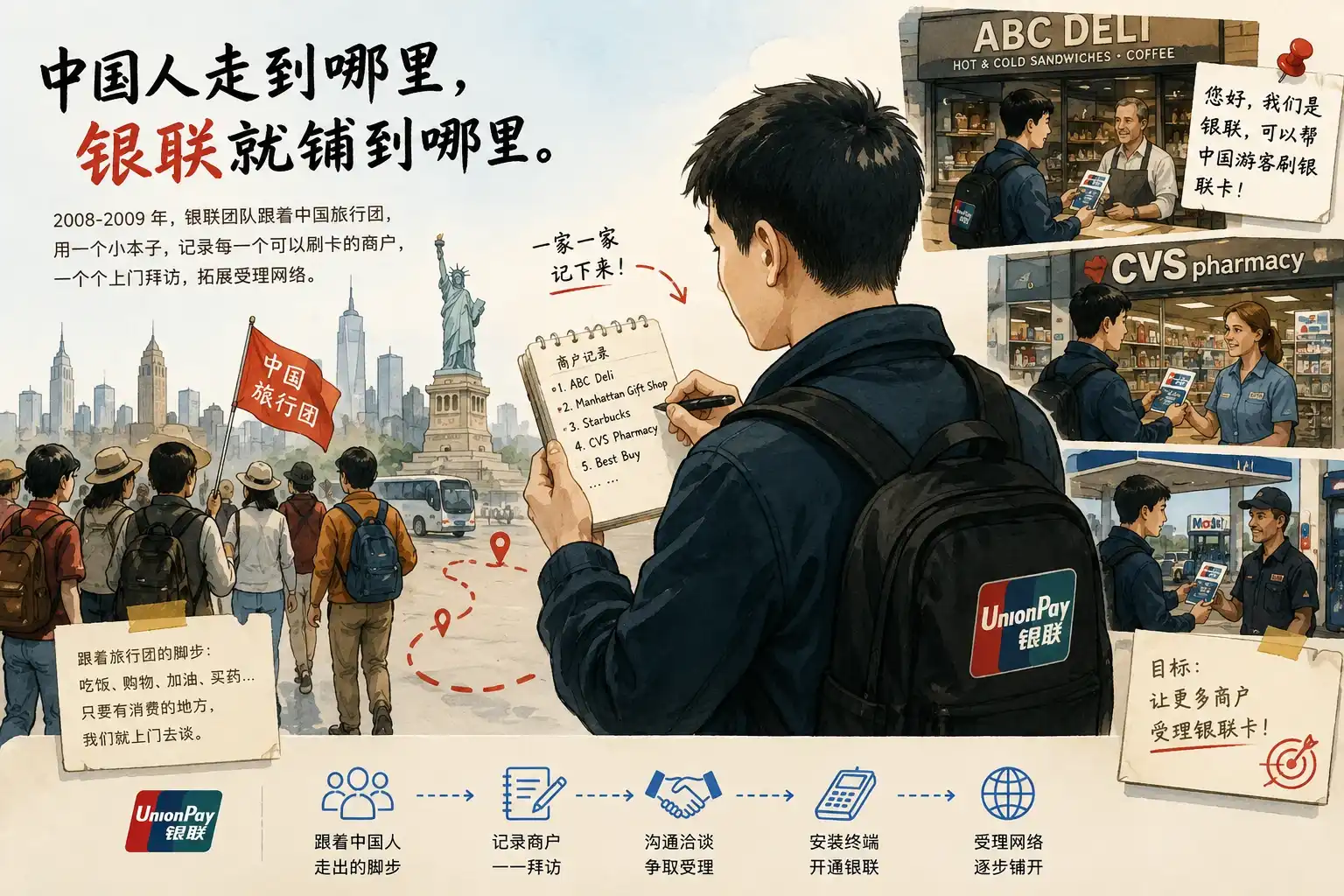
Jia Hang: Once domestic standardization was achieved, and Chinese outbound tourism grew, what we did was "Northern Card Southern Use"—this industry old term, probably people under forty haven't heard it.
Back then, UnionPay cards were mainly used in Hong Kong and Macau, expanding the acceptance network following outbound tourists. The logic was clear: For your card to be usable, you first need acceptance, merchants must accept it; what drives that? Driven by Chinese cross-border tourists pushing it. After merchants start accepting UnionPay cards, UnionPay then contacts local banks to promote issuing UnionPay cards to local users, then tries to promote card issuance in more countries.
| There's an old saying from that era: Wherever Chinese people go, UnionPay cards are used. |
Within this "Northern Card Southern Use" logic, there was also a selling point: this card could be used back in China. But this approach was actually weak in promoting overseas card issuance—the vast majority of overseas cardholders had no need to specially apply for a UnionPay card just for business trips or tourism to China.
2.3 The Unresolved Problem
Jia Hang: This was UnionPay's challenge—it never solved the problem of overseas card issuance—the acceptance network for outbound tourism grew, but that was an acceptance network around tourist areas, shopping areas, not a local-life acceptance network. No one goes to duty-free shops or Fifth Avenue every day; locals want to use cards at the convenience store downstairs from home, and your acceptance network doesn't cover there.
Today, UnionPay's business can be said to have entered a relatively difficult period. This difficulty started around 2012 with the rise of domestic mobile payment—UnionPay's basic market wasn't taken by Visa and Mastercard, but by Alipay and WeChat Pay. Next, cross-border tourist flow was further diverted, and overseas banks' willingness to issue UnionPay cards further decreased.
JCB's story is exactly the same: back then, wherever Japanese people went, JCB was used, but it ultimately never truly rose up either.
III. Ant: From "Replicating Alipay" to Alipay+
The problems UnionPay's path couldn't solve, Ant tried to solve with another logic. Behind this are two completely different clearing and settlement logics: local accounts and local wallets, and cross-border, cross-account clearing and settlement.
3.1 Global Alipay: An Unviable Concept
Host: The card scheme path, JCB is a cautionary tale. What about wallets? Is that a smoother path? Also your original intention for going to Ant to work on Alipay+?
Jia Hang: Initially, I thought yes. I joined Ant in 2015, a very important opportunity was that Alipay had already started cross-border acceptance, many people began using Alipay cross-border. The path was exactly the same as UnionPay—wherever Chinese people go, Alipay is used, following tourist flow, shopping needs.
| But although this strategy feels effective to implement, it has no direct relevance to locals—this is the same problem constraining WeChat Pay, Alipay, and UnionPay. |
But Alipay's management at that time were very smart people; they realized early on that just focusing on cross-border tourism was useless, it's a narrow-track sector. The problem faced then was: How to make Alipay a global Alipay, not just a Chinese Alipay?
That was when Alipay was at its peak—launching Yu'ebao in 2013, incredibly popular; WeChat Pay was already emerging, but still far behind in functionality and user experience, Alipay still dominated. But once the "Global Alipay" idea unfolded, it immediately triggered a key problem—Alipay holds balances, having balances means having customer funds, it's a wallet; to launch such services in various countries, you need to obtain local licenses in each country, need to set up entities, have local teams, compliance officers, manage customer funds—very heavy, impossible to achieve global coverage in the short term.
Moreover, even if a "Global Alipay" were truly realized, it would pose significant political challenges—you would become a worldwide organization equivalent to a bank, equivalent to HSBC.
3.2 Investing in Local Wallets, Building the Network Layer
Jia Hang: Just then, a headhunter recommended me to Alipay, and the solution I proposed was agreed upon by Ant's management—don't create your own Alipay in every country, obtain licenses yourself; that path is too heavy and slow.
Our plan was: Go to various countries to invest in, incubate a batch of local wallets, we take no more than 50% equity, meaning the wallet remains essentially a local wallet. We provide experience, technology, incubate it, then build a mobile payment-supporting network layer on top of these wallets, enabling cross-border interconnection between wallets—in other words, this is a global network supporting scan-to-pay, not a global network supporting cards like Visa and Mastercard.
Once this idea was proposed, it instantly solved the problem of how to globalize Alipay. Later, everyone saw, this is exactly how Ant did it: the first investment finalized in 2015 was India's Paytm, followed by Southeast Asia's GCash, Touch 'n Go, Indonesia's Dana, and Korea's Kakao Pay; Japan was negotiated three times, the investment agreement never finalized, a more arduous experience. The entire approach was in two steps: Step one, invest in local wallets, empower and incubate; Step two, interconnect these wallets, that's Alipay+.
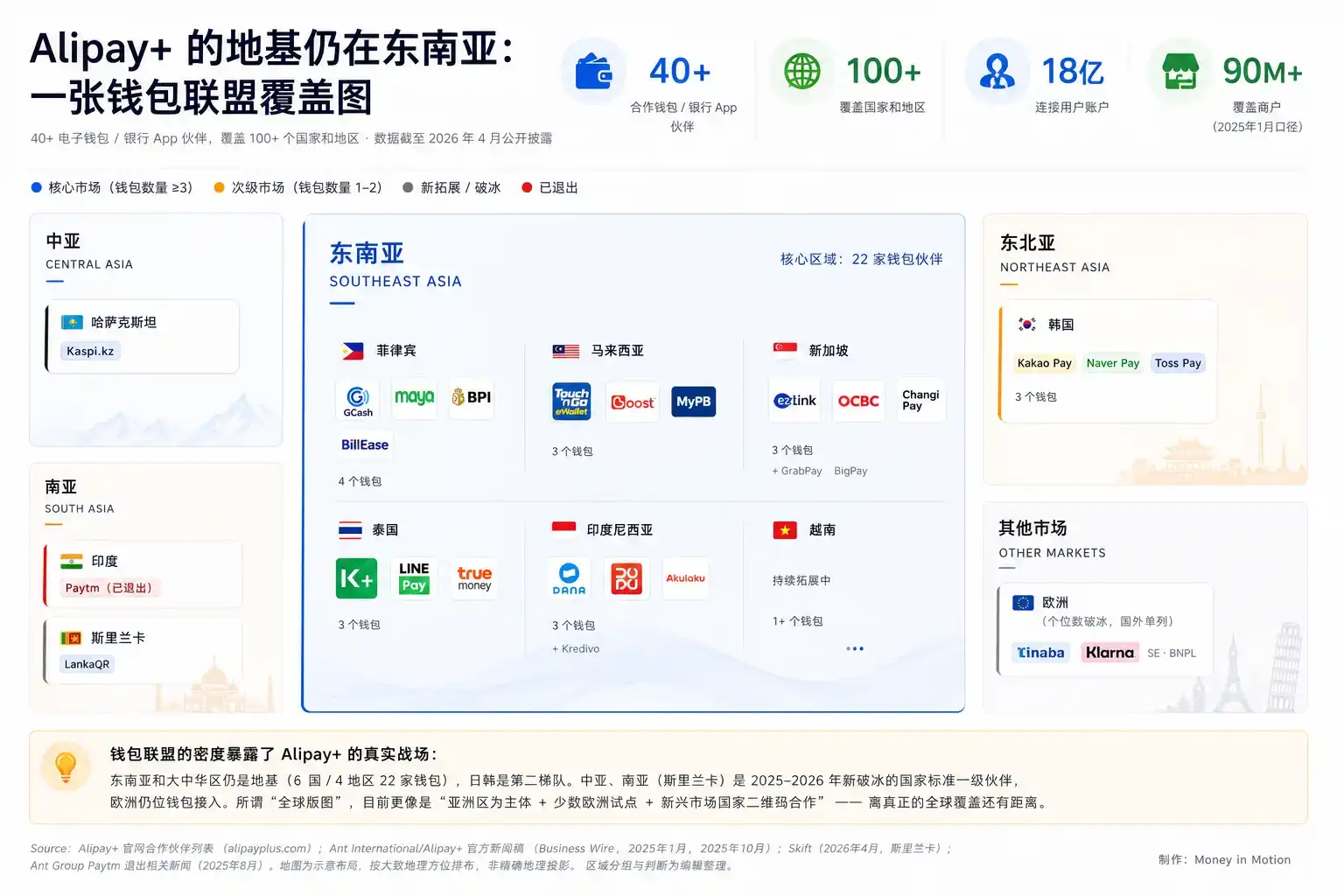
Jia Hang: Looking back, Alipay+ achieved some results, but didn't reach the level of covering the world with a mobile wallet network, nor did the QR code standard become globally unified.
| The reason is still what I mentioned earlier: You have a good business model, good standards, but didn't solve the most fundamental problem—disruptive user value driving force. |
Alipay+ does mobile payment, but at the underlying business logic level, there's no essential difference from Visa and Mastercard, still the same species. Whether swiping a card or scanning a code, it's essentially payment, nothing new, just competing for the existing market.
Even in China, scanning codes and swiping cards are still market segments—the mid-to-high-end market is still dominated by cards, because Visa and Mastercard established a very good revenue-sharing system, card swiping offers cashback, mileage accumulation; scanning codes don't. Scanning codes replaced more of the cash market, so it developed more smoothly in developing countries; developed countries are still dominated by cards.
A more fundamental difference lies in profit-sharing—Visa built a profit flywheel; scanning codes built a cost advantage. Card schemes established a clear model early on: merchants pay MDR (Merchant Discount Rate), the acquiring institution, card scheme, and issuing bank share the revenue in turn, with the issuing bank passing part back to the cardholder—the merchant bears the cost, the cardholder is incentivized. How does scanning code penetrate merchants? By having MDR far lower than cards, so it can cover all small merchants, including sweet potato vendors. But if the merchant side doesn't bear cost, what do you use to incentivize users?
Although Alipay and WeChat Pay overturned the card swiping profit chain, scanning codes haven't established a sustainable profit-sharing model to this day. A globalized wallet won't emerge, but interconnection between wallets still has opportunities—the premise is there needs to be a new way, not the traditional set.
IV. Will Stablecoins Repeat the Same Story?
Host: The logic of stablecoin payment is also end-to-end, lower fees, but indeed hasn't solved that value chain and incentive problem. Previously, a popular wave was "using stablecoins to replace Visa, Mastercard," but looking back now, Visa and Mastercard have come back—and not on the user consumption side, more using stablecoins for backend settlement.
4.1 What Stablecoins Really Challenge Is Not Visa
Jia Hang: "Stablecoins can replace Visa, Mastercard" is a head-scratching conclusion. Looking closely, you'll find stablecoins not only can't replace them, but have to combine with them—today's U Cards rely on Visa and Mastercard's acceptance network, something already discussed earlier about card schemes.
| Looking at the question of "the next global payment network," stablecoins actually answer a different question. Visa solves consumption payment; stablecoins solve fund movement—they are not competitive but two different layers of infrastructure. So what stablecoins really change is not payment, but fund movement. |
In other words, stablecoins challenge not Visa, but the bank account system. The ones who should really worry are banks, not payment companies.
4.2 Why Visa Actually Wants to Use Stablecoins
Jia Hang: I once asked a Visa executive: Would Visa gradually use stablecoins for global clearing and settlement? The efficiency is very high, not dependent on banks or SWIFT, internal ledgers synchronize and it's done. He was stumped. I pressed: Visa's major shareholders are all banks, would your shareholders agree? He was also somewhat embarrassed—because banks would eventually find that the large amount of clearing, settlement, and foreign exchange services they provided to Visa would disappear.
This is also why Visa and Mastercard operate actively below the surface but dare not be high-profile.
4.3 U Card, Just a Window Product
Host: The U Card form is interesting. Traditional card issuance has geographical restrictions, but a U Card can be issued directly to global users, using one pivot to leverage the world, then connecting to stablecoin accounts, potentially growing into a new on-chain banking species.
Jia Hang: This is indeed the more exciting aspect now. Traditional fiat currency cards are strictly regulated by country and region; Visa did this to let issuing banks in each country manage by region, avoiding internal competition. But the emergence of Web3 and stablecoin cards blurs geographical distinctions because these users' funds exist on-chain, in the cloud.
Large banks are currently reluctant to enter this field. Visa and Mastercard, realizing this potential issuing group, allow small institutions like DCS to do cross-border card issuance—this on-chain user group, with relatively good economic conditions and education levels, is a new blue ocean. When we issue cards, we look not at whether they have fiat currency cards, but whether they have crypto assets, so there's no conflict with fiat currency cards.
But this business is somewhat transitional. In maybe three more years, when large banks' tolerance for stablecoins increases, they will quickly enter the market. Rules like "Visa, Mastercard require special card BINs for cards involving stablecoin deposits" might also become invalid. So DCS's current strategy is to directly cooperate with exchanges to issue cards because customers on exchanges are more concentrated; pure C2C U Card consumption products, after gaining phased dividends, further enhance value-added services for the B2B side.
So U Card is not the final state; it's just a transitional product before banks enter the stablecoin era. In the future, users won't specially apply for a U Card; rather, the bank cards they hold today will themselves be able to accept stablecoins.
V. Betting on Singapore: From an Old License to Global Stablecoin Penetration
At the end of 2025, Teacher Jia Hang left Alibaba to take the helm at DCS—a fifty-year-old Diners Club license, running dual tracks of traditional clearing and blockchain. Why was he willing to bet on stablecoins again for something neither UnionPay nor Alipay+ could accomplish?
5.1 Believing in the Future of Stablecoins
Host: You left Alibaba at the end of 2025 and went to Singapore's DCS—why Singapore, why DCS?
Jia Hang: The main reason is I believe in the future of stablecoins. There are many tracks in stablecoin-related business—issuing coins, exchanges, OTC, payments—among which the payment track is what I'm most familiar with. What DCS does is enable seamless stablecoin payment to the consumer market and physical merchants. Cards are just one mode, scan-to-pay is another, and automatic on-chain smart contract deductions for online payments is yet another.
We often say internally that we are actually Web2.5—holding traditional banking licenses, operating according to rigorous AML, risk control, and regulatory requirements, acting as a bridge in the middle, making it easy for Web3 institutions to connect to Web2, and also making it easy for Web2 institutions to reach Web3 customers and payment traffic.
But what really attracted me wasn't a company, but that stablecoins for the first time made me feel: Maybe the next global payment network really has a chance to emerge.
5.2 This Time It's Really Different
Jia Hang: Actually, looking back, when we worked on UnionPay, on Alipay+, I always had an idealistic direction—really wanting to participate in building the next generation of global payment networks. There was even a bit of national sentiment here: Global payment networks have all been led and established by Europe and America; as a significant economy, can China make its own contribution to the world in this aspect?
But after two rounds of exploration, I found they were both "unable to jump out of Buddha's palm"—no fundamental change.
In the first two attempts, we were copying the previous generation of networks; this time, we have the first opportunity to reorganize the network's foundation. Upon encountering stablecoins, I suddenly felt this thing might really be able to jump out of that palm. But how to integrate with Web2, how to gradually replace old infrastructure, there are still many problems that need careful implementation, not as easy as telling stories. So I ultimately placed this aspiration in stablecoins—the first step is not replacement, but connection; only after connection can we talk about penetration and replacement.
5.3 Why Now
Jia Hang: Why DCS? This relates to different companies' positioning. Some companies are keen on hype, are to-VC companies. Today, DCS is not in that mindset; we more want to build some actual capabilities and payment infrastructure—not that lofty, just to occupy more territory before others can actually build tangible things. In the future, as stablecoins rise and usage rates further increase, the basic capabilities we've laid out in advance will seize opportunities.
A bear market does affect people doing stablecoin payments, especially companies like ours serving the B2C market—we serve people who already hold coins. When the market turns bearish, these people are less likely to choose to spend their coins directly; no one wants to spend more money. Conversely, in a bull market, everyone makes money, willingness to pay is stronger, wanting to improve life, buy new phones and TVs.
After doing stablecoin payments, I realized you're actually linked to the crypto market, affected by this layer, which is interesting—payment work before didn't have this layer. But overall looking now, compared to last year's overly noisy,浮躁 market, it's actually more suitable for entrepreneurs to truly settle down and do things that solve real problems; this market has finally cooled down.
5.4 The New Account for Singaporean Youth
Jia Hang: Overall, I believe the penetration of stablecoins into economies worldwide—from cross-border transactions to local markets in developing countries—is basically irreversible, only a matter of speed. Stablecoins provide an infrastructure that can bypass the traditional banking system; most countries don't have the ability to stop it—although major powers like China can block it through legislation and technical means, most countries can't, especially the official fiat currencies of countries with foreign exchange controls will face significant impact.
When such pressure emerges, merchants directly accept stablecoins, salaries are also directly paid in stablecoins, fiat currency will gradually be phased out of the local market. The portion of the cake in banks specifically responsible for cross-border clearing and foreign exchange might disappear—this cake taken from banks can incubate and sustain many small and medium-sized companies doing stablecoins, the market will undergo fundamental changes.
Give a concrete example. Doing stablecoin payment in Singapore is compliant and legal. Suppose a Singaporean youth earns a monthly salary of ten thousand SGD; he might keep eight thousand as fiat for rent, living expenses, and two thousand surplus to buy stablecoins or digital currencies (Singapore fiat interest rates are about 1%, stablecoin interest rates are far higher). But if this account can directly make external payments—scan to pay for coffee, pair with a stablecoin card for online/offline swiping—he will recalculate: Why do I still need to keep eight thousand fiat outside? I can keep only two thousand fiat, convert eight thousand into stablecoins. At this point, his crypto exchange account essentially becomes a "Yu'ebao."
What does this mean for exchanges? The number of people worldwide willing to speculate in coins has an upper limit, customer acquisition costs keep rising; but if inflows and outflows are convenient enough, users will put most of their money in, average account balance suddenly multiplies. This logic will roll forward: Coffee shops find customers all use U for payment, will request settlement partly in U, partly in fiat; coffee shop employees will also request salaries be directly paid partly in U. This way, end-to-end, U achieves a full cycle, fiat's share gradually weakens—this is the penetration path of stablecoins in the local retail market.
| For the past twenty years, the global payment network has revolved around bank cards; for the next twenty years, it may for the first time reorganize around accounts. |
VI. Words for Newcomers in Payments
Host: You're also considered a "veteran" in the payment industry. If giving some advice to newcomers just entering the field, what would you say?
Jia Hang: Maintain an open mind, diligently learn all new concepts, build your own logical thinking ability, form your own understanding of business and barriers in commercial logic. Don't just follow what others say, but also don't rigidly adhere to your own narrow scope—definitely stay open, keep learning, but use the new knowledge absorbed to build your own thinking model and business model; don't be easily fooled by others. Things that don't make sense logically, don't believe.
Host: Actually, I still have many questions, including you mentioning earlier that when doing UnionPay's overseas expansion, you followed tour groups—I find that particularly interesting—entrepreneurs should actually do very dirty work, but nowadays people are surrounded by too many "stories," many are packaged success theories, unable to see the real hurdles you have to cross when actually doing it.
Jia Hang: Many people are quite浮躁 nowadays, aiming to quickly tell a good story, get VC attention, so some stories are actually fabricated. Short videos and self-media are the same, constantly promoting stories like "Achieving hundreds of thousands of USD in 30 days"; these stories are impossible to achieve. There are even some old but still虛 stories, like "Seven lines of code to complete online acquiring." We want to burst some bubbles, let people接触 the real world.
Host: From UnionPay to Alipay+, to stablecoins, the path has kept changing. But the next global payment network will never be born just because a new technology appears. It still requires new user value, new profit-sharing, and new governance mechanisms. Twenty years have passed, Chinese payment going global has been answering the same question. And the answer, perhaps, is just beginning to emerge.
—— END ——
Organized Version | Money in Motion Dialogue with Jia Hang: Looking Back at Two Decades of Chinese Payment Going Global. This article is a transcription from spoken dialogue to written form, presented according to the original dialogue, with some content edited and merged. The views expressed in the article represent only the personal opinions of the guest and do not represent the views of the guest's organization or this media outlet.
For Money in Motion, what we care about is never just a hot topic, but how the financial system is being rewritten—where money comes from, through what channels it flows to whom, and what new technologies and rules change it. If you also care about payments, stablecoins, and next-generation financial infrastructure, welcome to follow Money in Motion on Xiaoyuzhou, YouTube, and Substack. We'll meet again next time.