World Unveils AgentKit for Human-Verified AI Agents with Coinbase Integration

TheNewsCryptoОпубликовано 2026-03-18Обновлено 2026-03-18

Введение

World has launched the beta of AgentKit, a developer toolkit that integrates with the x402 protocol (founded by Coinbase and Cloudflare) to enable AI agents to cryptographically prove they are backed by a unique human via World ID, without revealing the user’s identity. This addresses the growing challenge of trust and accountability in agentic commerce, which is projected to reach $3–5 trillion by 2030. By combining World ID’s privacy-preserving proof-of-humanity with x402’s micropayment system, AgentKit allows platforms to distinguish legitimate human-backed agents from malicious bots, control resource allocation per unique user, and prevent abuse—enabling use cases like fair ticketing, reservations, and trial access. The toolkit is now available to developers, with a more advanced version planned following feedback.

With the release of AgentKit beta, a developer toolkit for the agentic web that works with x402, AI agents will be able to use World ID to carry cryptographic proof of a unique person. Developers may create AI agents that can demonstrate that a real person is behind them while interacting with websites, APIs, and online services thanks to the toolkit’s integration as an extension of x402, an open protocol founded by Coinbase and Cloudflare.

Online operations that formerly needed direct human involvement, such as booking reservations and checking pricing among merchants, are increasingly being handled by AI agents. According to industry estimates, agentic commerce might reach $3 trillion to $5 trillion worldwide by 2030, with AI agents perhaps making up as much as 25% of e-commerce in the United States at that time. Establishing trust and responsibility in automated interactions is an increasing difficulty for developers and platforms as agents become online economic actors.

By allowing verified people to assign their World ID to AI agents, AgentKit solves this problem. By using this notion, developers may create what World calls “human-backed agents,” which are able to cryptographically demonstrate that a genuine, distinct person is behind them without disclosing the identity of the person.

“Payments are the ‘how’ of agentic commerce, but identity is the ‘who.’ By integrating World ID with the x402 protocol, developers now have a complete trust stack: a way for agents to pay for what they need and a way for platforms to verify there is a real human behind the wallet. This is a massive step toward a web where agents aren’t just seen as automated traffic, but as legitimate economic participants,” says Erik Reppel, Head of Engineering at Coinbase Developer Platform and Founder of x402.

“As AI agents start acting on behalf of users across the internet, the key challenge is separating legitimate, human-backed agents from bot swarms. Payment requirements can slow down abuse, but they don’t indicate how many real people are behind the activity. Proof of human addresses this gap by allowing websites to verify that an agent represents a unique person without revealing who that person is,” said DC Builder, Research Engineer at World Foundation.

Nowadays, the majority of websites see automated traffic as potentially dangerous and often completely prohibit it. This method stops productive AI agents from engaging with internet services, even though it was initially intended to combat malevolent bots. Agents often run into the same limitations intended to stop exploitation when they try to do activities like making reservations or accessing APIs.

New protocols have started looking at methods to make online agent action possible. Micropayments are introduced by the x402 protocol to allow agents to access resources and APIs while restricting excessive bandwidth. The x402 protocol has handled over 100 million payments via apps, APIs, and AI agents since its 2025 debut.
Micropayments provide a way to control access, but they don’t solve the issue of uniqueness or identification. It is difficult for platforms to discern between coordinated behavior and genuine users since a single person might run thousands of agents that can pay tiny fees. Additionally, payments by themselves generate public transaction trails that may reveal comprehensive records of an agent’s actions.

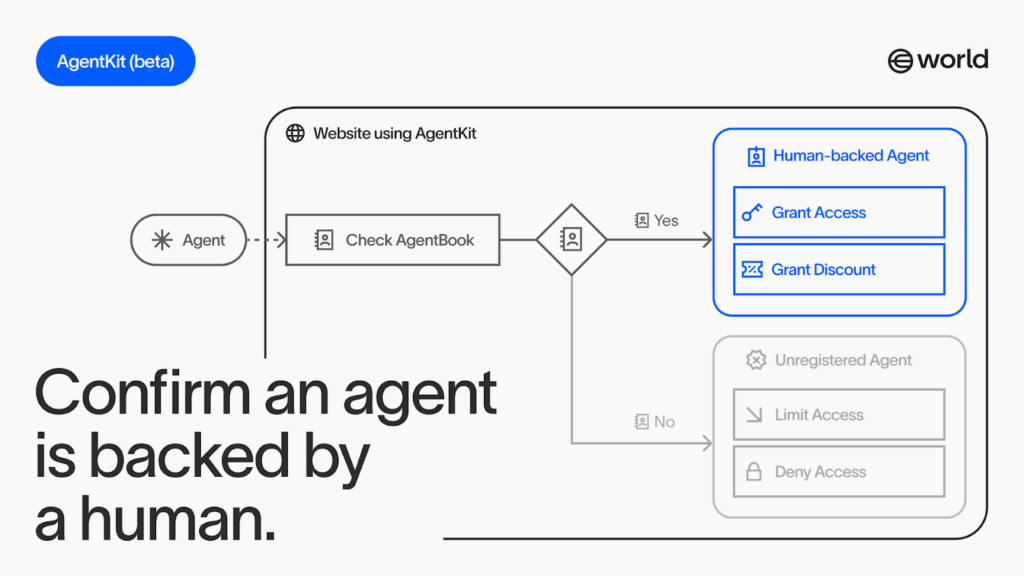
A supplementary signal, proof of unique human, is introduced by AgentKit. Without disclosing personal information, people may use World ID to cryptographically demonstrate their uniqueness as human beings. This feature is extended to AI agents by AgentKit, which enables platforms and websites to confirm that an agent is supported by a real person while protecting privacy.

Websites that currently use x402 may seek verification of unique human identity in addition to or instead of micropayments thanks to the toolkit’s integration with the x402 protocol. Verified World ID holders may use standard verification procedures to register their agents. Before allowing access, the platform may ask for payment, evidence of a unique person, or both when an agent visits a website that is compatible.

Although a single person may assign their World ID to many agents, platforms are able to identify that the agents come from the same person. This enables websites to detect abuse, establish limitations, and distribute resources based on the number of distinct persons interacting rather than the number of agents.

Numerous possible use cases are supported by the paradigm. Reservation systems might prevent scalpers from using a lot of automated agents to stockpile bookings while enabling human-backed agents to book tables. Ticketing systems could guarantee that actual fans, not automated networks, buy concert tickets. Instead of allocating access based on wallets or payments, websites that provide free trials might do so based on each individual person.

Additionally, AgentKit presents infrastructure that might facilitate services that need distinct identification signals, like age or country of residence, by sharing only relevant information using privacy-preserving zero knowledge proofs. Platforms may better control access while safeguarding user privacy by confirming the number of unique people responsible for agent activity.

Nearly 18 million verified people from more than 160 countries make up World’s network. With World ID, users may use cryptographic verification to anonymously demonstrate their uniqueness, enabling platforms to create trust signals without gathering or retaining personal information.

Developers creating AI agents with a validated World ID may now use the AgentKit beta. Developer access and documentation are accessible here.

A more sophisticated version is anticipated when the next iteration of the protocol is launched. The present beta version is based on the World ID architecture. The first release aims to collect developer input and show how proof of unique human may be extended to the expanding autonomous agent ecosystem.

World is meant to be the biggest, most inclusive network of actual people on the planet. The initiative, which was first conceptualized by Sam Altman, Max Novendstern, and Alex Blania, seeks to demonstrate humanity, finance, and connection for all people in the era of artificial intelligence. Visit world.org and X to learn more about the world.

TagsAltcoinBlockchain

Связанные с этим вопросы

QWhat is AgentKit and what problem does it aim to solve?

AAgentKit is a developer toolkit for the agentic web that integrates with the x402 protocol. It allows AI agents to cryptographically prove they are backed by a unique, verified human using World ID, without revealing the person's identity. It aims to solve the problem of establishing trust and accountability for AI agents operating online, distinguishing legitimate human-backed activity from malicious bot swarms.

QHow does the integration of World ID with the x402 protocol create a 'complete trust stack'?

AThe integration combines two key components: the x402 protocol provides a micropayment system that allows agents to pay for the resources and APIs they use (the 'how'), while World ID provides proof of a unique human behind the agent (the 'who'). This gives developers a way for agents to transact and a way for platforms to verify there is a real human behind the wallet, creating a more trustworthy ecosystem for agentic commerce.

QWhy are micropayments alone insufficient for managing AI agent access, and how does AgentKit address this?

AMicropayments control access but don't solve the issue of uniqueness or identity. A single person could run thousands of agents that can all pay tiny fees, making it hard to distinguish coordinated abuse from genuine users. AgentKit addresses this by adding a supplementary signal: proof of a unique human. This allows platforms to verify that an agent represents a distinct person, enabling them to be allocated based on the number of people, not the number of agents or wallets.

QWhat are some potential use cases for human-verified AI agents as described in the article?

APotential use cases include: reservation systems preventing scalpers from using automated agents to hoard bookings; ticketing systems ensuring concert tickets are bought by real fans, not bots; and websites offering free trials allocating access based on unique individuals rather than wallets or payments. It also enables services that require verification of specific attributes like age or country using privacy-preserving zero-knowledge proofs.

QWhat is the current status of AgentKit and what are the future plans?

AAgentKit is currently in a beta release, which is based on the existing World ID architecture. The goal of this initial release is to gather developer feedback and demonstrate how proof of unique human can be extended to autonomous agents. A more sophisticated version is anticipated with the launch of the next iteration of the protocol.

Похожее

The Bitcoin Inheritance Challenge: How to Help Your Family Recover Your Assets?

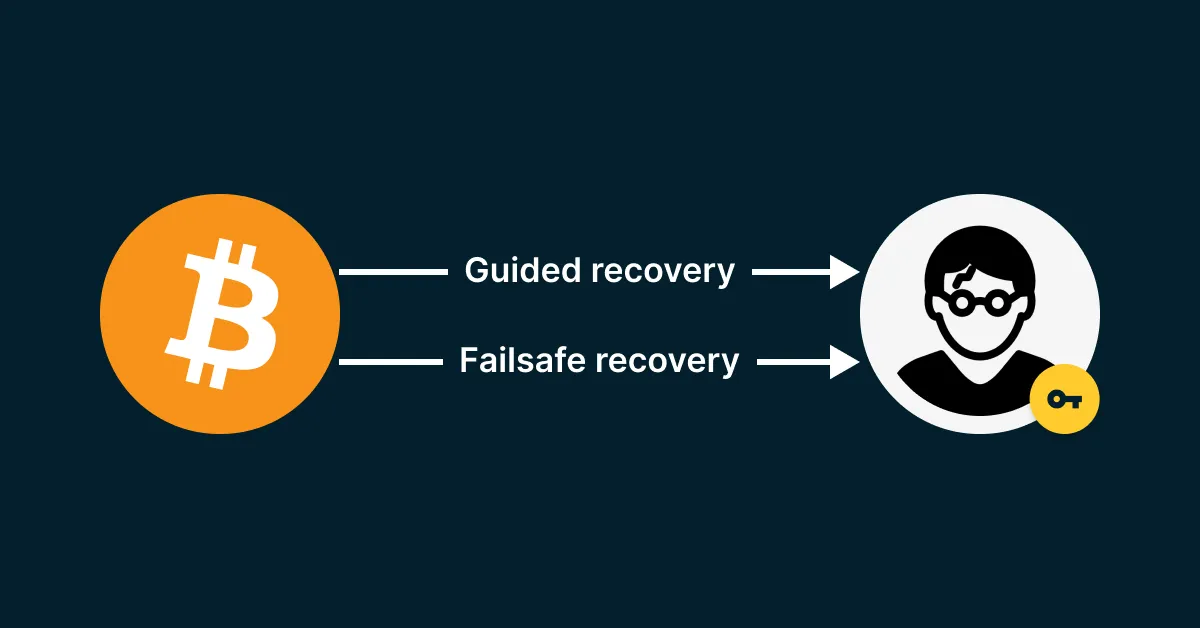
Self-custody of Bitcoin fundamentally changes estate planning. A robust inheritance plan must protect assets during the owner’s lifetime while ensuring designated individuals can recover them after death. Bitcoin’s key advantage—bypassing banks and custodians—also complicates inheritance, as the network only recognizes cryptographic keys, not legal documents. Key challenges include balancing security and accessibility, managing technical complexity for non-expert heirs, preserving privacy, and ensuring long-term viability. Common solutions include: 1. Custodial Inheritance: Relies on exchanges or institutions, sacrificing self-custody benefits for familiar legal processes. 2. DIY Inheritance: Ranges from simple seed-phrase handovers to complex multisig setups. High autonomy but requires technical competence from heirs. 3. Assisted Custody: Uses a service provider for multisig setup and recovery guidance, improving usability but depending on the provider’s longevity. 4. On-Chain Collaborative Inheritance: Combines assisted recovery with on-chain fallbacks (e.g., timelocks), ensuring access even if the provider fails. The strongest plans integrate a smooth, guided recovery path with a durable on-chain backup. Regular testing and updates are crucial. Inheritance isn’t just a technical issue—it must align with legal frameworks and family circumstances. Ultimately, a well-designed Bitcoin inheritance plan ensures assets remain secure, private, and recoverable for generations.

比推4 мин. назад

The Bitcoin Inheritance Challenge: How to Help Your Family Recover Your Assets?

比推4 мин. назад

Using AI for Weather Prediction: Earn $200 a Day While Doing Nothing?

Using AI for Weather Prediction: Can You Really Earn $200 a Day? This article explores how to leverage AI and data analysis to profit from weather prediction markets like Polymarket, focusing on Shanghai’s temperature forecasts. The system relies on Shanghai Pudong Airport (ZSPD) weather station data, sourced via Wunderground, rather than general city forecasts. Key insights include: - Temperature data is reported in whole Fahrenheit values in METAR format, not Celsius, affecting precision. - Historical data shows daily high temperatures most frequently occur between 11:00-13:00, peaking at 12:00 in summer (27.6% of days). Three effective prediction methods were implemented: 1. **Integrated Forecasting**: Combines Weather Company (WC) and ECMWF model data, weighted by weather conditions (e.g., sunny days favor WC). 2. **Real-Time Correction**: Uses morning temperature rise data and historical patterns to extrapolate the daily high, adjusted for cloud cover and wind. A Kalman filter dynamically weights real-time data vs. forecasts. 3. **Temperature Trend Model**: Predicts whether the day will be warmer/cooler than the previous day using pre-dawn data (pressure changes, wind, cloud cover, recent trends). It performs best in winter (clear signals) but poorly in autumn (63.7% accuracy). Two failed methods—Fourier analysis (systematic underestimation) and ERA5 peak-time prediction (insufficient precision)—were discarded. Case studies demonstrate the system identifying mispriced market opportunities, such as recognizing nighttime warming from moist air during rainfall, when public sentiment lagged. Limitations include autumn inaccuracy, lack of real-time pressure data, and unresolved coastal wind effects. Ultimately, the goal isn’t perfect accuracy but leveraging informational edges when odds are favorable.

marsbit24 мин. назад

Using AI for Weather Prediction: Earn $200 a Day While Doing Nothing?

marsbit24 мин. назад

Торговля

Спот
Фьючерсы

Популярные статьи

Неделя обучения по популярным токенам (2): 2026 может стать годом приложений реального времени, сектор AI продолжает оставаться в тренде

2025 год — год институциональных инвесторов, в будущем он будет доминировать в приложениях реального времени.

1.7k просмотров всегоОпубликовано 2025.12.16Обновлено 2025.12.16

Неделя обучения по популярным токенам (2): 2026 может стать годом приложений реального времени, сектор AI продолжает оставаться в тренде

Обсуждения

Добро пожаловать в Сообщество HTX. Здесь вы сможете быть в курсе последних новостей о развитии платформы и получить доступ к профессиональной аналитической информации о рынке. Мнения пользователей о цене на AI (AI) представлены ниже.

活动图片