Trading Time: Bitcoin Remains Under Pressure, Gold Price Falls Below Key Moving Average, Market Focus on Tonight's CPI

marsbitОпубликовано 2026-06-10Обновлено 2026-06-10

Введение

**Market Overview: Risk Assets Under Pressure Ahead of Key US CPI Data** Major risk assets faced selling pressure on Tuesday, with heightened geopolitical tensions and caution ahead of pivotal US inflation data weighing on sentiment. The Nasdaq fell 0.97%, led lower by a sharp sell-off in major tech stocks like Apple. Oil prices (WTI) plunged over 3% to around $88.50. **Key Assets in Focus:** * **Gold:** Spot gold tumbled to the $4,200 level, breaking below its 200-day moving average. Analysts cited ETF outflows and higher real yields, with support now eyed near $4,100. * **Bitcoin:** Continued its decline, with ETFs seeing net outflows. Analysts warn a break below $60,000 could trigger a move toward $50,000. * **Stocks:** Tech and semiconductor stocks were hit hard. Super Micro Computer sank on dilution fears, while a bearish research report triggered a crash in optical communication stocks like AAOI and Coherent. **Tonight's Macro Catalyst: US CPI** All eyes are on the US May CPI report. Headline inflation is forecast to rise to multi-year highs (~4.3%), driven by energy, while core CPI is expected to show moderation. **Asia-Pacific Markets Tumble** Asian markets followed US tech losses. South Korea's KOSPI index crashed 6.46%, briefly triggering a trading halt, and Japan's Nikkei 225 fell 2.49%. Semiconductor stocks like Samsung Electronics and SK Hynix led declines. **Crypto Market Notes:** Ethereum shows weakness with declining open interest. Two tokens, SAHAR...

Daily market key data review and trend analysis, produced by PANews.

Macro Markets
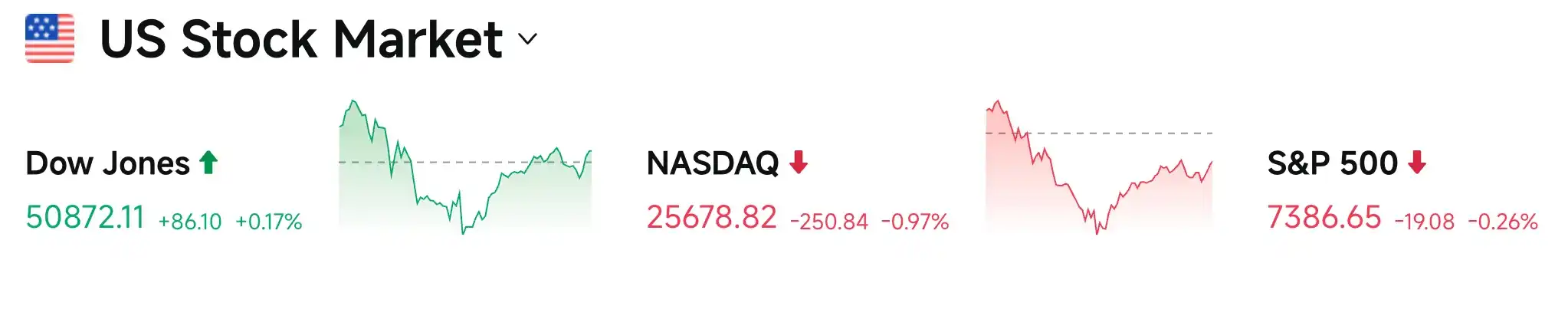
Tech stock selling caused sharp intraday volatility in US stocks on Tuesday, with the Nasdaq index at one point falling over 4%, closing down 0.97% below last Friday's low. The S&P 500 fell 0.26% to 7386.65 points, while the Dow Jones Industrial Average edged up 0.17% to 50872.11 points, supported by defensive sectors like consumer goods.

Geopolitical tensions escalated again. In response to the downing of a US military helicopter, US forces completed strikes on 20 targets within Iran. Iran subsequently retaliated against US bases in Jordan and Bahrain. Affected by this, the crude oil market saw intense volatility, with WTI crude oil briefly falling below $87, eventually closing sharply down over 3% near $88.50.

Gold prices were also impacted, with spot gold falling to the $4200 mark, hitting a nearly three-month low and already below the 200-day moving average. Analysts at Standard Chartered pointed out that as inflation rises and real yields climb, ETF funds are accelerating their outflow. The current ETP holdings structure is relatively fragile, potentially amplifying downward price pressure, with the next key technical support located near $4100. Notably, Citigroup analysts stated in a Monday report that if the Strait of Hormuz remains closed until late summer, gold prices could fall to $3500. Despite this, Ed Yardeni, founder of Yardeni Research, remains bullish, believing $4000 is a solid floor and sees potential up to $10,000.

US May inflation data will be released tonight at 8:30 PM. Wall Street institutions generally predict that, driven by surging energy prices, the May headline CPI year-on-year may rise to 4.2%~4.3%, hitting a nearly three-year high. However, the month-on-month core CPI is expected to be only 0.17%~0.22%, significantly below market consensus, with cooling in components like housing and auto insurance potentially being key to the slowdown in core inflation. The market is currently closely watching this data to gauge the policy stance of the new Federal Reserve Chairman, Kevin Warsh, at next week's interest rate meeting.

US Stock Dynamics
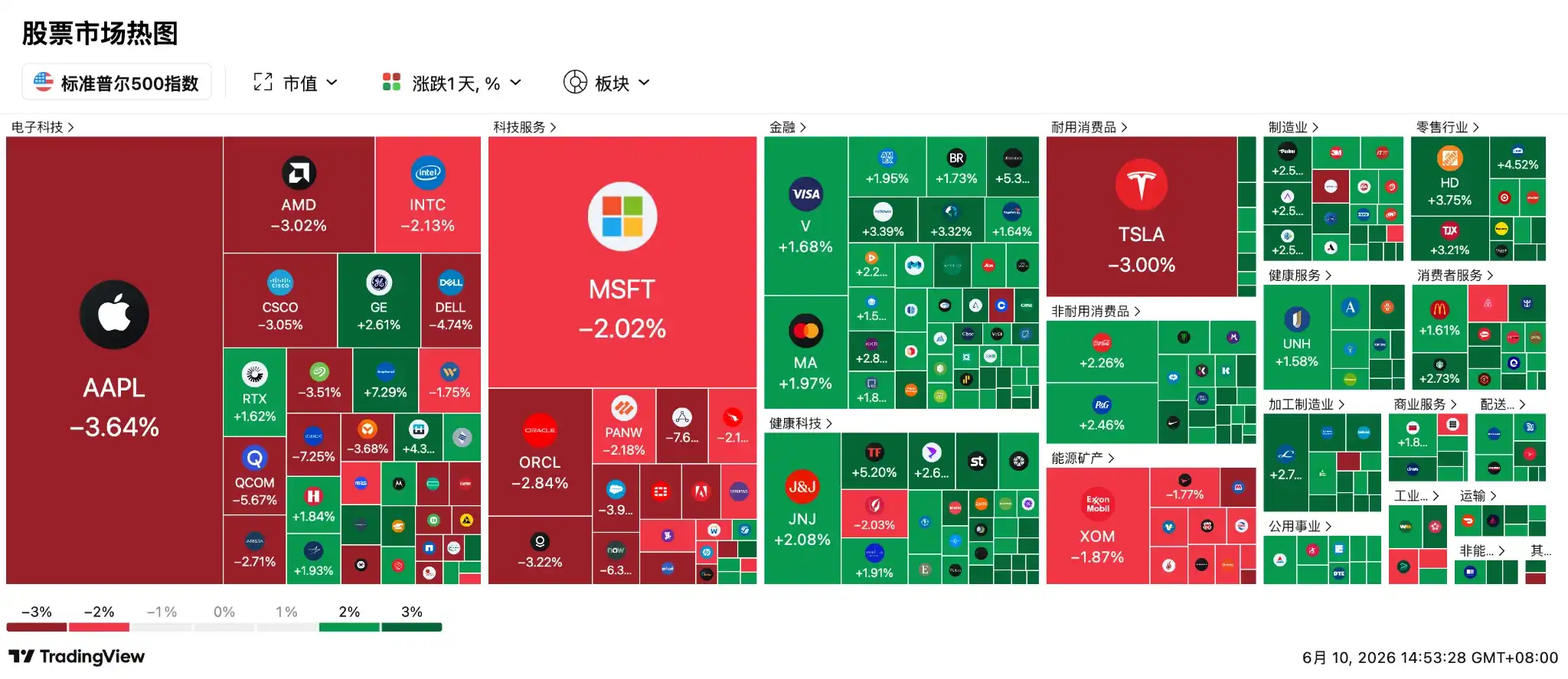
US stocks performed poorly after the AI frenzy subsided, with tech stocks experiencing heavy selling. The Philadelphia Semiconductor Index at one point plunged as much as 8.6%; ARM and Marvell Technology fell over 10% during the day; Micron Technology and Intel also fell up to 7% and 5% respectively. Apple, failing to deliver super-expected surprises at the WWDC conference, led the decline with its stock plummeting 3.64%. Super Micro Computer (SMCI) announced up to $7 billion in equity financing to purchase AI server components, with severe concerns about equity dilution causing its stock to crash over 10% in a single day, closing down 7.62%.

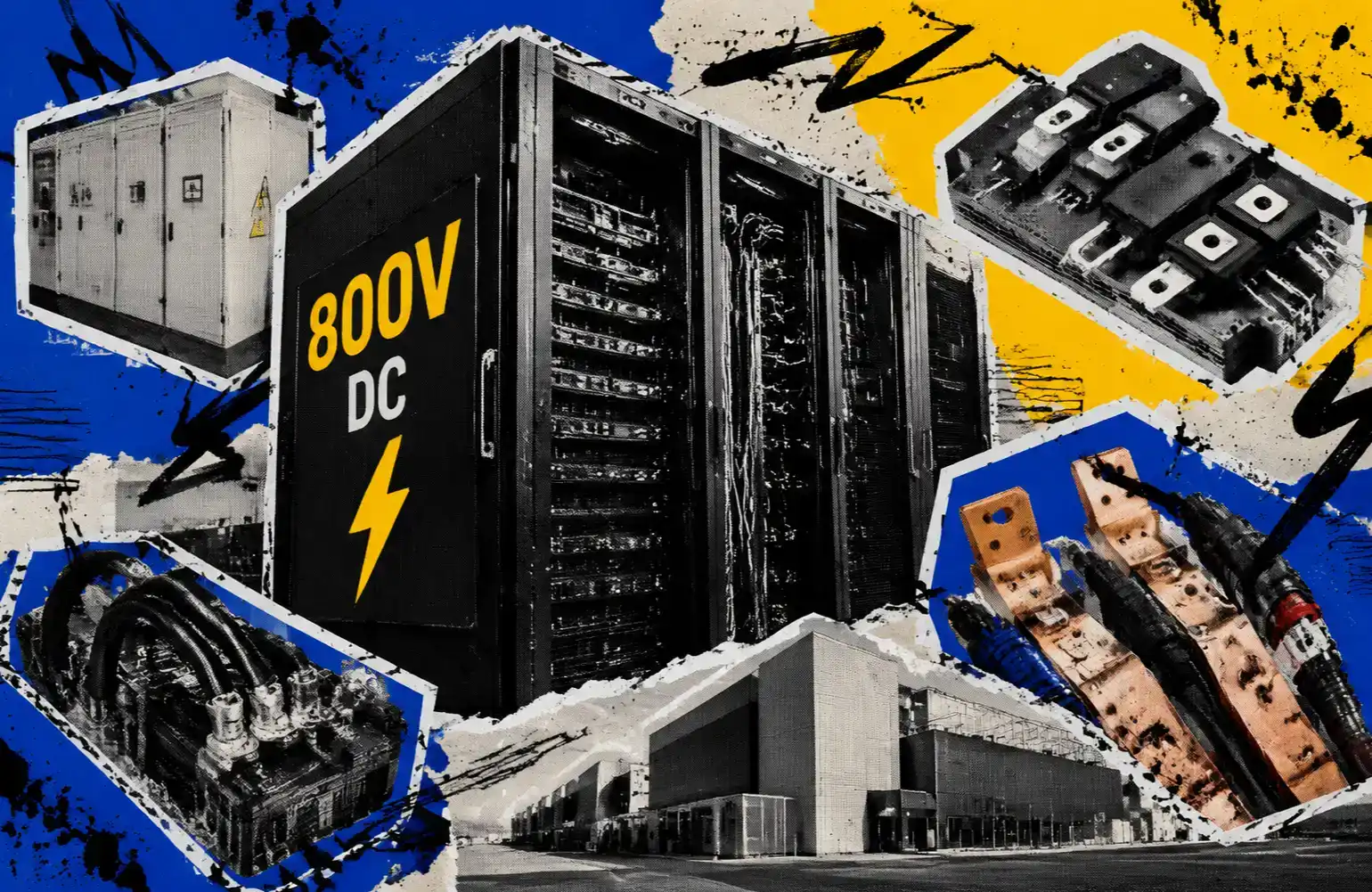
The optical communications sector experienced a "massacre" triggered by a research report. The prominent AI research firm SemiAnalysis released a report stating that NVIDIA's 800VDC power architecture and CPO (Co-Packaged Optics) large-scale production will be delayed until 2028. This expectation hammered the supply chain directly: Applied Optoelectronics (AAOI) plummeted 17% in a single day, Lumentum fell 8%, and chip giant COHERENT crashed 11.44%. Although NVIDIA Vice President Gilad Shainer strongly refuted this at the Computex exhibition, calling CPO "the most exciting technology today" and stating it would ramp up in the second half of the year, it failed to stop the spread of panic. The market began betting on NPO and traditional pluggable modules as transitional substitutes.

Meanwhile, Oracle is scheduled to release its earnings report after the US market close on Wednesday. The market generally expects revenue to reach $19.1 billion. TD Cowen and UBS have raised their price targets to $300 and $285 respectively, believing there is still room for acceleration in the cloud infrastructure business. Jefferies analyst Brent Thill stated that strong demand in the cloud infrastructure business will be a key factor driving the stock price. The options market indicates traders expect the company's stock price could swing up to 11% in a single week after the earnings release.

Cryptocurrency

Bitcoin continues to face pressure. Bitcoin ETFs saw a net outflow of $77.43 million yesterday, with total assets falling back to $775.8 billion, completely erasing the incremental funds since Trump's election victory.

The market remains cautious about the upcoming US CPI data. Analysts point out that if inflation remains high, it could further dampen the rationale for Bitcoin as a hedge tool. Bitwise research shows Bitcoin often reacts ahead of traditional markets, so its current trend may indicate a broader risk adjustment. Glassnode's MVRV model warns that once $60,000 is decisively lost, the deep value zone of $50,000 will become the next ruthless magnetic attraction point.

Ethereum is also weak. Options market data shows that ETH's open interest has fallen 25% since the May high, indicating weakening investor confidence in future price movements. Although institutions like Bitmine bought 75,000 ETH worth $122 million against the trend, analyst Ash Crypto warned that if it falls below $1500, Ethereum could head straight to $1000.

On-chain black swan events have intensified panic. Sahara AI saw its token halved by nearly 60% in a single day due to a rumor about a CCIP cross-chain bridge supplementing liquidity being misinterpreted as a sell-off. The Humanity project suffered a devastating blow, with hackers invading employee computers and wildly minting 1 billion H tokens. Currently, both H and SAHARA token prices have somewhat rebounded.

Today's Outlook:

  • Informed sources: SpaceX will determine the issuance price as early as June 11, with the stock listing on June 12.

  • Upbit 24-hour trading volume ranking: SAHARA, WLD, XRP, BTC, ETH.

  • Magic Eden (ME) will unlock approximately 172 million tokens worth about $10.4 million on June 11.

  • HOME (HOME) will unlock approximately 750 million tokens worth about $40.2 million.

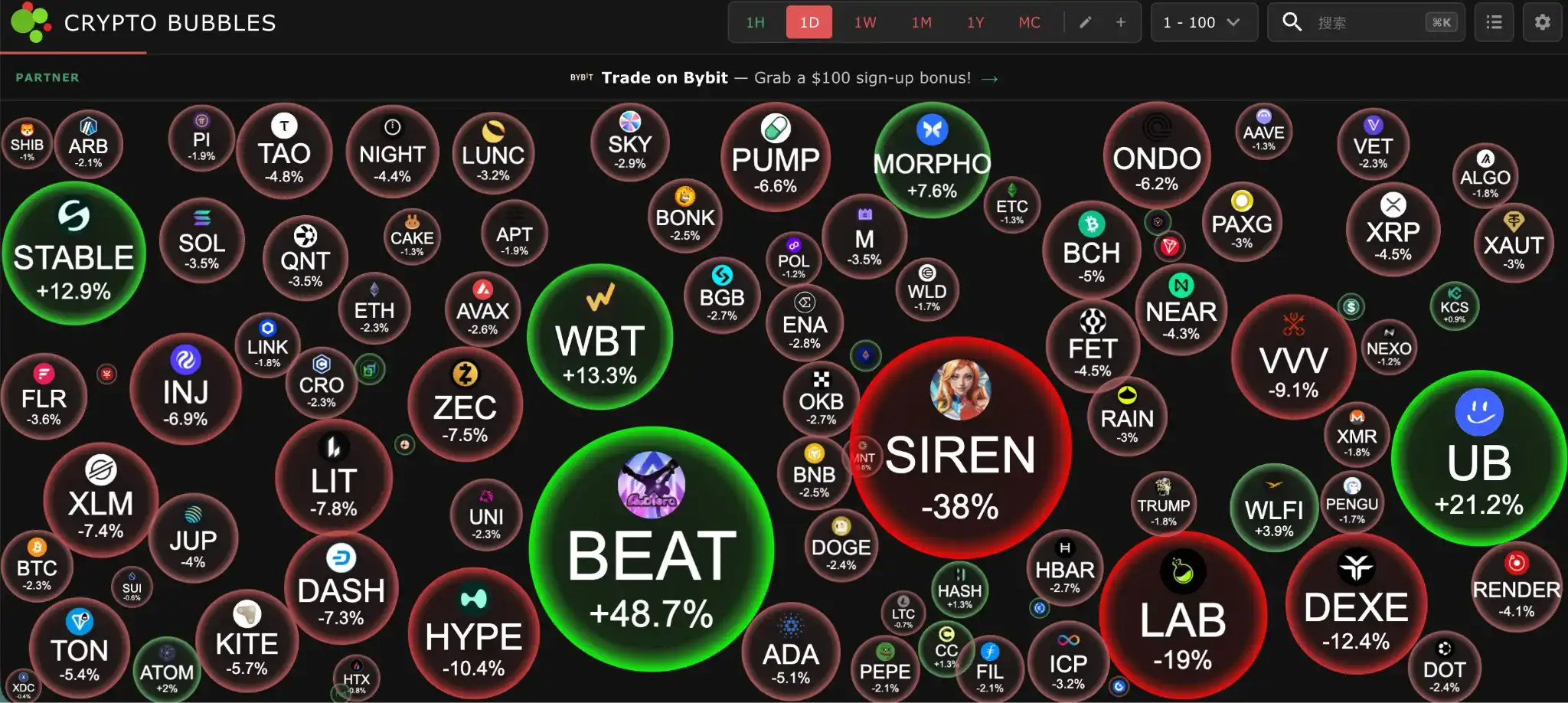
Top gainers among the top 100 cryptocurrencies by market cap today: BEAT up 48.7%, UB up 21.2%, WBT up 13.3%, STABLE up 12.9%, MORPHO up 7.6%.
Asia-Pacific Market

Asia-Pacific stock markets failed to stay immune. Under the dual pressure of Middle East conflict and the rout of US tech stocks, they experienced a major plunge.

The South Korean KOSPI index faced extremely severe selling, plummeting 6.46% and triggering circuit breakers at one point. The Japanese Nikkei 225 index also plunged over 1600 points, down 2.49%. Arjun Jayaraman, portfolio manager at Causeway Capital, pointed out that the proliferation of retail funds with high leverage and new ETFs in Japanese and Korean markets is amplifying this panic-driven volatility manifold.

Semiconductor giants became the epicenter of the selling wave in the Asia-Pacific market. Despite *The Korea Economic Daily* reporting the positive news that Samsung Electronics plans to build an advanced packaging plant in Gwangju, it seemed pale in the face of macro panic. Samsung Electronics stock plunged over 7%, and SK Hynix fell more than 8%. The Japanese chip contingent also retreated, with Advantest and Kioxia both falling nearly 4%. Not only that, even SoftBank Group saw its stock crash over 9% in a single day due to its attempt to use OpenAI shares as collateral for a $6 billion loan being blocked.

Amid the wailing, the A-share market walked its own independent logic due to strong data and World Cup expectations. China's May export data shone brightly, with a year-on-year surge of 19.4% in US dollar terms. Among them, integrated circuits skyrocketed 111%, and computer equipment surged 66%. Xing Zhaopeng, strategist at ANZ, remarked that the global AI hardware frenzy is substantively reshaping China's trade landscape. On the consumer side, with less than 48 hours until the US-Canada-Mexico World Cup opening, expectations for the "midnight viewing" late-night snack economy sparked by the time difference ignited the beer sector. Hui Quan Beer hit the daily limit up, while Zhujiang Beer and Yanjing Beer rose over 5%, becoming a rare bright spot in the gloomy market.

Связанные с этим вопросы

QWhat are the key factors putting pressure on Bitcoin and gold prices according to the article?

ABitcoin is under pressure due to net outflows from Bitcoin ETFs and market caution ahead of the US CPI data. Gold fell below the key 200-day moving average to around $4200, pressured by rising inflation, higher real yields, ETF outflows, and geopolitical tensions.

QWhat major event is the market focused on tonight (the night the article was published), and what is the general forecast for the data?

AThe market is focused on the release of the US May CPI (Consumer Price Index) data. Forecasts suggest the headline CPI may rise to 4.2%~4.3% year-over-year, driven by energy prices, but core CPI month-over-month is expected to be significantly lower at 0.17%~0.22%.

QWhich sectors and specific companies in the US stock market experienced significant declines, and what were the main reasons?

AUS tech stocks, especially semiconductors and AI-related companies, saw significant declines. Key losers included Apple (down 3.64% post-WWDC), ARM, Marvell Technology, Micron, Intel, and Super Micro Computer (SMCI, down over 10% on dilution fears). The optical communications sector (e.g., AAOI, Lumentum, COHERENT) crashed due to a bearish analyst report delaying expectations for CPO technology adoption.

QWhat caused the severe sell-off in major Asian stock markets like South Korea's KOSPI and Japan's Nikkei 225?

AThe severe sell-off in Asian markets was caused by a combination of escalating geopolitical tensions in the Middle East and the sharp decline in US tech stocks. The panic was amplified by high levels of leveraged retail money and new ETFs in these markets.

QDespite the broader market downturn, which Chinese sectors showed strength and why?

AChina's A-shares showed relative strength, driven by robust export data (with integrated circuit exports surging 111%) linked to the global AI hardware boom, and positive expectations for the 'late-night snacking' economy ahead of the FIFA World Cup, which boosted beer stocks like HuiQuan Brewery.

Похожее

Blockchain has finally begun sailing toward the main channel after 18 years

After 18 years of development, blockchain technology is beginning to move from a specialized niche into mainstream adoption, according to a recent industry analysis. The shift is reflected in the changing strategies of major crypto venture capital firms, which are expanding their focus beyond pure "digital ownership" towards broader themes like "autonomy." The report highlights that leading VC firms like Variant, Paradigm, Haun Ventures, and YZi Labs are broadening their investment mandates to include not only crypto but also artificial intelligence (AI), robotics, biotech, and other frontier technologies. This reflects a recognition that the isolated "crypto investment" narrative is losing appeal to limited partners (LPs) as capital and attention increasingly flow toward AI and other high-growth tech sectors. A key emerging thesis is that blockchain's most significant future application may not be as a consumer-facing product, but as the underlying economic and settlement infrastructure for the AI era. As AI agents and autonomous systems become more prevalent, they will require programmable, global, and low-cost payment networks (like stablecoins), verifiable digital identities, and secure wallets to manage transactions and assets on behalf of users. The investment by stablecoin issuer Tether into robotics company NEURA, with plans to integrate its wallet technology, is cited as a prime example of this convergence. However, the article cautions that simply labeling projects as "AI + Crypto" is insufficient. True value lies in integrations where blockchain technology is essential—such as enabling machine-to-machine micropayments, verifiable data provenance for AI, or transparent governance for autonomous organizations—rather than being a superficial marketing add-on. In conclusion, while AI currently dominates the tech narrative and capital flows, it may ultimately create the real-world, high-frequency demand that the crypto industry has long sought. For crypto VCs and projects, the path forward is to position blockchain not as a competing sector, but as a critical foundational layer powering autonomy and economic activity in an AI-driven future.

链捕手4 мин. назад

Blockchain has finally begun sailing toward the main channel after 18 years

链捕手4 мин. назад

Y Combinator Co-founder: How to Make a Billion Dollars?

The Y Combinator co-founder argues that becoming a billionaire by founding a successful startup is not only possible but demonstrably achievable without unfair or unethical practices. He disputes a politician's claim to the contrary, using the example of a founder whose company grew at 93% monthly solely through creating a product users loved and recommended. The core mechanism is exponential growth. A conservative 15% monthly growth rate compounds to a 4384x increase over five years, which can easily lead to billion-dollar valuations and founder wealth. The process depends on two key variables: the growth rate and the duration it can be sustained. A high growth rate stems from a great product that users naturally promote, while a long duration requires a large enough market. For aspiring founders, especially young ones, the simplest path is to build something they and their friends genuinely need. Young people's current needs often predict future mass-market trends. He advises against actively "searching" for ideas, as this tends to filter out unconventional but promising ones. Instead, inspiration should come from working on interesting projects with friends, as many iconic companies (e.g., Apple, Facebook) started this way. Ultimately, building a massively valuable startup is not about exploitation but empathy: deeply understanding a user group and building a product that significantly improves their lives. This, powered by exponential growth in a large market, is the legitimate path to immense wealth creation.

Foresight News7 мин. назад

Y Combinator Co-founder: How to Make a Billion Dollars?

Foresight News7 мин. назад

The 800V Voltage Standard Championed by Nvidia: Which Infrastructure Providers Stand to Benefit?

NVIDIA is actively promoting the 800VDC architecture as a key direction for its next-generation AI factories and high-power racks, particularly for the upcoming Rubin and Kyber platforms. The primary driver is the rapidly increasing power density of AI racks, with designs like GB200/GB300 NVL72 reaching 120-140kW and future systems potentially hitting 180-220kW. At such high power levels, traditional low-voltage power delivery becomes inefficient due to massive current, leading to significant copper use, cable bulk, heat, and power loss. The 800VDC standard aims to increase efficiency by transmitting power at higher voltage and lower current to the rack before stepping it down locally for GPUs. NVIDIA claims this can improve efficiency by up to 5%, reduce total cost of ownership (TCO) by up to 30%, and cut copper usage by approximately 45%. This shift redefines infrastructure roles, pushing power engineering to the forefront alongside GPU performance. Key beneficiaries and ecosystem partners highlighted include: 1. **Power Infrastructure Providers:** Companies like Vertiv, Schneider Electric, Delta Electronics (台达电), and Korean firms LS Electric and HD Hyundai Electric are involved in designing next-gen AI factory power distribution, rack power supplies, and backup systems. 2. **Power Semiconductors:** Suppliers of SiC/GaN devices, such as Infineon and STMicroelectronics, are better suited for high-voltage, high-efficiency conversion in this new architecture. 3. **Connectivity & Structure:** The focus shifts to high-reliability components like busbars, high-voltage connectors, and advanced PCBs that meet stricter insulation and safety requirements. 4. **Liquid Cooling & Rack ODM:** As power and heat density rise, liquid cooling becomes critical. Full-rack system integrators (e.g., Dell, Wiwynn, Wistron) must now demonstrate robust pre-delivery testing capabilities, including burn-in testing under full load, requiring significant power and cooling infrastructure in their factories. The transition is not immediate for all data centers but is targeted at high-density AI factories. NVIDIA’s 800VDC ecosystem is in a preparatory phase, with full-scale production expected to align with the 2027 launch of Kyber rack-scale systems. The investment thesis revolves around which companies can demonstrate proven product integration, customer validation, and reliable delivery of complete, high-power AI rack systems, making power, cooling, and testing capabilities new critical variables in the AI infrastructure value chain alongside GPUs.

marsbit27 мин. назад

The 800V Voltage Standard Championed by Nvidia: Which Infrastructure Providers Stand to Benefit?

marsbit27 мин. назад

Did 'Unlimited Minting' Actually Happen? Zcash Founder Responds to Four Major Market Concerns

The Orchard shielding pool in the privacy cryptocurrency Zcash was recently found to have contained a critical counterfeiting vulnerability that existed for four years. This discovery caused significant market panic and a sharp drop in the price of ZEC, though it has since recovered partially. Zcash founder Zooko Wilcox addressed four key questions raised by the vulnerability. First, while it's unknown if the bug was exploited, he believes it likely was not, citing advanced, targeted discovery methods, a rapid response to freeze the pool, and the typical "smash-and-grab" nature of past crypto exploits. Second, he states that if no exploitation occurred, all legitimate user funds in Orchard are recoverable. However, cautious users moving funds should be aware of privacy trade-offs and other risks involved in transferring to transparent or Sapling pools. Third, users currently cannot independently verify that the total ZEC supply hasn't been inflated due to this bug. However, the proposed "Ironwood" network upgrade will restore this ability by permanently sealing the Orchard pool. This will prevent any counterfeit funds from circulating and allow anyone running a node to cryptographically verify that the supply cap has not been breached. Finally, regarding other undiscovered vulnerabilities, Wilcox notes that intensive ongoing audits by multiple teams, including using advanced AI-assisted tools, have so far found no other counterfeiting bugs. This provides increased, though not absolute, confidence. In conclusion, while assessments suggest the bug was likely unused and funds are safe, the core issue was the loss of user-verifiable supply integrity. The Ironwood upgrade is presented as the solution, aiming to restore trust by allowing users to independently verify Zcash's supply security without relying on third-party assurances.

marsbit28 мин. назад

Did 'Unlimited Minting' Actually Happen? Zcash Founder Responds to Four Major Market Concerns

marsbit28 мин. назад

The First Prediction Market Stock Has Emerged!

"Prediction Market Unicorn Emerges!" While the World Cup drives record trading volumes in prediction markets, the industry leader Kalshi faces a new threat from a former key ally. In March 2025, Kalshi partnered with online broker Robinhood to offer prediction market services, allowing users to bet on events. This deal was mutually beneficial: Kalshi gained access to Robinhood's massive retail user base, with an estimated 25-35% of its volume coming through this channel, while Robinhood earned significant fees, reporting a 320% year-over-year increase in "other transaction revenue" to $147 million in Q1 2026, largely fueled by prediction markets. However, Robinhood's ambitions have grown. Recognizing that its user base and distribution power are the scarcest resources, it initiated a plan to bring operations in-house. In late 2025, Robinhood partnered with Susquehanna to acquire CFTC-regulated exchange MIAXdx, renaming it Rothera Exchange. By June 2026, Robinhood launched its own prediction market product on Rothera, strategically using the World Cup as a launchpad. Initial data shows Rothera processing tens of millions of contracts within days, directly siphoning volume away from Kalshi. This shift marks a pivotal moment: control is moving from the market infrastructure provider (Kalshi) to the entity controlling user distribution (Robinhood). The story illustrates a recurring internet era dynamic: "He who controls distribution controls everything." As more platforms with large user bases recognize the value of prediction markets, the industry's future competition may center less on which platform has the best market technology and more on which one owns the user gateway.

marsbit40 мин. назад

The First Prediction Market Stock Has Emerged!

marsbit40 мин. назад

Торговля

Спот
Фьючерсы

Популярные статьи

Как купить S

Добро пожаловать на HTX.com! Мы сделали приобретение Sonic (S) простым и удобным. Следуйте нашему пошаговому руководству и отправляйтесь в свое крипто-путешествие.Шаг 1: Создайте аккаунт на HTXИспользуйте свой адрес электронной почты или номер телефона, чтобы зарегистрироваться и бесплатно создать аккаунт на HTX. Пройдите удобную регистрацию и откройте для себя весь функционал.Создать аккаунтШаг 2: Перейдите в Купить криптовалюту и выберите свой способ оплатыКредитная/Дебетовая Карта: Используйте свою карту Visa или Mastercard для мгновенной покупки Sonic (S).Баланс: Используйте средства с баланса вашего аккаунта HTX для простой торговли.Третьи Лица: Мы добавили популярные способы оплаты, такие как Google Pay и Apple Pay, для повышения удобства.P2P: Торгуйте напрямую с другими пользователями на HTX.Внебиржевая Торговля (OTC): Мы предлагаем индивидуальные услуги и конкурентоспособные обменные курсы для трейдеров.Шаг 3: Хранение Sonic (S)После приобретения вами Sonic (S) храните их в своем аккаунте на HTX. В качестве альтернативы вы можете отправить их куда-либо с помощью перевода в блокчейне или использовать для торговли с другими криптовалютами.Шаг 4: Торговля Sonic (S)С легкостью торгуйте Sonic (S) на спотовом рынке HTX. Просто зайдите в свой аккаунт, выберите торговую пару, совершайте сделки и следите за ними в режиме реального времени. Мы предлагаем удобный интерфейс как для начинающих, так и для опытных трейдеров.

1.5k просмотров всегоОпубликовано 2025.01.15Обновлено 2026.06.02

Как купить S

Sonic: Обновления под руководством Андре Кронье – новая звезда Layer-1 на фоне спада рынка

Он решает проблемы масштабируемости, совместимости между блокчейнами и стимулов для разработчиков с помощью технологических инноваций.

2.3k просмотров всегоОпубликовано 2025.04.09Обновлено 2025.04.09

Sonic: Обновления под руководством Андре Кронье – новая звезда Layer-1 на фоне спада рынка

HTX Learn: Пройдите обучение по "Sonic" и разделите 1000 USDT

HTX Learn — ваш проводник в мир перспективных проектов, и мы запускаем специальное мероприятие "Учитесь и Зарабатывайте", посвящённое этим проектам. Наше новое направление .

1.8k просмотров всегоОпубликовано 2025.04.10Обновлено 2025.04.10

HTX Learn: Пройдите обучение по "Sonic" и разделите 1000 USDT

Обсуждения

Добро пожаловать в Сообщество HTX. Здесь вы сможете быть в курсе последних новостей о развитии платформы и получить доступ к профессиональной аналитической информации о рынке. Мнения пользователей о цене на S (S) представлены ниже.

活动图片