Bitcoin Reclaims $94,000: A New Bull Market Beginning or a Bull Trap?

marsbitОпубликовано 2025-12-10Обновлено 2025-12-10

Введение

Bitcoin has surged back to the $94,000 level, sparking debate over whether this marks the beginning of a new bull run or a short-term bullish trap. Despite the strong price performance, trading volume has not fully supported the upward move. Key resistance levels and the upcoming FOMC meeting have influenced market sentiment. After a brief period of consolidation, Bitcoin broke through $93,500, reestablishing a short-term bullish trend. Technical analysis indicates the formation of bullish patterns such as the "cup and handle" and "inverse head and shoulders," suggesting a potential rise to $104,000 if $96,000 is breached. However, failure to hold above $96,000 could trigger a pullback toward $88,000–$89,000 or even lower. Market liquidity presents mixed signals. The buy-sell ratio remains low, and retail participation—especially from South Korea—has cooled, though U.S. institutional demand appears stronger. On-chain data shows increased activity from large holders, indicating accumulation by "smart money." Macro factors include potential Fed rate cuts and supportive U.S. policy developments, such as proposed Bitcoin strategic reserves and stablecoin legislation. Bitcoin ETF approvals are also anticipated by mid-May, with traditional firms like Vanguard gradually opening access to crypto ETFs. Risks include overbought conditions, high leverage (with $120M in long liquidations possible below $87,000), and regulatory uncertainties outside the U.S. Investors should monitor t...

Last night, Bitcoin once again became the center of attention as its price strongly rebounded to the $94,000 mark. This breakthrough move has sparked widespread discussion in the market: does this mark the start of a new bull market, or is it just a brief technical rebound?

Despite the strong price performance, trading volume data did not fully support the upward trend.

Battle at Key Resistance and Market Sentiment Ahead of FOMC Meeting

After experiencing brief structural weakness on December 3rd, Bitcoin once struggled to secure a daily close above $93,000.

As the important macroeconomic event—the Federal Open Market Committee (FOMC) meeting—approached, most market participants chose to wait and see, leading to several days of sideways consolidation.

This stalemate was broken on December 5th when Bitcoin's price successfully broke through $93,500, forming the higher high needed to restore the short-term bullish trend.
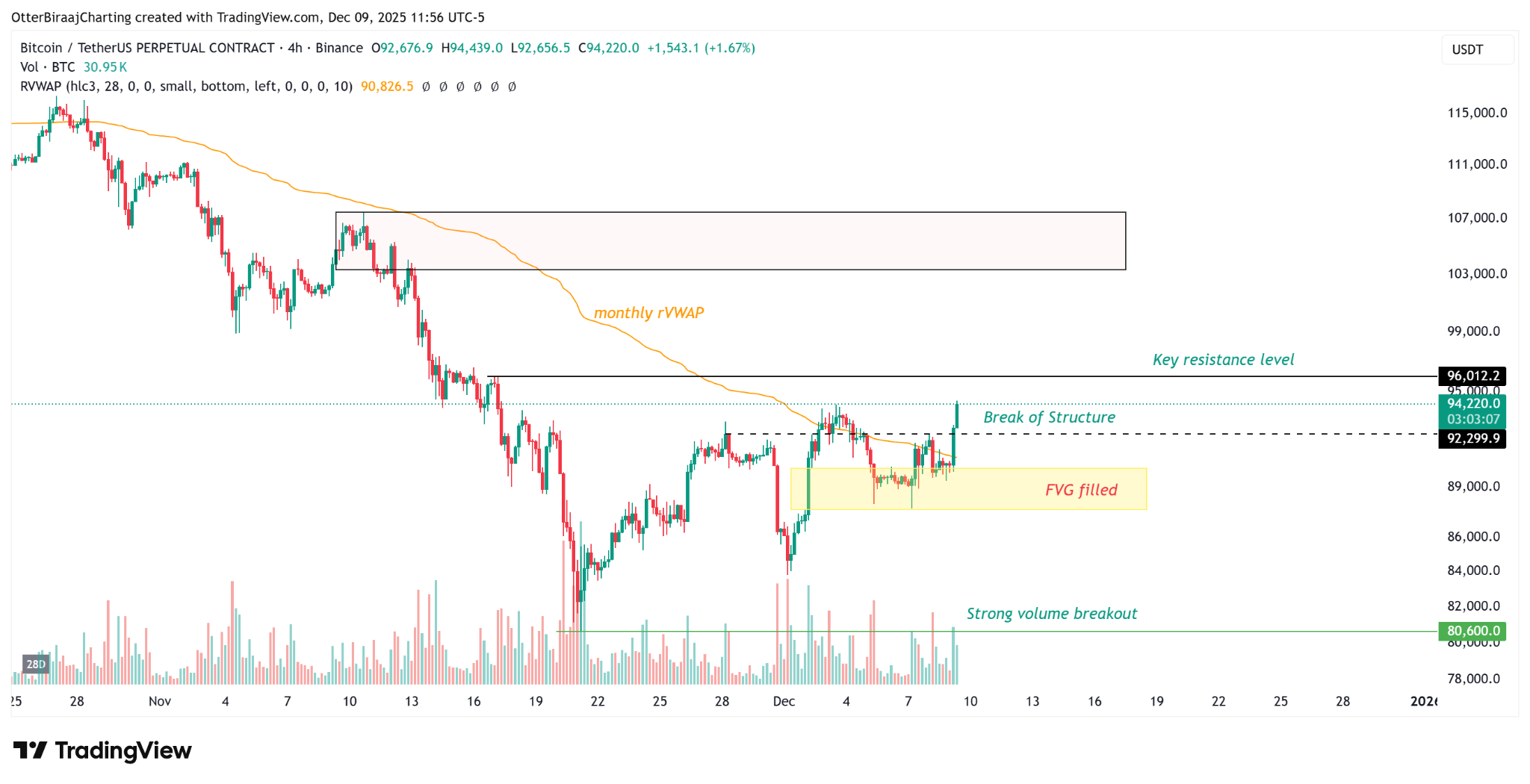
From a technical analysis perspective, on the four-hour chart, Bitcoin not only completely filled the fair value gap between $87,500 and $90,000 but also showed firm buying intent. The effectiveness of this breakthrough is particularly significant against the backdrop of potential volatility from upcoming macro events.


Technical Patterns and Key Level Analysis

Multiple bullish technical patterns have recently formed. A confirmed 'cup and handle pattern' is observed on the four-hour chart, suggesting that if Bitcoin can break above $96,000, the next target could be $104,000. Simultaneously, an 'inverse head and shoulders pattern' has also largely taken shape. These two bullish patterns together strengthen confidence among the bulls.

Market analysts generally view $94,000 as a key psychological level, coinciding with a descending trendline resistance. The criteria for judging trend sustainability are clear: if Bitcoin's daily closing price can stabilize above $96,000, it will be seen as a strong bullish reversal signal; conversely, failure at this resistance could lead to a rapid pullback to the $88,000-$89,000 range.

More broadly, the $95,000 area is seen as the 'main battlefield' between bulls and bears. A successful breakout above this area could open the door for the price to test the $99,000 to $107,000 range; whereas a failure to break through could result in a deeper correction, potentially retesting the $85,000 support, or even plunging further to $76,000 in extreme cases.


Contradictory Signals from Liquidity Conditions and Market Participation
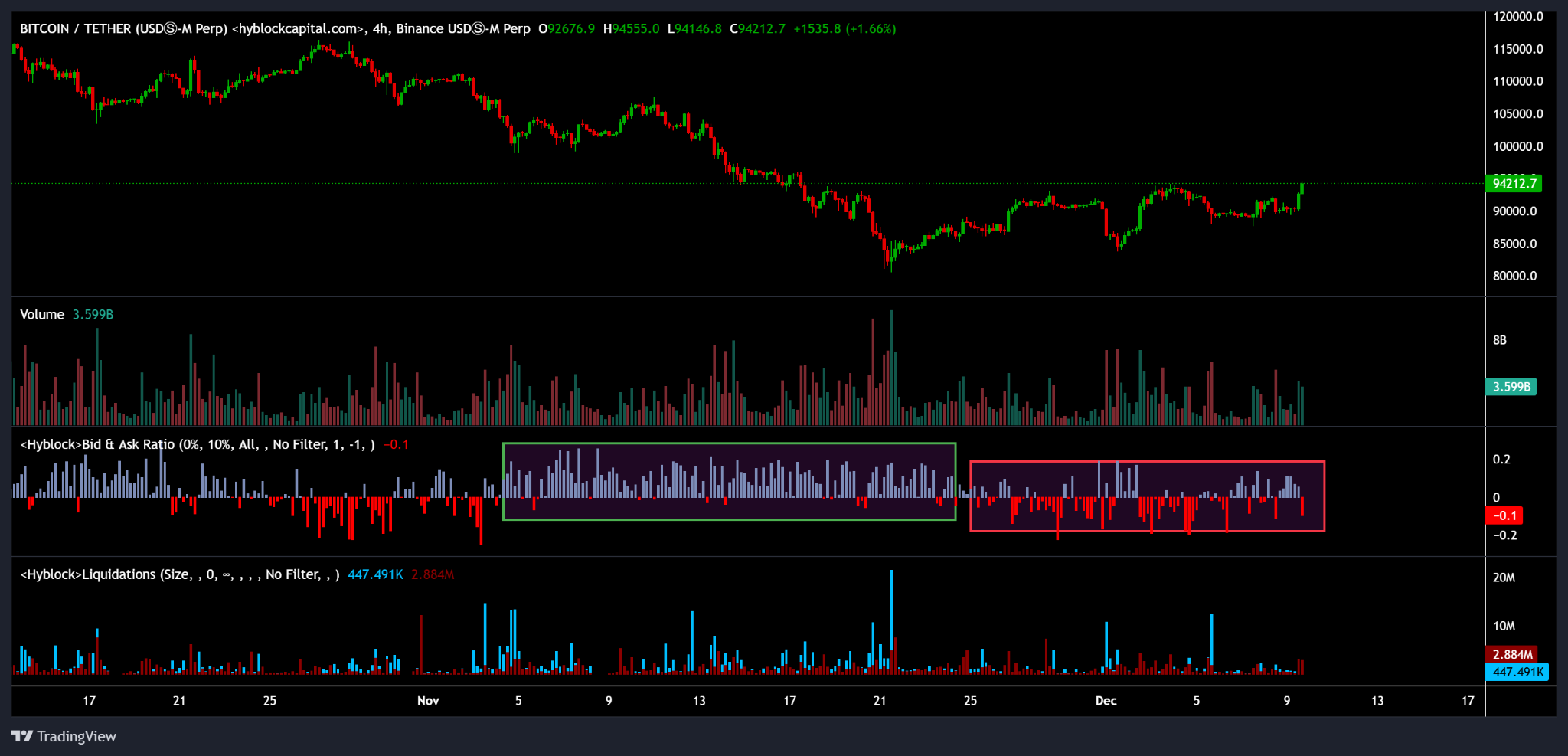
Analysis of Bitcoin's Preference-Sell Ratio and Liquidation Data. Source: Hyblock

Although the price action is encouraging, market liquidity indicators do not fully validate the upward trend. Bitcoin's buy-sell ratio remains at a relatively low and unstable level.

Unlike the aggressive buying seen during November's plunge from $100,000 to $80,000, the current rebound lacks the same intensity of buying support. This suggests that the recent rise is primarily driven by price movement rather than solid new demand. Exchange premium data also paints a complex picture.

The Kimchi Premium (a key indicator of retail sentiment in South Korea) has significantly cooled. Previously, the Korean market often traded at a premium during rallies, but this enthusiasm has now waned, approaching parity or slightly negative, indicating that retail speculators have not yet entered the market en masse.
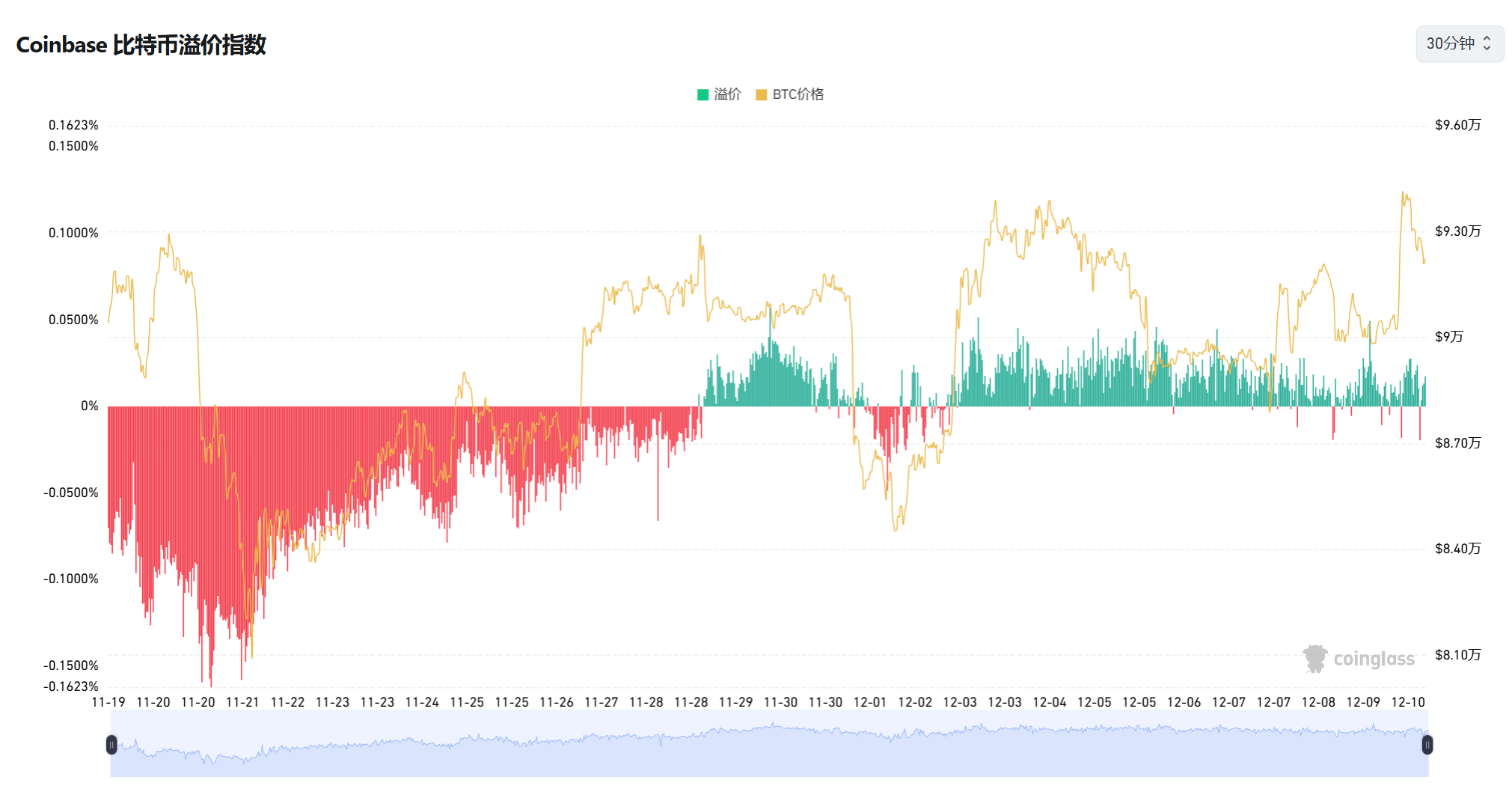
Meanwhile, the Coinbase Premium Index (representing U.S. institutional demand) has turned positive again.

Historical data shows that moderate positive readings often appear during early trend reversals and spot accumulation phases. This regional divergence makes the market outlook more complex.

On-chain data provides further insight. The number of 'whale' addresses holding at least 100 BTC has hit a new high for 2025, and large transfers have reached a three-month peak. This typically indicates that 'smart money' is building positions, rather than the market being dominated by short-term speculators. The average cost basis for short-term holders is now near $90,000, forming a psychological support level.


Macro Backdrop and Policy Catalysts

The Federal Reserve's monetary policy moves remain a key macro factor influencing Bitcoin's trajectory. Ahead of the FOMC meeting, the market widely anticipates a potential 25 basis point rate cut. Historical data shows that five out of the six FOMC meetings this year coincided with Bitcoin price pullbacks.

Furthermore, policy expectations have also become a major market driver. The Trump administration's proposed concept of a 'Bitcoin Strategic Reserve' and the advancement of U.S. stablecoin legislation have injected optimism into the market.

More crucially, the approval process for Bitcoin spot ETFs is entering its final stages, with Bloomberg analysts expecting a result by mid-May. Applications from institutions like BlackRock and Fidelity are queued awaiting approval.

Participation from traditional financial institutions is also deepening. Global asset management giant Vanguard has opened cryptocurrency ETF access to specific clients, including Bitcoin and Ethereum-related products. This widening of traditional financial channels removes another barrier for large-scale institutional capital inflows into the crypto market.


Market Risks and Potential Challenges

Despite the seemingly optimistic outlook, several risk factors cannot be ignored. From a technical indicator perspective, Bitcoin's Relative Strength Index (RSI) has entered overbought territory (>70), and the 200-day moving average around $96,216 poses strong resistance.

Leverage risk is particularly prominent. Data from Bybit and OKX shows that long positions account for 58%. If the price falls below $87,000, it could trigger a cascade of liquidations exceeding $120 million.

This high-leverage environment makes the market more prone to violent fluctuations. Regulatory uncertainty persists.

Although U.S. policy winds are warming, the EU's MiCA framework is just beginning to be implemented, and regulatory attitudes remain strict in some Asian countries. This global lack of regulatory synchronization could continue to affect market stability.


Conclusion

Bitcoin's climb back above $94,000 has undoubtedly injected new optimism into the market, but whether the bull market has truly restarted requires more evidence. The current market is at a resonance point of bullish technical signals and macro tailwinds, yet constrained by key resistance levels and liquidity concerns.

Investors should closely watch the situation around the $96,000 breakout and the Federal Reserve's policy moves, as these factors are more important than any single candlestick pattern. In an environment where volatility may intensify, position management and risk control are more crucial than chasing short-term gains.

The Bitcoin market has entered a new era of complex dynamics driven by ETF flows, leverage cycles, stablecoin liquidity, holder structure, and macro liquidity. Understanding the interrelationships of these signals will be key to navigating future markets.



Связанные с этим вопросы

QWhat are the two main bullish technical patterns mentioned in the article that have formed on Bitcoin's price chart?

AThe two main bullish technical patterns are a confirmed 'cup and handle pattern' and a nearly completed 'inverse head and shoulders pattern'.

QAccording to the article, what is the critical resistance level that Bitcoin needs to close above on a daily basis to signal a strong bullish reversal?

AA daily close above $96,000 is considered a strong bullish reversal signal.

QWhat contradictory signal does the market liquidity data show despite the encouraging price action?

AThe market liquidity data shows that the buy-to-sell ratio remains relatively low and unstable, indicating the recent rally is driven more by price movement than by solid new demand, unlike the aggressive buying seen during the November crash.

QWhich macroeconomic event is highlighted as a key catalyst and potential source of volatility for Bitcoin's price?

AThe Federal Open Market Committee (FOMC) meeting is highlighted as a key macroeconomic event and potential source of volatility, with markets widely anticipating a potential 25 basis point rate cut.

QWhat does the article identify as a significant risk due to the current high leverage in the market?

AA significant risk identified is the potential for a cascade of liquidations exceeding $120 million if the price were to drop below $87,000, due to the high proportion of long positions (58%) on exchanges like Bybit and OKX.

Похожее

Anthropic Major Release: "The Founder's Playbook" - All 4 Stages of Entrepreneurship, Completely Reimagined with AI

**Anthropic Releases "The Founder's Playbook," Reimagining the Four Stages of Startups with AI** The logic of entrepreneurship is being fundamentally reshaped by AI. Anthropic's new handbook, "The Founder's Playbook: Building an AI-Native Startup," defines the AI-native startup as a new species: not a traditional company with AI tools, but a venture driven by AI from day one. The founder's role is transforming from a hands-on builder to a conductor or architect, orchestrating AI agents for execution while focusing on high-level judgment and strategy. Anthropic outlines a product matrix of Claude tools for different tasks: Claude Chat for interactive research, Claude Code for generating production-ready code, and Claude Cowork for automating knowledge-intensive workflows. The handbook structures the startup lifecycle into four stages, detailing core goals, pitfalls, and AI applications for each: 1. **Idea Stage**: Focuses on validating a real problem. The core challenge is avoiding confirmation bias. AI practices include using Claude as a "structured devil's advocate" to challenge assumptions and for automated market/competitor research. 2. **MVP Stage**: Aims to gather early signals of Product-Market Fit (PMF). Key risks are technical debt and scope creep due to rapid AI-assisted development. Recommended AI uses include maintaining project memory documents (e.g., CLAUDE.md), using Claude Code for structured coding, and automating user feedback analysis. 3. **Launch Stage**: Centers on establishing scalable growth, operations, and compliance. Challenges include accelerating technical debt and founders becoming bottlenecks. AI should be used to build an "operating system" for launch—automating routine tasks (scheduling, reporting, content) and code audits—freeing founders for critical decisions. 4. **Scale Stage**: Focuses on achieving sustainable business operations. The main challenge is delegating operational control. AI should be leveraged for differentiated marketing, operational optimization, and building competitive moats through data network effects. The handbook concludes that in the AI era, "Can we build it?" is no longer the primary constraint. The advantage shifts back to foundational strengths: **insight, judgment, and a deep understanding of a specific problem and audience.**

marsbit47 мин. назад

Anthropic Major Release: "The Founder's Playbook" - All 4 Stages of Entrepreneurship, Completely Reimagined with AI

marsbit47 мин. назад

Eight Departments Launch Severe Crackdown on Cross-Border Securities Firms, How to Interpret This?

China's top financial regulators, including the CSRC and seven other ministries, have launched a sweeping crackdown on unlicensed cross-border securities operations. The core action involves a joint enforcement plan and the issuance of administrative penalties against major offshore internet brokers like Futu and Tiger Brokers for conducting unauthorized securities business in mainland China without a domestic license. The primary legal basis is China's requirement for securities businesses to operate with proper, locally issued licenses. The crackdown aims to eliminate a major regulatory gray area, plugging channels that allowed massive, unmonitored capital outflows which posed risks to financial stability, currency controls, and foreign exchange reserves. It also seeks to protect mainland investors who previously lacked legal recourse when dealing with offshore platforms and to secure sensitive financial data. The immediate impact is severe for the targeted brokers, including a complete ban on new mainland business, forced liquidation of existing mainland client positions over two years, and the confiscation of illegal profits estimated in the billions. Their U.S.-listed shares plummeted in response. Market analysts warn that the forced sell-off of an estimated 250-280 billion RMB in assets, concentrated in U.S. tech stocks, Chinese ADRs, and Hong Kong equities, could create sustained selling pressure on these markets over the next two years, potentially lowering valuations. For mainland investors, legal cross-border investment channels will become extremely constrained. The high asset threshold for the Stock Connect program and the severe shortage of QDII fund quotas—leading to chronic high premiums on popular U.S.-focused ETFs—mean retail access to overseas markets like the U.S. will be sharply limited. Conversely, some of the returning capital may flow into domestic A-share sectors like AI, semiconductors, and advanced manufacturing. However, this could further inflate valuations in these already elevated sectors. In conclusion, regulators frame this move not as closing off cross-border investment, but as a necessary step to enforce compliance, manage systemic risk, and steer investors toward regulated, protected channels like QDII and Stock Connect for the long-term health of the financial system.

链捕手50 мин. назад

Eight Departments Launch Severe Crackdown on Cross-Border Securities Firms, How to Interpret This?

链捕手50 мин. назад

Торговля

Спот
Фьючерсы

Популярные статьи

Как купить TWT

Добро пожаловать на HTX.com! Мы сделали приобретение Trust Wallet (TWT) простым и удобным. Следуйте нашему пошаговому руководству и отправляйтесь в свое крипто-путешествие.Шаг 1: Создайте аккаунт на HTXИспользуйте свой адрес электронной почты или номер телефона, чтобы зарегистрироваться и бесплатно создать аккаунт на HTX. Пройдите удобную регистрацию и откройте для себя весь функционал.Создать аккаунтШаг 2: Перейдите в Купить криптовалюту и выберите свой способ оплатыКредитная/Дебетовая Карта: Используйте свою карту Visa или Mastercard для мгновенной покупки Trust Wallet (TWT).Баланс: Используйте средства с баланса вашего аккаунта HTX для простой торговли.Третьи Лица: Мы добавили популярные способы оплаты, такие как Google Pay и Apple Pay, для повышения удобства.P2P: Торгуйте напрямую с другими пользователями на HTX.Внебиржевая Торговля (OTC): Мы предлагаем индивидуальные услуги и конкурентоспособные обменные курсы для трейдеров.Шаг 3: Хранение Trust Wallet (TWT)После приобретения вами Trust Wallet (TWT) храните их в своем аккаунте на HTX. В качестве альтернативы вы можете отправить их куда-либо с помощью перевода в блокчейне или использовать для торговли с другими криптовалютами.Шаг 4: Торговля Trust Wallet (TWT)С легкостью торгуйте Trust Wallet (TWT) на спотовом рынке HTX. Просто зайдите в свой аккаунт, выберите торговую пару, совершайте сделки и следите за ними в режиме реального времени. Мы предлагаем удобный интерфейс как для начинающих, так и для опытных трейдеров.

144 просмотров всегоОпубликовано 2026.05.07Обновлено 2026.05.07

Как купить TWT

Как купить BILL

Добро пожаловать на HTX.com! Мы сделали приобретение Billions Network (BILL) простым и удобным. Следуйте нашему пошаговому руководству и отправляйтесь в свое крипто-путешествие.Шаг 1: Создайте аккаунт на HTXИспользуйте свой адрес электронной почты или номер телефона, чтобы зарегистрироваться и бесплатно создать аккаунт на HTX. Пройдите удобную регистрацию и откройте для себя весь функционал.Создать аккаунтШаг 2: Перейдите в Купить криптовалюту и выберите свой способ оплатыКредитная/Дебетовая Карта: Используйте свою карту Visa или Mastercard для мгновенной покупки Billions Network (BILL).Баланс: Используйте средства с баланса вашего аккаунта HTX для простой торговли.Третьи Лица: Мы добавили популярные способы оплаты, такие как Google Pay и Apple Pay, для повышения удобства.P2P: Торгуйте напрямую с другими пользователями на HTX.Внебиржевая Торговля (OTC): Мы предлагаем индивидуальные услуги и конкурентоспособные обменные курсы для трейдеров.Шаг 3: Хранение Billions Network (BILL)После приобретения вами Billions Network (BILL) храните их в своем аккаунте на HTX. В качестве альтернативы вы можете отправить их куда-либо с помощью перевода в блокчейне или использовать для торговли с другими криптовалютами.Шаг 4: Торговля Billions Network (BILL)С легкостью торгуйте Billions Network (BILL) на спотовом рынке HTX. Просто зайдите в свой аккаунт, выберите торговую пару, совершайте сделки и следите за ними в режиме реального времени. Мы предлагаем удобный интерфейс как для начинающих, так и для опытных трейдеров.

203 просмотров всегоОпубликовано 2026.05.07Обновлено 2026.05.12

Как купить BILL

Что такое Спотовый Copy Trading на HTX?

Для спотовых трейдеров Спотовый Copy Trading на HTX значительно снижает нагрузку при принятии решений и сокращает временные затраты.

993 просмотров всегоОпубликовано 2026.05.12Обновлено 2026.05.12

Что такое Спотовый Copy Trading на HTX?

Обсуждения

Добро пожаловать в Сообщество HTX. Здесь вы сможете быть в курсе последних новостей о развитии платформы и получить доступ к профессиональной аналитической информации о рынке. Мнения пользователей о цене на A (A) представлены ниже.

活动图片