Bitcoin Vs. The S&P: How The Stock Market Predicts The BTC Bottom Before the Rally

bitcoinistОпубликовано 2026-05-27Обновлено 2026-05-27

Введение

Analyst Chain Mind correlates Bitcoin's bottom with the S&P 500's performance, noting BTC has historically not bottomed before the stock market. With the S&P 500 still reaching new all-time highs without a significant retrace, Chain Mind argues Bitcoin's final low is likely not yet in. He suggests the S&P is showing classic topping signals, implying a market dump is imminent, which would precede a BTC bottom. Further analysis points to Bitcoin potentially forming a Head-and-Shoulders topping pattern on charts. Analyst Colin notes a break below the pattern's neckline could target $65,000 or lower. Chain Mind also observes a weekly Head-and-Shoulders, expecting a dump to mark a final bottom around $50,000. Currently, Bitcoin trades around $75,500, down over 24 hours.

Crypto analyst Chain Mind has drawn a correlation between Bitcoin and the S&P 500, noting how the latter could determine the BTC bottom. Based on analysis, the leading crypto has yet to find a bottom, with the stock market still making new highs.

Bitcoin Yet To Bottom With The S&P 500 Still Reach New Highs

In an X post, Chain Mind stated that Bitcoin has never bottomed before the S&P 500 does. He further noted that each BTC bear market ended exactly when the stock market made its final retrace, as in the 2015, 2018, and 2022 cycles. The analyst added that BTC is repeating the same structure again. Meanwhile, he noted that the stock market hasn’t printed its final retrace yet, which means that BTC hasn’t bottomed.

The S&P 500 continues to reach new all-time highs (ATHs), climbing above $7,500 this week, and has yet to see a significant retrace despite the U.S.-Iran war. As such, the Bitcoin bottom may not be in. However, Chain Mind suggested that BTC may soon bottom, with a potential retrace for the stock market on the horizon.

In another X post, Chain Mind stated that the S&P 500 is showing a classic top signal, including a broadening pattern, a parabolic arc, and a fake breakout. He noted that history shows this exact setup before every major top, as this setup appeared during the Dotcom bubble and the financial crisis in 2008. The analyst added that the macro confirms this, with the Buffett Indicator at historical highs, suggesting a dump is imminent. In line with this, he declared that the stock market won’t reach $9,000 as some have predicted.

BTC May Be Forming A Topping Pattern

In an X post, crypto analyst Colin stated that he sees the current Bitcoin price action as a potential Head-and-Shoulders topping pattern. He noted that BTC will have to break below the neckline to confirm this bearish pattern. The analyst added that if that happens, the downside target will be $65,000, and that it could even drop lower due to a potential breakdown of the yellow channel, with the target being as low as $61,000. As such, he believes that this is something to keep an eye on.
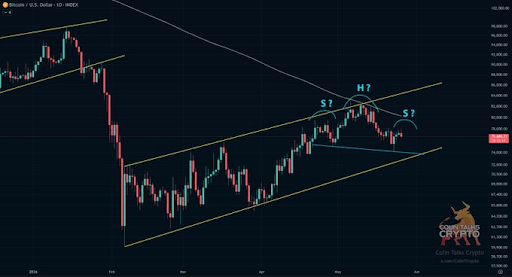
Source: Chart from Colin on X

Meanwhile, crypto analyst Chain Mind revealed that Bitcoin has just printed a Head-and-Shoulders pattern on the 1-week chart. He noted that the cycle structure has played out exactly as expected, with a first peak, a cycle high, a final rebound, and now a dump. He added that BTC has gotten the final rejection to dump and will mark the final bottom at around $50,000.

Related Reading: Everyone Is Calling For Lower Bitcoin Price: Why This Is The Perfect Time To Go Parabolic

At the time of writing, the Bitcoin price is trading at around $75,500, down in the last 24 hours, according to data from CoinMarketCap.

BTC trading at $75,934 on the 1D chart | Source: BTCUSDT on Tradingview.com

Связанные с этим вопросы

QWhat correlation has crypto analyst Chain Mind drawn between Bitcoin and the S&P 500?

AChain Mind has drawn a correlation noting that Bitcoin has never bottomed before the S&P 500 does, and that each BTC bear market ended exactly when the stock market made its final retrace.

QAccording to Chain Mind's analysis, has Bitcoin found its bottom yet? Why or why not?

AAccording to Chain Mind's analysis, Bitcoin has not found its bottom yet. He states this is because the S&P 500 continues to reach new all-time highs and has not printed its final retrace, a condition historically linked to Bitcoin's bottoming process.

QWhat specific pattern does analyst Colin suggest Bitcoin may be forming on its price chart?

AAnalyst Colin suggests that Bitcoin's current price action may be forming a Head-and-Shoulders topping pattern.

QAccording to Chain Mind's second X post, what signals is the S&P 500 showing that suggest a classic top?

AChain Mind states the S&P 500 is showing a classic top signal, including a broadening pattern, a parabolic arc, and a fake breakout. He also mentions the Buffett Indicator is at historical highs, suggesting a dump is imminent.

QWhat potential downside price targets for Bitcoin are mentioned if the Head-and-Shoulders pattern is confirmed?

AIf the Head-and-Shoulders pattern is confirmed by breaking below the neckline, the mentioned downside targets are $65,000, and potentially as low as $61,000 due to a breakdown of the yellow channel.

Похожее

Sitting on a Trillion-Dollar Market, Why Hasn't Real Estate Tokenization Taken Off?

For years, real estate tokenization has been hailed as a breakthrough technology poised to democratize property investment. In theory, it promises fractional ownership of premium assets, rapid transactions, and enhanced liquidity. Yet, in practice, it has failed to gain traction, accounting for less than 0.1% of the global real estate market. The core issue is not a lack of tokens, but the absence of a robust legal, operational, and compliant framework that grants them credibility as financial instruments. The industry initially erred by prioritizing technology over investor needs, creating products with unclear ownership and unreliable liquidity. Key infrastructure remains missing: legally sound ownership structures, compliant transfer mechanisms, professional servicing, and interoperability with traditional finance. This regulatory ambiguity and operational complexity deter institutional investors, who already have access to established, well-governed investment channels. A mature model would feature low minimum investments in institutional-grade assets, transparent rental income distribution, and genuine liquidity through regulated secondary markets. While regulatory progress in regions like the UAE and growth in other tokenized asset sectors (like treasuries) are positive signs, the focus must shift from issuing tokens to building foundational systems. The investment proposition of tokenized real estate is not to create new returns, but to improve access, efficiency, and liquidity for existing income-generating properties. For mainstream adoption, the sector must demonstrate tangible economic advantages over traditional models, not just technical novelty. The next phase depends on proving scalable, compliant operations with auditable track records. The barrier is no longer technology, but infrastructure and regulation. The vision remains unfulfilled until this gap is bridged.

marsbit4 мин. назад

Sitting on a Trillion-Dollar Market, Why Hasn't Real Estate Tokenization Taken Off?

marsbit4 мин. назад

Large Language Models Ace All Exams, Yet Move Farther from AGI: What Does This Paper Reveal?

The article discusses the ongoing challenge of defining and achieving Artificial General Intelligence (AGI). It notes that industry leaders have set vague, often profit- or time-based benchmarks for AGI, while the concept itself lacks a consensus definition—a situation the article compares to a "Rorschach test." It highlights a recent 2025 paper by researcher Michael Timothy Bennett, who proposes a new, measurable definition. Bennett frames AGI not as mimicking human performance on tests, which current large language models (LLMs) have already mastered, but as an "artificial scientist." A true AGI, according to this view, should be able to widely and efficiently adapt to new environments and tasks within real-world constraints (like computational and energy limits), focusing on the *discovery of new knowledge* rather than the replication of existing data. The author contrasts this with the current dominant approach of "scale-maxing"—massively scaling up data, parameters, and compute. While powerful, this method leads to models that fail on out-of-distribution problems and lack core intelligent abilities: they are passive learners, cannot reason causally, and cannot actively experiment or balance exploration with exploitation. The article argues that Bennett's framework offers a crucial shift. It makes AGI a quantifiable engineering problem and proposes new evaluation "adaptation benchmarks" that test an AI's ability to actively learn in novel scenarios. The conclusion is that achieving AGI will require a fundamental reset—a fusion of multiple methodologies beyond simple scaling, moving AI from mimicking patterns to embodying the scientific spirit of inquiry and discovery.

marsbit1 ч. назад

Large Language Models Ace All Exams, Yet Move Farther from AGI: What Does This Paper Reveal?

marsbit1 ч. назад

Pope Issues First AI Encyclical: 40,000 Words, 10 Key Points, Clarifying AI Anxiety

Pope Leo XIV's historic encyclical "Magnifica Humanitas," released in May 2026, marks the Catholic Church's first major document addressing artificial intelligence. The 40,000-word text moves beyond theological abstraction to confront practical AI anxieties affecting society. It argues that AI is no longer a mere tool but an embedded environment influencing daily decisions in areas like employment, healthcare, justice, and information, often without users' awareness. The encyclical presents ten core concerns. It highlights that the central issue isn't just regulation, but who holds the underlying *power*—control over data, compute, and platforms—often concentrated in private entities. It warns that even developers cannot fully explain AI systems, creating accountability gaps. While AI can simulate human interaction and creativity, it cautions against treating it as a moral agent capable of bearing true responsibility or forming genuine relationships. Key risks identified include AI's role in opaque decision-making for jobs or welfare, the amplification of persuasive disinformation, and the potential for education to focus on tool use over critical thinking. The document stresses that work has value beyond efficiency, and AI should enhance human capabilities, not merely replace roles. It firmly states that irreversible decisions, especially involving life and death, must remain under human judgment. Ultimately, the encyclical frames AI's challenge as anthropological, not just technological. As AI simulates uniquely human capacities like judgment and creation, it forces a re-examination of what makes human action meaningful: our capacity for responsibility, vulnerability, and bearing real consequences. The Pope concludes that technology is never neutral; its development and deployment are shaped by human values and choices, making an inclusive, ethically grounded dialogue essential for its future.

marsbit1 ч. назад

Pope Issues First AI Encyclical: 40,000 Words, 10 Key Points, Clarifying AI Anxiety

marsbit1 ч. назад

Торговля

Спот
Фьючерсы

Популярные статьи

Как купить S

Добро пожаловать на HTX.com! Мы сделали приобретение Sonic (S) простым и удобным. Следуйте нашему пошаговому руководству и отправляйтесь в свое крипто-путешествие.Шаг 1: Создайте аккаунт на HTXИспользуйте свой адрес электронной почты или номер телефона, чтобы зарегистрироваться и бесплатно создать аккаунт на HTX. Пройдите удобную регистрацию и откройте для себя весь функционал.Создать аккаунтШаг 2: Перейдите в Купить криптовалюту и выберите свой способ оплатыКредитная/Дебетовая Карта: Используйте свою карту Visa или Mastercard для мгновенной покупки Sonic (S).Баланс: Используйте средства с баланса вашего аккаунта HTX для простой торговли.Третьи Лица: Мы добавили популярные способы оплаты, такие как Google Pay и Apple Pay, для повышения удобства.P2P: Торгуйте напрямую с другими пользователями на HTX.Внебиржевая Торговля (OTC): Мы предлагаем индивидуальные услуги и конкурентоспособные обменные курсы для трейдеров.Шаг 3: Хранение Sonic (S)После приобретения вами Sonic (S) храните их в своем аккаунте на HTX. В качестве альтернативы вы можете отправить их куда-либо с помощью перевода в блокчейне или использовать для торговли с другими криптовалютами.Шаг 4: Торговля Sonic (S)С легкостью торгуйте Sonic (S) на спотовом рынке HTX. Просто зайдите в свой аккаунт, выберите торговую пару, совершайте сделки и следите за ними в режиме реального времени. Мы предлагаем удобный интерфейс как для начинающих, так и для опытных трейдеров.

1.4k просмотров всегоОпубликовано 2025.01.15Обновлено 2025.03.21

Как купить S

Sonic: Обновления под руководством Андре Кронье – новая звезда Layer-1 на фоне спада рынка

Он решает проблемы масштабируемости, совместимости между блокчейнами и стимулов для разработчиков с помощью технологических инноваций.

2.3k просмотров всегоОпубликовано 2025.04.09Обновлено 2025.04.09

Sonic: Обновления под руководством Андре Кронье – новая звезда Layer-1 на фоне спада рынка

HTX Learn: Пройдите обучение по "Sonic" и разделите 1000 USDT

HTX Learn — ваш проводник в мир перспективных проектов, и мы запускаем специальное мероприятие "Учитесь и Зарабатывайте", посвящённое этим проектам. Наше новое направление .

1.8k просмотров всегоОпубликовано 2025.04.10Обновлено 2025.04.10

HTX Learn: Пройдите обучение по "Sonic" и разделите 1000 USDT

Обсуждения

Добро пожаловать в Сообщество HTX. Здесь вы сможете быть в курсе последних новостей о развитии платформы и получить доступ к профессиональной аналитической информации о рынке. Мнения пользователей о цене на S (S) представлены ниже.

活动图片