Money Has Gone to Bonds and IPOs, Leaving Only HYPE Rising in Crypto

marsbitОпубликовано 2026-05-19Обновлено 2026-05-19

Введение

The article "Where Has All the Money Gone? Bonds and IPOs Are Soaring, While Crypto Only Sees HYPE Rising" analyzes the recent underperformance of major cryptocurrencies like Bitcoin and Ethereum compared to traditional financial markets. It identifies three primary factors diverting capital away from crypto: First, surging bond yields, with the 30-year U.S. Treasury hitting a near 20-year high of 5.12%, are attracting capital seeking safe, predictable returns. This is evidenced by Bitcoin spot ETFs experiencing a significant $10.39 billion net outflow in mid-May. Second, a massive $4 trillion IPO pipeline, highlighted by SpaceX's upcoming listing, is absorbing risk capital that might otherwise flow into crypto. Platforms like Hyperliquid are even channeling on-chain crypto liquidity into pre-IPO trading for traditional stocks. Third, uncertainty surrounds new Federal Reserve Chair Warsh's ability to deliver expected interest rate cuts this year due to conflicting political pressures and stubborn inflation expectations, potentially eliminating a hoped-for source of new market liquidity. Consequently, while traditional equities and bonds rally, the crypto market's post-leverage crash recovery is stalled. The notable exception is assets like Hyperliquid (HYPE), which is rising due to its role in facilitating traditional asset trading, underscoring a market divergence where only crypto projects with novel, cross-market narratives are gaining. The article concludes that Bitcoin...

Where has all the money gone?

The S&P 500 hit new all-time highs last week, and the Nasdaq completed a nearly seven-week winning streak. The 30-year US Treasury yield surged to 5.12%, the highest since 2007. SpaceX's Pre-IPO contracts on Hyperliquid saw $40 million in turnover on the first day.

Money is pouring in everywhere—except into crypto. BTC, which had just climbed above $82,000 on May 14th, has since tumbled below $77,000 in recent days. ETH fared no better, dropping nearly 10% over the week from the $2,300 range down to $2,110. Solana completely erased its recent gains, falling from a high near $100 back to $84. It seems nothing in the major crypto space is holding strong, except for HYPE.

Why is crypto, as a risk asset, falling behind alone?

30-Year Bond Yields Hit Nearly 20-Year High

The bond market is once again becoming the gravitational center for global capital.

The yield on the 30-year US Treasury bond has reached its highest level since June 2007, rising from 4.63% at the end of February to 5.12%. Meanwhile, the 10-year yield touched 4.6%, and the two-year yield climbed to 4.08%.
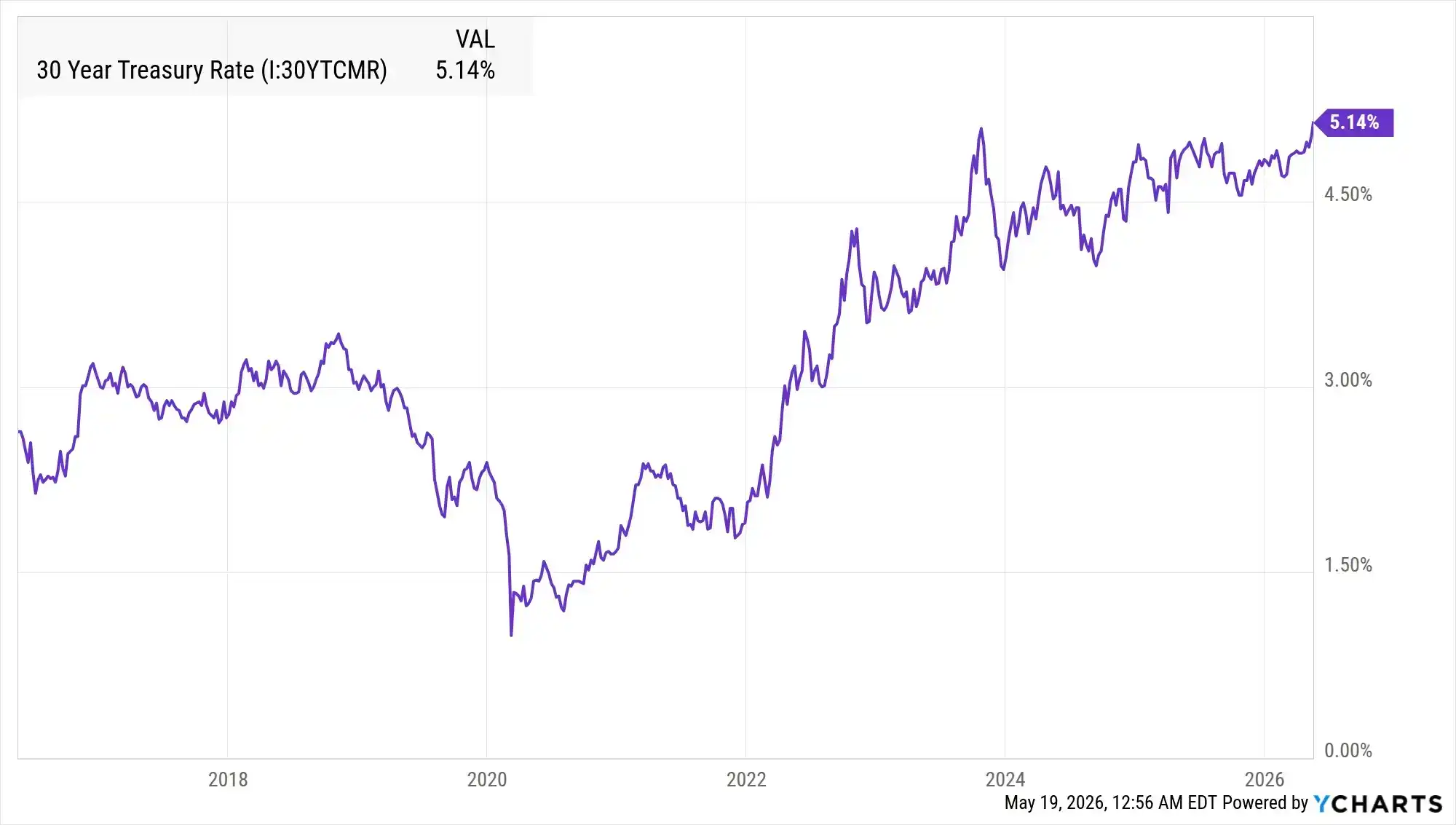
It's not just the United States. In a report on Sunday, May 17th, Apollo Global Management chief economist Torsten Slok stated that the yields on government bonds with maturities of 10 years or longer across G7 nations have collectively reached their highest levels since 2004, all approaching 5%.

Government fiscal deficits are expanding worldwide, necessitating more borrowing and bond issuance. The US fiscal deficit remains around 6% of GDP. Rising borrowing costs make it harder for governments to spend their way out of crises, precisely at a time when many countries face crises due to war.

In a report on May 18th, Deutsche Bank's Jim Reid noted that bond issues are likely to be on the agenda for the two-day G7 finance ministers' meeting opening that day in Paris. However, the structural problems in the bond market cannot be solved by any single ministerial meeting.

At a time of heightened geopolitical tension, global capital favors assets with more certain returns.

The outflow data from Bitcoin ETFs also corroborates this point.
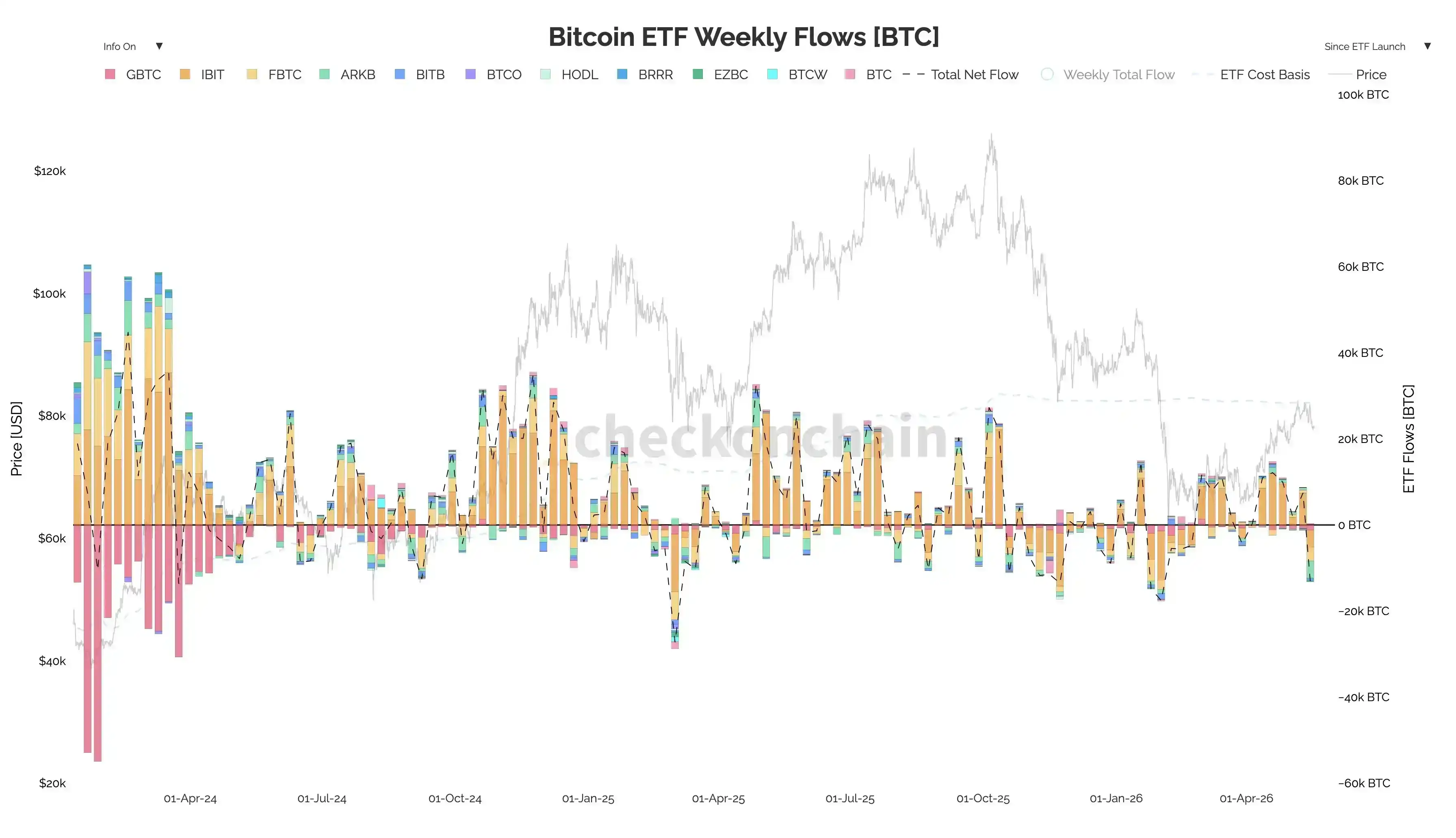
According to SoSoValue data, Bitcoin spot ETFs saw a net outflow of $1.039 billion for the week of May 11th to May 15th, ending six consecutive weeks of net inflows. This was also the largest weekly outflow since the end of January.

Drilling down to specific products, ARKB had a weekly net outflow of $324 million, and IBIT saw a net outflow of $317 million, with both leading products bleeding simultaneously. The intraday data paints an even sharper picture. There was a net outflow of $233 million on May 12th, a single-day withdrawal of $635 million on May 13th, and on Friday, May 15th, the 11 Bitcoin ETFs collectively experienced another outflow of $290 million. This indicates institutional funds are exiting in an orderly fashion.

Comparing with data from previous weeks highlights the force of this reversal. The week of April 17th saw nearly $1 billion in net inflows, the week of April 24th had $824 million in net inflows, and the week of May 8th still recorded $623 million in net inflows. The funding situation reversed from "sustained inflows" to "a $1 billion weekly outflow" within a single week.

Concurrently, Ethereum ETFs also saw a net outflow of $255 million, marking five consecutive days of negative outflows. The funding landscape for the entire crypto ETF asset class collectively turned downward in mid-May.

As the bond market's attractiveness grows, crypto's relative appeal naturally diminishes passively.

$4 Trillion in IPOs: How Can Crypto Compete?

Bonds are siphoning off funds with little risk appetite. IPOs are capturing risk capital, which constitutes the most direct liquidity drain for crypto.

There are $4 trillion worth of IPOs queued up for 2026, waiting to compete for capital. This is a figure substantial enough to reshape the map of global capital allocation.

SpaceX has become the next concentrated market focus. In this environment, Pre-IPO and new listing strategies offer an attraction that bonds cannot provide—non-linear wealth effects.

Meanwhile, the AI narrative remains the dominant theme of 2026. In a report on May 15th, Evercore analysts pointed out that US economic data shows demand remains strong, especially with a surge in AI-related capital expenditures. The flip side of this AI capital spending boom is the life-changing wealth effects created by AI leaders in the secondary market.

The return efficiency of names like Nvidia and Cerebras makes any crypto narrative seem less appealing by comparison.

More glaringly, even on-chain activity is helping traditional markets pull in money.

On the night SpaceX debuted on Trade.xyz, the Pre-IPO contracts on Hyperliquid saw $40 million in turnover on the first day. The HIP-3 platform is using perpetuals to facilitate price discovery for traditional stocks. Hyperliquid itself rose 10% to $45 for the week, becoming the only major crypto asset to buck the downtrend. Related reading: The Biggest Winner of the SpaceX IPO Might Be Trade.xyz.

In the short term, this is not exactly good news for crypto-native assets.

On-chain liquidity is being directed to price discovery for traditional stock targets like SpaceX, rather than flowing back to Bitcoin, ETH, or Solana. Even Hyperliquid's gains are not fundamentally driven by crypto narratives, but rather by the dividends of traditional asset narratives.

Warsh Takes Over, But Rate Cuts May Be Off the Table

While the bond and IPO markets are draining liquidity from the crypto space, looking at the Federal Reserve, the anticipated new liquidity injection might not materialize either.

Powell's term ended on May 15th. Warsh was confirmed by the Senate as the new Federal Reserve Chair last week and is currently awaiting formal appointment committee approval from the President and completion of asset clearance to comply with ethics regulations.

And even before officially taking the oath, Warsh already faces some tough problems.
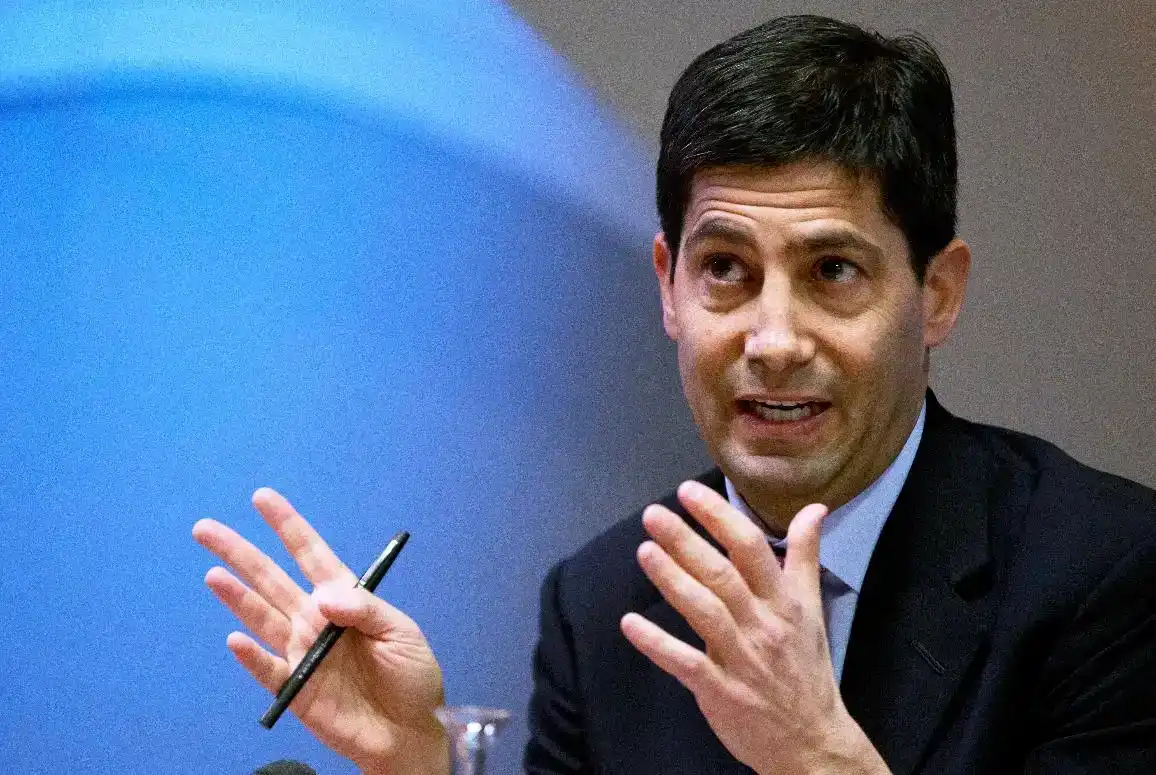
Trump nominated Warsh partly because he hoped Warsh would be more cooperative than Powell with the White House's cost-cutting agenda. Treasury Secretary Bessent has consistently included lowering the government's borrowing costs as a core part of the White House's cost-cutting promises over the past few months. He laid it out clearly in his speech at the New York Fed last autumn: lowering government borrowing costs means lower corporate borrowing costs, lower mortgage rates, lower car loan payments—improving affordability for all Americans.

But as mentioned earlier, today's reality is that the bond market has pushed five-year inflation expectations to 2.7%, the highest since 2023. Yardeni Research directly pointed out in a report on May 17th that a two-year Treasury yield of 4.08% is the market using price to signal to the Fed that the current target range of 3.50%-3.75% is set too low.

By Warsh's own logic, he should continue raising rates, or at least not cut them. But the White House, especially Trump himself, has made its political desire for rate cuts almost public.

On the other hand, those who heard Warsh's pre-confirmation hearing remarks know he spent considerable time discussing AI. He believes AI will boost productivity, suppress inflation, and thus supports rate cuts. The problem is, short-term data shows no signs of this happening.

The view of José Torres, a senior economist at Interactive Brokers, already represents a large segment of opinion. In a report on May 15th, he wrote the assessment that, due to lack of progress in geopolitical conflicts, the market has abandoned bets on room for further rate hikes.

If Warsh chooses to succumb to Trump's political pressure and forces a rate cut, the bond market will respond with even higher long-end yields, making all duration-sensitive assets even more uncomfortable. If Warsh chooses a hawkish stance, then rate cut expectations for this year are directly off the table, and the market's bets on liquidity easing all need to be repriced.

This means the bets placed over the past few months on Warsh cutting rates upon taking office may be completely overturned.

HYPE Leads Crypto Gains

After October 10th, the recovery period following the crypto market's deleveraging should have been fueled by the return of new capital.

With $4 trillion in IPOs queued for 2026 and AI names continuing to generate wealth effects, the appeal of altcoin trades is being persistently diluted in this environment. Even Bitcoin, the most institutionally-favored crypto asset, is beginning to cede ground to traditional markets. The $1 billion weekly outflow from ETFs is the most direct evidence.

High bond yields, Bitcoin ETF outflows. The recovery period is being drawn out indefinitely, and crypto consistently fails to catch up with the overall upward pace of risk assets.

However, it's worth noting that some differentiation trends are already emerging within the broader crypto market.
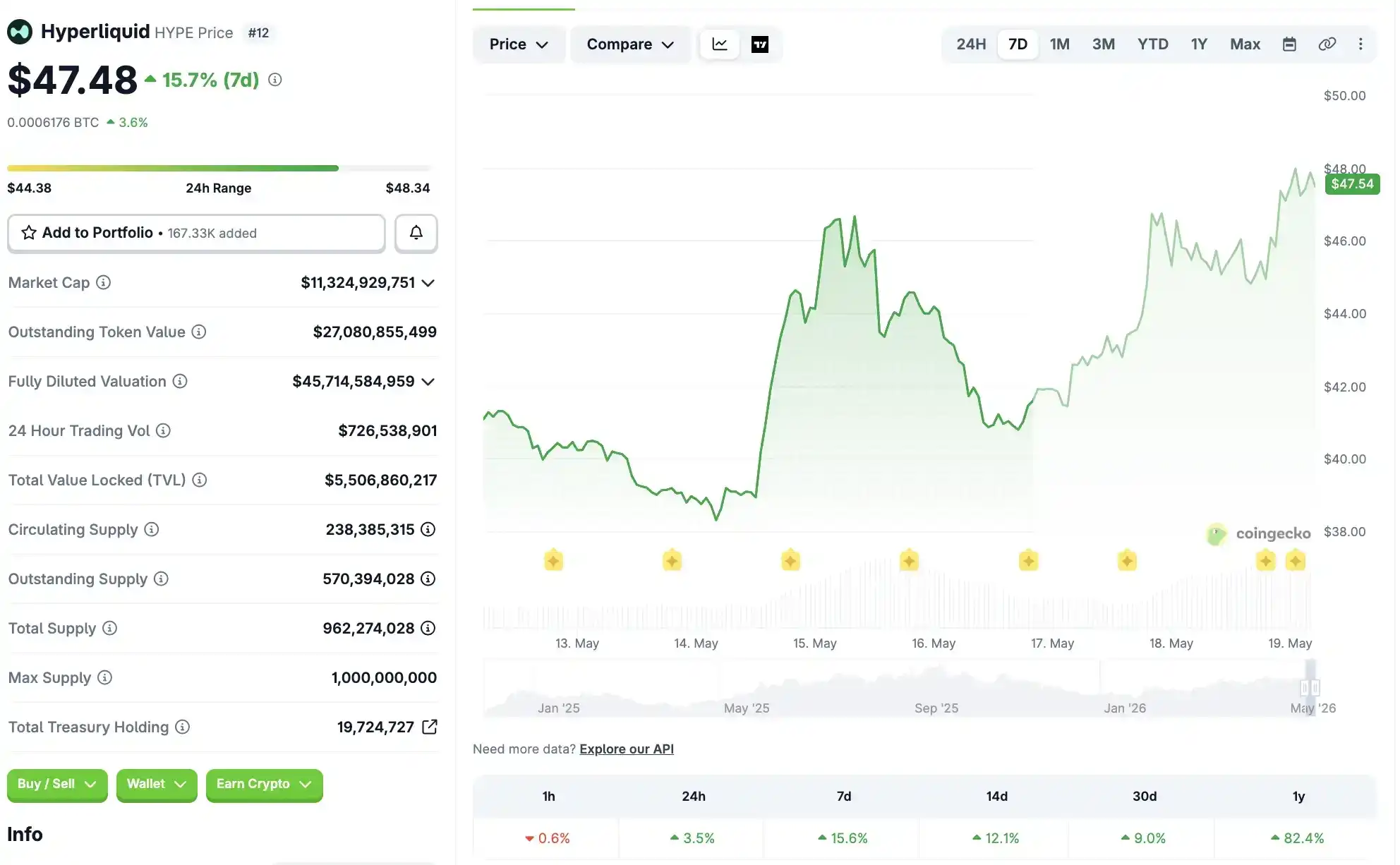
Hyperliquid rose 15% weekly to $48, with a year-to-date gain of 69%, precisely riding on the Pre-IPO price discovery narrative enabled by HIP-3. Assets that can tell new stories and capture entry points into traditional markets are still rising, while assets relying purely on beta are being compressed in pricing. Even Bitcoin has to take a back seat.

Zooming out to view the broader financial market reveals three forces simultaneously draining liquidity from the crypto space over the past few weeks. The bond market is pulling risk-averse money back with 5% yields, IPOs are capturing incremental risk budgets with a $4 trillion queue, and the new Fed Chair Warsh, upon taking office, may be unable to deliver on this year's rate cut expectations.

However, there are still potential catalysts for Bitcoin's next phase.

The upside catalyst is the enactment of the CLARITY Act in August. This is the biggest policy tailwind window for crypto this year, and increased regulatory certainty could directly release some pent-up institutional demand.

The downside risk is that before this catalyst materializes, we may need to retest the $70,000 level. If the current $77,000 level fails to hold, the next effective support is likely around $70,000.


Связанные с этим вопросы

QWhat is the main point of the article regarding the current state of the crypto market?

AThe main point is that capital is being diverted away from the crypto market towards traditional assets. Specifically, it highlights that money is flowing into high-yield bonds (like the 30-year US Treasury) and into traditional IPOs (with a $4 trillion pipeline), leaving the crypto market behind and causing major assets like Bitcoin and Ethereum to decline. The only crypto asset seeing gains is HYPE, which benefits from a narrative tied to traditional finance.

QAccording to the article, what are the three forces currently draining liquidity from the cryptocurrency circle?

AThe three forces draining liquidity from the crypto market are: 1) The bond market, offering high yields (e.g., 5.12% for 30-year US Treasuries), pulling away risk-averse capital. 2) The traditional IPO market, with a $4 trillion pipeline of upcoming listings, competing for and absorbing risk capital. 3) The uncertainty around the Federal Reserve's future interest rate policy under the new Chairman Warsh, which threatens the expected liquidity injection from potential rate cuts.

QWhat does the article say about the performance of Bitcoin ETFs and what does this indicate?

AThe article states that Bitcoin spot ETFs experienced a net outflow of $1.039 billion for the week of May 11-15. This ended six consecutive weeks of inflows and was the largest weekly outflow since late January. It indicates that institutional money is making an organized retreat from the crypto market, likely due to the increased attractiveness of yields in traditional bonds.

QHow does the article describe the situation with the new Federal Reserve Chairman, Kevin Warsh?

AThe article describes a dilemma for the new Fed Chairman, Kevin Warsh. On one hand, there is significant political pressure from the Trump administration for him to cut interest rates to lower government borrowing costs. On the other hand, the bond market's high yields signal that inflation expectations are elevated, suggesting that current rates might be too low and that a rate hike or hold would be more appropriate. The article suggests his earlier dovish stance based on AI productivity gains may be challenged by short-term data, and markets may have to revise their expectations for rate cuts in 2026.

QWhat is one potential upcoming positive catalyst for Bitcoin mentioned in the article, and what is a key downside risk?

AOne potential positive catalyst for Bitcoin is the August enactment of the 'CLARITY Act', which is described as the biggest policy tailwind for crypto this year, as it would provide greater regulatory clarity and potentially unlock institutional demand. A key downside risk mentioned is that Bitcoin may need to retest the $70,000 support level if it fails to hold above $77,000 before that catalyst materializes.

Похожее

Following the KelpDAO Hack: $40 Billion in Assets Flee LayerZero, Chainlink Emerges as the Primary 'Beneficiary'

Following a major security breach in April where KelpDAO's bridge using LayerZero was attacked for approximately $292 million, a significant shift is underway in the cross-chain infrastructure landscape. An estimated $40 billion in assets is in the process of migrating or has already migrated from LayerZero to Chainlink's Cross-Chain Interoperability Protocol (CCIP). The attack exploited a single-point-of-failure vulnerability due to KelpDAO's 1-of-1 validator configuration within the LayerZero network. Attackers corrupted RPC nodes and used DDoS attacks to force the system to rely on compromised nodes, allowing fraudulent messages. While LayerZero acknowledged a serious error in allowing its validator network to service high-value transactions with such a configuration, the incident highlighted critical security risks. This triggered a rapid migration wave. Starting with KelpDAO on May 6th, several major protocols—including Solv Protocol, Re, Tydro, Kraken, and Lombard—announced switching their cross-chain infrastructure exclusively to Chainlink CCIP. The combined value of these migrations is estimated to be around $40 billion. This movement followed earlier major adoptions by Coinbase (in late 2025) and Circle (in early 2024). Market sentiment reflected this shift, with LINK's price showing relative stability while ZRO (LayerZero's token) declined significantly. Data indicates a net outflow of approximately $20.1 billion from the LayerZero network over 30 days. The migration is largely driven by perceived security differences. Chainlink CCIP employs a decentralized oracle network as its default consensus layer, featuring multiple independent node operators, a separate Risk Management Network, and built-in safeguards like rate limits. In contrast, LayerZero's highly modular architecture offers flexibility but places more responsibility on application developers to configure security settings, a risk underscored by the KelpDAO incident. LayerZero has since apologized for its communication handling post-attack and stated the protocol itself was not compromised, but rather its Labs DVN's internal RPC was poisoned. An official post-mortem report with external security partners is forthcoming.

marsbit18 мин. назад

Following the KelpDAO Hack: $40 Billion in Assets Flee LayerZero, Chainlink Emerges as the Primary 'Beneficiary'

marsbit18 мин. назад

Making AI Products Is No Longer the Hard Part; Being Seen Is: Developers, Web3, and Chinese AI Opportunities at mu Shanghai

The article discusses the shifting challenges of AI entrepreneurship, based on insights from the mu Shanghai AI WEEK event in May 2026. As AI tools drastically lower the barrier to creating product prototypes, the core difficulty for startups has moved from "how to build" to "who to build for"—finding real users, sustainable business models, and community engagement. The event itself was structured as an extended, immersive developer community space rather than a traditional conference, attracting a global mix of participants (40% AI, 20-30% Web3). This format emphasized deep networking and collaborative creation over one-way presentations. A key observation is that with powerful models and coding assistants becoming ubiquitous, execution is less of a moat. The new scarce resource is judgment—identifying valuable, defensible scenarios where an application won't be quickly rendered obsolete by the next model update. This pushes competition downstream to distribution, user acquisition, and commercialization. Notably, many Web3 practitioners are migrating into AI, bringing with them expertise in community building, global collaboration, and grassroots marketing—skills highly relevant as AI apps fight for visibility. Meanwhile, opportunities in AI hardware, robotics, and embodied intelligence are seen as more durable, leveraging China's robust manufacturing and supply chain ecosystem as a key advantage. The article notes that major Chinese model companies (like MiniMax) are now actively competing for developer mindshare through community programs, hackathons, and improved tooling, recognizing developers as core users. Ultimately, the conclusion is that while AI simplifies building, the harder part of the journey is ensuring a product is truly needed, understood, and retained by its users.

marsbit36 мин. назад

Making AI Products Is No Longer the Hard Part; Being Seen Is: Developers, Web3, and Chinese AI Opportunities at mu Shanghai

marsbit36 мин. назад

Why is the RWA Boom Failing to Benefit DeFi?

The rapid growth of the tokenized real-world assets (RWA) market, now nearing $30 billion on-chain, has largely bypassed the DeFi ecosystem. Only about $2.47 billion is actively locked in DeFi protocols, indicating a penetration rate of just 9%. A major barrier is the "permissioned" architecture of most RWA products, like BlackRock's BUIDL fund, which are designed for institutional compliance. They require whitelisting, off-chain settlement, and strict investor accreditation, making them incompatible with open, permissionless DeFi applications like Aave or Uniswap. This is evident in categories like bonds/money market funds ($16.6B on-chain, $920M in DeFi) and tokenized equities ($2.7B on-chain, $78M in DeFi). Notable exceptions are private credit protocols (e.g., Maple Finance, Centrifuge) and assets like Ondo's USDY, which were designed from inception for DeFi composability, allowing them to be used freely as collateral. Morpho and Aave Horizon also demonstrate successful RWA lending integrations. However, industry reports (IOSCO, ECB) warn that growth may remain confined within traditional financial systems due to fragmented regulations, lack of unified standards, and inherent conflicts between DeFi's open logic and compliance requirements like minimum investments and fixed redemption windows. The RWA sector is effectively split into two markets: a compliant, permissioned on-chain finance market and a smaller DeFi-native market focused on composability. For DeFi penetration to rise significantly, asset issuers must prioritize designs that enable permissionless circulation from the start, moving away from models centered solely on institutional compliance.

marsbit57 мин. назад

Why is the RWA Boom Failing to Benefit DeFi?

marsbit57 мин. назад

Торговля

Спот
Фьючерсы

Популярные статьи

Как купить S

Добро пожаловать на HTX.com! Мы сделали приобретение Sonic (S) простым и удобным. Следуйте нашему пошаговому руководству и отправляйтесь в свое крипто-путешествие.Шаг 1: Создайте аккаунт на HTXИспользуйте свой адрес электронной почты или номер телефона, чтобы зарегистрироваться и бесплатно создать аккаунт на HTX. Пройдите удобную регистрацию и откройте для себя весь функционал.Создать аккаунтШаг 2: Перейдите в Купить криптовалюту и выберите свой способ оплатыКредитная/Дебетовая Карта: Используйте свою карту Visa или Mastercard для мгновенной покупки Sonic (S).Баланс: Используйте средства с баланса вашего аккаунта HTX для простой торговли.Третьи Лица: Мы добавили популярные способы оплаты, такие как Google Pay и Apple Pay, для повышения удобства.P2P: Торгуйте напрямую с другими пользователями на HTX.Внебиржевая Торговля (OTC): Мы предлагаем индивидуальные услуги и конкурентоспособные обменные курсы для трейдеров.Шаг 3: Хранение Sonic (S)После приобретения вами Sonic (S) храните их в своем аккаунте на HTX. В качестве альтернативы вы можете отправить их куда-либо с помощью перевода в блокчейне или использовать для торговли с другими криптовалютами.Шаг 4: Торговля Sonic (S)С легкостью торгуйте Sonic (S) на спотовом рынке HTX. Просто зайдите в свой аккаунт, выберите торговую пару, совершайте сделки и следите за ними в режиме реального времени. Мы предлагаем удобный интерфейс как для начинающих, так и для опытных трейдеров.

1.3k просмотров всегоОпубликовано 2025.01.15Обновлено 2025.03.21

Как купить S

Sonic: Обновления под руководством Андре Кронье – новая звезда Layer-1 на фоне спада рынка

Он решает проблемы масштабируемости, совместимости между блокчейнами и стимулов для разработчиков с помощью технологических инноваций.

2.2k просмотров всегоОпубликовано 2025.04.09Обновлено 2025.04.09

Sonic: Обновления под руководством Андре Кронье – новая звезда Layer-1 на фоне спада рынка

HTX Learn: Пройдите обучение по "Sonic" и разделите 1000 USDT

HTX Learn — ваш проводник в мир перспективных проектов, и мы запускаем специальное мероприятие "Учитесь и Зарабатывайте", посвящённое этим проектам. Наше новое направление .

1.8k просмотров всегоОпубликовано 2025.04.10Обновлено 2025.04.10

HTX Learn: Пройдите обучение по "Sonic" и разделите 1000 USDT

Обсуждения

Добро пожаловать в Сообщество HTX. Здесь вы сможете быть в курсе последних новостей о развитии платформы и получить доступ к профессиональной аналитической информации о рынке. Мнения пользователей о цене на S (S) представлены ниже.

活动图片