Are the "Magnificent Seven" No Longer Enough? SpaceX IPO Attracts Retail Frenzy, Wall Street Serves Up the "AI Tech Ten"

marsbitОпубликовано 2026-06-16Обновлено 2026-06-16

Введение

The article discusses a potential shift in Wall Street's categorization of major tech stocks, driven by SpaceX's highly successful IPO. On its first day of trading, SpaceX attracted $117 million in net purchases from retail investors, accounting for 56% of all U.S. retail stock buys that day. This surge has prompted research firm Vanda to propose a new group called the "FAB 10" (Frontier AI & Big Tech 10). This concept suggests replacing the long-standing "Magnificent Seven" with ten companies believed to define the next decade of AI and technology. The proposed FAB 10 would include the original seven giants plus SpaceX and the yet-to-be-public AI firms OpenAI and Anthropic, both anticipated to go public later this year with valuations potentially reaching trillions. This contrasts with another proposed grouping, Bank of America's "AI Big 10," which adds semiconductor companies like Broadcom, AMD, and Micron to the core seven, focusing more on hardware. The divergence highlights different bets on the future drivers of tech growth. Analysts note that the massive influx of retail money into new listings like SpaceX might divert capital from other hot sectors, such as chip stocks, and warn that high valuations across the tech sector may indicate bubble risks.

Author: Claude, TechFlow Deep Tide

Deep Tide TechFlow Introduction:SpaceX's debut on Friday attracted $117 million in net retail purchases, accounting for 56% of the total U.S. retail stock buying that day. Based on this, research firm Vanda proposed the new "FAB 10" concept, advocating for replacing the long-standing "Magnificent Seven" with a frontier AI and tech top ten, including SpaceX, OpenAI, and Anthropic. The latter two are not yet public, but are expected to list later this year with valuations potentially exceeding a trillion dollars each.
SpaceX's market debut is rewriting the way Wall Street labels tech stocks.

According to a report released by Vanda Research last Sunday, cited by Cailian Press, the frenzy among retail investors for SpaceX's IPO last Friday was a huge success, sparking discussions in the market about redefining the entire tech industry. Prior to this, this fundraising round of approximately $75 billion was already the largest IPO on record. SpaceX priced its shares at $135 each, giving it a valuation of about $1.75 trillion, placing it among the world's ten most valuable publicly listed companies.

On SpaceX's Debut, Retail Buying Constituted 56% of the Day's Entire Market

Vanda's data quantifies this frenzy. The report stated that SpaceX attracted $117 million in net retail purchases on its first trading day, accounting for 56% of the total retail stock buying across the entire U.S. market that day.

This figure only reflects secondary market buying on the first day and does not include funds from retail investors who participated in the IPO allocation through brokers. Separate data indicates that retail investors ultimately received about 20% of the allocation in this $75 billion offering, above average; hedge funds got 10%, while long-term institutional investors took 70%.

The concentrated bets by retail investors are further channeling capital towards a handful of mega-cap tech companies. Vanda believes these companies are not only dominating stock market performance but are also driving the entire wave of tech investment.

Vanda: Replace the "Magnificent Seven" with the "FAB 10"

It is based on this judgment that Vanda proposed a new classification framework.

"If markets were dominated by the 'Magnificent Seven' over the past few years, then last Friday might be the clearest signal yet that investors are starting to focus on what we call the 'FAB 10'," Vanda wrote in the report. FAB 10 is short for Frontier AI & Big Tech 10, referring to the ten frontier AI and big tech giants.

According to Vanda's definition, the FAB 10 adds SpaceX, OpenAI, and Anthropic to the original seven giants. The latter two are not yet public, but the market expects them to enter the capital market later this year, with valuations potentially reaching hundreds of billions or even trillions of dollars.

Vanda's reasoning is straightforward: these companies collectively represent the direction of the AI and tech industry for the next decade.

The Same Concept, But Bank of America's Version is Different

Vanda is not the only player packaging mega-cap tech stocks into a new index.
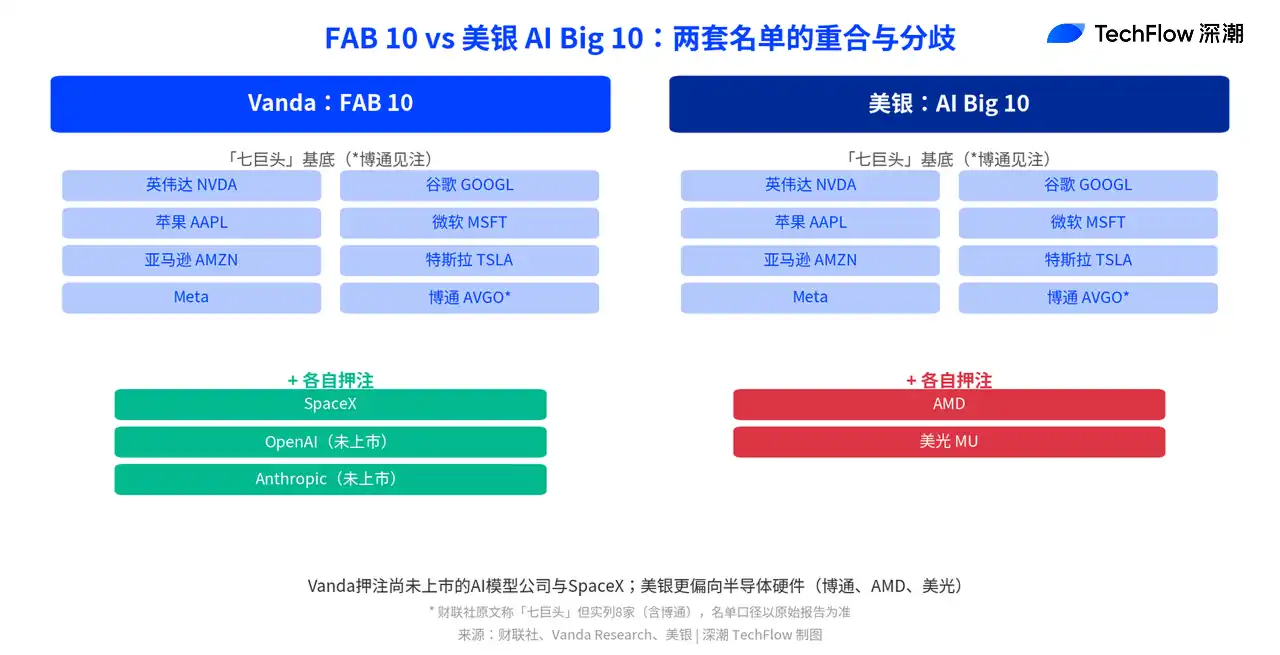
Bank of America's chief strategist, Michael Hartnett, previously proposed an "AI Big 10" portfolio in his "Guide to the Investment Universe." The difference from the FAB 10 lies in the stock selection: BofA's version is the Magnificent Seven plus Broadcom, AMD, and Micron, leaning more towards semiconductor hardware, while Vanda is betting on unlisted AI model companies and SpaceX.

The divergence between the two lists is essentially a different bet on "who defines the next ten years." One side favors the chipmakers, the other favors the model builders and rocket launchers.

Retail Floods into SpaceX, Chip Stocks May Suffer Capital Drain

The other side of the new concept is the redistribution of capital.

Vanda researchers noted that the fervor for SpaceX may be drawing funds away from other hot sectors, especially previously soaring chip stocks, which may be losing favor with retail investors. In other words, even within the FAB 10, favor might not be evenly spread; the capital-attracting effect of new entrants could come at the cost of pullbacks for older members.

However, analysts also caution that valuations across the tech sector are already showing signs of froth. SpaceX's IPO at a $1.75 trillion valuation itself is built on optimistic expectations for AI infrastructure. How long this optimism can last remains for the market to answer.

Связанные с этим вопросы

QWhat is the concept of 'FAB 10' proposed by Vanda Research, and which companies does it include?

AThe concept of 'FAB 10' (Frontier AI & Big Tech 10), proposed by Vanda Research, is a new classification framework aiming to replace the long-standing 'Magnificent Seven.' It includes the original seven tech giants (like Apple, Microsoft, etc.) and adds SpaceX, OpenAI, and Anthropic. These ten companies are seen as representing the direction of the AI and tech industry for the next decade.

QHow did retail investors contribute to SpaceX's IPO debut, and what was their market share?

AAccording to Vanda Research, on SpaceX's first day of trading, retail investors made a net purchase of $117 million, which accounted for 56% of all retail stock buying in the U.S. market that day. In the overall $75 billion IPO, retail investors ultimately received about 20% of the allocated shares, which is higher than the average allocation.

QWhat is the difference between Vanda's 'FAB 10' and Bank of America's 'AI Big 10' list?

AThe key difference lies in the selected companies. Vanda's 'FAB 10' includes the Magnificent Seven plus SpaceX, OpenAI, and Anthropic, focusing on AI models and space tech. Bank of America's 'AI Big 10' includes the Magnificent Seven plus Broadcom, AMD, and Micron, with a stronger emphasis on semiconductor hardware companies.

QWhat potential market impact does Vanda suggest the rise of 'FAB 10' might have?

AVanda suggests that the influx of capital into new members like SpaceX could draw funds away from other hot sectors. Specifically, semiconductor stocks, which previously experienced significant gains, might lose favor with retail investors. This indicates a potential redistribution of capital within the tech sector, where new entrants' success might come at the expense of older members' performance.

QWhat was SpaceX's valuation at its IPO, and what caution do analysts express regarding this?

ASpaceX went public with a valuation of approximately $1.75 trillion at a share price of $135, making it one of the top ten most valuable publicly traded companies globally. Analysts caution that this valuation, built on optimistic expectations for AI infrastructure, shows signs of a bubble in the overall tech sector, and its sustainability remains to be tested by the market.

Похожее

Pricing OpenAI Pre-IPO: A New, Life-or-Death Business on Hyperliquid Lasting Half a Year

Pricing OpenAI Pre-IPO: Hyperliquid's High-Stakes, Six-Month Business Venture The article analyzes the nascent market for pre-IPO perpetual contracts on the Hyperliquid blockchain, exemplified by two contrasting teams: Trade.xyz and Ventuals. Trade.xyz, an anonymous team, successfully built the largest pre-market on Hyperliquid. Its strategy focused on near-term events, like the SpaceX IPO. By listing a SpaceX contract with a known launch date and price, the market had a tangible "anchor" (the eventual Nasdaq opening price) to converge upon, which kept speculation in check. This approach fueled significant growth. In stark contrast, Ventuals, backed by Paradigm, failed despite holding coveted contracts for OpenAI and Anthropic. Its critical flaw was its pricing mechanism for these companies, which have no imminent IPO. Ventuals' oracle price was half-derived from infrequent private market transactions and half from its own contract's moving average. This created a self-reinforcing loop where buying pressure artificially inflated the price, disconnecting it from real supply and demand. The market became illiquid and structurally skewed. Ventuals shut down nine months after launch, reportedly through an acquisition. Its final settlement prices—OpenAI at ~$1,341 and Anthropic at ~$1,618—were thus partially products of its flawed model. Ironically, some company employees and late-stage VCs reportedly used these prices for valuation reference, highlighting the desperate demand for price discovery in opaque private markets. The failure of Ventuals exposes the core challenge of this business: price for illiquid, non-public assets requires a robust, self-correcting market, which is absent without a definitive public listing event. Nevertheless, demand is driving major players like Coinbase and traditional finance (e.g., Citi) to enter the space, aiming to provide 24/7 trading for coveted private company shares. The venture's ultimate viability, however, hinges on solving the fundamental pricing problem Ventuals could not.

marsbit1 ч. назад

Pricing OpenAI Pre-IPO: A New, Life-or-Death Business on Hyperliquid Lasting Half a Year

marsbit1 ч. назад

M&A Deals in the Crypto Market Are Unusually Active

Title: M&A Activity in Crypto Market Becomes Unusually Active A rare signal is emerging in the crypto primary market: mergers and acquisitions (M&A) are nearing half of all financing deals. According to RootData, this month, M&A cases in the crypto industry reached 10, while financing rounds numbered only 14, meaning M&A accounts for approximately 42% of primary market transactions—the highest level in history. This does not signal a sudden industry boom. Instead, the rapid rise in M&A share primarily reflects the continued downturn in the financing market. Since November 2024, monthly crypto M&A deals have remained between 10-20, while financing deals have plummeted from around 100 to about 50, possibly hitting a new low this month. For project teams, this means the traditional path of relying on narratives, token expectations, and ecosystem subsidies to maintain valuations is narrowing. For leading companies, it presents a rare window to acquire teams, licenses, technology, liquidity, and market access at lower prices, with less competition and stronger bargaining power. Key active buyers include Coinbase, Kraken, Ripple, MoonPay, Polymarket, Kaiko, Sol Strategies, GSR, Keyrock, Jupiter, Paxos, and Ondo Finance. Their M&A logic is consistent: acquiring key capabilities at lower costs during the industry downturn. This is driven by more attractive valuations, reduced time and trial-and-error costs, the acquisition of licenses and compliance resources, and the integration of industry upstream and downstream segments. Current M&A focuses are concentrated in four areas: trading infrastructure (e.g., Coinbase acquiring Deribit, Kraken acquiring NinjaTrader), payments and stablecoins (e.g., MoonPay, Ripple expanding payment networks), compliance licenses, and asset issuance/distribution (e.g., acquisitions related to RWA and token issuance platforms like Coinbase's purchases of Liquifi and Echo). The rise in M&A is altering the primary market's exit logic. It provides an alternative path to the token-dependent model, encouraging teams to build tangible products, revenue, and strategic value that can be integrated. This could inject confidence into the market, showing that asset buyers and exit possibilities still exist, albeit with a stricter focus on real utility. However, this trend also indicates the crypto industry is becoming more centralized. As asset issuance, trading, market-making, custody, payments, and data gradually consolidate in the hands of a few major players, the industry's initial emphasis on openness and anti-monopoly is being reshaped by commercial realities. Coupled with rising compliance barriers, this signals the end of the low-barrier era for crypto entrepreneurship.

链捕手1 ч. назад

M&A Deals in the Crypto Market Are Unusually Active

链捕手1 ч. назад

Торговля

Спот
Фьючерсы

Популярные статьи

Как купить S

Добро пожаловать на HTX.com! Мы сделали приобретение Sonic (S) простым и удобным. Следуйте нашему пошаговому руководству и отправляйтесь в свое крипто-путешествие.Шаг 1: Создайте аккаунт на HTXИспользуйте свой адрес электронной почты или номер телефона, чтобы зарегистрироваться и бесплатно создать аккаунт на HTX. Пройдите удобную регистрацию и откройте для себя весь функционал.Создать аккаунтШаг 2: Перейдите в Купить криптовалюту и выберите свой способ оплатыКредитная/Дебетовая Карта: Используйте свою карту Visa или Mastercard для мгновенной покупки Sonic (S).Баланс: Используйте средства с баланса вашего аккаунта HTX для простой торговли.Третьи Лица: Мы добавили популярные способы оплаты, такие как Google Pay и Apple Pay, для повышения удобства.P2P: Торгуйте напрямую с другими пользователями на HTX.Внебиржевая Торговля (OTC): Мы предлагаем индивидуальные услуги и конкурентоспособные обменные курсы для трейдеров.Шаг 3: Хранение Sonic (S)После приобретения вами Sonic (S) храните их в своем аккаунте на HTX. В качестве альтернативы вы можете отправить их куда-либо с помощью перевода в блокчейне или использовать для торговли с другими криптовалютами.Шаг 4: Торговля Sonic (S)С легкостью торгуйте Sonic (S) на спотовом рынке HTX. Просто зайдите в свой аккаунт, выберите торговую пару, совершайте сделки и следите за ними в режиме реального времени. Мы предлагаем удобный интерфейс как для начинающих, так и для опытных трейдеров.

1.5k просмотров всегоОпубликовано 2025.01.15Обновлено 2026.06.02

Как купить S

Sonic: Обновления под руководством Андре Кронье – новая звезда Layer-1 на фоне спада рынка

Он решает проблемы масштабируемости, совместимости между блокчейнами и стимулов для разработчиков с помощью технологических инноваций.

2.3k просмотров всегоОпубликовано 2025.04.09Обновлено 2025.04.09

Sonic: Обновления под руководством Андре Кронье – новая звезда Layer-1 на фоне спада рынка

HTX Learn: Пройдите обучение по "Sonic" и разделите 1000 USDT

HTX Learn — ваш проводник в мир перспективных проектов, и мы запускаем специальное мероприятие "Учитесь и Зарабатывайте", посвящённое этим проектам. Наше новое направление .

1.8k просмотров всегоОпубликовано 2025.04.10Обновлено 2025.04.10

HTX Learn: Пройдите обучение по "Sonic" и разделите 1000 USDT

Обсуждения

Добро пожаловать в Сообщество HTX. Здесь вы сможете быть в курсе последних новостей о развитии платформы и получить доступ к профессиональной аналитической информации о рынке. Мнения пользователей о цене на S (S) представлены ниже.

活动图片