Ripple’s RLUSD Lands In Mastercard’s Stablecoin Settlement Expansion

bitcoinistОпубликовано 2026-06-04Обновлено 2026-06-04

Введение

Mastercard is expanding its stablecoin settlement capabilities, adding Ripple's RLUSD alongside other regulated stablecoins like USDC and PYUSD. This move allows issuers and acquirers to settle card transactions using digital assets on various blockchains, including Ethereum, Solana, and the XRP Ledger. The enhancement introduces intraday, weekend, and holiday settlement options, aiming to provide more flexibility, especially for cross-border payments and treasury operations. Mastercard positions this as a network-level addition that complements existing processes, with initial support focused on the US and Latin America. Ripple views RLUSD's inclusion as validation for regulated stablecoins in institutional payment infrastructure, highlighting the growing demand for faster, always-on settlement.

Mastercard is moving deeper into stablecoin infrastructure, adding Ripple’s RLUSD to a broader settlement expansion that will allow issuers and acquirers to settle card transactions through regulated digital assets alongside traditional fiat rails.

The payments giant said Wednesday that it plans to expand its settlement capabilities with intraday, weekend and holiday settlement options, as well as on-chain card settlement using regulated stablecoins. The move is designed to give Mastercard partners more flexibility in how and when they settle transactions across its global payments network, with particular relevance for cross-border payments, treasury operations and payouts.

Ripple Scores Mastercard Settlement Role

For Ripple, the key development is the inclusion of RLUSD among the stablecoins Mastercard plans to support. According to the announcement, Mastercard will enable settlement using Circle’s USDC, Paxos-issued stablecoins including PYUSD, USDG and USDP, Ripple’s RLUSD and SoFi’s SoFiUSD. These assets will be supported across a range of blockchain networks, including Arbitrum, Base, Canton, Ethereum, Polygon, Solana, Tempo and the XRP Ledger.

The announcement places RLUSD inside one of the most closely watched institutional use cases for stablecoins: settlement. Rather than positioning stablecoins primarily as trading instruments or exchange liquidity tools, Mastercard is framing them as part of the back-end financial infrastructure that can support faster money movement between issuers, acquirers and merchants.

“The next phase of stablecoin adoption is about real-world utility, especially in settlement, where timing and liquidity matter most,” said Raj Dhamodharan, executive vice president for Blockchain and Digital Assets at Mastercard. “By introducing intraday and weekend on settlement options across our global network, we’re expanding how partners manage liquidity and operate in an always-on digital economy while maintaining the trust, resilience and safeguards they expect from Mastercard.”

Mastercard said the stablecoin settlement option will sit alongside existing processes, rather than replace them. The company described the expansion as a “network-level enhancement” intended to preserve existing security standards, fraud safeguards and dispute processes while adding digital asset-based settlement as another choice for partners.

Initial support is expected from ARQ, formerly known as DolarApp, CBW Bank, Cross River, Lead Bank and Nuvei, with early focus on the United States and Latin America. Mastercard said further expansion is planned through 2026, subject to regulation, with additional regions, partners and regulated stablecoins expected over time.

Ripple framed the inclusion of RLUSD as validation for regulated stablecoins built for institutional payment flows. Jack McDonald, Ripple’s senior vice president of stablecoins, said Mastercard’s move into on-chain settlement marks “a landmark validation that blockchain technology is ready for the world’s most critical payment infrastructure.”

“RLUSD’s inclusion in Mastercard’s global settlement network reflects growing demand for trusted, regulated stablecoins built for real-world financial use cases on public blockchains like the XRP Ledger,” McDonald added. “We’re excited to support the next evolution of faster, more flexible, always-on settlement.”

Other stablecoin issuers and banking partners echoed that view, focusing on liquidity management and the limits of traditional settlement windows. Circle’s chief commercial officer Kash Razzaghi said demand is growing for infrastructure that can operate beyond banking hours, while Cross River’s Luca Cosentino said stablecoins have emerged as “a powerful tool” for faster and more transparent settlement.

At press time, XRP traded at $1.24.
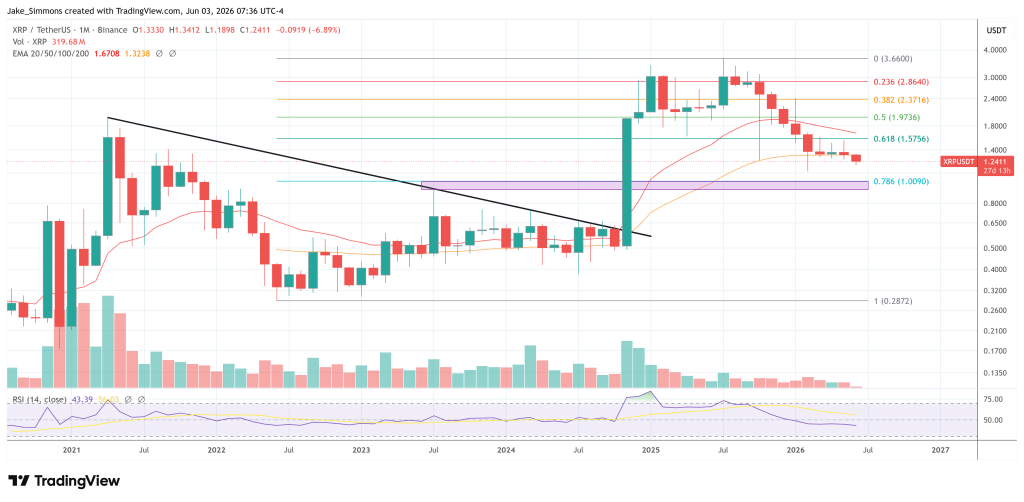
XRP falls below the 50-week EMA, 1-month chart | Source: XRPUSDT on TradingView.com

Связанные с этим вопросы

QWhat is the main announcement made by Mastercard in the article?

AMastercard is expanding its settlement capabilities to include on-chain settlement using regulated stablecoins, including Ripple's RLUSD, alongside traditional fiat methods. This will offer intraday, weekend, and holiday settlement options for its partners.

QWhich stablecoins are specifically mentioned as being supported by Mastercard's new settlement expansion?

AThe stablecoins mentioned are Circle's USDC, Paxos-issued stablecoins (PYUSD, USDG, USDP), Ripple's RLUSD, and SoFi's SoFiUSD.

QAccording to Raj Dhamodharan of Mastercard, what is the next phase of stablecoin adoption about?

ARaj Dhamodharan stated that the next phase of stablecoin adoption is about real-world utility, especially in settlement, where timing and liquidity matter most.

QHow does Mastercard describe the role of the new stablecoin settlement option in relation to its existing processes?

AMastercard said the stablecoin settlement option will sit alongside existing processes as a 'network-level enhancement,' adding it as another choice for partners rather than replacing current methods. It is intended to preserve existing security and fraud safeguards.

QWhat significance does Ripple attribute to RLUSD's inclusion in Mastercard's network, according to Jack McDonald?

AJack McDonald stated that RLUSD's inclusion reflects growing demand for trusted, regulated stablecoins built for real-world financial use cases. He called Mastercard's move a 'landmark validation' that blockchain technology is ready for critical payment infrastructure.

Похожее

ByteDance Adopts Arm CPUs, Jensen Huang: So Sad I Didn't Buy Arm

**Summary:** At Computex 2026, Arm CEO Rene Haas announced that ByteDance and Oracle have adopted Arm's self-designed Arm AGI data center CPU. The company expects significant revenue growth from this product, projecting $20 billion in demand for the 2027/2028 fiscal years. Haas noted that restricting AI-capable CPUs from the US to China is nearly impossible due to their widespread applications. Arm's stock has surged dramatically this year, notably rising 16% after NVIDIA's Arm-based Vera CPU and RTX Spark announcements. A highlight was the informal, humorous on-stage conversation between Haas and NVIDIA CEO Jensen Huang. Huang joked about NVIDIA's failed attempt to acquire Arm and playfully lamented selling his Arm shares. Both executives showed a clear sense of camaraderie and shared regret over the missed merger. Key technical topics were discussed: 1. **AI PC Design:** Huang explained NVIDIA's RTX Spark superchip (with a 20-core Arm CPU) is designed for future AI agents that will autonomously run and use tools on PCs, blending local and cloud processing. 2. **Agent vs. OS:** Huang emphasized the operating system remains crucial, as AI agents rely on its APIs and tools to function. 3. **Growth Constraints:** He identified the shift to "useful AI" that generates profitable tokens as a primary driver for immense, almost limitless, computational demand. Haas outlined Arm's strategy across PC and data centers. For PCs, Arm collaborates with partners like NVIDIA and MediaTek, offering its compute subsystem (CSS) for custom SoCs. In data centers, its Arm AGI CPU (built on TSMC's 3nm process) has gained major partners including OpenAI, Meta, and now ByteDance and Oracle. Arm presented a multi-year roadmap for its in-house CPU line. The article concludes that while GPUs dominated the AI training race, the explosion of AI agents is shifting significant focus to CPUs for inference, state management, and tool orchestration. The industry is trending towards vertical integration, with companies like cloud providers designing chips and chip/IP firms offering full solutions, all competing to deliver more efficient computing per watt.

marsbit12 мин. назад

ByteDance Adopts Arm CPUs, Jensen Huang: So Sad I Didn't Buy Arm

marsbit12 мин. назад

New Wall Street Play: Yen Shorts Still Adding, But Japan Stocks Don't Rely on Carry Trade Unwinding

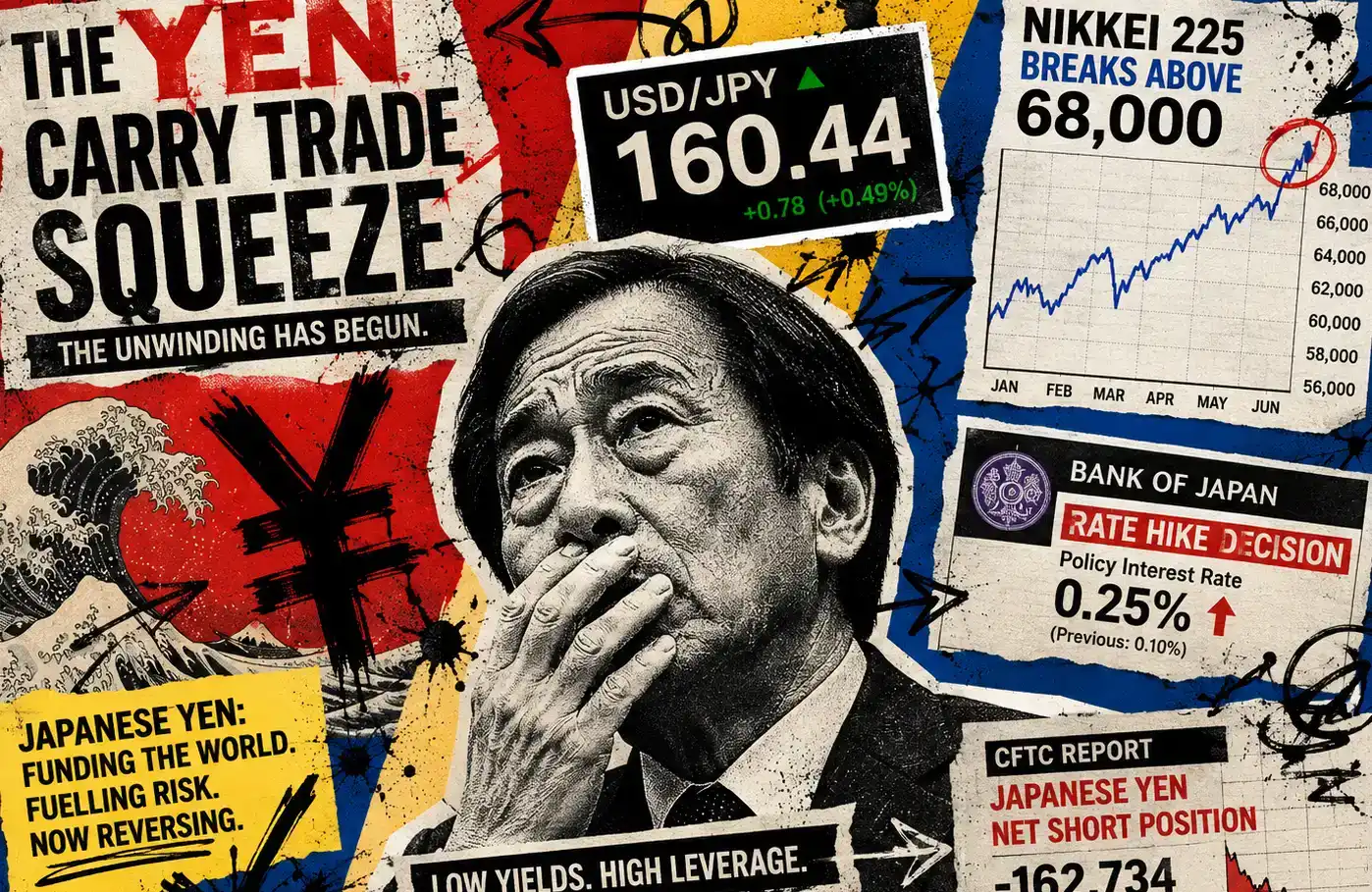
On June 3rd, USD/JPY hit 160.44, its highest level since July 2024, while the Nikkei 225 surged past 68,000 points. Contrary to popular narratives of an imminent "carry trade unwind" akin to August 2024, data reveals a more complex picture. Speculative net short positions in yen futures have actually increased, reaching -114,667 contracts by late May, suggesting traders are doubling down rather than retreating. Meanwhile, Japan's Finance Ministry conducted its largest-ever single-round FX intervention (11.73 trillion yen) in April-May but failed to hold the 160 yen line. The Nikkei's rally is not driven by carry trade dynamics. Foreign investors are aggressively buying Japanese stocks, with net purchases in 2026 running nearly 16 times higher than 2025 levels. This inflow is concentrated in AI and semiconductor-related stocks like SoftBank and Socionext, fueled by positive sector outlooks, rather than being a flight from unwinding yen shorts. Furthermore, the Nikkei has continued climbing despite the Bank of Japan's (BOJ) rate hikes to 0.75%. This disconnect exists because the current equity boom is fueled by AI-driven foreign investment, not reliant on cheap yen funding. However, this relationship remains fragile. Should the BOJ hike rates further (e.g., to 1.0%) while dollar weakness increases carry trade costs, the trajectories of the yen and Japanese stocks could reconverge, potentially triggering volatility.

marsbit16 мин. назад

New Wall Street Play: Yen Shorts Still Adding, But Japan Stocks Don't Rely on Carry Trade Unwinding

marsbit16 мин. назад

Broadcom's Q3 Guidance Misses Expectations by $12 Billion, After-Hours Trading Plummets Over 13%, AI Narrative "Cooling"?

On June 3, Broadcom released record Q2 FY26 results with revenue of $22.19B, up 48% YoY, and AI chip sales of $10.8B, up 143%. Adjusted EPS of $2.44 beat estimates. However, its Q3 AI semiconductor revenue guidance of $16B, while up over 200% YoY, fell roughly $1.2B (7%) short of analyst consensus expectations of $17.2B. This miss, coupled with slightly weaker-than-expected software revenue, triggered a severe market reaction. CEO Hock Tan maintained the FY26 AI revenue outlook of over $100B but did not raise it, disappointing investors who had priced in more robust growth. The stock plummeted over 13% in after-hours trading, erasing roughly $270B in market cap. The sell-off extended to peers like Marvell. A key concern for markets, particularly for Chinese optical module suppliers, was Tan's comment that the contribution of AI networking (e.g., Ethernet switches, optical interconnect chips) to AI revenue, currently near 40%, is expected to normalize to around 30% over time, signaling a potential peak in growth for that segment. Despite the guidance shortfall, Tan reiterated that AI demand remains "insatiable" and reaffirmed the long-term target of exceeding $100B in AI revenue by FY27. The reaction highlights the heightened sensitivity and premium valuation placed on AI-exposed stocks, where anything less than stellar guidance can prompt significant profit-taking. The broader question is whether this represents a cooling AI narrative or a correction in overstretched valuations.

marsbit16 мин. назад

Broadcom's Q3 Guidance Misses Expectations by $12 Billion, After-Hours Trading Plummets Over 13%, AI Narrative "Cooling"?

marsbit16 мин. назад

Fei-Fei Li's Team Clarifies the Concept of 'World Models', Sora Merely a Renderer

"World Models" has become a widely used yet confusing term in AI. To address this, a team led by Fei-Fei Li and World Labs proposed a functional taxonomy based on the Partially Observable Markov Decision Process framework. This taxonomy categorizes systems called "world models" into three distinct projections: Renderers, Simulators, and Planners. Renderers, like OpenAI's Sora and other video generation models, focus on producing photorealistic visual outputs for human perception. They prioritize visual fidelity over physical accuracy. Simulators, such as NVIDIA Omniverse, aim to compute precise future environmental states for computational tasks like engineering analysis or digital twins. Planners, like Vision-Language-Action models, take in observations and goals to output executable actions for robots or agents. The article clarifies that most current "world models," including Sora, are primarily Renderers. They generate convincing visuals but lack the core ability to simulate state transitions based on actions, a key requirement for a true world model in classic reinforcement learning definitions. This conceptual confusion has practical implications, leading to potential misalignment in technology selection, investment, and public understanding of AI capabilities. Clear categorization is crucial. It helps enterprises avoid costly mistakes (e.g., using a renderer for robot training), allows investors to accurately assess markets, and enables researchers to build comparable benchmarks. While future systems may integrate these functions, recognizing current boundaries is essential for honest assessment and progress.

marsbit1 ч. назад

Fei-Fei Li's Team Clarifies the Concept of 'World Models', Sora Merely a Renderer

marsbit1 ч. назад

Торговля

Спот
Фьючерсы

Популярные статьи

Как купить S

Добро пожаловать на HTX.com! Мы сделали приобретение Sonic (S) простым и удобным. Следуйте нашему пошаговому руководству и отправляйтесь в свое крипто-путешествие.Шаг 1: Создайте аккаунт на HTXИспользуйте свой адрес электронной почты или номер телефона, чтобы зарегистрироваться и бесплатно создать аккаунт на HTX. Пройдите удобную регистрацию и откройте для себя весь функционал.Создать аккаунтШаг 2: Перейдите в Купить криптовалюту и выберите свой способ оплатыКредитная/Дебетовая Карта: Используйте свою карту Visa или Mastercard для мгновенной покупки Sonic (S).Баланс: Используйте средства с баланса вашего аккаунта HTX для простой торговли.Третьи Лица: Мы добавили популярные способы оплаты, такие как Google Pay и Apple Pay, для повышения удобства.P2P: Торгуйте напрямую с другими пользователями на HTX.Внебиржевая Торговля (OTC): Мы предлагаем индивидуальные услуги и конкурентоспособные обменные курсы для трейдеров.Шаг 3: Хранение Sonic (S)После приобретения вами Sonic (S) храните их в своем аккаунте на HTX. В качестве альтернативы вы можете отправить их куда-либо с помощью перевода в блокчейне или использовать для торговли с другими криптовалютами.Шаг 4: Торговля Sonic (S)С легкостью торгуйте Sonic (S) на спотовом рынке HTX. Просто зайдите в свой аккаунт, выберите торговую пару, совершайте сделки и следите за ними в режиме реального времени. Мы предлагаем удобный интерфейс как для начинающих, так и для опытных трейдеров.

1.4k просмотров всегоОпубликовано 2025.01.15Обновлено 2026.06.02

Как купить S

Sonic: Обновления под руководством Андре Кронье – новая звезда Layer-1 на фоне спада рынка

Он решает проблемы масштабируемости, совместимости между блокчейнами и стимулов для разработчиков с помощью технологических инноваций.

2.3k просмотров всегоОпубликовано 2025.04.09Обновлено 2025.04.09

Sonic: Обновления под руководством Андре Кронье – новая звезда Layer-1 на фоне спада рынка

HTX Learn: Пройдите обучение по "Sonic" и разделите 1000 USDT

HTX Learn — ваш проводник в мир перспективных проектов, и мы запускаем специальное мероприятие "Учитесь и Зарабатывайте", посвящённое этим проектам. Наше новое направление .

1.8k просмотров всегоОпубликовано 2025.04.10Обновлено 2025.04.10

HTX Learn: Пройдите обучение по "Sonic" и разделите 1000 USDT

Обсуждения

Добро пожаловать в Сообщество HTX. Здесь вы сможете быть в курсе последних новостей о развитии платформы и получить доступ к профессиональной аналитической информации о рынке. Мнения пользователей о цене на S (S) представлены ниже.

活动图片