Are Bears Still in Control? Bitcoin’s (BTC) Shows Downside Signals Despite Fresh Inflows

bitcoinistОпубликовано 2025-12-19Обновлено 2025-12-19

Введение

Bitcoin's price is experiencing a conflicted phase, trading over 30% below its all-time high despite some renewed institutional ETF interest. A significant source of selling pressure comes from long-term holders, with 1.6 million BTC sold since early 2023 and over $300 billion in long-held supply re-entering circulation in 2025 alone. Although U.S. spot Bitcoin ETFs saw a recent $457 million inflow, demand remains inconsistent and insufficient to counter persistent selling. Technically, BTC shows bearish signals, trading in a range below key moving averages with weak momentum. The market structure suggests continued downside risk until long-term holder distribution eases and liquidity improves.

Bitcoin’s (BTC) price action has entered a conflicted phase, with renewed institutional inflows clashing against clear signs of market stress. After peaking above $126,000 earlier this year, the world’s largest crypto has retreated sharply and is now trading more than 30% below its all-time high.

Related Reading: Bipartisan SAFE Crypto Act Unveiled: New Task Force To Combat Digital Asset Scams

While some capital has returned through exchange-traded funds (ETFs), broader market signals suggest that selling pressure and weak participation continue to weigh on sentiment. Consequently, recent weeks have shown that Bitcoin’s recovery attempts remain fragile.
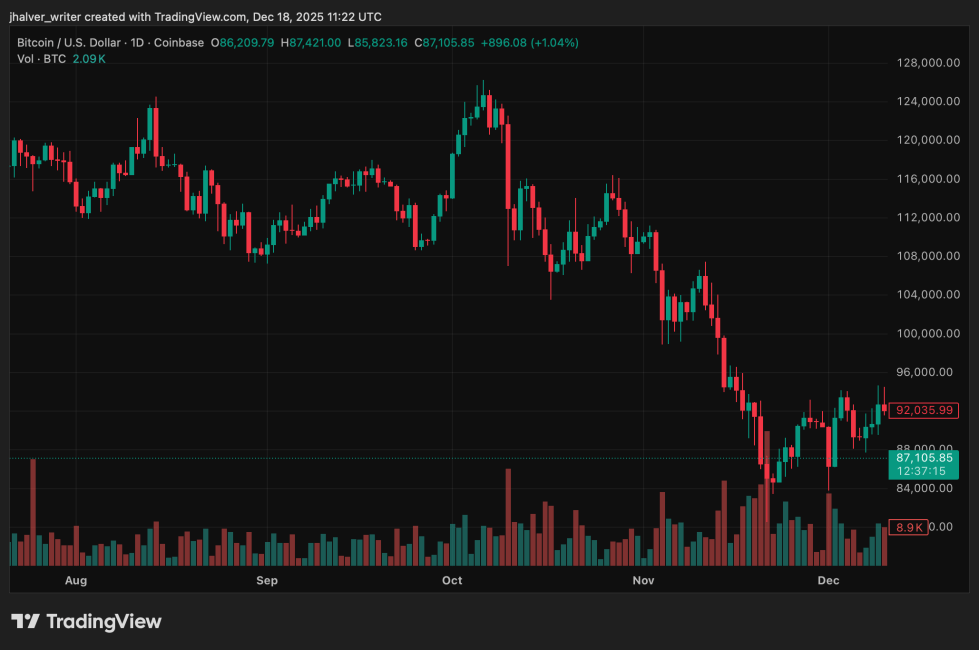
BTC's price trends to the downside with some minor gains on the daily chart. Source: BTCUSD on Tradingview

Long-Term Holders Drive Persistent Supply Pressure

A major source of downside pressure has been sustained selling by long-term holders. Data from K33 Research shows that roughly 1.6 million BTC that had been dormant for at least two years has been sold since early 2023. In 2025 alone, more than $300 billion worth of long-held Bitcoin has re-entered circulation.

Analysts note that this type of distribution creates gradual, grinding declines rather than sharp capitulation events. With fewer active buyers in the market, the reactivated supply has proven difficult to absorb.

Blockchain data indicates that the past month marked one of the heaviest long-term holder sell-offs in over five years, reinforcing the idea that structural selling remains unresolved.

ETF Inflows Return, But Demand Remains Uneven

Institutional demand has shown brief signs of recovery. U.S. spot Bitcoin ETFs recorded roughly $457 million in net inflows on December 17, snapping a multi-day outflow streak. Fidelity’s Bitcoin fund accounted for the majority of the inflows, with BlackRock also posting gains.

Despite this rebound, ETF activity has been inconsistent. December inflows remain modest compared with earlier in the year, following nearly $3.5 billion in ETF outflows in November.

Market observers say these inflows, while supportive, have not yet been large or sustained enough to offset ongoing sell-side pressure from long-term holders and cautious retail participation.

Technical Signals and Market Structure Favor Bears

From a technical perspective, Bitcoin continues to flash bearish signals. The price has traded within a broad $82,000–$95,000 range for over a month, forming patterns such as an inverse cup and handle on the daily chart. Bitcoin has also slipped below key moving averages, while momentum indicators suggest sellers remain in control.

Recent liquidation events have reinforced this weakness. Around $152 million in Bitcoin positions were liquidated in a single day, and derivatives open interest has declined since the October market crash tied to macroeconomic shocks and tariff-related concerns.

Related Reading: XRP Ledger Adds Military-Grade Security Via Payments Engine Standard

Bitcoin remains caught between sporadic institutional inflows and persistent structural pressure. Until selling from long-term holders eases and liquidity improves, downside risks are likely to remain part of the market’s near-term outlook.

Cover image from ChatGPT, BTCUSD chart from Tradingview

Похожее

How the $900 Billion Anthropic Was Built?

Anthropic, the AI startup behind Claude, is reportedly in early talks to raise at least $30 billion in new funding, targeting a valuation exceeding $900 billion. This would propel it past OpenAI's recent $852 billion valuation. The funding round is expected to close by late May 2026. The company's valuation surge is driven by extraordinary revenue growth, reportedly reaching an annualized $30 billion by March 2026 from $1 billion in December 2024. However, OpenAI questions this figure, suggesting a net revenue closer to $22 billion after cloud platform fees. Despite high revenue, Anthropic's gross margin is reportedly around 40%, and it is not yet profitable, with breakeven projected for 2028. A significant portion of the new capital would fund massive, pre-committed computing infrastructure with partners like Amazon, Google, and Microsoft. This highlights a new AI financing model where high valuations fuel compute spending, which in turn requires even higher future valuations to sustain. Notably, many early-stage investors are reportedly sitting out this round. Bankers privately estimate a potential IPO valuation between $400-500 billion, creating a rare scenario where the final private funding round valuation ($900B+) could far exceed the expected public market debut. Anthropic is targeting an IPO between October 2026 and the first half of 2027. Its public listing is poised to be a critical test for the entire AI sector's valuation logic, potentially validating or challenging the high-stakes "valuation-compute-valuation" cycle that has defined private market investments.

链捕手1 ч. назад

How the $900 Billion Anthropic Was Built?

链捕手1 ч. назад

UBS Enters the Fray, 20 Swiss Banks Now Offer Crypto Trading, Covering 2.5 Million Accounts

Global wealth management giant UBS has entered the cryptocurrency market, offering Bitcoin and Ethereum trading to select private banking clients in Switzerland as of January 2026. This move is part of a broader trend in Switzerland, where approximately 20 banks now provide crypto services, collectively covering over 2.5 million accounts. Client data from Zurich Cantonal Bank (ZKB) challenges the stereotype of crypto being solely for the young, revealing that the average buyer is aged 30-50 and predominantly male. Notably, over 40% of these clients previously held no investment portfolio, indicating crypto is activating dormant capital. The business case is proving substantial. For several Swiss banks, crypto-related activities already contribute a significant and disproportionate share of profits, with unit economics often outperforming traditional banking services. This institutional adoption in Switzerland reflects a global trend, with a recent survey showing 73% of institutional investors planning to increase crypto allocations in 2026. Switzerland's early regulatory clarity through its DLT Act and established custody infrastructure have provided a foundation for this growth. However, upcoming challenges include the implementation of the OECD's Crypto Asset Reporting Framework (CARF) in 2027 and ongoing reforms by Swiss regulator FINMA. The final shape of these regulations will be crucial in determining whether Switzerland can maintain its leading position in the global banking crypto sector.

marsbit1 ч. назад

UBS Enters the Fray, 20 Swiss Banks Now Offer Crypto Trading, Covering 2.5 Million Accounts

marsbit1 ч. назад

Circle Releases Arc Network Whitepaper: Can the New Economic Mechanism Drive It to Become the "Clearing Coordination Layer" for Institutional-Grade Stablecoin Payments?

Circle has released the whitepaper for its Arc Network, detailing plans for a new economic coordination layer using the proposed ARC token. Arc is a Layer 1 blockchain designed for enterprise-level stablecoin payments, featuring USDC as its native gas token, a high-performance consensus mechanism for instant transaction finality, and optional enterprise privacy features. Currently operating on a Proof-of-Authority (PoA) model, the network plans a future transition to a Proof-of-Stake (PoS) system. The ARC token is intended to serve as the network's native coordination asset, facilitating governance, enabling staking rewards, and managing fee mechanisms. User fees paid in stablecoins would be converted to ARC, with portions distributed as rewards and burned. The governance model will blend token-based voting with institutional oversight, especially for high-sensitivity matters like security and compliance. While positioning Arc as a potential settlement layer for institutional stablecoin payments, the whitepaper acknowledges challenges. These include the network's current centralization, the unfinished and potentially volatile ARC token economics, and the evolving global regulatory landscape for stablecoins. The development signals a broader industry trend where Web3 infrastructure competition is shifting from pure performance to factors like liquidity, compliance, and institutional-grade stability.

marsbit1 ч. назад

Circle Releases Arc Network Whitepaper: Can the New Economic Mechanism Drive It to Become the "Clearing Coordination Layer" for Institutional-Grade Stablecoin Payments?

marsbit1 ч. назад

Торговля

Спот
Фьючерсы

Популярные статьи

Как купить S

Добро пожаловать на HTX.com! Мы сделали приобретение Sonic (S) простым и удобным. Следуйте нашему пошаговому руководству и отправляйтесь в свое крипто-путешествие.Шаг 1: Создайте аккаунт на HTXИспользуйте свой адрес электронной почты или номер телефона, чтобы зарегистрироваться и бесплатно создать аккаунт на HTX. Пройдите удобную регистрацию и откройте для себя весь функционал.Создать аккаунтШаг 2: Перейдите в Купить криптовалюту и выберите свой способ оплатыКредитная/Дебетовая Карта: Используйте свою карту Visa или Mastercard для мгновенной покупки Sonic (S).Баланс: Используйте средства с баланса вашего аккаунта HTX для простой торговли.Третьи Лица: Мы добавили популярные способы оплаты, такие как Google Pay и Apple Pay, для повышения удобства.P2P: Торгуйте напрямую с другими пользователями на HTX.Внебиржевая Торговля (OTC): Мы предлагаем индивидуальные услуги и конкурентоспособные обменные курсы для трейдеров.Шаг 3: Хранение Sonic (S)После приобретения вами Sonic (S) храните их в своем аккаунте на HTX. В качестве альтернативы вы можете отправить их куда-либо с помощью перевода в блокчейне или использовать для торговли с другими криптовалютами.Шаг 4: Торговля Sonic (S)С легкостью торгуйте Sonic (S) на спотовом рынке HTX. Просто зайдите в свой аккаунт, выберите торговую пару, совершайте сделки и следите за ними в режиме реального времени. Мы предлагаем удобный интерфейс как для начинающих, так и для опытных трейдеров.

1.3k просмотров всегоОпубликовано 2025.01.15Обновлено 2025.03.21

Как купить S

Sonic: Обновления под руководством Андре Кронье – новая звезда Layer-1 на фоне спада рынка

Он решает проблемы масштабируемости, совместимости между блокчейнами и стимулов для разработчиков с помощью технологических инноваций.

2.2k просмотров всегоОпубликовано 2025.04.09Обновлено 2025.04.09

Sonic: Обновления под руководством Андре Кронье – новая звезда Layer-1 на фоне спада рынка

HTX Learn: Пройдите обучение по "Sonic" и разделите 1000 USDT

HTX Learn — ваш проводник в мир перспективных проектов, и мы запускаем специальное мероприятие "Учитесь и Зарабатывайте", посвящённое этим проектам. Наше новое направление .

1.8k просмотров всегоОпубликовано 2025.04.10Обновлено 2025.04.10

HTX Learn: Пройдите обучение по "Sonic" и разделите 1000 USDT

Обсуждения

Добро пожаловать в Сообщество HTX. Здесь вы сможете быть в курсе последних новостей о развитии платформы и получить доступ к профессиональной аналитической информации о рынке. Мнения пользователей о цене на S (S) представлены ниже.

活动图片