$7.8mln ETH deployed into DeFi – Is Ethereum Foundation setting the tone?

ambcryptoОпубликовано 2026-03-19Обновлено 2026-03-19

Введение

The Ethereum Foundation has deployed 3,400 ETH (worth approximately $7.8 million) into DeFi protocol Morpho, signaling strong institutional confidence in Ethereum’s staking and lending ecosystem. This follows an earlier deposit of 2,400 ETH and $6 million in stablecoins in October 2025. The move is seen as a strategic effort to encourage broader DeFi adoption and strengthen Ethereum’s financial infrastructure. This activity coincides with growing institutional interest, including BlackRock’s Staked ETH ETF (ETHB) recording its largest inflow of 28,810 ETH ($67.18 million) and Grayscale’s Ethereum Mini Trust locking 76,800 ETH in under a week. Total Value Locked (TVL) in DeFi has surpassed $100 billion, with Ethereum dominating nearly 60% of the market. The upcoming CLARITY Act is expected to further accelerate institutional participation, positioning Ethereum’s DeFi as a key area for long-term investment and a hedge during market volatility. The Ethereum Foundation still holds over $400 million in ETH, underscoring its ongoing influence.

Staking yields are one of the main bridges connecting TradFi and DeFi.

Put simply, staking yields let traditional investors earn “predictable” returns while getting exposure to the decentralized ecosystem, similar to earning interest in banks. That’s why many in TradFi see the CLARITY Act as a real disruptor, as it could speed up DeFi adoption and reshape capital flows.

Ethereum [ETH], however, seems to be ahead of the curve.

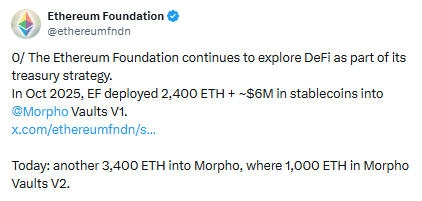
The Ethereum Foundation recently deployed 3,400 ETH into Morpho, including 1,000 ETH into Morpho Vaults V2. Back in October 2025, they had already added 2,400 ETH plus about $6 million in stablecoins into Morpho Vaults V1.

Source: X

From a strategic perspective, these moves carry real weight.

For instance, the Ethereum Foundation (a non-profit focused on network development) is showing that it’s actively putting capital to work in DeFi. By doing so, it signals confidence in Ethereum’s staking and lending ecosystem while also encouraging broader adoption across the network.

Notably, this strategy is playing out in real time.

On the 17th of March, the BlackRock Staked ETH ETF (ETHB) saw its largest inflow since inception, with a net flow of 28,810 ETH (about $67.18 million) and $0.3 billion in trading volume, highlighting growing institutional interest in Ethereum’s staking ecosystem.

And it doesn’t stop there.

Grayscale’s Ethereum Mini Trust has locked in 76,800 ETH in under a week alone. Technically, this shows that large ETH holders are allocating more and more capital into DeFi, with the Ethereum Foundation’s moves setting the pace.

Naturally, the question is: Does this give the network an edge as the CLARITY Act draws closer?

Ethereum treasuries deploy ETH, showing DeFi as a risk-off catalyst

Beyond network-level breakdowns, the DeFi sector is seeing unprecedented growth.

In fact, Total Value Locked (TVL) recently crossed $100 billion for the first time since February, demonstrating that staking continues to attract capital even in a broader risk-off environment.

Ethereum, which represents nearly 60% of the market, is clearly benefiting the most, making this trend a strong bullish signal for the network.

Against this backdrop, the CLARITY Act could become a meaningful catalyst for Ethereum, both technically and fundamentally. Backing this, the Ethereum Foundation is deploying millions into the financial infrastructure, showing that developers are laying the groundwork for broader DeFi adoption.

Source: Arkham

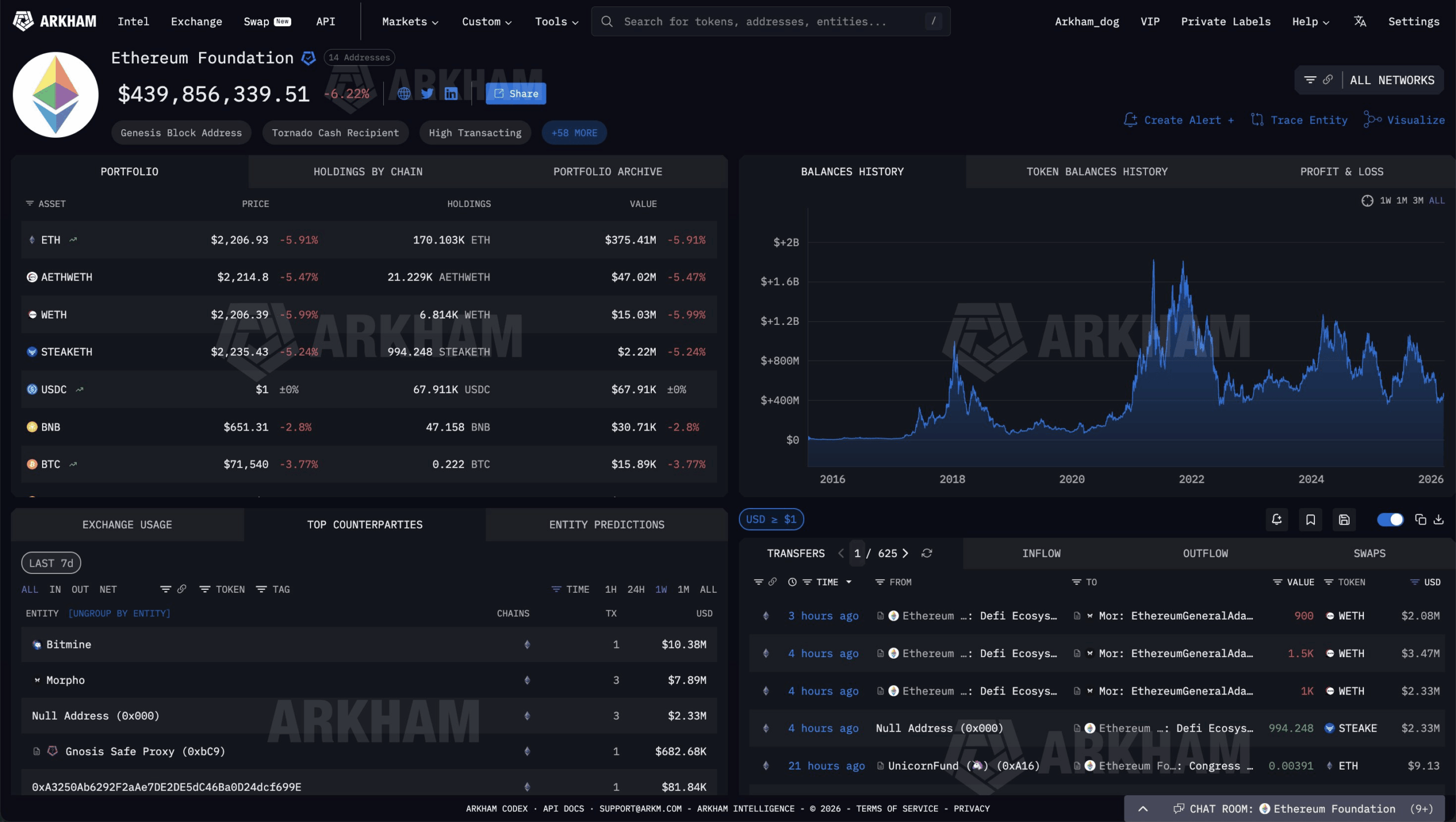
As the chart above shows, the Ethereum Foundation recently deposited $7.88 million of ETH to Steakhouse, a billion-dollar DeFi asset manager.

More importantly, the Foundation still holds over $400 million in ETH, highlighting its continued influence and strategic role in supporting the network’s growing market share.

According to AMBCrypto, this is just the start of a deeper trend.

As noted earlier, the CLARITY Act could act as a major catalyst, driving even greater institutional interest in Ethereum DeFi, with more ETH treasuries likely following BitMine’s playbook. Recent inflows into BlackRock’s ETHB only reinforce this momentum.

At the heart of it all, the Ethereum Foundation is clearly leading the way. Its recent “strategic” moves clearly signal the network’s direction, positioning Ethereum’s DeFi ecosystem as a key focus for long-term investors and a safety net during periods of intense volatility, supported by a 6% jump in ETH TVL so far this month.


Final Summary

  • Ethereum treasuries, including the Ethereum Foundation, are deploying hundreds of millions of ETH into DeFi protocols, signaling confidence and driving network growth.
  • Big inflows into BlackRock’s ETHB and Grayscale’s Ethereum Mini Trust show that traditional finance is increasingly participating in Ethereum staking, with the CLARITY Act likely acting as a catalyst.

Связанные с этим вопросы

QWhat is the significance of the Ethereum Foundation deploying 3,400 ETH into Morpho, according to the article?

AThe deployment signals the Foundation's confidence in Ethereum's staking and lending ecosystem, actively putting capital to work in DeFi to encourage broader adoption and set a strategic tone for the network.

QHow does the article connect the CLARITY Act to the growth of Ethereum's DeFi ecosystem?

AThe CLARITY Act is seen as a potential major catalyst that could accelerate DeFi adoption and drive greater institutional interest in Ethereum, reshaping capital flows and providing regulatory clarity.

QWhat recent institutional developments highlight growing interest in Ethereum's staking ecosystem?

ABlackRock's Staked ETH ETF (ETHB) had its largest inflow with a net flow of 28,810 ETH (about $67.18 million), and Grayscale's Ethereum Mini Trust locked in 76,800 ETH in under a week, showing increased institutional participation.

QWhat does the Total Value Locked (TVL) crossing $100 billion indicate for the DeFi sector and Ethereum specifically?

AIt demonstrates that staking continues to attract capital even in a risk-off environment, with Ethereum benefiting the most as it represents nearly 60% of the market, making it a strong bullish signal for the network.

QHow much ETH does the Ethereum Foundation still hold, and what does this signify for its role in the ecosystem?

AThe Ethereum Foundation still holds over $400 million in ETH, highlighting its continued influence and strategic role in supporting the network's growth and market share through DeFi deployments.

Похожее

The Merger of Codex and ChatGPT Marks the Beginning of a Major Reshuffle in Programming Tools

OpenAI is shifting its strategic focus from ChatGPT to Codex, merging them along with the browser tool Atlas into a unified desktop super-app. This move signals an internal belief that Codex, originally a programming tool, represents the next evolution of AI more than conversational models like ChatGPT. Over the past year, Codex's weekly active users have surged past 5 million. The key distinction is that while ChatGPT answers questions, Codex executes tasks. Enterprises increasingly value this ability to get work done over simply receiving advice. Consequently, Codex is attracting professionals beyond developers, including analysts, bankers, marketers, and product managers. OpenAI's reorganization and increased investment in Codex stem from recognizing that the future of AI competition lies in execution capabilities, not just conversation. The company is launching role-specific plugins (e.g., for data analysis, sales, design) to transform Codex into a broad knowledge work platform that automates and redefines white-collar workflows. Beyond being a tool, Codex reflects OpenAI's ambition to redefine software. New features like "Sites"—which generates interactive websites from documents—and collaborative "Annotations" aim to create a paradigm where the AI understands the goal and handles the tools and steps, functioning more like a digital colleague than traditional software. The ultimate goal is a unified experience where the user cares only about the completed task.

marsbit4 мин. назад

The Merger of Codex and ChatGPT Marks the Beginning of a Major Reshuffle in Programming Tools

marsbit4 мин. назад

Interpreting Investment Opportunities in the Age of Great Navigation, Invesco Great Wall Fund Releases '2026 Report on Chinese Enterprises Going Global'

Invesco Great Wall Fund has released its "2026 China Corporate Globalization Report," titled "The 'Great Navigation Era' of Chinese Enterprises." The report analyzes the new trends and investment opportunities as Chinese companies expand globally, moving from simple product exports to comprehensive overseas operations involving services, branding, and local production. Driven by factors like trade friction, the pursuit of higher profit margins abroad, and policy support, globalization is becoming essential for Chinese companies. The report outlines an evolution: from early product export ("Globalization 1.0") to the current "Globalization 2.0," characterized by overseas capacity, capital goods investment, consumer brand expansion, and service exports. Chinese firms' competitive advantages are highlighted, including a vast engineer talent pool, low-cost and robust infrastructure, and complete industrial clusters. Specific sectors with significant出海 potential are identified: * **Capital Goods** (e.g., engineering machinery, power equipment): Benefiting from global demand, especially in Belt & Road markets and the AI-driven power grid upgrade cycle. * **Consumer Brands**: Transitioning from cost to brand advantage, leveraging供应链 efficiency. * **Technology & Innovation**: Including AI applications, optical modules within global tech supply chains, and new energy vehicles focusing on local production. * **Pharmaceuticals**: Chinese biotech firms are becoming preferred partners for global pharma, with potential for breakthrough drugs in areas like oncology and weight loss. The report concludes that corporate globalization represents a sustained, core theme for China's capital markets, though companies must navigate challenges like geopolitics and localization.

marsbit16 мин. назад

Interpreting Investment Opportunities in the Age of Great Navigation, Invesco Great Wall Fund Releases '2026 Report on Chinese Enterprises Going Global'

marsbit16 мин. назад

GitHub, Transfixed by AI

On the night of February 9th, GitHub suffered a major outage caused by a simple configuration change—reducing a cache refresh interval from 12 to 2 hours—that triggered a cascade of failures. This was not an isolated event, but part of a broader pattern. In early 2026, GitHub experienced at least 8 major incidents, failing to meet its promised 99.9% availability. These outages stemmed from structural issues: explosive growth in load, tight service coupling, and insufficient protection against abnormal traffic. This unprecedented load is driven by AI Agents. In 2025, GitHub handled ~1 billion commits. By 2026, weekly commits reached 275 million, projecting to ~14 billion for the year—a 14x increase. AI tools like Claude Code now contribute 4.5% of all public repository commits, with weekly submissions surging 25x in just three months. AI-generated pull requests jumped from 4 million to 17 million per month in half a year. Unlike human developers, AI Agents work continuously, generating commits at a scale that overwhelms infrastructure designed for human rhythms. The surge also shattered GitHub's business model. Copilot's flat-rate pricing, based on assisting human developers, became unsustainable as Agentic AI sessions consumed resources worth hundreds of dollars for a few dollars in fees. In response, GitHub imposed usage limits and, by June 1st, shifted to a pay-per-use "AI Credits" system. Facing this new reality, GitHub realized a 10x scaling plan was insufficient. It announced a need to *redesign* its architecture for 30x current scale—decoupling services, adding fault isolation, and improving change management to prevent cascading failures. Other platforms like Stripe and AWS are facing similar challenges with AI Agents. Fundamentally, GitHub is transitioning from a human collaboration platform to an "exhaust pipe" for automated AI workflows. Its detailed post-mortem reports aim to maintain trust during this turbulent rebuild. The February outage was not just a technical glitch, but a signal of the software industry's entry into a new, AI-driven era.

marsbit56 мин. назад

GitHub, Transfixed by AI

marsbit56 мин. назад

Торговля

Спот
Фьючерсы
活动图片