$7 Billion Iran Bet Forces U.S. to Tighten Rules on Prediction Markets

marsbitОпубликовано 2026-03-16Обновлено 2026-03-16

Введение

Polymarket and Kalshi, two prediction market platforms, are reportedly seeking funding at valuations of around $20 billion each. This coincides with increased regulatory scrutiny from U.S. lawmakers and the CFTC, driven by controversial contracts related to Iran. Approximately $529 million was wagered on contracts predicting the timing of an Iranian attack, and $150 million on contracts related to the potential ouster of Supreme Leader Khamenei. Six accounts allegedly profited around $1.2 million from well-timed trades just hours before an attack on Iranian officials. These events have intensified concerns about insider trading, market manipulation, and the use of sensitive or classified information. In response, U.S. legislators are drafting bills to restrict certain event contracts, while the CFTC is advancing new regulatory frameworks. Despite the controversy, prediction markets are gaining traction as information products. Major media outlets like CNBC and Dow Jones have partnered with these platforms to integrate predictive data into their reporting. However, the integration of such data into mainstream media raises questions about fairness, trust, and the potential influence on public perception. The core challenge lies in balancing innovation and growth with regulatory oversight, especially when contracts involve geopolitical events, assassinations, or military actions. The U.S. must decide whether to heavily regulate these markets or outright ban certain contract...

Written by: Andjela Radmilac

Compiled by: Saoirse, Foresight News

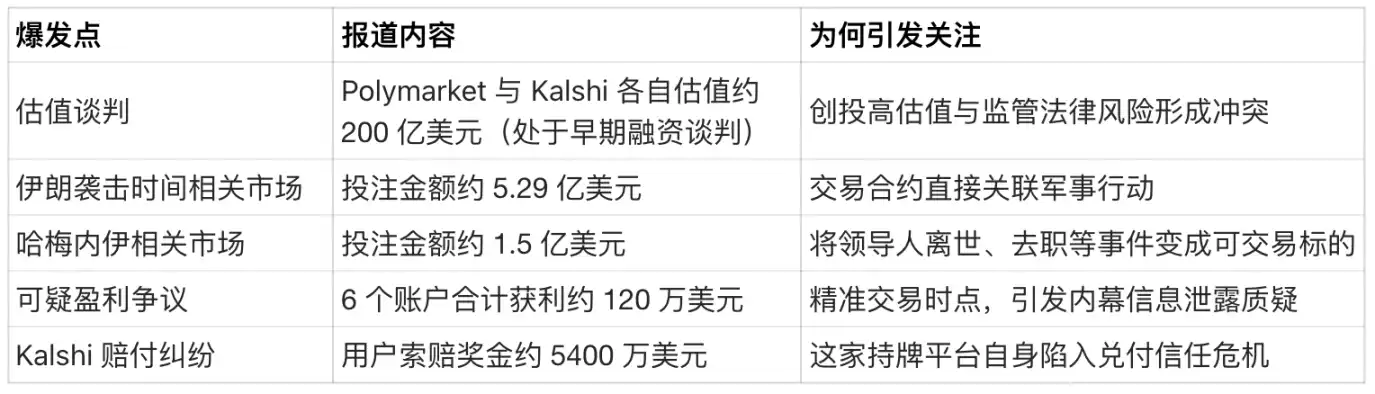
Polymarket and Kalshi are seeking funding at valuations that would place them among the top consumer fintech companies, while U.S. regulators are simultaneously accelerating the development of new rules for such products. It is reported that both companies are in early-stage funding negotiations, with valuations expected to reach approximately $20 billion each.

This funding boom coincides with a political storm.

Iran-related contracts have turned prediction markets from a niche forecasting tool into a controversial focal point involving insider information and war speculation. A Reuters investigation into the markets on Polymarket related to the timing of the attack and Khamenei's ouster found that approximately $529 million was wagered on contracts related to the timing of the attack, and about $150 million was bet on contracts related to Khamenei; meanwhile, sources indicate that six accounts, through precisely timed trades, collectively profited about $1.2 million.

Now, U.S. lawmakers are drafting relevant bills, and the U.S. Commodity Futures Trading Commission (CFTC) has also stated it will advance new regulatory rules.

Wall Street believes that event probability prediction will become part of the information system; but Washington is blocking it because it fears this system could benefit the wrong people at the worst possible time.

Why Wall Street is Bullish on Prediction Markets

Prediction markets can convert attention into trades, earn fees from those trades, and simultaneously generate real-time probability data, packaged as information products.

It is this data product that moves prediction markets out of the "gambling" category and classifies them as information tools similar to market data, polls, and financial terminals—because their output format is highly similar to market quotes.

Mainstream media have begun partnering with these platforms:

  • CNBC has signed a multi-year agreement with Kalshi to integrate its probability data into television and digital content starting in 2026.
  • Dow Jones has reached an exclusive deal with Polymarket to introduce prediction data into platforms like The Wall Street Journal and Barron's, treating contract prices as news infrastructure on par with earnings reports, interest rates, and election coverage.

These partnerships also amplify the impact of scandals: once probability data is embedded in mainstream media, it influences public perception of an event's likelihood and urgency. This is also why regulators believe platforms must adhere to higher standards in fairness, monitoring, and settlement.

This explains why, even as Iran-related trades spark political controversy, the valuations of both companies are rising.

Iran Incident Makes Prediction Markets a Washington Headache

The biggest advantage of prediction markets is early access to information. And the Iran-related contracts clearly show that these platforms are touching on sensitive information that the government tries to control.

On March 2, bets on the attack timing-related contracts reached $529 million, and contracts related to Khamenei's death and ouster reached about $150 million. Just hours before the attack on Iranian officials, six accounts suddenly injected funds and profited $1.2 million through these contracts.

As the conflict escalated, multiple reports pointed out that a large number of newly registered accounts made precise bets on Iran-related events. Such reports have thrust Polymarket from a crypto-niche platform directly into the sights of government regulation and law enforcement.

The core issues these platforms now face are: trust and fairness.

For prediction markets to function, users must believe the rules are stable, outcomes are determined consistently, and there is no insider advantage. Once the subject of trading is military action, the trust issue escalates into a political problem—because the motive for trading early could become a motive for leaking sensitive or even classified information.

This is also why the policy response has rapidly escalated.

Representative Mike Levin and Senator Chris Murphy are already drafting legislation aimed at restricting prediction markets. Congress will directly define which event contracts can be legally traded.

Additionally, CFTC Chairman Michael Selig stated that the agency has submitted an advance notice of proposed rulemaking to the White House Office of Management and Budget and is about to introduce a regulatory framework for prediction markets, which could affect all aspects from contract design to monitoring and enforcement.

The choice facing Washington is clear:

  • Acknowledge prediction markets as legal event contracts, strengthen regulation, clarify restrictions, and allow the industry to expand orderly under rules;
  • Directly prohibit contract categories related to war, assassination, and leader ousters because such trading极易 (is highly prone to) trigger insider trading and foster不良动机 (bad motives).

The data below reveals why this conflict is difficult to resolve:
Kalshi's own dispute also shows that regulation alone cannot fully solve the trust problem.

On March 5, Kalshi faced a class-action lawsuit where users accused the platform of refusing to pay approximately $54 million in winnings—users had bet that Iran's supreme leader would step down before March 1. The plaintiffs claimed the platform only activated a "death-related exception clause" after the Iranian leader was attacked, using it to refuse payment.

But Kalshi stated that its rules regarding trades on leader deaths were already clear, and it had refunded fees and compensated users for losses, meaning users did not lose money.

This is precisely the contradictory dilemma currently facing investors and policymakers.

Investors hope the industry will achieve growth, expand its reach, and justifiably integrate probability prediction data into the mainstream information system.

Users hope that when event outcomes are controversial and emotionally charged, the platform rules will be stable and credible.

Regulators希望杜绝 (hope to eliminate) these markets turning sensitive state actions into tradable products, avoiding situations where "access to confidential intelligence yields optimal trading returns." Because once these trading prices begin to influence the public information environment, the associated risks evolve into a governance challenge.

Связанные с этим вопросы

QWhat is the total amount of money involved in the Iran-related contracts on Polymarket, and how was it distributed between the two main types of contracts?

AApproximately $679 million was involved in Iran-related contracts on Polymarket. This includes about $529 million bet on contracts related to the timing of an attack and approximately $150 million on contracts concerning the ousting or death of Supreme Leader Khamenei.

QWhy are US regulators and lawmakers moving to create new rules for prediction markets, specifically in response to the Iran-related events?

AUS regulators and lawmakers are moving to create new rules because the Iran-related contracts highlighted the risk of prediction markets being used for trading on sensitive or even classified information related to military actions and political assassinations. This raises concerns about insider trading, the potential to incentivize the leaking of state secrets, and the platforms' influence on public perception when their data is integrated into mainstream media.

QHow have mainstream media organizations partnered with prediction market platforms like Kalshi and Polymarket, and what does this signify for the industry?

AMainstream media organizations have formed significant partnerships with these platforms. CNBC has a multi-year deal with Kalshi to integrate its probability data into its TV and digital programming starting in 2026. Dow Jones has an exclusive partnership with Polymarket to bring prediction data to platforms like The Wall Street Journal and Barron's, treating the contract prices as part of their news infrastructure. This signifies the industry's attempt to legitimize itself as a provider of valuable information tools rather than mere gambling platforms.

QWhat specific incident involving six accounts on Polymarket raised suspicions of insider trading related to the Iran events?

AJust hours before a high-level Iranian official was attacked, six accounts suddenly deposited funds and placed bets on the relevant contracts. These accounts collectively profited approximately $1.2 million from their precisely timed trades, raising strong suspicions of insider trading based on non-public information about the impending event.

QWhat is the core dilemma facing investors, users, and regulators regarding the future of prediction markets, as illustrated by the article?

AThe core dilemma is a three-way conflict of interests: Investors want the industry to grow and for its probability data to be widely adopted into the mainstream information ecosystem. Users demand that platform rules remain stable and trustworthy, especially when settling emotionally charged and controversial events. Regulators aim to prevent these markets from turning sensitive state actions into tradable products, fearing it creates incentives for leaking机密情报 (classified intelligence) and poses a significant governance risk when trading prices begin to influence public opinion and the information environment.

Похожее

BitMine добавляет 7 430 ETH и тратит $86 млн на выкуп акций – Почему?

Компания Bitmine на прошлой неделе значительно сократила закупки Ethereum (ETH), приобретя лишь 7430 ETH — это минимальный еженедельный объем с мая. Вместо наращивания криптовалютного резерва компания направила примерно 86 млн долларов на обратный выкуп 5,5 млн своих обыкновенных акций по средней цене 15,62 доллара, чтобы повысить акционерную стоимость. Несмотря на замедление темпов покупки, резерв Bitmine по-прежнему огромен и составляет 5 777 468 ETH (около 4,8% от общего объема эмиссии ETH). Компания близка к достижению своей долгосрочной цели — владению 5% всех ETH. Уже через 12 месяцев после запуска стратегии фонд почти достиг этого показателя. Кроме того, Bitmine разместила в стейкинге через свою платформу MAVAN около 4,92 млн ETH (85% своих активов). Это может приносить примерно 247 млн долларов годового дохода при текущей доходности в 2,67%, а после стейкинга всего резерва доход может вырасти до 290 млн долларов. Параллельно в статье отмечается, что пока Bitmine фокусируется на Ethereum, компания MicroStrategy Майкла Сэйлора продолжает агрессивно накапливать Bitcoin (BTC), несмотря на финансовое давление и недавние продажи части активов.

ambcrypto20 мин. назад

BitMine добавляет 7 430 ETH и тратит $86 млн на выкуп акций – Почему?

ambcrypto20 мин. назад

9,42 миллиона частных инвесторов бросились покупать акции Changxin Technology, кто же выиграл в лотерее?

Результаты размещения акций Changxin Technology привлекли огромное внимание инвесторов. Всего в онлайн-подписке для частных инвесторов участвовало около 9,4288 миллиона человек, было подано 816,92 миллиарда заявок на акции, сгенерировано примерно 7,7 миллиона выигрышных лотерейных номеров, а итоговая ставка онлайн-подписки составила около 0,4714%, что является рекордно высоким показателем для новых акций на рынке STAR. Из-за высокого спроса компания активировала механизм обратного перевода, увеличив количество акций, размещаемых онлайн, до 3,851 миллиарда. Среди институциональных инвесторов 285 организаций, управляющих 10907 счетами, подали заявки на сумму около 12,38 триллиона акций, получив в итоге 2,173 миллиарда акций при коэффициенте распределения около 0,1756%. Taikang Asset Management стал институциональным инвестором, получившим наибольшее распределение. Среди публичных фондов лидерами по объему размещения стали E Fund, Southern Fund и ICBC Credit Suisse. Основатель ведущей китайской компании в области больших моделей DeepSeek, Лян Вэньфэн, через свои хедж-фонды Ningbo幻方量化 и Zhejiang九章资产 получил самое большое распределение среди частных фондов — акций на общую сумму примерно 1,75 миллиарда юаней. Ожидается, что Changxin Technology официально выйдет на биржу 27 июля. По оценкам рынка, её стоимость после IPO может превысить 1 триллион юаней, а некоторые аналитики дают прогноз до 2-3 триллионов юаней. Однако недавняя коррекция на глобальном технологическом рынке может оказать определенное влияние на цену акций компании после листинга.

marsbit45 мин. назад

9,42 миллиона частных инвесторов бросились покупать акции Changxin Technology, кто же выиграл в лотерее?

marsbit45 мин. назад

Криптовалюта USCR стабилизируется на отметке $0,0022: Сможет ли мемкоин отыграть потери второго квартала?

Криптовалюта USCR, мемкоин, отслеживающий тему официальных крипторезервов США, пытается восстановиться после падения до двухмесячного минимума в $0.0022. В мае цена выросла на 65%, но в июне упала на 37%. Сейчас наблюдается потенциальный отскок, и если быкам удастся закрепиться выше ключевых скользящих средних, возможен рост до $0.0028 (уровень Фибоначчи) и далее до майского пика в $0.0036, что означает потенциал роста на 30-60%. Динамика USCR тесно связана с новостями о создании стратегического резерва биткойна в США. Майский рост совпал с увеличением вероятности этого события и внесением соответствующего законопроекта. Однако его рассмотрение застопорилось, а шансы на создание резерва к 2027 году, по данным Polymarket, упали до 18%, что давит на настроения. Несмотря на неопределённость, база держателей USCR остаётся значительной: 48 тысяч, сократившись лишь на 4 тысячи с начала 2026 года. Восстановление цены будет зависеть от позитивных новостей по законопроекту о биткойн-резерве.

ambcrypto1 ч. назад

Криптовалюта USCR стабилизируется на отметке $0,0022: Сможет ли мемкоин отыграть потери второго квартала?

ambcrypto1 ч. назад

«Богиня благотворительности» с 3 млн подписчиков целиком создана ИИ, поддельный детский дом, международный «фальшивый фонд» рухнул за одну ночь

**Шокирующий разоблачение: Астролябка «благотворительности» с 300 000 подписчиков оказалась масштабной аферой на основе ИИ** Австралийская инфлюенсерша Лили Джей, имевшая почти 3 миллиона подписчиков в Instagram, создала тщательно продуманную мошенническую схему под прикрытием своего «Фонда Лили Джей». Используя искусственный интеллект, она и ее команда генерировали фальшивые изображения и видео, изображающие строительство мечетей, раздачу хлеба в Газе и даже открытие детского дома в Уганде для привлечения пожертвований от преимущественно мусульманской аудитории. Расследование ABC News Verify выявило многочисленные подделки: видео с «открытием» детского дома полностью сгенерировано ИИ (включая детей, саму Лили и фонды), «награда» за гуманитарную деятельность оказалась фальшивкой с цифровым водяным знаком ИИ, а заявленные благотворительные проекты в Уганде и Газе не существуют. Фонд не зарегистрирован как официальная благотворительная организация, что позволяло избегать финансовой отчетности. После запросов ABC сайт фонда стал скрывать кнопки для пожертвований и предупреждения о своем неблаготворительном статусе для посетителей из Австралии, но оставил их для иностранных пользователей. Эксперты предупреждают, что эта афера — тревожный прецедент, демонстрирующий, как ИИ может эксплуатировать человеческое доверие и желание творить добро, создавая убедительные, но полностью вымышленные нарративы.

marsbit1 ч. назад

«Богиня благотворительности» с 3 млн подписчиков целиком создана ИИ, поддельный детский дом, международный «фальшивый фонд» рухнул за одну ночь

marsbit1 ч. назад

L2 «рекалибровка»: когда L1 становится собственным ролл-апом, каков финал Ethereum?

«L2 перекалибровка»: когда L1 становится собственным роллапом, каков финал Ethereum? Первоначально, роллапы (L2) рассматривались как основной путь масштабирования Ethereum, обеспечивая дешёвое и быстрое исполнение транзакций. Однако, с развитием самого L1 (повышение лимита газа, внедрение безсостоятельности и zkEVM) и объединением задач масштабирования, традиционное разделение между L1 как безопасным, но медленным «слоем урегулирования» и L2 как дешёвым «слоем исполнения» меняется. Вопрос теперь не только в увеличении пространства блоков, а в перераспределении ролей в системе с множеством исполняющих сред. Будущая роль L2 смещается от простого предоставления дешёвого газа к обеспечению уникальных функций, таких как оптимизация для конкретных приложений, приватность и гибкие модели управления. Таким образом, L2 станет скорее спектром исполняющих сред с разной степенью наследования безопасности Ethereum, чем единым техническим классом. Ключевой задачей становится решение фрагментации. Разделённая ликвидность и состояние пользователя ухудшают опыт. Усилия концентрируются на улучшении взаимодействия (интероперабельности) через системы на основе намерений (intents) и нативные протоколы, такие как Ethereum Interoperability Layer (EIL), чтобы Ethereum вновь «ощущался как единая цепь». Сокращение времени до финальности транзакций L1 также имеет решающее значение для доверия между цепями. Ещё более радикальная идея — с появлением систем доказательств (zkEVM) внутри L1 сама Ethereum может стать своего рода «собственным роллапом», где высокопроизводительные узлы исполняют транзакции, а валидаторы проверяют криптографические доказательства. Это размывает классические границы между слоями и открывает путь к архитектуре, где множество исполняющих доменов (специализированных L2) сосуществуют, разделяя общую безопасность, ликвидность и систему урегулирования Ethereum. В итоге, будущее Ethereum видится не как победа L1 над L2 или наоборот, а как экосистема взаимосвязанных исполняющих сред, которые, будучи «разобранными» для масштабирования, вновь объединяются в единое, безопасное и удобное для пользователя целое.

marsbit1 ч. назад

L2 «рекалибровка»: когда L1 становится собственным ролл-апом, каков финал Ethereum?

marsbit1 ч. назад

Торговля

Спот
活动图片




