67% Of Ethereum Stablecoin Transfers Are P2P, Yet Institutions Dominate Volume

bitcoinistОпубликовано 2025-12-24Обновлено 2025-12-24

Введение

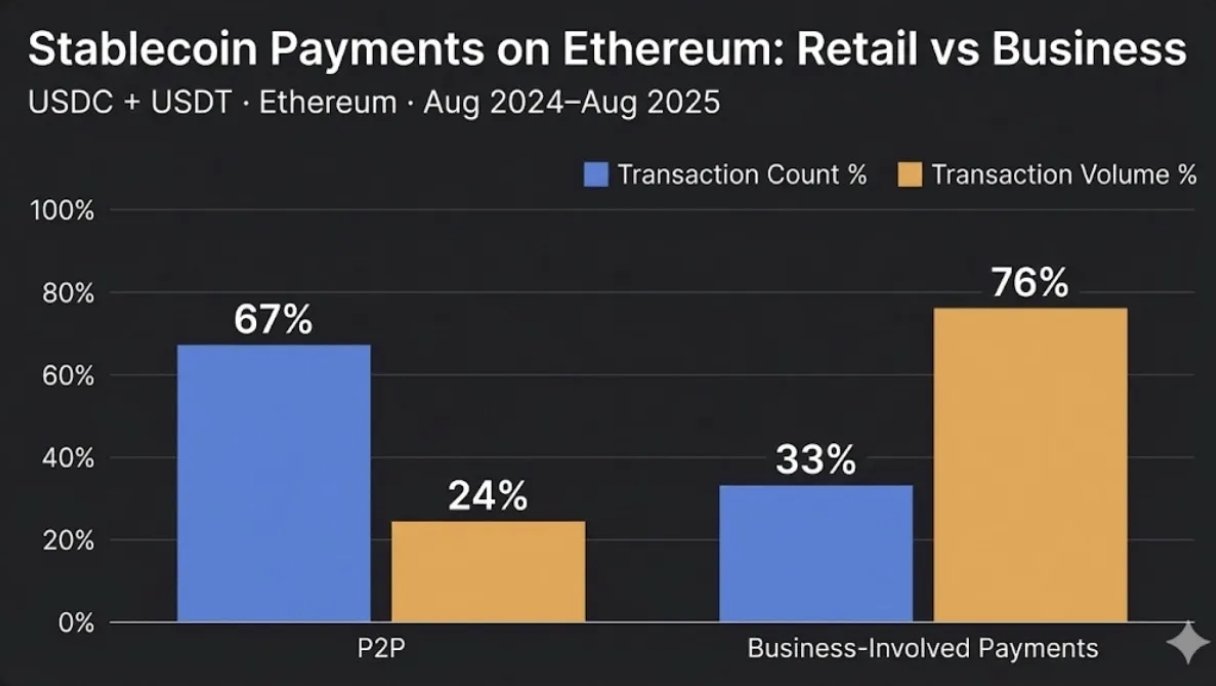
A new analysis of Ethereum stablecoin transactions reveals that while peer-to-peer (P2P) transfers dominate in frequency, institutional activity accounts for the vast majority of transaction volume. According to data shared by an Ethereum Foundation member, 67% of USDT and USDC transfers on the Ethereum network from August 2024 to 2025 were P2P, typically associated with retail users. However, these transfers represented only 24% of the total volume. In contrast, business-related transactions—including business-to-business (B2B), internal business moves, and person-to-business (P2B) transfers—made up just 33% of transaction count but a dominant 76% of the volume. The data, sourced from Artemis, focused exclusively on USDT and USDC transfer transactions, excluding mints, burns, or cross-chain transfers. Ethereum remains the leading network for stablecoins, hosting over 50% of the global supply. Meanwhile, ETH’s price briefly recovered above $3,000 before pulling back to around $2,950.

Data shows 67% of Ethereum transactions involving the stablecoins USDT and USDC are P2P in nature, but the majority of volume lies elsewhere.

Business-Related Ethereum Stablecoin Transactions Dominate Volume

In a new post on X, Ethereum Foundation head of ecosystem James has shared some numbers related to stablecoin transactions on the ETH blockchain. Stablecoins refer to cryptocurrencies that have their value pegged to a fiat currency.

As these assets are relatively “stable” by nature, they have quickly established themselves as the preferred mode of payments, with their volume surpassing combined that of the top five non-stablecoin cryptocurrencies.

But what does the nature of these transactions look like? Below is the data posted by James, showcasing how the transfers related to the Ethereum versions of USDT and USDC break down between retail and business payments.

Businesses seem to be dominating in terms of the volume | Source: @Snapcrackle on X

As is visible in the chart, 67% of USDT and USDC transactions on the Ethereum network that occurred between August 2024 and 2025 were of the peer-to-peer (P2P) type. Such transactions are usually a sign of activity from retail users.

The small size of the users being involved could be why the transaction volume share of P2P transfers was just 24%. In contrast, business-involved payments made up for 76% of the volume, despite occupying a transactions share of just 33%.

The Ethereum Foundation member sourced the data from Artemis’ report on Ethereum stablecoin payment usage. While stablecoins pegged to various currencies exist, Artemis focused on the USD-tied USDC and USDT as they are by far the most popular options, occupying 88% of the sector’s market cap.

These coins circulate on several blockchains, but Ethereum is currently the most dominant network, hosting more than 50% of the global stablecoin supply. “We also only focus on transfer transactions and exclude any mint, burn, or bridge transactions from our analysis,” noted the report.

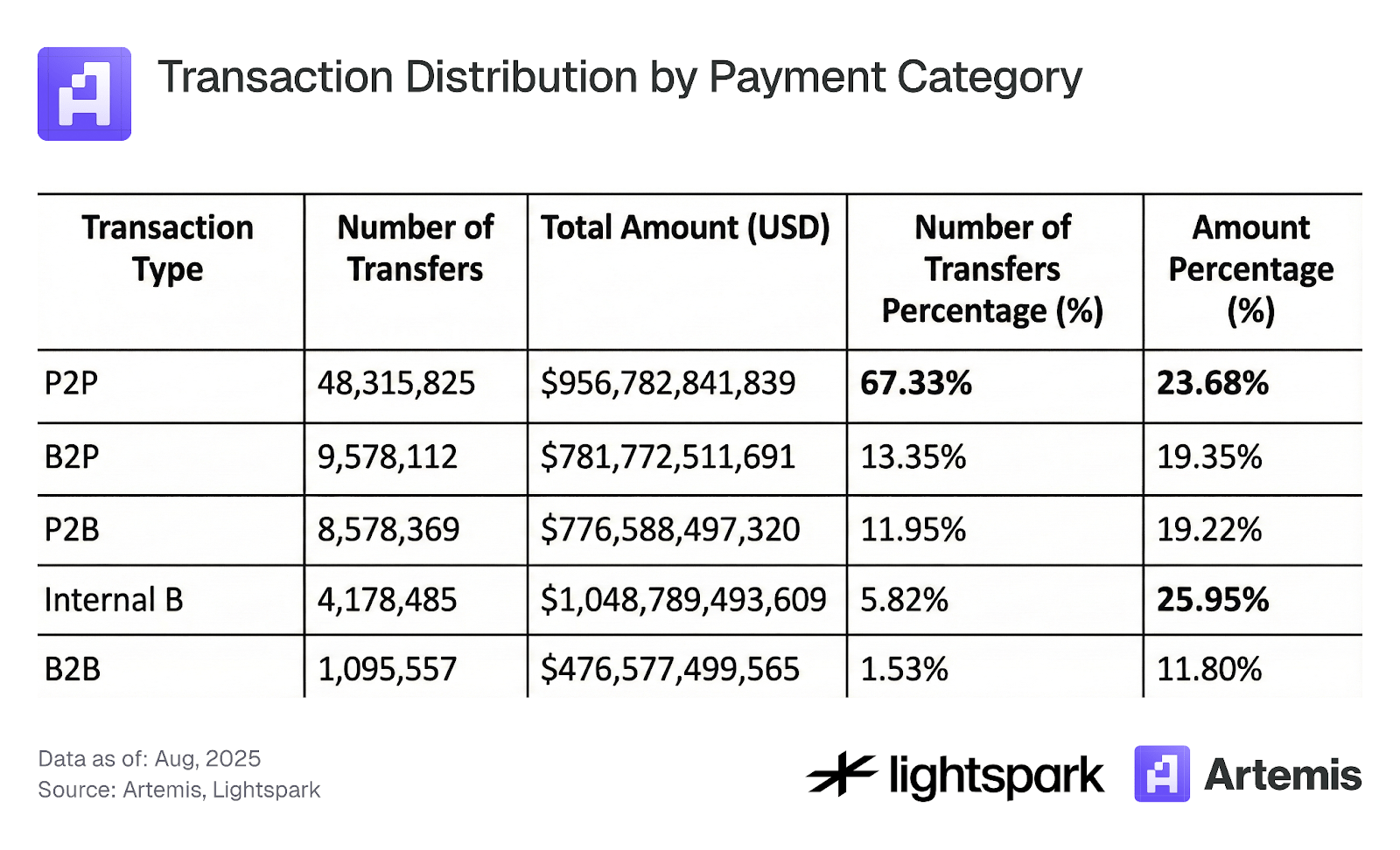
Artemis has broken down how it classifies transactions. Transfers are considered P2P if they occur between the externally owned accounts (EOAs) of two separate users.

Determining whether a transaction is P2P can be tricky, however, given that it’s not always possible to determine whether two accounts are owned by different entities. Problems also arise for wallets owned by exchanges and other centralized entities. “In our dataset we are able to label many institutional and firm EOA wallets; however, the labeling is not perfect and some EOA wallets that are owned by firms and are not documented in our dataset can be mislabeled as individual wallets,” explained the report.

The second category is business-to-business (B2B), naturally consisting of the moves taking place between two institutional EOAs. Transactions between the same institutional entity fall inside the “Internal B” label.

Finally, there is the person-to-business (P2B) category, accounting for the transfers happening between individuals and businesses. James’ chart clubs all the business categories into one.

The numbers related to the stablecoin transactions on the Ethereum network | Source: Artemis

ETH Price

Ethereum made recovery above $3,000 earlier, but it seems the coin has once again faced a pullback as its price is now back at $2,950.

The trend in the ETH price over the last five days | Source: ETHUSDT on TradingView

Связанные с этим вопросы

QWhat percentage of Ethereum stablecoin transfers are P2P, and what is their share of the total volume?

A67% of Ethereum stablecoin transfers are P2P, but they account for only 24% of the total volume.

QWhich stablecoins were the focus of the data analysis, and why were they chosen?

AThe analysis focused on USDT and USDC because they are the most popular stablecoins, occupying 88% of the sector's market cap.

QWhat is the main reason P2P transactions have a low volume share despite their high transaction count?

AThe small size of the users involved in P2P transactions is why their volume share is low, as these are typically retail users making smaller transfers.

QHow does the Ethereum network classify a transaction as P2P?

AA transfer is classified as P2P if it occurs between the externally owned accounts (EOAs) of two separate individual users.

QWhat was the price of Ethereum mentioned in the article after it faced a pullback?

AAfter facing a pullback, Ethereum's price was back at $2,950.

Похожее

Jensen Huang's CMU Speech: In the AI Era, Don't Just Watch, Build

Jensen Huang, CEO of NVIDIA and a first-generation immigrant, delivered the commencement address to Carnegie Mellon University's class of 2026. He shared his personal journey from a humble background to founding NVIDIA, emphasizing resilience, learning from failure, and the responsibility that comes with leadership. Huang framed the present moment as the dawn of the AI revolution, a shift he believes is more profound than previous computing waves. He described AI as fundamentally resetting computing—moving from human-written software to machines that understand, reason, and use tools. This will create a new industry for generating intelligence and transform every sector. While acknowledging AI's potential to automate tasks and displace some jobs, Huang distinguished between the *tasks* of a job and its core *purpose*. He argued AI will augment human capability, not replace humans. The real risk, he stated, is not AI itself, but people being left behind by those who effectively use AI. He presented AI as a generational opportunity for massive infrastructure investment—in chip factories, data centers, energy grids, and advanced manufacturing—that could re-industrialize nations like the U.S. and bridge the digital divide by making computing and intelligent tools accessible to all. Huang called for a balanced approach: advancing AI safely and responsibly, establishing prudent policies, ensuring broad access, and encouraging universal participation. He urged the graduates not to fear the future but to engage with optimism and ambition, reminding them of CMU's motto, "My heart is in the work." His core message was clear: this is their moment to actively build and shape the AI-powered future, not merely observe it.

marsbit39 мин. назад

Jensen Huang's CMU Speech: In the AI Era, Don't Just Watch, Build

marsbit39 мин. назад

The Era Has Arrived Where Human Writers Must Prove They Are Not Machines

The article describes an era where AI-generated content is flooding the market, forcing human authors to prove they are not machines. It begins with the example of dozens of AI-written, error-ridden biographies of Henry Kissinger appearing on Amazon within hours of his death, a pattern repeated for other deceased celebrities and even living experts who find fraudulent books under their names. This spam content has exploded, with monthly new book releases on platforms like Amazon reaching 300,000 by late 2025. The issue spans genres, from suspiciously high proportions of AI-written teen romance and self-help books to dangerous, AI-generated foraging guides containing lethal advice. The platforms' automated review systems, designed to catch plagiarism and banned words, are ill-equipped to detect AI-generated text that avoids these pitfalls while being nonsensical or fraudulent. The problem has infiltrated traditional publishing. A major publisher, Hachette, had to recall a bestselling horror novel after AI detection tools suggested 78% of its content was machine-generated. An acclaimed European philosophy book was later revealed to be entirely written by AI under a fake author persona. In response, authors are fighting back. At the 2026 London Book Fair, 10,000 writers published a blank book titled "Don't Steal This Book" containing only their signatures—using emptiness as a protest weapon in an age of AI overproduction. Initiatives like the "Human Author Certification" program have emerged, ironically placing the burden on humans to prove their work is not machine-made. The article warns of a vicious cycle: AI-generated low-quality books pollute the data used to train future AI models, leading to "model collapse" and an ever-worsening flood of digital waste, eroding trust in publishing and devaluing human creativity.

marsbit1 ч. назад

The Era Has Arrived Where Human Writers Must Prove They Are Not Machines

marsbit1 ч. назад

Торговля

Спот
Фьючерсы

Популярные статьи

Manyu: восходящая мем-звезда на Ethereum, готовая открыть новую эру культуры Shiba

Manyu - это мемтокен на Ethereum, который приносит децентрализованную культурную и развлекательную ценность через вирусное влияние в соцсетях и вовлечённость сообщества.

1.9k просмотров всегоОпубликовано 2025.11.27Обновлено 2025.11.27

Manyu: восходящая мем-звезда на Ethereum, готовая открыть новую эру культуры Shiba

Неделя обучения по популярным токенам 14: Glamsterdam — самое ожидаемое обновление Ethereum в 2026 году

Ordinals/Runes по-прежнему стимулируют доходы от комиссий за блоки и активность разработчиков, рассматриваются как отправная точка «нативной эмиссии активов» в сети.

1.3k просмотров всегоОпубликовано 2026.04.29Обновлено 2026.04.29

Неделя обучения по популярным токенам 14: Glamsterdam — самое ожидаемое обновление Ethereum в 2026 году

Обсуждения

Добро пожаловать в Сообщество HTX. Здесь вы сможете быть в курсе последних новостей о развитии платформы и получить доступ к профессиональной аналитической информации о рынке. Мнения пользователей о цене на ETH (ETH) представлены ниже.

活动图片