$50 Million Funding Ignites Airdrop Anticipation, Variational Becomes New Focus of Perp DEX

Odaily星球日报Опубликовано 2026-05-21Обновлено 2026-05-21

Введение

Variational, a perpetual decentralized exchange (Perp DEX) on Arbitrum, has become a focal point in the crypto community after announcing a $50 million Series A funding round led by Dragonfly Capital, with participation from Bain Capital Crypto and Coinbase Ventures. This news caused a significant pre-listing price surge and increased predictions of a high fully diluted valuation (FDV) upon launch. A key feature of Variational is its zero-trading-fee model. It differentiates itself by aggregating multi-source liquidity, including traditional and crypto-native market makers, to address on-chain liquidity challenges. According to DefiLlama, it ranks fourth among Perp DEXs by open interest and is notable as the only top-five platform yet to issue a token. The primary way for users to engage is through its "Trade-to-Earn" Omni Points program. Points are awarded weekly based on trading activity, with bonuses for early users and a tiered reward system that incentivizes higher trading volumes. The program also includes a referral system offering USDC rewards and extra points. The design emphasizes organic trading over mere volume farming. While an exact Token Generation Event (TGE) date for the VAR token is not confirmed, official documentation states the points program will run at least until the end of Q3 2026. Community and prediction market sentiment generally expects the TGE to occur in Q3 or Q4 of this year.

Original | Odaily Planet Daily (@OdailyChina)

Author | Asher (@Asher_0210)

A funding announcement has made Perp DEX Variational the hot topic in the airdrop farming community.

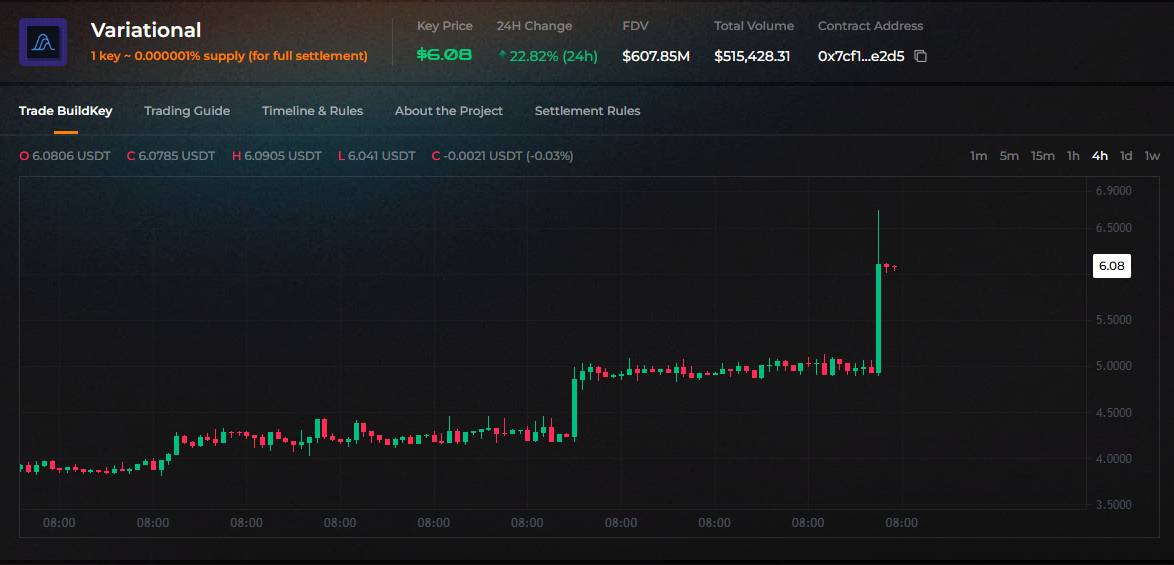
Last night, Variational announced the completion of a $50 million Series A funding round, led by Dragonfly Capital, with participation from Bain Capital Crypto and Coinbase Ventures. Influenced by this news, Variational's pre-market price surged over 36% briefly, hitting $6.9 at one point (corresponding to an FDV of $690 million). It has since pulled back and is currently quoted at $6.1 (corresponding to an FDV of $610 million).

Variational pre-market price movement

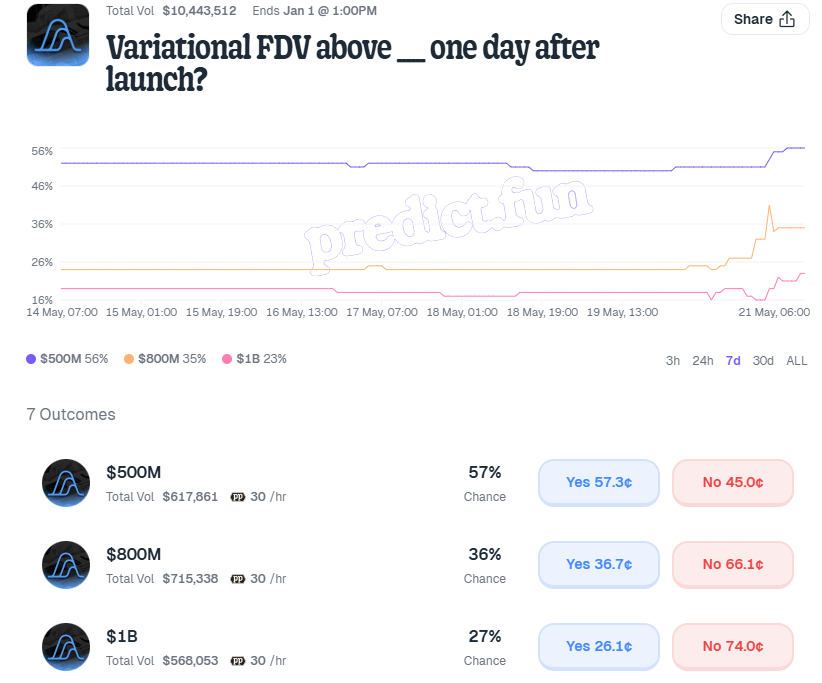
Additionally, the probability for the event “Variational's FDV exceeds $500 million one day after listing” on prediction platform predict.fun has risen to 57%; the probability for “Variational's FDV exceeds $1 billion one day after listing” has risen to 27%.

Prediction event for "Variational FDV one day after listing" on predict.fun

Next, Odaily Planet Daily will introduce Variational, its trade-to-earn points rules, and the TGE timeline.

Variational: Zero-Fee Perp DEX Deployed on Arbitrum

Variational is a Perp DEX platform deployed on Arbitrum. The company is headquartered in the Cayman Islands, and its core product is Omni. In simple terms, users can trade perpetual contracts for mainstream crypto assets like BTC, ETH, and SOL on Variational, as well as for long-tail assets, stocks, commodities, volatility indices, and more.

Compared to most Perp DEXs, the most obvious feature of Variational is zero transaction fees. When trading on Omni, the platform does not charge regular transaction fees. The main costs come from spreads, slippage, funding rates, and deposit/withdrawal fees.

Furthermore, Variational's underlying design differs from traditional Perp DEXs. It does not rely solely on internal platform matching or a single liquidity pool to handle trades. Instead, it connects to multi-source liquidity through a "brokerage-like" model, including traditional financial market makers, crypto-native market makers, and major trading platforms, to solve the "liquidity cold start" problem in on-chain markets.

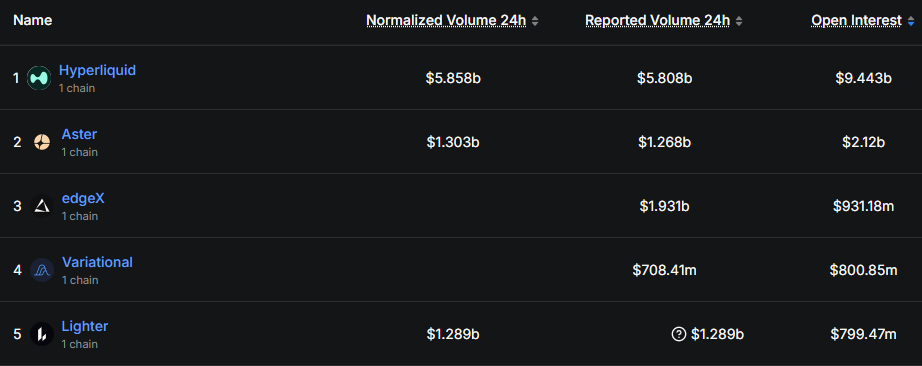
According to DefiLlama data, Variational's trading volume over the past month has exceeded $16 billion, and its current open interest exceeds $800 million, ranking fourth in the Perp DEX sector. Notably, among the top five Perp DEXs by open interest, Variational is the only platform that has not yet issued a token.

Perp DEX open interest ranking

Trade-to-Earn Points: Detailed Rules for Variational

For ordinary users, the most direct way to participate in Variational currently is still through trading to earn points.

Variational officially launched the Omni Points Program on December 17, 2025, and retroactively distributed 3 million points to historical traders at launch, covering activity up to December 11, 2025. Since then, points are distributed every Friday at 00:00 UTC, accounting for platform activity from the previous cycle ending Thursday at 00:00 UTC.

Additionally, according to the documentation, the project commits to allocating approximately 50% of the token supply to the community (through points, revenue sharing, and other mechanisms, not solely airdrops), while also planning to use at least 30% of protocol revenue for VAR token buybacks and burns.

The core of Variational's points system is not complicated: the more active the trading, the greater the chance to earn more points. However, Variational does not distribute points solely based on trading volume; it incorporates designs that favor trading quality. Specifics include:

  • Points are directly related to user trading activity: The platform rewards page indicates that the points program is designed to reward protocol users, who can earn points through platform activities. The official team reserves the right to adjust points and address non-organic behavior, meaning that obvious meaningless volume farming or arbitrage-style point farming may be subject to reduction or disqualification later;
  • Early users receive an extra bonus: Accounts that traded before the points program launched receive a 10% point bonus on subsequently earned points;
  • Introduction of a Reward Tiers system: A user's total trading volume over the past 30 days affects their tier, calculated as personal trading volume plus 0.2 times the invited trading volume. Different tiers correspond to different point multipliers: Iron at 0%, Bronze at 0.5%, Silver at 1%, Gold at 2%, Platinum at 3%, Diamond at 4%, Infinity at 5%. The thresholds are: Bronze requires $1 million Total Volume in the past 30 days, Silver $5 million, Gold $25 million, Platinum $100 million, Diamond $750 million, Infinity $2.5 billion;
  • Referrals also bring points and USDC rewards: Referrers receive 5% USDC of the spreads paid by the referred users. Additionally, whenever a referred user earns 10 points, the referrer earns 1 point.

Judging from the rules, Variational's points design leans more towards organic trading rather than pure volume farming. For airdrop farmers, the focus is not just on completing a single transaction, but on considering whether their trading frequency, capital efficiency, position risk, and points cost align.

When Will Variational Conduct Its TGE?

Currently, Variational has not announced a clear TGE date for VAR. However, based on information disclosed in the official documentation, points distribution will continue at least until the end of Q3 2026. Therefore, the community generally expects the TGE to occur in Q3 to Q4 of this year.

Data source: Variational official documentation

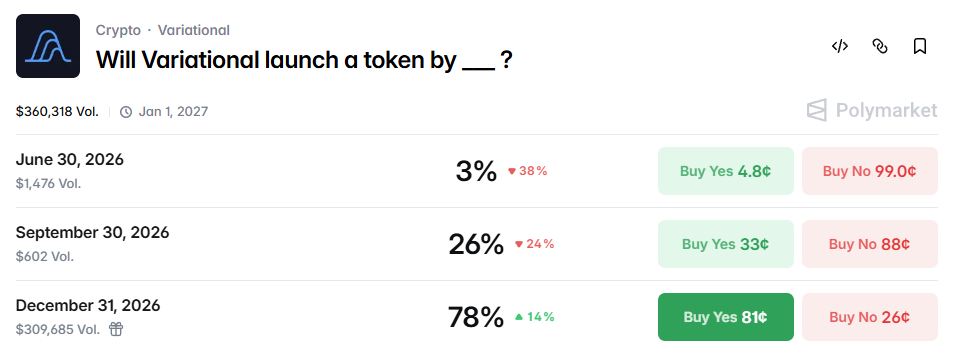
Furthermore, prediction markets lean towards Q4. Polymarket data shows the probability for the event "Variational will launch its token before September 30 this year" is only 26%, while the probability for "Variational will launch its token before December 31 this year" is 78%.

Polymarket prediction event "When will Variational TGE?"

Связанные с этим вопросы

QWhat is the key news that caused a stir in the airdrop farming community regarding Variational?

AThe key news is that Variational announced the completion of a $50 million Series A funding round, led by Dragonfly Capital, with participation from Bain Capital Crypto and CoinBase Ventures.

QWhat is Variational, and what is its most distinctive feature as a Perp DEX?

AVariational is a perpetual decentralized exchange (Perp DEX) deployed on Arbitrum. Its most distinctive feature is that it charges zero trading fees to users. Costs for traders mainly come from the bid-ask spread, slippage, funding rates, and deposit/withdrawal fees.

QHow does Variational's 'Omni' points program work, and what is a key consideration for users farming points?

AThe Omni points program rewards users based on their trading activity on the platform. Points are distributed weekly. A key consideration is that the system is designed to favor 'organic' trading behavior, meaning users should focus on trading frequency and capital efficiency rather than simply high-volume, low-risk arbitrage trades, as such behavior risks having points reduced or invalidated.

QWhat is the current market expectation for Variational's Token Generation Event (TGE) timeline based on the article?

ABased on the article, there is no official TGE date. However, official documentation states the points program will run at least until the end of Q3 2026. Community expectations and prediction market data (e.g., on Polymarket) suggest the TGE is more likely to occur in Q4 2026, with a 78% probability of happening before December 31, 2026.

QAccording to the article, what percentage of the VAR token supply is promised to be allocated to the community, and what is planned for protocol revenue?

AThe project has promised to allocate approximately 50% of the token supply to the community through mechanisms like points and revenue sharing. Furthermore, it plans to use at least 30% of protocol revenue to buy back and burn VAR tokens.

Похожее

Who Funds the Agents?

**Summary: Who Funds AI Agents?** OpenAI recently shut down a feature allowing AI agents to shop for users, highlighting the challenge of creating a secure and regulated environment for agent-driven transactions. While payment infrastructure exists, a crucial governance layer—defining spending limits, fraud detection, tax handling, and return policies—is largely missing. The potential is enormous: AI agents already processed $73M across 176M transactions last year, with McKinsey forecasting this could grow to $3-5T in global consumer commerce by 2030. The core competition isn't just about processing payments, which can be very cheap (especially with crypto-based settlement), but about controlling the rules that govern agent spending. Key players like Stripe and Coinbase are racing to dominate this governance layer. Stripe's acquisition of wallet provider Privy allows it to set spending policies, identity checks, and human-in-the-loop approvals directly at the wallet level. Similarly, Coinbase's stack, including its x402 protocol and AgentKit, embeds governance rules. This vertical integration across settlement, wallet, and governance layers is becoming the dominant strategy. Control over the governance layer is where significant future value lies. If agents handle trillions in transactions, even a small fee for managing compliance, fraud prevention, and policy enforcement could generate billions in annual revenue. The companies that successfully integrate across the payment stack will capture value from idle agent balances, transaction fees, and governance services, positioning themselves as the foundational banks of the AI agent economy.

marsbit9 мин. назад

Who Funds the Agents?

marsbit9 мин. назад

A Nation Blocks Chips, a Giant Buys a Nuclear Power Plant: Why It's Time to Seriously Consider DeAI

**Title: Great Powers Blockade Chips, Giants Buy Nuclear Plants: Why It's Time to Seriously Consider DeAI** In May 2026, the US closed loopholes for Chinese firms to acquire advanced NVIDIA chips via overseas subsidiaries. That same month, Kenya halted a $1B geothermal data center project involving Microsoft, fearing its immense energy consumption. Meanwhile, Huawei announced mass production of its Ascend AI chip. These disparate events underscore a new reality: the competition for computing power ("compute") has escalated beyond the tech industry, becoming a geopolitical and infrastructural battleground. A new era of oligopoly is forming, with control over the AI stack—from GPU chips (NVIDIA) and cloud platforms (AWS, Azure, Google Cloud) to foundational models (OpenAI, Anthropic)—concentrating in a few Western "AI Octopus" corporations. This centralization creates systemic risks: pricing power and platform lock-in for users, infrastructure fragility, and a widening "compute divide" that threatens to marginalize nations without independent AI capacity. An "AI Iron Curtain" is deepening through export controls. In response, some nations like Saudi Arabia and the UAE are investing heavily to buy compute power, aiming to transition from oil to AI economies. The EU seeks to triple its compute capacity by 2030 to reduce dependency. However, the spending gap is vast, with four US tech giants alone planning ~$750B in AI capex for 2026. The race is increasingly constrained by energy, with AI tasks consuming up to 1000x more power than web searches, pushing firms to even acquire nuclear plants. This landscape is fueling interest in Decentralized AI (DeAI). It proposes a third way: using open protocols to coordinate a global network of idle GPUs, independent developers, and data centers, creating an AI infrastructure without a single controlling entity. Leveraging blockchain and cryptographic verification, DeAI aims to break market concentration, disperse energy demands, reduce geopolitical dependencies, and enhance transparency. While still nascent in performance and stability, DeAI's core promise is not immediate superiority but providing a crucial alternative architecture to resist monopoly, censorship, and centralized power. As specialized AI hardware costs fall and open-source models flourish, the window to build this foundation is open. The very existence of such competition serves as a vital check against the inevitable abuse of concentrated power.

marsbit1 ч. назад

A Nation Blocks Chips, a Giant Buys a Nuclear Power Plant: Why It's Time to Seriously Consider DeAI

marsbit1 ч. назад

Outpoll Review: A Prediction Market Platform Built for Active Traders

Outpoll Review: A Prediction Market Platform Built for Active Traders In recent years, prediction markets have grown from a niche sector to a mainstream arena, attracting billions in trading volume and institutional capital. However, the user experience and tools for traders have not kept pace. Outpoll, a new global prediction market platform, aims to fill this gap by providing enhanced trading infrastructure for active and professional traders. Built on standard prediction market principles, Outpoll allows users to trade on the outcome of specific events. It uses fully collateralized contracts with USDC settlement, charges a competitive 0.1% fee per trade, and provides clear settlement rules upfront to minimize disputes. A key focus for Outpoll is its professional-grade trading tools. The platform supports limit and market orders, as well as take-profit and stop-loss orders for open positions—features uncommon in prediction markets. For automated trading, Outpoll offers comprehensive REST and WebSocket APIs, enabling portfolio management, price arbitrage, and integration with existing tools. The platform also features a creator-led market model, where approved experts and community leaders can create and manage markets for niche topics under platform supervision. Its integrated interface combines news feeds directly with trading functions, allowing users to monitor events and manage positions seamlessly. Outpoll launched with a native Android app (available on Google Play) and plans an iOS version later this year. In summary, Outpoll distinguishes itself with trader-focused tools, practical APIs, transparent and collateralized markets, integrated news, and an expanding creator program. For active traders, its advanced order types and API access alone make it a platform worth watching. Outpoll is now globally accessible via outpoll.com and Google Play.

marsbit1 ч. назад

Outpoll Review: A Prediction Market Platform Built for Active Traders

marsbit1 ч. назад

Торговля

Спот
Фьючерсы
活动图片