Bill Gates' Latest Long-Form Article: The Real Trouble with AI is That We Aren't Ready

marsbitОпубликовано 2026-08-28Обновлено 2026-08-28

Введение

Bill Gates' latest essay, "The turbulent AI era is here. The choices we make now are critical," warns that society is unprepared for the profound social and economic transition AI will bring. While optimistic about AI's long-term potential in healthcare, education, and other fields, Gates focuses on the "transition period" over the next 10-20 years. He argues this transition differs from past technological shifts like the Industrial Revolution because AI automates cognitive labor itself, potentially reducing the total number of future jobs. Risks like enhanced cyber-attacks and social disruption are already emerging, not distant future threats. A key concern is "low-cost intelligence substitution," where AI performs defined tasks cheaper than humans, gradually thinning workforces. Gates introduces the concept of "Human Reserved" jobs—roles like nursing or delivering serious medical news—where human judgment and empathy should remain central, even if AI is technically capable. To manage the transition, he calls for new governance, stronger social safety nets, retraining, and international cooperation, especially between the US and China. Crucially, he proposes taxing AI usage and robots to slow displacement and fund social programs. The core dilemma Gates presents is that AI could become humanity's "greatest equalizer" or its "worst source of injustice," depending on whether its immense productivity gains are broadly shared or concentrate wealth and power. The fundamental c...

By | Deng Ding Kexuan

On August 26, Bill Gates published a long-form article about AI on Gates Notes:

The turbulent AI era is here. The choices we make now are critical.(The Turbulent AI Era Has Arrived, The Choices We Make Now Are Critical)

Original article on Bill Gates' Gates Notes:
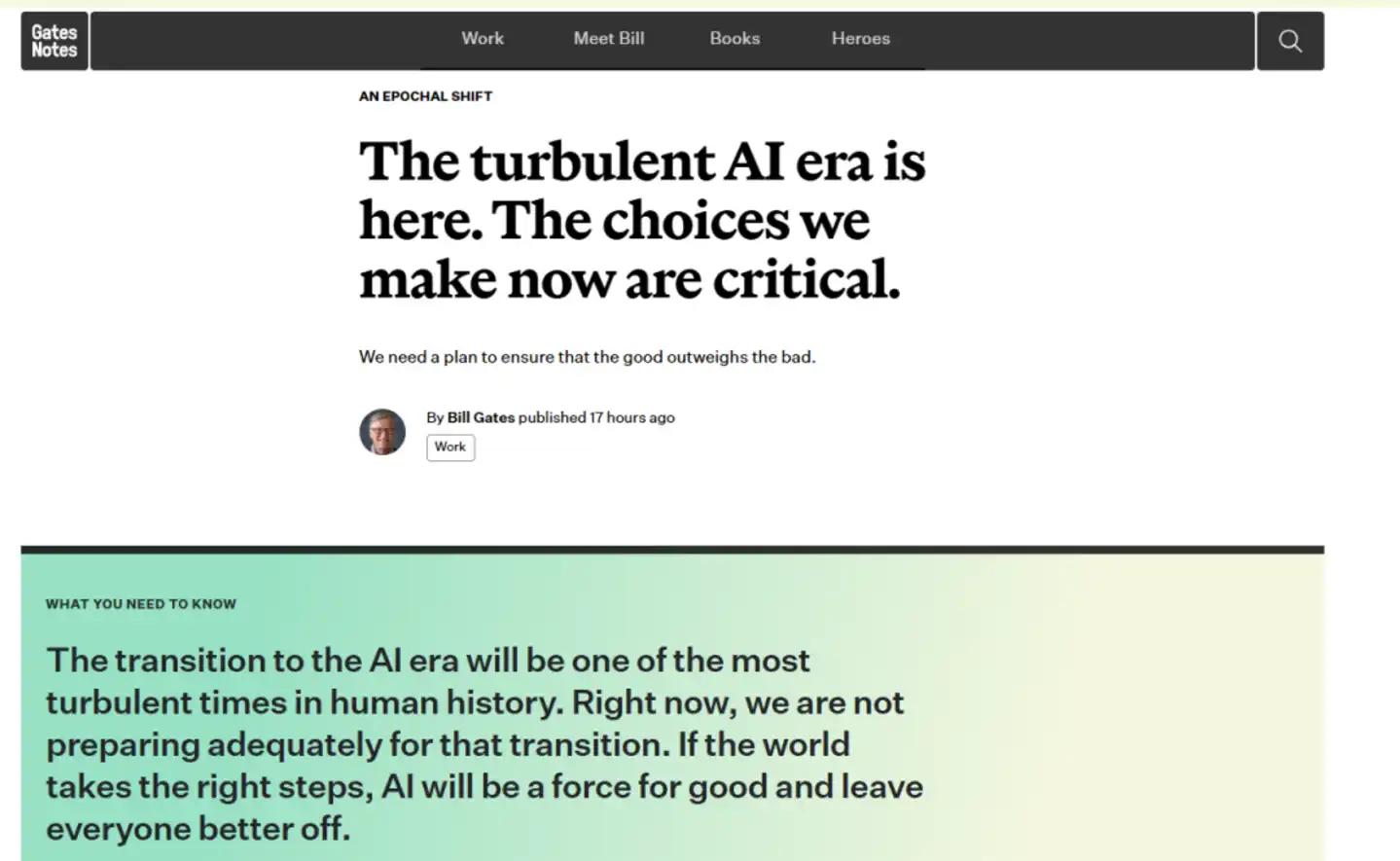
Core gist of the original article: AI could become the most powerful tool for equality, or a major source of inequality. Gates believes we need to start planning for this transition now.

This article is highly readable. Gates has not become an AI pessimist, nor does he deny AI's long-term value. He still believes AI will drive significant progress in fields like healthcare, education, agriculture, energy, and scientific research.

But his focus has changed.

In recent years, he talked more about what AI could ultimately create. This time, he spends considerable space discussing another question:

What will happen on the path from today to that future?

If the entire article were condensed into one sentence, it would probably be:

AI's long-term benefits could be enormous. But the 'transition period' between now and that future could become one of the most dramatic social transformations in human history. And we have barely established institutions for it.

Gates still believes in AI's long-term value. What worries him now is: how we get through the next decade or so in the middle.

He writes directly in the original text: "Unfortunately, we are not preparing for it now."

First Level: Gates believes this time cannot be simply compared to the Industrial Revolution

This is a point I consider very important and easily missed by news headlines.

Faced with the question 'Will AI take jobs?' in the past, a standard answer was: The steam engine eliminated some jobs but created new ones; the internet did the same, so AI will ultimately create new jobs too.

Gates now expresses clear skepticism about this analogy. Previous technologies primarily replaced physical labor or specific capabilities. New jobs ultimately still required human cognition.

The special thing about AI is: it is itself replacing cognitive labor.

The default cycle of the past two hundred years

Old jobs disappear → New jobs appear → Humans transition to them

Gates directly mentions law, customer service, healthcare, software, and manufacturing in the original text, later listing jobs like sales, software engineering, paralegal, loan approval, data analysis, and patient triage.

His assessment is: New jobs will still emerge, but without appropriate policies, the number of future positions may be far fewer than today's.

This assessment considers a deeper issue than the usual 'AI taking jobs'. For the past two hundred years, we assumed technological progress would ultimately create more, more complex jobs that also required human cognition.

But what if what's being scaled and made cheaper is 'cognitive capability' itself? The validity of this historical experience then becomes uncertain.

The biggest impact of AI on employment might not be a sudden wave of mass unemployment. A more likely change is that the same company, the same business, will need far fewer people in the future.

One person plus a few Agents can complete work that previously required a small team.

Jobs won't vanish overnight, but new job creation will slow, teams will thin out, and companies will become increasingly unwilling to pay the previous price for 'cognitive labor that can be done by AI'.

Second Level: The risk is no longer a post-AGI problem, it's happening now

Another important context for Gates's shift in stance this time.

He explained to MIT Technology Review why he is speaking out now specifically.

He believes several previously discussed 'danger thresholds' are actually starting to be crossed, including: biological capabilities, cyber attack capabilities, psychological and social influence, job market disruption, and AI controllability.

Especially Coding. Advances in Claude Code, long context, and Agentic Coding made him realize AI is crossing more than just a programming capability threshold.

An Agent capable of writing code at scale could also become a powerful tool for cyber attacks.

The stronger AI's capabilities, the better defenders become at finding vulnerabilities and patching systems. But the cost for attackers to find vulnerabilities and launch attacks using the same capabilities is also falling.

Gates also mentions this issue in the original text. The new capabilities attackers are gaining are rapidly increasing, while defenders cannot patch all weaknesses simultaneously.

Capabilities are crossing lines, governance remains stuck in the discussion stage.

Third Level: His biggest worry isn't just unemployment, but 'low-cost intelligent substitution'

There's one line from the MIT interview I find even more intriguing than the main text:

For well-defined jobs, AI will be cheaper and will do them better.

The examples he gives are very ordinary: telemarketing, customer service, finance departments, month-end closing, discount judgment, etc. A large number of white-collar jobs with clear processes, defined rules, and describable digitally will increasingly be easily done by low-cost AI.

The most crucial word here might not be 'substitution', but: cheaper.

The reality likely won't be a sudden switch where AI = 1, human = 0. It might be a department that previously needed 10 people now only needing 6.

The information processing required for entry-level positions is first handled mostly by Agents. A person's work hours used to dictate the speed of business expansion; now software can process vast numbers of tasks in parallel.

The core of the change is the marginal cost of labor and intelligence.

Following this line of thought further, Gates proposes an idea rarely heard from him: For some jobs, even if AI can do them, society may still want to leave them to people.

Fourth Level: A very interesting new concept – Human Reserved

Can be translated as: 'Human Reserved Domains.' Gates uses a vivid analogy: nature reserves.

Of course, roads and buildings could be built in nature reserves. We choose not to because the cost of losing them is too high. Human Reserved follows similar logic: even if AI can do it, we still decide to have humans do it.

This idea comes from his father's later years.

Gates's father had Alzheimer's disease. In his final years, a group of caregivers looked after him around the clock. Sometimes, his father could no longer express that he was hungry, but the caregivers could still understand him.

Gates writes there is something 'irreplaceably human' in this kind of care. Education and mental health might adopt a 'human + AI' approach, with humans bearing final responsibility and AI extending human capabilities.

Another example in healthcare: Technically, a robot could certainly tell a person 'You have an incurable disease.' Gates believes it should not.

The meaning of 'human work' in the future may no longer be determined solely by efficiency.

Fifth Level: Therefore, taxes and social security must be redesigned

If AI and robots continuously reduce labor demand, existing systems will encounter a very practical problem.

The current tax base

People work → Companies pay wages → Wages are taxed

If more and more work becomes: AI / robots work → Companies gain productivity benefits, the original tax base could be affected.

Therefore, Gates again raises the idea of a robot tax, and states it very directly:

"I believe we should tax AI tokens and robots."

"I believe we should tax AI tokens and robots."

When a company hires a person, it must pay payroll tax based on the salary. Purchasing a robot can often be immediately written off as a business expense.

Gates believes the current tax system actually incentivizes companies to replace humans with machines faster.

Taxation could, on one hand, slightly slow the pace at which companies move away from human labor, and on the other hand, raise funds for retraining and a stronger social safety net.

This touches on the flip side of the issue I previously considered when writing 'The Bill for AI Won't Just Be Paid by Tech Companies'.

If these investments ultimately do create huge productivity gains, who will the gains flow to?

Sixth Level: AI could simultaneously become 'the greatest equalizer' and 'the worst source of injustice'

This is the overarching thesis of the article.

"AI will either be the greatest equalizer ever invented, or the worst source of injustice."

AI will either be the greatest tool for equality ever invented by humanity, or the most severe source of injustice.

If the marginal cost of AI healthcare, AI education, AI agriculture, and AI research is low enough, capabilities previously available only to affluent regions have the opportunity to reach more ordinary people.

The same technology could also amplify existing disparities.

AI ownership is concentrated in a few companies.

Capital captures the main productivity gains.

The value of ordinary people's labor declines.

Affluent regions gain AI benefits first.

Low-income groups bear the brunt of job impacts first.

So the question is no longer just: 'Can AI create wealth?', but also: 'Who ultimately gets the wealth AI creates?'

Finally, the three categories of action he suggests

First, establish a new AI transition governance system.

Existing government agencies were not designed for a technology that spans employment, national security, education, healthcare, taxation, energy, finance, and cybersecurity.

Second, proactively manage job market impacts.

Including strengthening the social safety net, vocational retraining, adjusting tax systems, and unconventional solutions like Human Reserved.

Third, international coordination is needed; the US and China cannot be absent.

Cybersecurity, biological risks, and model proliferation all cross borders. Gates explicitly writes that a certain degree of cooperation between the US and China is needed.

The most hotly debated view in this article is his prediction about the future

Gates is discussing an AI transition period problem:

The endpoint of AI may be abundance, but there is no automatically smooth path between the 'abundant society' and the present.

An abundant society is at least a decade away. The entire transition process could last the next 10–20 years.

Sam Altman, Dario Amodei, and others often describe where AI can ultimately push productivity. Gates is discussing another period this time:

What exactly will happen between now and that abundant society?

This question is more realistic for ordinary people than 'When will AGI arrive?': Companies stop hiring so many new people. A department starts using Agents to do the work of several. Certain professional services become very cheap.

New productivity gains flow more to those who own the models, compute, and capital. But tax, education, social security, and employment systems still operate in the old way.

These changes don't need to wait for AGI to appear; some have already begun. The hardest part of AI may not just be making models powerful enough.

Once technology enters society, there is a slower, harder problem:

Do we have the capacity to make society adapt to it?

  • References:Bill Gates / Gates Notes; MIT Technology Review Interview; Anthropic Claude Code materials.


Трендовые криптовалюты

Связанные с этим вопросы

QAccording to Bill Gates, what is the main concern regarding AI's future development?

AAccording to Bill Gates, the main concern is not AI's ultimate potential but the "transition period" leading up to that future. This period could be one of the most dramatic social transformations in human history, and he believes we are largely unprepared for the institutional changes required to manage issues like employment disruption and inequality during this time.

QWhy does Bill Gates argue that the AI transition is not a simple repeat of the Industrial Revolution?

ABill Gates argues that past technological revolutions, like those driven by steam engines or the internet, primarily replaced physical labor or specific tasks, eventually creating new jobs that still required human cognition. AI is different because it is replacing cognitive labor itself, the very foundation upon which new jobs have historically been created. This calls into question whether the historical pattern of 'old jobs disappear → new jobs appear' will hold true.

QWhat is the concept of "Human Reserved" that Bill Gates introduces?

A"Human Reserved" refers to certain jobs or domains that society should purposefully reserve for humans, even if AI becomes technically capable of performing them. Gates uses the analogy of a nature preserve. Examples include certain aspects of caregiving (like for his father with Alzheimer's), education, and delivering serious medical news. The idea is that the human element in these roles provides an irreplaceable value that should be protected for social, not just efficiency, reasons.

QWhat specific policy recommendation does Bill Gates make to address potential economic disruptions from AI?

ABill Gates recommends implementing a "robot tax" or a tax on AI tokens. He argues that current tax systems, which tax human labor through payroll taxes but often allow immediate write-offs for capital investments in robots/AI, incentivize the rapid replacement of human workers. Taxing AI and robots could slow this transition and generate revenue to fund retraining programs and strengthen social safety nets for those affected by job displacement.

QWhat are the two potential, opposing outcomes that Bill Gates sees for AI's impact on society?

ABill Gates states that AI will either become "the greatest equalizer ever invented" or "the worst source of injustice." It could be an equalizer by drastically lowering the cost of access to high-quality services like healthcare and education, making them available to more people globally. Conversely, it could exacerbate inequality if the ownership and productivity gains from AI are concentrated among a few companies and capital owners, while the labor value of the majority declines and lower-income groups bear the brunt of job losses.

Похожее

Несмотря на недавний рост биткоина, один аналитик сохраняет осторожность: «Я пока не увидел того, чего хотел»

Хотя недавний рост биткоина вновь разжигает бычьи настроения, аналитик Жоао Ведсон (Alphractal) сохраняет осторожность на основе данных блокчейна. Он указывает, что ключевой индикатор MVRV Z-Score, измеряющий поведение инвесторов, ещё не опустился в отрицательную зону, что исторически ассоциировалось с достижением циклического минимума. Проводя параллели с 2018 годом, Ведсон отмечает, что после трёх пиков MVRV Z-Score и последующего падения BTC индикатор сформировал базу, но затем снова вырос, как и сейчас. Однако главный риск, по его мнению, в том, что индикатор пока не достиг отрицательных значений. На основе этой модели аналитик не исключает, что окончательный минимум цикла ещё не достигнут, и если историческая динамика повторится, цена биткоина может опуститься до $53 000 или ниже. Ведсон подчёркивает, что его оценка основана на анализе данных, а не отрицает бычий настрой рынка, и напоминает, что в 2018 году большинство также не ожидало резкого обвала. По его мнению, внутрисетевые метрики пока свидетельствуют, что риски снижения ещё не устранены.

cryptonews.ru26 мин. назад

Несмотря на недавний рост биткоина, один аналитик сохраняет осторожность: «Я пока не увидел того, чего хотел»

cryptonews.ru26 мин. назад

Anthropic прицелилась на «тренировочные чипы»? Раскрыто, что компания рассматривала покупку производителя AI-чипов MatX за 70 миллиардов долларов

Крупная компания в области ИИ Anthropic рассматривала возможность приобретения стартапа по производству чипов MatX примерно за 70 миллиардов долларов. Целью сделки было ускорение разработки собственных чипов, в частности для этапа обучения больших языковых моделей. Хотя переговоры о приобретении в конечном итоге были приостановлены, и стороны перешли к обсуждению потенциального сотрудничества, этот шаг демонстрирует растущий интерес Anthropic к аппаратному обеспечению. Компания активно формирует внутреннюю команду по разработке чипов, наняв таких ветеранов отрасли, как Амир Салик, бывший руководитель проекта TPU в Google, и Клайв Чан, бывший инженер по чипам из OpenAI. Эта стратегия, включающая найм талантов, изучение архитектур и переговоры со стартапами, направлена на снижение зависимости от поставщиков, таких как Nvidia, и оптимизацию затрат на вычисления. Однако Anthropic не планирует полностью отказываться от сотрудничества с крупными поставщиками облачных услуг и чипов, признавая сложность и высокую стоимость самостоятельной разработки процессоров.

marsbit1 ч. назад

Anthropic прицелилась на «тренировочные чипы»? Раскрыто, что компания рассматривала покупку производителя AI-чипов MatX за 70 миллиардов долларов

marsbit1 ч. назад

Глава ФРС Уорш «взялся за ястреба», Goldman Sachs по-прежнему не верит в «сентябрьское повышение ставки», JPMorgan заявляет «всё зависит от августовских данных по занятости и CPI»

Председатель Федеральной резервной системы США Кевин Уорш выступил на симпозиуме в Джексон-Хоуле с более жесткой, чем в июле, позицией по инфляции, назвав ее «основной проблемой» и указав, что ФРС готова действовать, если базовые тенденции инфляции не вернутся к цели достаточно быстро. Его заявления привели к росту доходности 2-летних казначейских облигаций и увеличению рыночных ожиданий повышения ставки в сентябре до более 50%. Однако ведущие банки Уолл-стрит не изменили свои прогнозы. JPMorgan сохраняет базовый сценарий повышения ставки в декабре, подчеркивая, что решение по сентябрьскому заседанию будет зависеть от данных по занятости и ИПЦ за август. Goldman Sachs ожидает, что базовые инфляционные показатели вырастут примерно на 0,2% в месячном исчислении, и считает, что при таком раскладе ФРС, вероятно, оставит ставку без изменений. По мнению банка, повышение в сентябре возможно только в случае неожиданно высоких данных по инфляции. Уорш посвятил значительную часть выступления анализу инфляции, отметив, что доля товаров и услуг в корзине PCE с ростом цен более 3% остается высокой, хотя и снизилась с пиковых значений. Он также скорректировал два своих спорных заявления июля, подтвердив приверженность 2% цели по инфляции и ключевую роль краткосрочных ставок в политике. В оценке экономики он отметил устойчивость потребительских расходов, быстрый рост корпоративных инвестиций (более половины из которых связаны с ИИ) и стабильный рынок труда, заключив, что финансовые условия в широком смысле нельзя назвать ограничительными.

marsbit1 ч. назад

Глава ФРС Уорш «взялся за ястреба», Goldman Sachs по-прежнему не верит в «сентябрьское повышение ставки», JPMorgan заявляет «всё зависит от августовских данных по занятости и CPI»

marsbit1 ч. назад

Еженедельный выбор редактора Weekly Editor's Picks (22-28 августа)

**Еженедельный выбор редактора (22.08–28.08)** Ключевые темы недели в мире финансов и криптовалют: * **Макроэкономика:** Внимание приковано к возможным действиям Министерства финансов США для снижения давления на долгосрочные доходности казначейских облигаций. Золото, достигнув уровня $4600 за унцию, продолжает привлекать интерес инвесторов на фоне действий центральных банков и активности на рынке опционов. * **Криптовалюты и инвестиции:** * Рынок демонстрирует сильный рост: Bitcoin превысил $80 000, а общая капитализация альткойнов вернулась к отметке $1 трлн. * Эксперты обсуждают перспективы Ethereum, потенциал новых проектов (например, Flop Network) и анализируют акции компаний, связанных с криптоиндустрией (MSTR, COIN, Circle). * Дефляционные механизмы, такие как выкуп токенов за счет доходов протокола, внедряются в проектах Hyperliquid (HYPE) и Ethena (ENA), положительно влияя на настроения рынка. * **AI и хранение данных:** Несмотря на рекордные квартальные доходы, NVIDIA сталкивается с ограничениями со стороны предложения. В то же время на рынке памяти акции лидера, SK Hynix, переживают коррекцию, за которой внимательно следят инвесторы. * **DeFi и CeFi:** На фоне общего восстановления рынка выделяются DeFi-протоколы с высокой доходностью. Одновременно развиваются сервисы, такие как кредитные линии Galaxy Digital под залог криптоактивов, предлагающие альтернативу продаже активов. * **Прочее:** Продолжается активность вокруг потенциальных аирдропов, мемкойнов и обсуждение регуляторных событий. В центре внимания также оказалась деятельность компании BitMine, активно скупающей Ethereum, что вызывает вопросы о концентрации и рисках.

marsbit1 ч. назад

Еженедельный выбор редактора Weekly Editor's Picks (22-28 августа)

marsbit1 ч. назад

Высокопоставленный сотрудник Strive: Переосмысление ценового маховика Биткойна

Автор Джо Барнетт, вице-президент по биткоин-стратегии Strive, предлагает новый взгляд на динамику цены биткоина, выходя за рамки популярной модели степенного закона (power law), которая описывает долгосрочное замедление роста доходности актива. В статье проводится аналогия с усталостью металла, где процесс монетизации биткоина разделён на три фазы: 1) Открытие (высокая волатильность и доходность), 2) Созревание (снижение волатильности и доходности, описываемое степенным законом), 3) Финансово-обусловленная монетизация. Ключевой тезис: нынешнее снижение волатильности (например, максимальные просадки в циклах уменьшаются) — это не конец истории, а подготовка к третьей фазе. Более низкая волатильность улучшает соотношение риск/доходность, позволяя институциональным инвесторам увеличивать аллокацию, и, что критически важно, делает биткоин более качественным залогом. Это открывает путь для масштабного кредитного плеча: по мере снижения волатильности кредиторы могут безопасно выдавать больше средств под залог биткоина (например, через кредиты, конвертируемые облигации, привилегированные акции). Расширение кредита в долларах создаёт дополнительный спрос на биткоин с фиксированным предложением. Таким образом, формируется самоподкрепляющийся цикл: созревание → снижение волатильности → улучшение профиля залога → расширение кредита → рост цены → дальнейшее повышение стоимости залога и возможностей для кредитования. Этот цикл, движимый традиционной финансовой системой, в конечном итоге может привести к ускорению роста цены биткоина и прорыву выше траектории, предсказываемой классическим степенным законом.

marsbit1 ч. назад

Высокопоставленный сотрудник Strive: Переосмысление ценового маховика Биткойна

marsbit1 ч. назад

Торговля

Спот

Популярные статьи

Как купить BILL

Добро пожаловать на HTX.com! Мы сделали приобретение Billions Network (BILL) простым и удобным. Следуйте нашему пошаговому руководству и отправляйтесь в свое крипто-путешествие.Шаг 1: Создайте аккаунт на HTXИспользуйте свой адрес электронной почты или номер телефона, чтобы зарегистрироваться и бесплатно создать аккаунт на HTX. Пройдите удобную регистрацию и откройте для себя весь функционал.Создать аккаунтШаг 2: Перейдите в Купить криптовалюту и выберите свой способ оплатыКредитная/Дебетовая Карта: Используйте свою карту Visa или Mastercard для мгновенной покупки Billions Network (BILL).Баланс: Используйте средства с баланса вашего аккаунта HTX для простой торговли.Третьи Лица: Мы добавили популярные способы оплаты, такие как Google Pay и Apple Pay, для повышения удобства.P2P: Торгуйте напрямую с другими пользователями на HTX.Внебиржевая Торговля (OTC): Мы предлагаем индивидуальные услуги и конкурентоспособные обменные курсы для трейдеров.Шаг 3: Хранение Billions Network (BILL)После приобретения вами Billions Network (BILL) храните их в своем аккаунте на HTX. В качестве альтернативы вы можете отправить их куда-либо с помощью перевода в блокчейне или использовать для торговли с другими криптовалютами.Шаг 4: Торговля Billions Network (BILL)С легкостью торгуйте Billions Network (BILL) на спотовом рынке HTX. Просто зайдите в свой аккаунт, выберите торговую пару, совершайте сделки и следите за ними в режиме реального времени. Мы предлагаем удобный интерфейс как для начинающих, так и для опытных трейдеров.

793 просмотров всегоОпубликовано 2026.05.07Обновлено 2026.06.02

Как купить BILL

Обсуждения

Добро пожаловать в Сообщество HTX. Здесь вы сможете быть в курсе последних новостей о развитии платформы и получить доступ к профессиональной аналитической информации о рынке. Мнения пользователей о цене на BILL (BILL) представлены ниже.

活动图片