$467K In Crypto Seized As Spain Cracks Down On Illegal Piracy Platform

bitcoinistОпубликовано 2026-04-24Обновлено 2026-04-24

Введение

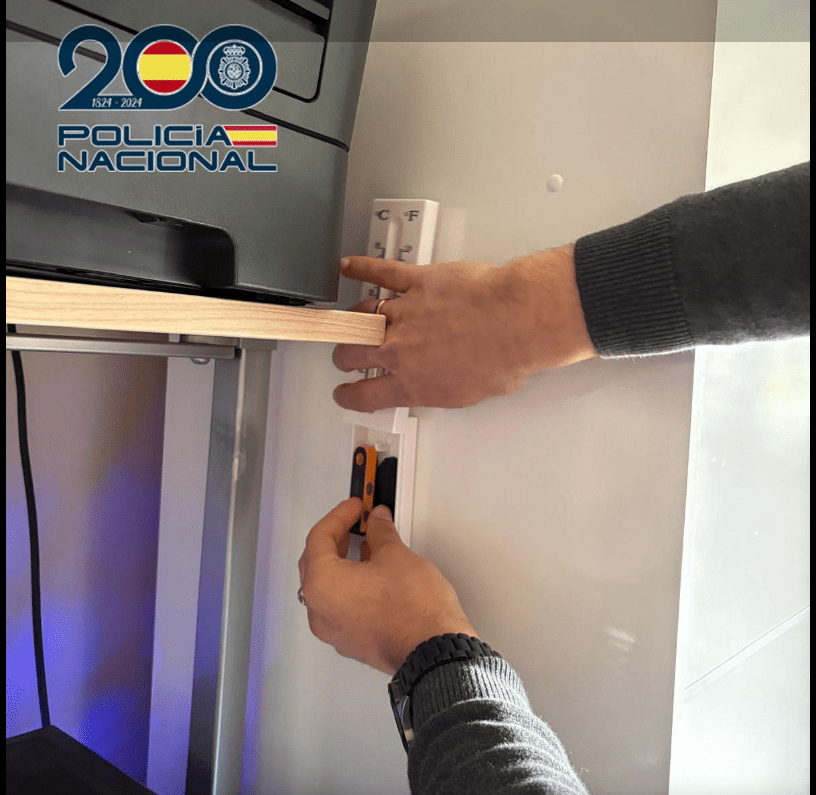
Spanish police seized €400,000 ($467,000) in cryptocurrency from two cold wallets hidden inside a wall thermometer during a raid in Almería. Three suspects were arrested in connection with the country’s largest illegal Spanish-language manga distribution platform, operational since 2014. The site generated over €4 million ($4.55 million) in ad revenue by offering pirated content. Authorities have not confirmed whether they can access the seized funds, as cold wallets require PINs or seed phrases. The case highlights challenges law enforcement face in handling crypto seizures, illustrated by custody failures in other countries like South Korea.

Spanish police made an unusual discovery during their raid — two crypto cold wallets tucked inside a household wall thermometer. The devices contained roughly 400,000 euros, about $467,000.

Authorities arrested three suspects in Almería in connection with what officials described as the biggest illegal Spanish-language manga distribution platform in the country’s history.

The site had been running since 2014. Over roughly a decade, it pulled in more than 4 million euros — around $4.55 million — mostly through advertising revenue. Visitors got free access to pirated manga while the operators quietly collected ad money in the background.

Spain’s Interior Ministry confirmed the arrests and the seizure. The investigation was opened in June 2025 after rights holders filed complaints against the platform.

Authorities uncovered an unusual find during the raid: two crypto cold wallets hidden inside a household wall thermometer. Source: Ministerio Del Interior

Whether Police Can Actually Access The Funds Remains Unclear

Seizing a cold wallet is one thing. Getting inside it is another.

Cold wallets require a PIN or a seed phrase to unlock. Without those credentials, the hardware is essentially useless — the funds stay locked, inaccessible to anyone, including law enforcement.

Officials have not said whether they obtained the information needed to open the devices. Spain’s Interior Ministry had not responded to requests for comment before the story was published.

The case puts a spotlight on a problem that police departments worldwide are still working through. Hardware wallets are showing up in investigations that have nothing to do with crypto fraud or digital currency schemes. Piracy operations, it turns out, are now storing earnings the same way crypto investors do.

BTCUSD currently trading at $77,860. Chart: TradingView

South Korea Has Faced Its Own Custody Failures

Even when authorities can access seized crypto, holding onto it has proven difficult. South Korea has dealt with two high-profile losses of confiscated digital assets in recent years.

In one case, about 22 Bitcoin — valued at $1.5 million at the time — went missing from the Gangnam Police Station.

The funds had been seized in 2021 and vanished without the cold wallet being physically stolen, according to reports. A nationwide audit of digital asset custody practices uncovered the loss.

Featured image from DualShockers, chart from TradingView

Связанные с этим вопросы

QWhat unusual item did Spanish police discover during their raid that contained the seized funds?

ATwo crypto cold wallets hidden inside a household wall thermometer.

QHow much money, in US dollars, was contained in the seized crypto wallets?

AApproximately $467,000.

QWhat was the primary source of revenue for the illegal manga distribution platform?

AAdvertising revenue.

QWhat is one major challenge law enforcement faces when seizing a cold wallet?

AAccessing the funds without the required PIN or seed phrase.

QWhich country was cited as an example of facing high-profile losses of confiscated digital assets?

ASouth Korea.

Похожее

Where the AI Bubble Really Is: Which Layer of Players Are Naked

AI Bubble: Where It Really Is and Who's Swimming Naked This analysis dissects the AI industry not as a single entity but as a five-layer pyramid, arguing that bubbles are concentrated in specific tiers, not uniformly distributed. **Key Distinction from the 2000 Dot-com Bubble:** Unlike 2000, where companies had stock prices before revenue, today's leading AI players have massive, contract-backed revenue driving their valuations. Core infrastructure demand is real, with every GPU running at full capacity for paying customers. **The Five-Layer Pyramid & Bubble Assessment:** * **L0 (Fab/Manufacturing) & Top L4 (Leading AI Apps): NO BUBBLE.** Companies like TSMC, NVIDIA, major cloud providers (Microsoft, Google, Meta, Amazon), and top AI labs have real revenues and orders. Supply is tightly constrained by TSMC's disciplined capacity control and physical limits like power/land for data centers, preventing a supply glut. * **L1 (Memory): BATTLEGROUND.** Sky-high HBM margins could signal a new structural cycle or a classic "boom before bust." The oligopoly of three major players may enforce supply discipline, making this a high-stakes bet. * **L2 (Interconnect/Optical Modules): BUBBLE TERRITORY.** Companies like Lumentum and AAOI have seen stock surges (4-10x) far outpacing revenue growth. This hardware segment has lower physical barriers to expansion than fabs, allowing speculation. It mirrors the 2000 bubble's epicenter—optics. * **L3 (Infrastructure/"GPU Landlords"): VULNERABLE.** GPU leasing companies profit from the current compute shortage but own no long-term moat. Their business model relies on a temporary bottleneck that will ease as big tech expands and new tech (e.g., potential space-based data centers) emerges. * **L4 Long Tail (VC-backed Startups): STRONG BUBBLE SIGNALS.** VC funding concentration in AI is twice that of the 1999 peak. Many startups with little revenue use the valuation logic of successful giants to justify their own, creating high risk of a "valuation crunch" when funding dries up. **Critical Risks to Monitor:** 1. **GPU Depreciation & Accounting:** Companies extending the assumed useful life of GPUs artificially boost profits. The true economic life depends on future generational leaps from NVIDIA. 2. **"GPU Credit" & Off-Balance-Sheet Leverage:** Emerging structures where shell companies borrow to buy GPUs and lease them out (with chipmakers sometimes investing) move debt off major balance sheets. This echoes the "vendor financing" of 2000 and the securitization risks of 2008, though currently small-scale. 3. **TSMC Abandoning Caution:** If the primary supply bottleneck (TSMC's conservative capacity planning) breaks, runaway supply could trigger a bust. 4. **Algorithmic Efficiency Breakthrough:** A major leap in software efficiency could drastically reduce the need for raw compute hardware, undermining the investment thesis. **Conclusion:** The AI boom is expensive and has frothy areas, but its core is underpinned by real demand and physical supply constraints. The bubble risk is layered: most present in optical components, GPU leasing, and the long-tail startup ecosystem, while the foundational chip manufacturing and leading application layers remain relatively solid—for now.

marsbit14 мин. назад

Where the AI Bubble Really Is: Which Layer of Players Are Naked

marsbit14 мин. назад

Standing in the Light: A Comprehensive Guide to the Optical Module and CPO Supply Chain

"Standing in the Light: Understanding the Optical Module and CPO Industry Chain" This article analyzes the critical role of optical communication technology, specifically optical modules and Co-Packaged Optics (CPO), as the "nervous system" for modern AI data centers. With exponential growth in AI computational demands (e.g., NVIDIA's Vera Rubin architecture), traditional electrical interconnects using copper cables face severe bottlenecks in bandwidth, power consumption, and signal integrity over distance. The core function of an optical module is to act as a "translator," converting electrical signals from chips into optical signals for transmission over fiber (and vice-versa). Key internal components include lasers, modulators, photodetectors, drivers, and DSP chips. The industry is currently transitioning from 800G to 1.6T modules. However, the future lies in CPO. This next-generation technology integrates the optical engine directly with the switch ASIC/XPU on the same package substrate, drastically reducing power consumption (by ~3.5x according to NVIDIA), overcoming bandwidth density limits, and minimizing signal attenuation compared to traditional pluggable modules. Key challenges for CPO include advanced packaging capacity (dominated by TSMC), thermal management, repairability, and standardization. The article details the broader technology landscape, including Near-Packaged Optics (NPO, a pragmatic intermediate step), Linear-drive Pluggable Optics (LPO), Optical I/O (OIO for chip-level integration), and Optical Circuit Switches (OCS). A comprehensive CPO industry chain is mapped, highlighting shifting power dynamics: * **Architecture Definers:** NVIDIA, Broadcom, and Marvell now hold greater influence. * **Advanced Packaging & Manufacturing:** TSMC is central; Fabrinet is a key EMS player. * **Lasers ("The Heart"):** A strategic bottleneck. EML lasers are led by Lumentum and Coherent (both receiving major NVIDIA investments). CW lasers, favored for CPO/silicon photonics, see strong Chinese players like Source Photonics and Sicoya. * **Silicon Photonics Chips:** The mainstream path for CPO engines, with key players like Broadcom, Intel, Marvell, and China's Accelink. * **Fiber Connectivity Components:** A major new, high-growth market created by CPO, including Fiber Array Units (FAU), Polarization-Maintaining Fiber (PMF), and MPO connectors. Companies like Tianfu Communication and US Conec are leaders. * **Fiber & Cable:** Experiencing a super-cycle (e.g., Corning, Yangtze Optical Fiber). * **PCB/Substrates:** Requiring advanced materials (e.g., Shengyi Tech). * **DSP & SerDes:** Functions are integrated into switch ASICs in the CPO era (e.g., Broadcom, Astera Labs). * **Optical Module Makers:** Transitioning from standalone module suppliers to providers of optical engines and NPO/LPO solutions while riding the current pluggable boom (e.g., Zhongji Innolight, Eoptolink). The investment timeline is segmented: Short-term (2026-2027) features the "last feast" for pluggable modules and CPO's initial rollout. Medium-term (2027-2029) will see CPO expand and NPO peak. Long-term (2029-2032+) involves CPO/OIO penetration into intra-rack scaling. In conclusion, optical interconnects are fundamental to AI infrastructure. The competitive landscape sees US firms leading in architecture and high-end chips, TSMC in advanced packaging, and Chinese firms holding strong positions in modules, connectivity components, CW lasers, and fiber/cable. The future belongs to companies that can navigate the technological shift from "selling shovels" (modules) to "building highways" (CPO/OIO infrastructure).

marsbit24 мин. назад

Standing in the Light: A Comprehensive Guide to the Optical Module and CPO Supply Chain

marsbit24 мин. назад

Торговля

Спот
Фьючерсы
活动图片