Russia's Banking Bleed and the Crypto Hunt: Citizens Have Withdrawn 24 Billion Euros from Banks This Year; Bill Limiting Total Crypto Purchases Set to Take Effect

marsbitОпубликовано 2026-08-20Обновлено 2026-08-20

Введение

**Title: Russia's Banking System Bleeds Cash as Citizens Turn to Crypto, But New Law Imposes Strict Limits** **Summary:** Russia is witnessing a significant outflow of cash from its banking system, with citizens withdrawing approximately €24.4 billion in the first seven months of 2026. This trend accelerated in July, marking the highest monthly increase for the year. Major banks like Gazprombank and Sberbank have reported substantial deposit losses. Simultaneously, cryptocurrency transaction volumes have surged, with an estimated daily trading volume of around $650 million. Officials note that annual crypto transactions exceed 10 trillion rubles, largely occurring outside regulated channels. Citizens are increasingly using crypto as a tool to hedge against currency depreciation and financial uncertainty. In response, President Putin signed the "Digital Currency and Digital Rights Law," with key provisions taking effect on September 1, 2026. This law severely restricts access for ordinary citizens. Non-qualified retail investors will be limited to purchasing only about $3,600 worth of cryptocurrency (initially Bitcoin, Ethereum, and USDT) per year through any single licensed intermediary. Qualified investors and businesses face no such limits for cross-border settlements. Official explanations for the cash exodus cite technical factors like tax changes and digital payment disruptions. However, analysts and media point to deeper public concerns over potential asset freezes...

Author: Claude, Deep Tide TechFlow

Deep Tide Guide: On August 4th, Russian President Vladimir Putin signed the "Digital Currency and Digital Rights Law," with its core provisions taking effect on September 1st. Non-qualified retail investors in Russia will be limited to purchasing no more than 300,000 rubles (approximately $3600) worth of cryptocurrency annually through any single licensed intermediary. Furthermore, a central bank draft regulation limits the purchasable assets to Bitcoin, Ethereum, and USDT. Almost simultaneously, data from the Russian Central Bank shows that in the first 7 months of 2026, citizens withdrew approximately 24.4 billion euros in cash from the banking system, with July alone seeing the highest monthly increase in cash circulation for the year. On one hand, traditional bank deposits are rapidly fleeing; on the other, the purchase of crypto assets is being tightly restricted. For ordinary Russians, both potential escape routes are narrowing.

Banks Are Bleeding: 24.4 Billion Euros in Cash Outflow Over 7 Months
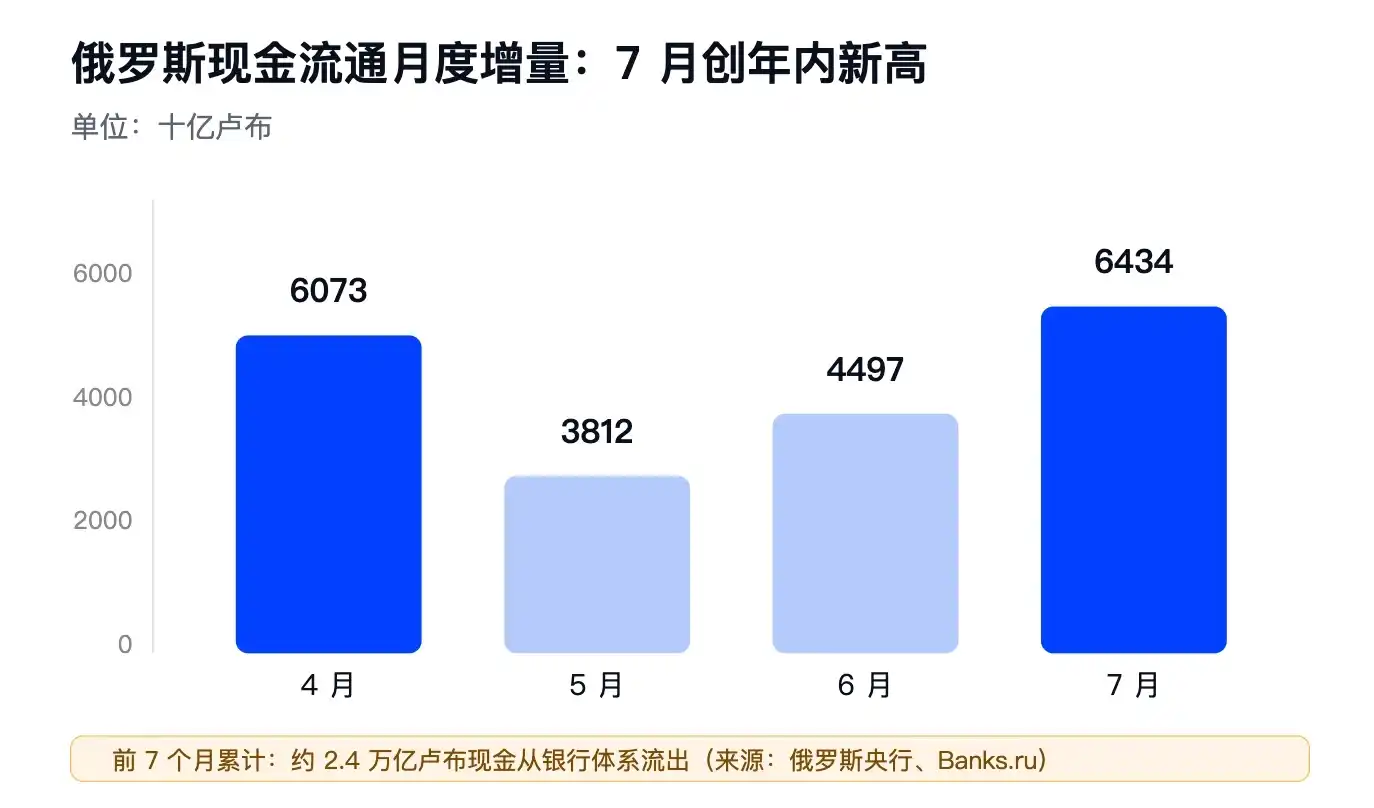
Russians are moving cash out of banks. According to reports from media outlets like the Financial Times and the Washington Post, in the first 7 months of 2026, Russians withdrew approximately 24.4 billion euros (about 2.4 trillion rubles) in cash from the banking system. Data from the Russian financial data platform Banks.ru indicates this withdrawal trend began in early March, with around 300 billion rubles leaving personal accounts each month.

The pace of outflow is accelerating. Data from the Russian Central Bank shows that cash in circulation increased by 607.3 billion rubles in April, by 381.2 billion rubles in May (a record high for May since 1995), by 449.7 billion rubles in June, and by another 643.4 billion rubles in July, marking the largest monthly increase in 2026. By July of this year, the total cash held by Russian citizens and businesses exceeded 21.9 trillion rubles.

Deposit data from specific banks paints a clearer picture. Gazprombank lost 299.5 billion rubles in personal deposits over 4 months, accounting for 10.8% of its total deposits; Rosselkhozbank lost 270.5 billion rubles, a decline exceeding 15%; Russia's largest private bank, Alfa-Bank, lost 179.4 billion rubles, a 5.6% decrease. Even the traditionally stable Sberbank was not spared, losing 211.6 billion rubles in June alone and another 31.8 billion rubles in July.

This Money Has Not Disappeared; It Has Flowed into Cryptocurrency
While cash flowed out of banks, cryptocurrency trading volume expanded rapidly. In February 2025, Russian Deputy Finance Minister Ivan Chebeskov stated at the Alfa Talk conference that daily cryptocurrency transaction volume among the Russian public reached approximately 50 billion rubles, equivalent to about $648 million at the then exchange rate, with millions of citizens participating annually.

Chebeskov's exact words were: "The annual volume of cryptocurrency transactions in our country exceeds 10 trillion rubles, all occurring outside the regulatory zone." This statement highlights the real anxiety of Russian regulators. The public is not treating cryptocurrency as a speculative toy but rather as a savings tool to hedge against ruble depreciation, circumvent capital controls, and cope with financial uncertainty.

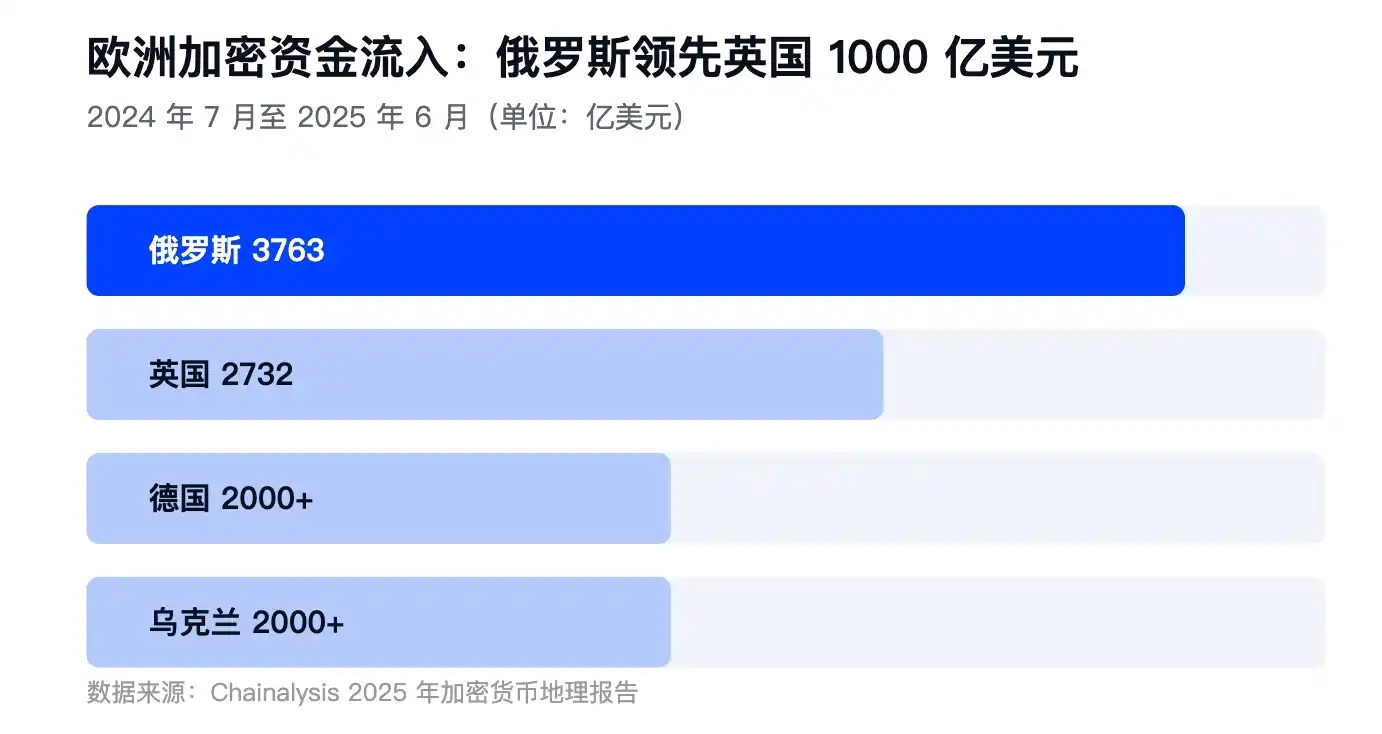
Data from Chainalysis corroborates the scale of this market. From July 2024 to June 2025, Russia received cryptocurrency inflows amounting to $376.3 billion, nearly 1.4 times the UK's $273.2 billion, ranking first in Europe. Sergei Shvetsov, Chairman of the Supervisory Board of the Moscow Exchange, estimated that Russian users pay approximately $15 billion in fees to overseas crypto platforms annually.

New Crypto Law Takes Effect September 1st, Locking Retail Investors at 300,000 Rubles Per Year
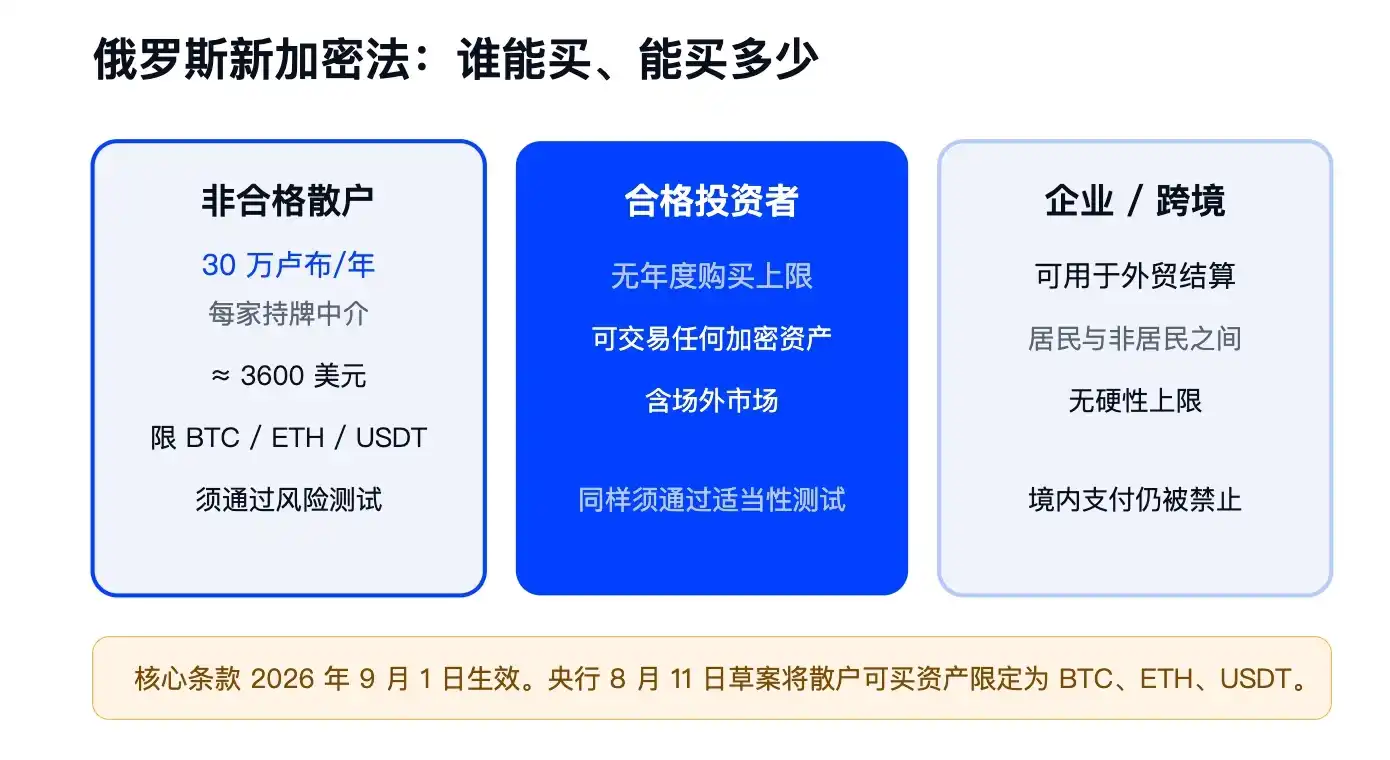
The government chose to formalize this gray channel through legislation. On July 21, 2026, the Russian State Duma passed the second and third readings of the "Digital Currency and Digital Rights Law" in a single day; Putin signed it into law on August 4th. The core provisions of this law will officially take effect on September 1, 2026.

For ordinary retail investors, the law stipulates strict entry conditions. Non-qualified investors must pass a suitability test administered by the Russian Central Bank and are limited to purchasing no more than 300,000 rubles worth of cryptocurrency annually through any single licensed intermediary, roughly equivalent to $3600 to $3800. On August 11th, the Russian Central Bank released a draft instruction initially limiting the crypto assets retail investors can purchase to Bitcoin, Ethereum, and USDT.

Qualified investors are exempt from these restrictions and can trade freely on exchanges and over-the-counter markets. Businesses and import-export firms can also use cryptocurrency for cross-border settlements, with no rigid caps for this segment. The law simultaneously maintains the ban on using cryptocurrency for domestic payments of goods and services.

In other words, ordinary people looking to preserve value with crypto assets can only buy about $3600 worth per year per platform, while businesses and high-net-worth individuals retain ample channels. This design leaves the "large outflow" valve open on the institutional side while tightening it on the retail side.

Why Are Banks Bleeding? Two Explanations Coexist

Regarding the cash outflow, Russian officials and the market offer different explanations.

Russian Central Bank and Finance Ministry officials have repeatedly emphasized that there is no plan to freeze citizens' deposits, with Finance Minister Anton Siluanov dismissing related rumors as "fake news." Central Bank Deputy Governor Alexei Zabotkin publicly stated in August 2025 that restricting withdrawals would have "destructive consequences" for the financial system.

The central bank attributes the surge in cash to several technical factors: the increase in VAT from 20% to 22% starting January 2026, coupled with bank acquiring services also being subject to VAT, pushing small and medium enterprises towards cash to avoid taxes; frequent disruptions to mobile communications and the internet since spring, causing digital payments to fail and forcing the public and businesses to hoard cash; additionally, declining deposit interest rates have made deposits less attractive.

However, the market offers a different narrative. The Financial Times and the Washington Post, citing analysts and anonymous former finance officials, suggest that the public's withdrawals stem from concerns about rising war costs, asset nationalization, and banking system instability. Last year, Russian prosecutors transferred approximately $51.5 billion in private assets to state control, and in June seized about $7.6 billion in assets related to agricultural magnate Vadim Moshkovich. These events have fueled persistent rumors that "deposits might be requisitioned by the government."

September 1st Isn't Just for the Crypto Law; The Digital Ruble is Also Launching

Notably, September 1st is also the day the Russian central bank digital currency, the "Digital Ruble," opens to the general public. Systemically important banks like Sberbank, VTB, Alfa-Bank, Gazprombank, and T-Bank, among 12 in total, must enable their clients to conduct Digital Ruble transactions, and retailers with annual turnover exceeding 120 million rubles must accept Digital Ruble payments.

This means that on the same day, Russia will undertake two simultaneous actions: on one hand, bringing民间 crypto trading under a regulatory framework through licensed intermediaries; on the other hand, pulling retail payments back into the official system via the central bank digital currency. For ordinary Russians, the attractiveness of bank deposits is waning, cryptocurrency purchase limits are being fixed, and the Digital Ruble offers a third path—one that is entirely state-controlled.

As 24.4 billion euros in cash surged out of the banking system and $650 million in daily crypto transactions flowed through the gray market, the law Putin signed on August 4th resembles a watershed moment. For ordinary Russians, the channels to autonomously manage their wealth are diminishing, with each remaining choice carrying different implications for who holds the control.


Трендовые криптовалюты

Связанные с этим вопросы

QAccording to the article, what is the main reason for the mass withdrawal of cash from Russian banks in 2026?

AThe article presents two main explanations. Russian officials attribute it to technical factors like VAT increases, digital payment disruptions, and lower deposit rates. Market analysts and reports, however, suggest the primary driver is public fear over rising war costs, asset nationalizations, and potential government confiscation of bank deposits.

QWhat are the key restrictions on cryptocurrency purchases for non-qualified retail investors under Russia's new law effective September 1, 2026?

ANon-qualified retail investors must pass a suitability test from the Russian Central Bank. They are limited to purchasing no more than 30,000 rubles (approx. $3600) worth of cryptocurrency per year through any single licensed intermediary. Furthermore, the Central Bank's draft instruction restricts permissible assets for these investors to Bitcoin, Ethereum, and USDT.

QHow does the article contrast the treatment of ordinary citizens and institutions/qualified investors under the new cryptocurrency law?

AThe law creates a sharp divide. Ordinary retail investors face strict annual purchase limits (30,000 rubles) and asset restrictions. In contrast, qualified investors face no such limits and can trade freely. Additionally, businesses and importers/exporters are permitted to use cryptocurrency for cross-border settlements without hard limits, while domestic payments with crypto remain banned for everyone.

QWhat significant financial technology event is scheduled to occur in Russia on the same day (September 1, 2026) as the new crypto law takes effect?

AOn September 1, 2026, the Russian Central Bank's Digital Ruble (CBDC) will be launched for general public use. Twelve systemically important banks are required to enable digital ruble transactions for their clients, and large retailers must accept it as payment.

QWhat does the article suggest is the ultimate consequence of the new regulations and trends for ordinary Russian citizens?

AThe article suggests that for ordinary Russians, the channels to autonomously manage and preserve their wealth are narrowing. Bank deposits are losing appeal due to outflow fears, cryptocurrency purchases are now severely capped by law, and the newly launched Digital Ruble offers a state-controlled alternative. This leaves them with fewer options, each carrying different degrees of government control.

Похожее

Маск ожидает $50 трлн: есть ли предел у госдолга США и что будет дальше

20 августа 2026 года Илон Маск прокомментировал прогноз, согласно которому госдолг США достигнет $50 трлн к 2030 году. На тот момент долг только превысил $40 трлн, а процентные платежи по нему впервые обошли расходы на оборону. Рост долга сам по себе не вызывал немедленного кризиса в прошлом, но ключевая проблема в 2026 году — растущая стоимость его обслуживания. Экономист Рэй Далио предупреждает о возможном долговом кризисе в ближайшие годы. Более точным критерием опасности, чем номинальная сумма долга, является соотношение средней ставки по долгу и темпа роста экономики. По прогнозам Бюджетного управления конгресса США, ставка превысит темпы роста к 2031 году, что может запустить «долговую спираль». Абсолютного предела долга нет, но существует экономический предел, определяемый доверием рынка к доллару. При его достижении вероятны три основных сценария адаптации: финансовая репрессия и монетизация долга (наиболее вероятный «японский путь»), жёсткая бюджетная консолидация («греческий путь») или реструктуризация. Таким образом, опасность представляет не конкретная цифра долга, а переход к ситуации, когда его обслуживание становится непосильным для экономики, что может привести к долгосрочной стагнации.

cryptonews.ru17 мин. назад

Маск ожидает $50 трлн: есть ли предел у госдолга США и что будет дальше

cryptonews.ru17 мин. назад

Вчера альткоин побил рекорд по количеству сожженных токенов за сутки! Это исторический максимум!

Собственный токен Uniswap, $UNI, 21 августа установил исторический рекорд по ежедневному объему сжигания в долларовом эквиваленте — было уничтожено токенов на сумму около 590 000 долларов. Основная часть сжигания пришлась на сеть Ethereum (примерно 267 000 долларов), за которой следуют Base (165 000 долларов) и Robinhood Chain (около 87 000 долларов). В количественном выражении было сожжено примерно 150 000 токенов $UNI, что является вторым по величине суточным показателем. Активность механизма сжигания $UNI в последнее время значительно возросла и распространилась на различные сети. Несмотря на рост цены на 6,88% за последние 24 часа, $UNI все еще торгуется примерно на 90,7% ниже своего исторического максимума в 45 долларов.

cryptonews.ru18 мин. назад

Вчера альткоин побил рекорд по количеству сожженных токенов за сутки! Это исторический максимум!

cryptonews.ru18 мин. назад

Разработчик Solana Мерт Мумтаз высоко оценил альткоин!

Ведущие специалисты в области криптовалют, в том числе Мерт Мумтаз из Solana и Дев из Valor Group, обсудили ключевые разработки и будущее Zcash (ZEC) на платформе The Rollup. Основные темы включали недавнее обновление Ironwood, которое устранило критическую уязвимость в пуле Orchard, исключив риск создания поддельных монет и укрепив доверие сообщества. Также обсуждалась дорожная карта проекта, где главной целью заявлено достижение масштабируемости до уровня обработки более 50 000 транзакций в секунду с минимальной задержкой, что сравнимо с пропускной способностью кредитных карт. Основное внимание уделяется оптимизации процессов сканирования кошельков и новой архитектуре для улучшения пользовательского опыта. Важным аспектом стало предстоящее обновление Tachion, направленное на защиту сети Zcash от угроз квантовых вычислений с помощью рекурсивных доказательств с нулевым разглашением. Это обновление должно значительно уменьшить размер транзакций, снизить нагрузку на узлы и создать полноценную «квантово-защищенную» систему конфиденциальности.

cryptonews.ru58 мин. назад

Разработчик Solana Мерт Мумтаз высоко оценил альткоин!

cryptonews.ru58 мин. назад

Почему биткоин действительно так сильно вырос? Достаточно ли четырехлетнего цикла? Вот мнение Кейтлинг Лонг

После резкого роста крипторынка Кейтлин Лонг, глава Custodia Bank, связала это движение с макроэкономикой и действиями Минфина США. Она отметила, что решение властей более чем вдвое увеличить выкуп долгосрочных гособлигаций (30-летних) представляет собой форму «контроля кривой доходности». Этот шаг спровоцировал резкие изменения в процентных ставках и оказал давление на доллар США, ослабив его. Ослабление доллара, в свою очередь, традиционно поддерживает рисковые активы, что и вызвало скачок в ценах биткоина и Ethereum. На вопрос о том, завершился ли знаменитый четырехлетний цикл биткоина, Лонг заявила, что данные графиков и фундаментальные показатели указывают на его продолжение. Основные процессы в майнинговой экономике не изменились: снижение рентабельности и выход игроков с рынка из-за высоких затрат на электроэнергию и вычислительные мощности являются естественной частью цикла. Лонг не стала давать прогнозов по цене, но отметила, что, исходя из прошлого опыта, биткоин на текущих уровнях выглядит дешево.

cryptonews.ru3 ч. назад

Почему биткоин действительно так сильно вырос? Достаточно ли четырехлетнего цикла? Вот мнение Кейтлинг Лонг

cryptonews.ru3 ч. назад

Компания HumidiFi приостанавливает торговлю послеdentв сети, что ограничивает влияние на наши внутренние средства

Децентрализованная биржа HumidiFi на Solana приостановила торговлю после инцидента с безопасностью в своей сети. Компания заявила, что ущерб ограничился её внутренними средствами, а активы клиентов и третьих лиц не пострадали. Подробности атаки и сумма убытков не раскрываются. По данным DefiLlama, за последние сутки на платформе было обработано сделок на сумму около $213,79 млн. Ранее у HumidiFi уже возникали проблемы: продажа токенов на Jupiter была сорвана из-за действий злоумышленника с использованием автоматизированных кошельков. Распродажа была отменена, команда пообещала провести новый выпуск токенов для добросовестных участников. Этот инцидент происходит на фоне роста числа атак в сфере цифровых активов. Во втором квартале 2026 года было зафиксировано рекордное количество инцидентов — около 83, общий ущерб от которых составил примерно $775 млн.

cryptonews.ru3 ч. назад

Компания HumidiFi приостанавливает торговлю послеdentв сети, что ограничивает влияние на наши внутренние средства

cryptonews.ru3 ч. назад

Торговля

Спот

Популярные статьи

Как купить S

Добро пожаловать на HTX.com! Мы сделали приобретение Sonic (S) простым и удобным. Следуйте нашему пошаговому руководству и отправляйтесь в свое крипто-путешествие.Шаг 1: Создайте аккаунт на HTXИспользуйте свой адрес электронной почты или номер телефона, чтобы зарегистрироваться и бесплатно создать аккаунт на HTX. Пройдите удобную регистрацию и откройте для себя весь функционал.Создать аккаунтШаг 2: Перейдите в Купить криптовалюту и выберите свой способ оплатыКредитная/Дебетовая Карта: Используйте свою карту Visa или Mastercard для мгновенной покупки Sonic (S).Баланс: Используйте средства с баланса вашего аккаунта HTX для простой торговли.Третьи Лица: Мы добавили популярные способы оплаты, такие как Google Pay и Apple Pay, для повышения удобства.P2P: Торгуйте напрямую с другими пользователями на HTX.Внебиржевая Торговля (OTC): Мы предлагаем индивидуальные услуги и конкурентоспособные обменные курсы для трейдеров.Шаг 3: Хранение Sonic (S)После приобретения вами Sonic (S) храните их в своем аккаунте на HTX. В качестве альтернативы вы можете отправить их куда-либо с помощью перевода в блокчейне или использовать для торговли с другими криптовалютами.Шаг 4: Торговля Sonic (S)С легкостью торгуйте Sonic (S) на спотовом рынке HTX. Просто зайдите в свой аккаунт, выберите торговую пару, совершайте сделки и следите за ними в режиме реального времени. Мы предлагаем удобный интерфейс как для начинающих, так и для опытных трейдеров.

2.0k просмотров всегоОпубликовано 2025.01.15Обновлено 2026.06.02

Как купить S

Sonic: Обновления под руководством Андре Кронье – новая звезда Layer-1 на фоне спада рынка

Он решает проблемы масштабируемости, совместимости между блокчейнами и стимулов для разработчиков с помощью технологических инноваций.

2.5k просмотров всегоОпубликовано 2025.04.09Обновлено 2025.04.09

Sonic: Обновления под руководством Андре Кронье – новая звезда Layer-1 на фоне спада рынка

HTX Learn: Пройдите обучение по "Sonic" и разделите 1000 USDT

HTX Learn — ваш проводник в мир перспективных проектов, и мы запускаем специальное мероприятие "Учитесь и Зарабатывайте", посвящённое этим проектам. Наше новое направление .

2.0k просмотров всегоОпубликовано 2025.04.10Обновлено 2025.04.10

HTX Learn: Пройдите обучение по "Sonic" и разделите 1000 USDT

Обсуждения

Добро пожаловать в Сообщество HTX. Здесь вы сможете быть в курсе последних новостей о развитии платформы и получить доступ к профессиональной аналитической информации о рынке. Мнения пользователей о цене на S (S) представлены ниже.

活动图片