The Optimal 'AI Bubble Trade': Simultaneously Going Long on 'Arrogance' and 'Bias'

marsbitОпубликовано 2026-08-17Обновлено 2026-08-17

Введение

The optimal investment strategy in the current AI bubble environment is a dual "leg" approach: going long on both "hubris" (AI tech leaders) and "humiliation" (neglected, underperforming cyclical assets). This aims to capture gains from both sides during the final surge of a nominal GDP-driven bubble, according to a Bank of America report by strategist Michael Hartnett. The bank's Bull & Bear Indicator remains in extreme bullish territory, signaling "sell", yet history shows such signals have limited immediate impact. Current fund flows show structural shifts: gold saw its largest weekly inflow since January, commodities are up 58.9% YTD, while tech stocks experienced their largest weekly outflow in seven weeks. The core thesis is that the final stage of a bubble benefits both the leading theme ("hubris" - AI) and oversold sectors ("humiliation" - like consumer stocks), similar to patterns seen in the 1999 tech bubble and 2007-2008 credit crisis. The report advises shorting "AI bonds," anticipating pressure from massive capital expenditures. Key risks include high concentration, surging bond yields, and cautious voter sentiment. The US debt burden is highlighted, with servicing costs reaching $1.4 trillion. The 10-year Treasury yield breaching 5% is seen as a red line for policymakers. For the "avoid the dollar" theme, BofA recommends gold and Hong Kong property stocks, the latter seen as deeply undervalued. The November US midterm elections, particularly the Texas govern...

The optimal investment strategy in the current AI bubble environment is to simultaneously go long on "Arrogance" (AI technology leaders) and "Bias" (neglected, underperforming assets), capturing two-way returns during the final surge phase of the nominal GDP bubble.

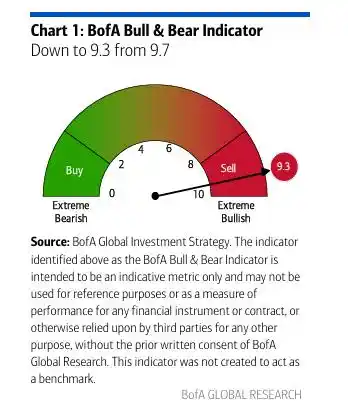
According to the Chasing the Wind Trading Desk, Michael Hartnett, Chief Strategist at Bank of America Securities, stated in his latest research report that the BofA Bull & Bear Indicator has slightly retreated from 9.7 to 9.3, remaining in extreme bullish territory, and continues to signal a "sell." Meanwhile, over the past week, capital flows showed structural divergence: technology stocks saw their largest weekly outflow in seven weeks, gold recorded its largest weekly inflow since January this year, commodities have delivered year-to-date returns as high as 58.9%, while Bitcoin has fallen nearly 28% year-to-date.

Bank of America points out that the core logic for major asset allocation currently remains the framework of avoiding bonds, avoiding the dollar, and fully investing in AI, further reinforced by policymakers viewing the stock market as "too big to fail." However, the strategist also warns that three potential constraints are suppressing the continuation of the bull market: surging bond yields, a shift towards caution in voter sentiment, and widespread positioning already skewed towards longs.

"Arrogance" Plus "Bias": The Optimal Two-Legged Strategy for the AI Bubble

Bank of America's core trading logic on the AI theme is derived from comparisons with historical bubble patterns.

The report points out, the optimal bubble trading strategy is to simultaneously go long on "Arrogance" (hubris)—which is AI technology itself—and go long on "Bias" (humiliation)—which are oversold cyclical assets that have been long neglected by the market and have the potential to be lifted during the final surge phase of nominal GDP.

The report cites historical examples: emerging markets during the 1999 internet frenzy, and the 2007-2008 subprime period, both played roles as "beneficiaries of spillover effects" just before the dominant bubble peaked. Bank of America believes that in the current environment, the assets most likely to replicate this path are in the consumer sector.

At the same time, Bank of America recommends shorting AI bonds—arguing that capital expenditure exceeding $1 trillion combined with negative net cash flow implies significant pressure for massive bond issuance that cannot be ignored.

Bull & Bear Indicator Remains at Extreme Levels, But Sell Signal's Impact is Limited

The BofA Bull & Bear Indicator fell slightly this week from 9.7 to 9.3, maintaining a sell signal, triggered by weaker inflows into high-yield bonds and net outflows from the technology and healthcare sectors.

The report notes that since the sell signal was issued on May 26 this year, the S&P 500 index has risen 4% cumulatively, and the MSCI World Index has gained 3%, despite experiencing a maximum drawdown of 5% during the period (from May 26 to July 30, interrupted by JPY/USD intervention and strong earnings from the "Magnificent Seven" tech stocks).
Bank of America cautions that overly concentrated positioning can disrupt the pace of a bull market, but truly ending a bull market requires the convergence of three elements: excessive positioning, overly optimistic profit expectations, and policy tightening. Currently, these three elements are not simultaneously present.

Historical data shows that since the Bull & Bear Indicator was established, it has issued 17 sell signals. Global stocks on average fell 2% to 3% within 2 to 3 months afterward, with a hit rate of about 60% and maximum drawdowns ranging between 15% and 20%.

Capital Flows: Gold and Commodities in Favor, Tech Stocks Sold

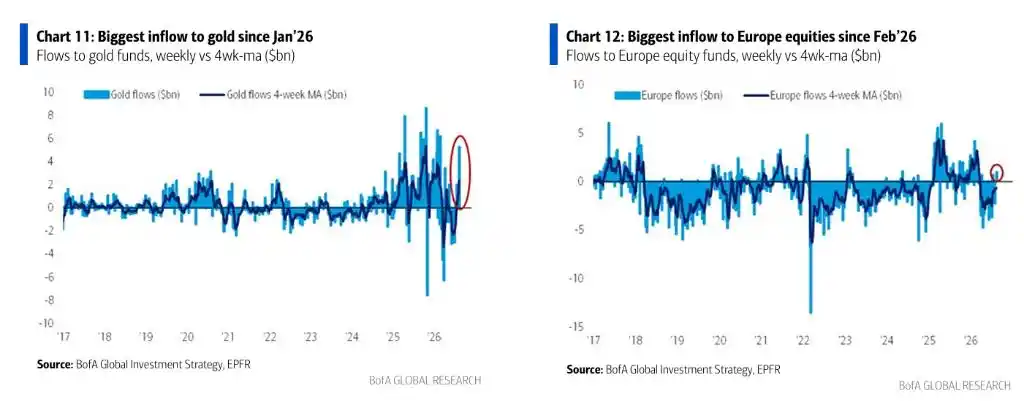
This week's capital flow data showed significant structural divergence. Gold funds recorded a net inflow of $6.3 billion, the largest weekly inflow since January this year; commodities, with a year-to-date total return rate of 58.9%, topped all asset classes, with crude oil up 43% year-to-date.

In contrast, technology funds saw a net outflow of $1.2 billion this week, the largest weekly outflow in seven weeks. European equity funds received a net inflow of $1.2 billion, the largest since February this year; South Korean equity funds recorded net inflows for the seventh consecutive week.
In fixed income, investment-grade bond funds saw inflows of $10.6 billion, the largest in five weeks; emerging market bond funds saw inflows of $1.4 billion, the largest in seven weeks. Cash-like assets attracted $25.4 billion in weekly inflows.

BofA Private Clients: Equity Allocation at Record High, Cash at Record Low

Data from BofA Private Clients shows that managed assets total $4.7 trillion, with equity allocation rising to 66.4%, a record high; bond allocation fell to 17.0%, the lowest since March 2022; cash allocation fell to 9.4%, the lowest level on record. Weekly net equity inflows were the largest since September 2022.

Within bonds, private clients are slightly extending duration, with allocations to 2-10 year U.S. Treasuries rising 15% year-to-date, while allocations to Treasury bills with maturities under one year have fallen over 30% since last November, though interest in 30-year long bonds remains lacking. Over the past four weeks, private clients have purchased ETFs in Japanese bonds, municipal bonds, and inflation-protected bonds, while reducing ETFs in emerging market debt, utilities, and the financial sector.

High Debt Pressure, U.S. Treasury Yields as the Key Variable

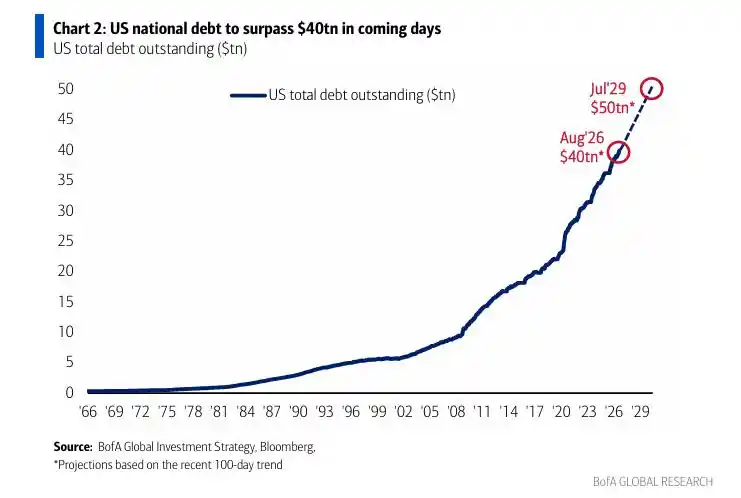
Bank of America warns that U.S. national debt is about to exceed $40 trillion and is projected to reach $50 trillion by July 2029. Federal government debt servicing costs over the past 12 months have reached $1.4 trillion and will continue to rise until the 5-year Treasury yield falls below 3.25%.

At the same time, the U.S. 30-year Treasury completed an auction at a yield of 5.126%, the highest in 25 years, while U.S. stocks hit record highs on the same day, highlighting the continued effectiveness of the "avoid bonds" allocation logic.
Bank of America points out that despite the overall upward trend in yields in 2026, long-duration, previously neglected assets such as REITs, small-cap stocks, biotech (XBI), and regional banks (KRE) are quietly outperforming the broader market, reflecting the market's advance pricing of expectations for "peak yields."

The report believes that the USD/JPY intervention has sent a clear signal that the U.S. government does not want the 10-year Treasury yield to break above 5%.

Strategists expect core CPI to fall to the 2.1%-2.6% range before the midterm elections. Hawkish Fed Chairman Warsh is then expected to use the Jackson Hole speech and the September FOMC meeting to declare "mission accomplished," working in tandem with a Bank of Japan rate hike to jointly cap the upside for yields.

Hong Kong Real Estate and Gold: Two Trades for "Avoiding the Dollar"

Under the "avoid the dollar" theme, Bank of America recommends two specific trade paths. First, go long on gold, viewing it as the best hedge against dollar depreciation, bond market collapse, and asset inflation. This week's gold inflows also confirm the market consensus in this direction.

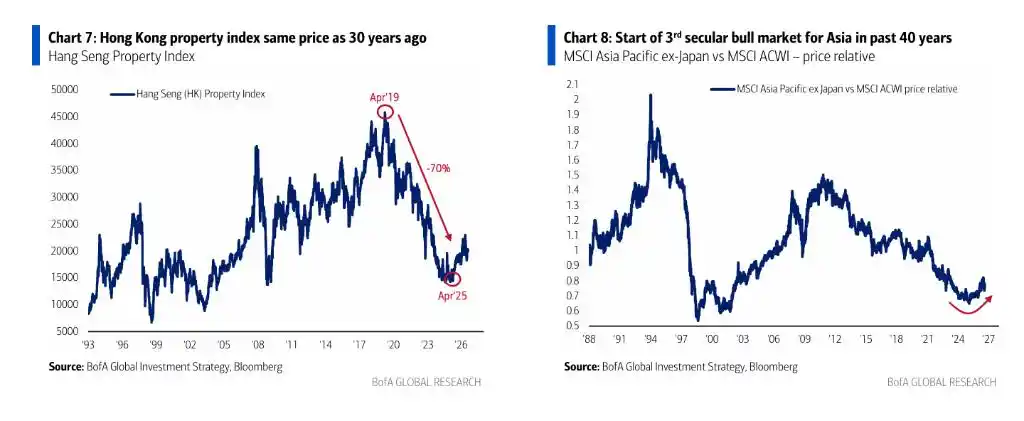
Second, go long on the Hong Kong real estate sector. BofA strategists summarize this logic as "buy humiliation, sell arrogance": the Hang Seng Properties Index is currently at the same level as 30 years ago, with a valuation of only about 12 times earnings.

The report believes Asia is entering its third long-term bull market in the past 40 years, driven by Japanese and Korean technology and Chinese AI. Hong Kong simultaneously benefits from the relative decline in attractiveness of Dubai (geopolitical conflict) and Singapore (taxes).
November Midterm Elections: The Political Variable Determining the AI Bull Market's Continuation

Bank of America lists the U.S. midterm elections on November 3 as one of the most critical events influencing market direction.

The report notes that if the Republican Party holds the Senate and Texas Governor Abbott secures re-election, AI-led risk assets are expected to accelerate towards a peak in 2027; however, if the Democratic Party wins the Senate or the Texas gubernatorial seat in November, stocks, the dollar, and bond yields could all experience sharp declines of over 10% before year-end.

The Texas gubernatorial election is seen as a referendum between "affordability" and "AI data centers": the state currently has 335 data centers, with another 247 planned. Abbott recently announced a temporary pause on data center expansion, reflecting voter concerns over grid stability and cost of living.

Additionally, key dates highlighted by Bank of America include: August 28 for Warsh's Jackson Hole speech, September 16 for the Fed FOMC meeting (current probability of a hike: 35%), and September 18 for the Bank of Japan meeting (probability of a hike: 74%).

This article is from the WeChat public account "Wall Street News," author: Zhang Yaqi

Трендовые криптовалюты

Связанные с этим вопросы

QAccording to the article, what is Bank of America's optimal trading strategy in the current AI bubble environment?

AThe optimal strategy is to simultaneously go long on 'Hubris' (AI tech leaders) and 'Humiliation' (neglected, undervalued cyclical assets expected to rise during the final surge of the nominal GDP bubble). This two-legged strategy aims to capture returns from both sides.

QWhat are the three potential constraints that Bank of America warns could suppress the bull market's continued advance?

AThe three potential constraints are: 1) soaring bond yields, 2) a shift towards cautious sentiment among voters, and 3) market positioning that is already broadly skewed towards being long.

QBased on the fund flow data mentioned in the report, which asset class saw the largest weekly inflow recently and which saw a significant outflow?

AGold funds saw the largest weekly inflow of $6.3 billion, the biggest since January. In contrast, technology funds experienced a significant outflow of $1.2 billion, marking their largest weekly outflow in seven weeks.

QWhat two specific trades does Bank of America recommend under the 'Avoid the Dollar' theme?

AUnder the 'Avoid the Dollar' theme, Bank of America recommends: 1) Going long on gold as the best hedge against dollar devaluation, bond market collapse, and asset inflation. 2) Going long on the Hong Kong property sector, citing its low valuation and potential benefits from shifting dynamics in Asia.

QWhy does Bank of America consider the November U.S. midterm elections a critical political variable for the AI bull market?

AThe outcome of the midterm elections is seen as crucial. If Republicans hold the Senate and the Texas Governor is re-elected, AI-led risk assets could accelerate towards a peak in 2027. However, if Democrats win the Senate or the Texas Governor race, it could trigger a sharp correction of over 10% in stocks, the dollar, and bond yields before year-end. The Texas Governor race is framed as a referendum on 'affordability' versus 'AI data center' expansion.

Похожее

Сектор DeFi демонстрирует самый мощный отскок. Какие высокодоходные проекты стоит рассматривать для входа?

В статье анализируются протоколы DeFi с высокими доходами на фоне резкого роста сектора. Акцент делается на том, что доходность является ключевым фундаментальным показателем устойчивого спроса, в отличие от сиюминутных рыночных трендов. Данные по доходам (за вычетом выплат поставщикам ликвидности) взяты из Tokenomist и DefiLlama. **DEX:** Лидерами по доходам за последние 30 дней являются Uniswap (UNI, $7.18 млн), Jupiter (JUP, $4.69 млн), PancakeSwap (CAKE, $5.16 млн) и Aerodrome (AERO, $4.11 млн) на Base. Многие из них, такие как Uniswap, Jupiter и PancakeSwap, направляют часть доходов на выкуп и сжигание своих токенов. Aerodrome распределяет 100% доходов среди держателей veAERO. **Кредитование:** World Liberty Financial (WLFI) показал самый высокий 30-дневный доход в $10.47 млн, а Aave (AAVE) — $4.12 млн. В Aave программа выкупа токенов временно приостановлена. **Стейкинг ETH:** Лидеры — ether.fi (ETHFI, $3.03 млн) и Lido (LDO, $2.31 млн). Ether.fi использует часть доходов на выкуп ETHFI для стейкеров sETHFI, а в Lido недавно запущен механизм автоматического выкупа LDO (NEST) при превышении порога годового дохода. В целом, статья выделяет проекты с сильной фундаментальной доходностью и различными механизмами распределения стоимости среди держателей токенов, что может представлять интерес для долгосрочных инвесторов.

Odaily星球日报5 мин. назад

Сектор DeFi демонстрирует самый мощный отскок. Какие высокодоходные проекты стоит рассматривать для входа?

Odaily星球日报5 мин. назад

HBM находится на перепутье

На конференции Hot Chips 2026 ведущие производители памяти, Samsung и SK Hynix, представили различные стратегии развития HBM, указывая на расхождение подходов в индустрии. Samsung анонсировала zHBM — концепцию истинной 3D-интеграции, где DRAM стекируется непосредственно на вычислительный чип (например, GPU), что позволяет значительно снизить энергопотребление и увеличить пропускную способность. Компания представила трехэтапную дорожную карту, где базовый чип (base die) эволюционирует от пассивного интерфейса к активному участнику системы: перенос контроллера памяти, добавление функций RAS, телеметрии, расширения памяти и даже специализированных вычислений (например, для операций внимания). SK Hynix фокусируется на увеличении числа слоев в стеке (до 16 для HBM4) и решении сопутствующих проблем — управления теплом и механическими напряжениями. Ключевыми технологиями для будущих поколений (HBM5 и далее) являются гибридная сборка (hybrid bonding) для более высоких стеков и архитектура iHBM со встроенными теплопроводящими элементами для охлаждения. Micron в своем выступлении подчеркнул, что «стена памяти» усугубляется, так как производительность AI-ускорителей растет быстрее, чем пропускная способность HBM. Компания обозначила ключевые вызовы: стоимость кремния, сложность advanced-пакета, тепловыделение и надежность гетерогенной интеграции. Таким образом, конкуренция в сфере HBM смещается от простого наращивания пропускной способности и объема к архитектурным инновациям базового чипа и революции в области упаковки (advanced packaging), где компании выбирают разные пути для преодоления ограничений следующего поколения вычислений.

marsbit23 мин. назад

HBM находится на перепутье

marsbit23 мин. назад

Предрассветные часы бычьего рынка: что стоит посмотреть из непопулярных/инновационных нарративов

Автор: Haotian Поскольку наступает бычий рынок и многие не знают, чем заняться, какие интересные, но малоизвестные нарративы, появившиеся в медвежьем рынке, можно продолжать отслеживать? (Некоторые уже начали расти в цене.) 1) **Hooks (Хуки):** Hooks в Uniswap V4 — это настраиваемые смарт-контракты, которые позволяют вставлять пользовательскую логику в ключевые моменты жизненного цикла пула AMM (инициализация, добавление/удаление ликвидности, до/после обмена, пожертвования, обработка комиссий и т.д.). Примеры: uPEG, SATO, Slonks. 2) **x402:** Перезапуск редко используемого кода состояния HTTP 402 Payment Required как основы для платежей между AI-агентами (Agent Payment). Примеры: PAYAI, dreams. 3) **RWAFI (Real World Asset DeFi):** Превращение реальных активов (TradFi) в базовую ликвидность или внедрение токенизации активов в DeFi для создания новых комбинируемых возможностей. Примеры: Stonkbroker, INDEX. 4) **Agentic Economy (Агентская экономика):** Открытый протокол от Google, позволяющий AI-агентам на разных платформах находить друг друга, общаться, делегировать задачи и сотрудничать, создавая основу для коммуникации в Agentic Economy. Открывает возможности для социальных взаимодействий агентов, игр и приложений, где агенты заменяют людей. Пример: Moltbook. Кроме того, существует ряд инновационных нарративов, связанных с AI + Crypto, включая инфраструктуру, приложения и протоколы для агентов. Нарративы Prediction Markets, Perp DEX и приватности здесь не рассматриваются, так как они остаются популярными. Какие ещё интересные темы и нарративы вы можете добавить? (Примечание: большинство упомянутых проектов уже неактивны, информация предоставлена только для ознакомления, не является инвестиционной рекомендацией.)

marsbit25 мин. назад

Предрассветные часы бычьего рынка: что стоит посмотреть из непопулярных/инновационных нарративов

marsbit25 мин. назад

Бесент задумал покупать облигации на триллион из TGA, цены на нефть и доходность облигаций падают, хардвер для ИИ продолжает обвал — NVIDIA падает седьмой день подряд, золото, доллар и биткоин растут вместе

Основные события на финансовых рынках: акции компаний, связанных с искусственным интеллектом, продолжили снижение, возглавляемое NVIDIA, которая упала седьмой день подряд, что стало худшей серией падения с 2022 года. Это привело к снижению индекса Nasdaq. В то же время средства перетекают в защитные активы: растут цены на золото (до максимума за 3 месяца) и биткоин (приближается к $80 000). Казначейство США рассматривает возможность использования средств из счета TGA (примерно $1 трлн) для выкупа облигаций, что вызвало небольшое снижение доходностей гособлигаций. Нефть также подешевела. Индекс Dow Jones вырос второй день подряд благодаря финансовому и потребительскому секторам, в то время как крупные технологические компании (Meta, Amazon) показали относительную устойчивость. На этой неделе рынки ожидают отчетов NVIDIA и выступления главы ФРС, что может усилить волатильность.

华尔街日报3 ч. назад

Бесент задумал покупать облигации на триллион из TGA, цены на нефть и доходность облигаций падают, хардвер для ИИ продолжает обвал — NVIDIA падает седьмой день подряд, золото, доллар и биткоин растут вместе

华尔街日报3 ч. назад

Недавний всплеск биткоина — это благо или ловушка?

За последнюю неделю биткоин резко вырос с примерно 63 000 до почти 80 000 долларов. По данным аналитической платформы Glassnode, этот скачок обусловлен реальным притоком капитала, а не низкой ликвидностью. Рост поддержан агрессивными покупками на спотовых рынках, увеличением объемов торгов, укреплением ликвидности и активным институциональным спросом, в том числе через биткоин-ETF. Данные с производных рынков указывают на переход инвесторов к более агрессивным стратегиям и рост спекулятивного участия с использованием кредитного плеча. Активность в сети Биткоин также увеличилась, что подтверждается ростом количества ежедневно активных адресов и объемов переводов. Показатели прибыльности инвесторов значительно улучшились, и в их поведении теперь преобладает фиксация прибыли, а не продажа с убытком. Однако, по оценке Glassnode, текущий рост в большей степени поддерживается активностью краткосрочных инвесторов, тактическим позиционированием и спекулятивным аппетитом, чем долгосрочным накоплением капитала, так как приток макроэкономического капитала остается ограниченным.

cryptonews.ru3 ч. назад

Недавний всплеск биткоина — это благо или ловушка?

cryptonews.ru3 ч. назад

Торговля

Спот

Популярные статьи

Неделя обучения по популярным токенам (2): 2026 может стать годом приложений реального времени, сектор AI продолжает оставаться в тренде

2025 год — год институциональных инвесторов, в будущем он будет доминировать в приложениях реального времени.

2.0k просмотров всегоОпубликовано 2025.12.16Обновлено 2025.12.16

Неделя обучения по популярным токенам (2): 2026 может стать годом приложений реального времени, сектор AI продолжает оставаться в тренде

Обсуждения

Добро пожаловать в Сообщество HTX. Здесь вы сможете быть в курсе последних новостей о развитии платформы и получить доступ к профессиональной аналитической информации о рынке. Мнения пользователей о цене на AI (AI) представлены ниже.

活动图片