Left Hand PYUSD, Right Hand Open USD: PayPal's Stablecoin Risk "Hedging"

Odaily星球日报Опубликовано 2026-08-13Обновлено 2026-08-13

Введение

PayPal recently released its Q2 2024 earnings, reporting revenue of $8.68 billion and a Total Payment Volume of $486.4 billion, both exceeding market expectations. However, GAAP profit margins declined year-over-year, with the company attributing an $81 million net loss partly to strategic investments and crypto assets. The report highlighted the strategic role of its PYUSD stablecoin, now positioned as a "major enabler" for the PayPal World platform and integrated into a newly formed "Payment Services & Crypto" business unit. PayPal aims to launch more merchant products powered by PYUSD and AI-driven "agentic payments," focusing on mainstream consumer and business use cases. Despite this strategic push and expansion to over 70 markets and nine blockchains, PYUSD's circulating supply has contracted significantly. After peaking around $4.2 billion in March 2024, its supply fell approximately 31% to roughly $2.7 billion by the end of Q2, indicating a gap between its broad integration narrative and actual sustained user demand post-incentives. The competitive landscape is evolving with the announcement of Open USD, a consortium-backed stablecoin project with over 140 partners including Visa, Mastercard, and Stripe. Unlike PYUSD's single-issuer model, Open USD proposes a shared revenue and governance model among its participants. Notably, PayPal itself is a signatory to the Open USD initiative, suggesting a hedging strategy where it continues developing PYUSD while securing a ...

Original | Odaily Planet Daily(@OdailyChina)

Author|jk
Recently, payment giant PayPal recently announced its Q2 earnings: revenue of $8.68 billion, exceeding market expectations, with total payment volume (TPV) reaching $486.4 billion, a year-on-year increase of 10%.

Furthermore, PayPal has positioned PYUSD (PayPal USD) as the "major enabler/key enabler" of the PayPal World platform, emphasizing its core role as a "commerce-first" stablecoin targeted at mainstream consumer and merchant scenarios.

In the fiercely competitive stablecoin market, PYUSD has remained lukewarm. What is its future development prospect? And can PayPal really withstand the cost?

Q2 Earnings: Where Does PYUSD Stand?

PayPal's revenue this quarter was $8.68 billion, an increase of approximately 5% year-on-year, exceeding analysts' expectations of $8.68 billion vs. $8.47 billion; adjusted earnings per share (EPS) were $1.38, also better than the market consensus of $1.28, while GAAP EPS was $1.26, slightly below expectations. Total Payment Volume reached $486.4 billion, a 10% year-on-year increase, or 9% on a currency-neutral basis. The full-year adjusted EPS guidance was raised to approximately $5.38.

Looking at these core indicators alone, this is a slightly better-than-expected earnings report.
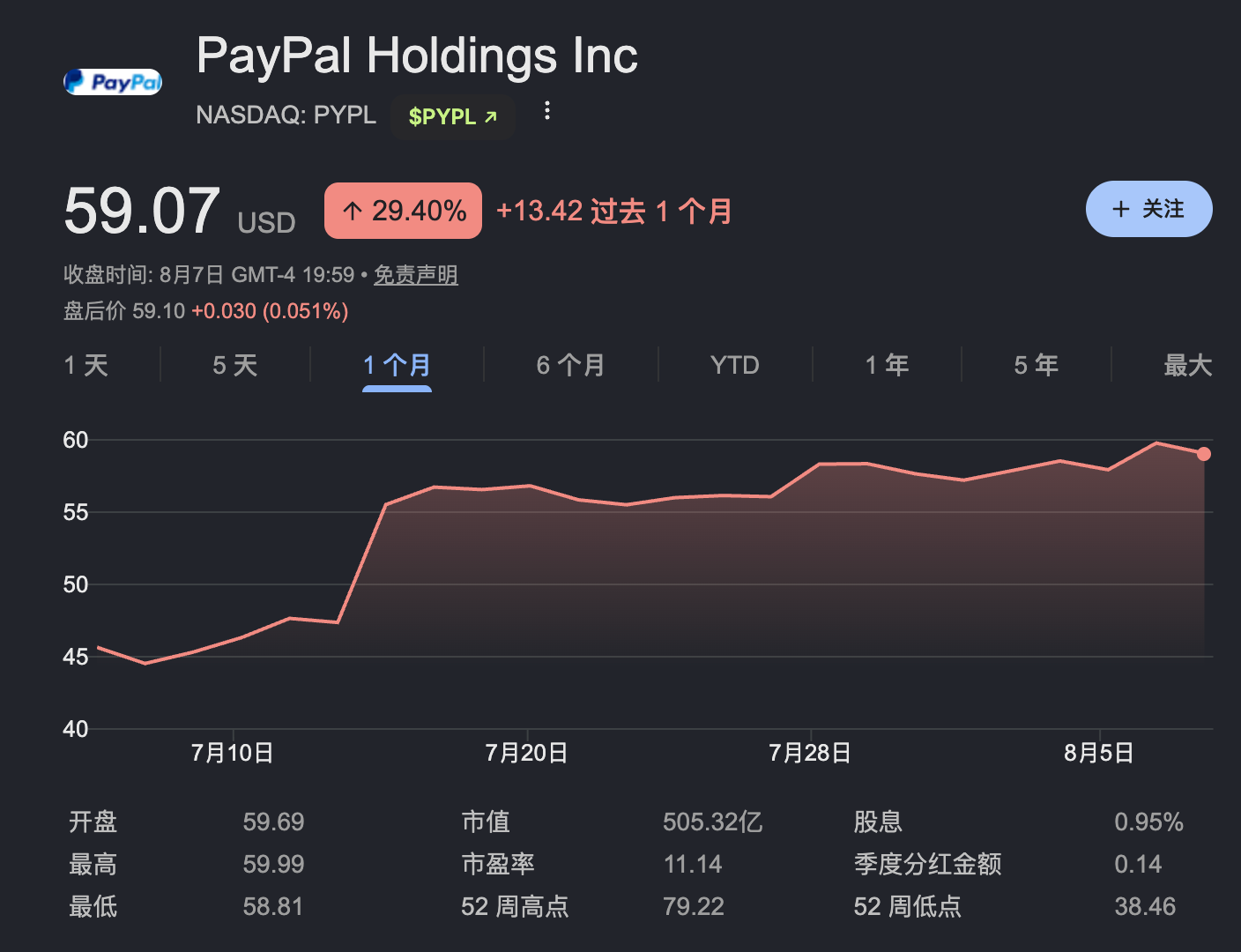
The stock price has been growing over the past month. Source: Google

But the story on the profit margin side is different. The GAAP operating margin decreased from 18.1% in the same period last year to 16.4%. The company attributed an $81 million net loss to strategic investments and crypto assets held for investment purposes, excluding it from non-GAAP results. In other words, crypto assets have already exerted some pressure on PayPal's reported profits. However, it's still difficult to conclude whether this loss is merely a temporary paper loss due to market declines or a cost the company is actively bearing to drive the expansion of related businesses.

At the same time, PayPal established a new "Payment Services & Crypto" department this quarter, placing PYUSD and merchant processing businesses under the same line. CEO Enrique Lores stated in the earnings call that the company plans to launch more merchant products powered by PYUSD and AI-driven agentic payments. PYUSD has been integrated into PayPal's core merchant payment system, no longer just a relatively independent innovation project. Compared to management's verbal emphasis on its "strategic value," this organizational restructuring better reflects PayPal's actual positioning of PYUSD.

However, the company has still not separately disclosed PYUSD's specific contributions to revenue, merchant retention, or transaction profit margins. Investors can only infer how much this stablecoin is truly driving performance from aggregate data and management's statements, making this the most critical information gap to track in the coming quarters.

The Strategic Significance of PYUSD for PayPal: Expanding Narrative and Contracting Supply

Since its issuance in August 2023, PYUSD has gone through a cycle of expansion and contraction along with the crypto market.

In March of this year, the company expanded its coverage to 70 markets, and its supply once surged to around $4.2 billion, with a year-on-year growth rate peaking at nearly 680%, making it the fastest-growing among mainstream stablecoins at the time. To date, PYUSD has been deployed on nine public chains including Ethereum, Solana, Arbitrum, Stellar, Avalanche, Aptos, Sei, Tron, and Abstract. PayPal also designated Solana as the default payment processing network in February this year.

On July 9th, PYUSD achieved a native launch via Polygon's Open Money Stack, integrating wallets, fiat on-ramps, compliance tools, and on-chain settlement capabilities, explicitly targeting enterprise-level cross-border payment scenarios. The PYUSDx framework, launched in collaboration with MoonPay, allows developers to issue application-specific stablecoins based on PYUSD reserves, attempting to position PYUSD as a foundational layer for others to build upon, rather than just an end-consumer product. Kraken also recently announced support for PYUSD deposits and withdrawals on the Stellar network, further expanding its presence on exchanges.

Putting these moves together sketches out the story PayPal wants to tell: PYUSD is evolving from a balance tool for PayPal users into a payment infrastructure layer that can be directly utilized by third-party wallets, exchanges, and developers.

In other words, in the future, when businesses plan to accept global payments, they could directly use or develop PYUSD-based payment collection tools to receive fees globally, without the lengthy customs declarations and foreign exchange processing required for fiat currencies, and without being limited to crypto-related users like other stablecoins. This is a scenario all import/export businesses dream of: All funds arrive in real-time, fees are lower than before, and the paying users hardly notice the process. The payer's fiat is converted to PYUSD in the backend and then converted again to another fiat currency for the recipient, with the entire process being rapid and convenient.

This is also why PYUSD is mentioned alongside AI in PayPal's earnings report. The company stated it is using machine learning to optimize fraud detection, reduce processing costs, and support automatic conversion between fiat and stablecoins based on exchange rates and user behavior.

However, on-chain data is less encouraging: After reaching a peak supply of around $4.2 billion in March, PYUSD's supply contracted by approximately 31% by the end of Q2, falling to around $2.7 billion. This is the first significant decline since issuance, mainly due to reduced reward incentives and capital rotation into other assets. As of early August, the circulating supply of PYUSD is about 2.7 billion tokens, with a market cap of approximately $2.72 billion, ranking around 32nd on CoinGecko's stablecoin rankings.
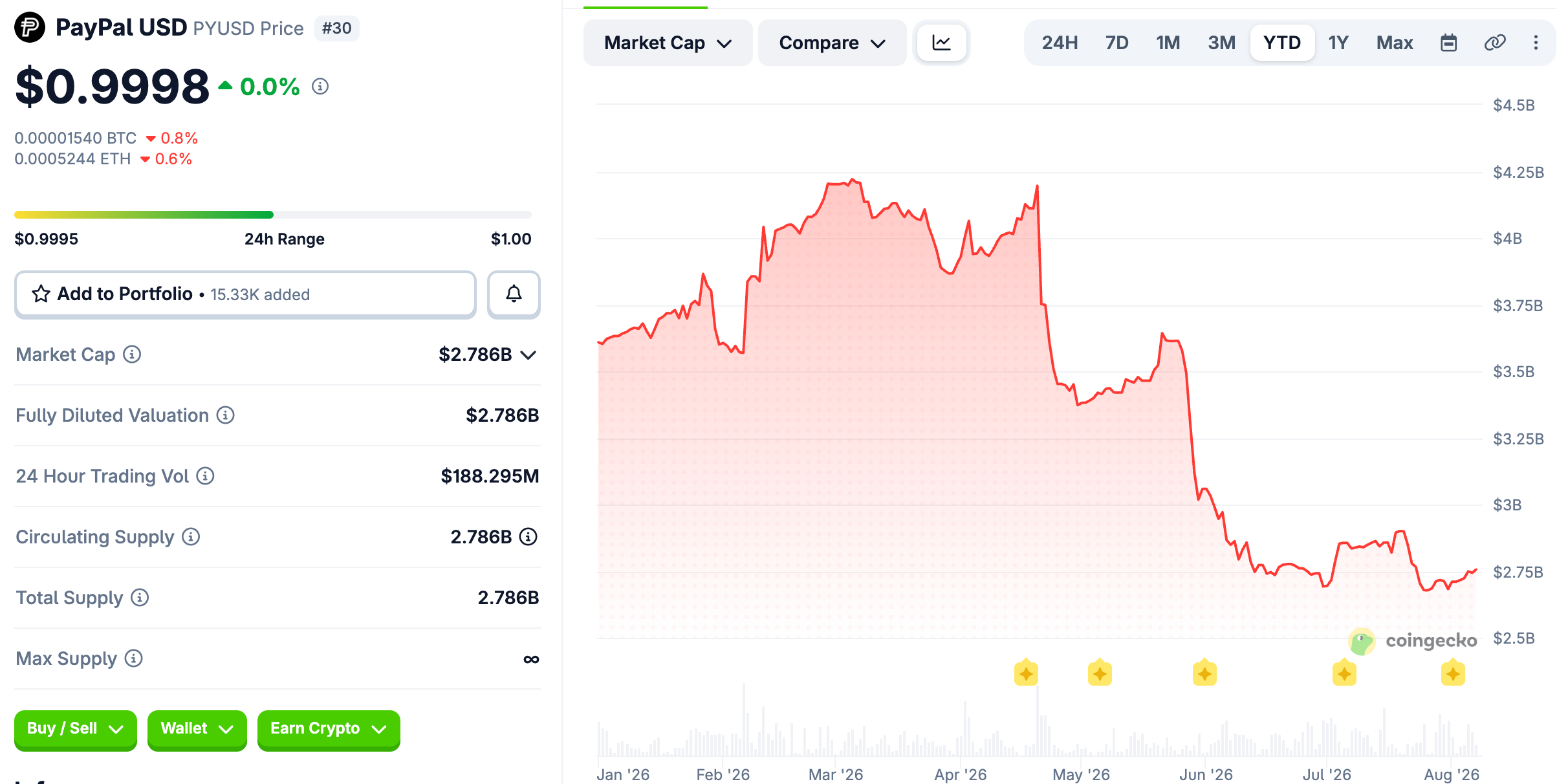
PYUSD's scale is declining. Source: Coingecko

This means that while the earnings narrative emphasizes the breadth of market coverage and chain integrations, the actual circulating supply contracted by nearly one-third during the same period. The coexistence of an expanding narrative and contracting supply reflects a harsh reality: unique market position and regulatory status (PYUSD is the first dollar stablecoin issued by a federally regulated entity, Paxos, a status further solidified when Paxos transitioned to OCC federal oversight by the end of 2025) do not necessarily translate into sustained demand for holding the token. When incentives were withdrawn, the initial volume did not transform into stable usage, and the competition with USDC still has a long way to go. If subsidies prove ineffective like early crypto industry tactics, PYUSD's current cake may not grow any larger.

PYUSD vs. Open USD: Why Did PYUSD Come Earlier But Have Less Influence?

If PYUSD represents the single-issuer model of stablecoins, then Open USD, which emerged on June 30th, represents a structurally different path, and its timing was just under a month before PayPal's Q2 earnings release.

Open USD is operated by a newly formed independent company, Open Standard, with its founding CEO being Zach Abrams, co-founder of Stripe's Bridge. It has over 140 signed partners, covering almost the entire roster of top names in payments and finance: payment networks like Visa and Mastercard; payment infrastructure like Stripe and Shopify; asset management and banking like BlackRock, BNY, and Standard Chartered; tech platforms like Google and IBM; and crypto-native players like Coinbase, Solana, and Aave. The project is expected to launch in the second half of 2026 and has not been officially issued yet.

The most fundamental difference between Open USD and PYUSD lies in their economic structure and governance model: Simply put, only PayPal profits from PYUSD, while everyone benefits from Open USD.

PYUSD follows the classic model used by USDT and USDC, with Paxos as the single issuer custodian holding reserve assets and earning floating income, and PayPal as the brand owner driving product roadmap and market strategy. Open USD, in contrast, makes minting and redemption completely free and without limits for partners. The income generated from reserve assets, after deducting minimal management fees, is returned to the partner institutions participating in distribution, rather than being monopolized by a single issuer. Governance power is also given to a board composed of partner institutions, not dictated by one company. As some industry commentary suggests, this is closer to the governance logic of interbank clearing networks like ACH or SWIFT, not that of today's USDC or USDT.

A detail easily overlooked but crucial for understanding PayPal's situation is that PayPal itself is one of the over 140 signatories of Open USD, even though PYUSD will continue to exist as an independently issued asset. This means PayPal has not fully tied itself to the PYUSD ship but has instead taken a position in both stablecoin models—continuing to bet on PYUSD as its proprietary branded asset while securing a seat in the potential future industry landscape through signing onto Open USD.

In contrast, Circle and Tether are absent from Open USD's partner list. Circle's stock price fell over 16% on the day of the announcement. Circle CEO Jeremy Allaire later publicly responded, emphasizing USDC's network effects and distribution depth, and cited Paxos's consortium-model stablecoin USDG as a precedent, pointing out that its supply only reached about $3 billion after more than two years since launch, far short of initial optimistic expectations.

Looking at these three together, the competitive landscape PayPal faces is becoming more complex. PYUSD, with its first-mover advantage, has built some brand recognition and multi-chain deployment foundation, but its absolute size is still only about one-twentieth of USDC, and recent signs show supply contraction. If Open USD successfully launches, its real threat is not in poaching PYUSD's existing holders but in its attempt to redefine the distribution economics of the entire industry. If distribution giants like Stripe, Visa, and Mastercard can share reserve income through a consortium model, the single-issuer stablecoin model could be entirely replaced.

By hedging its bets, PayPal, in a way, acknowledges this uncertainty. Rather than betting on one model winning out, it keeps a seat at both tables. For PYUSD, what truly needs to be proven in the coming quarters is not how many markets or chains it covers, but whether it can convert the established distribution network into sustained, subsidy-independent demand after incentives fade. If it ultimately fails to carve out this path, then the current $2.7 billion might be PYUSD's existing peak.


Трендовые криптовалюты

Связанные с этим вопросы

QHow has the supply of PYUSD changed over time, and what is its current standing in the stablecoin market according to the article?

AThe supply of PYUSD peaked around $4.2 billion in March but has since contracted by approximately 31%, falling to about $2.7 billion by the end of Q2. As of early August, its supply remains around $2.7 billion, ranking approximately 32nd in market capitalization among stablecoins.

QWhat is the fundamental difference between PayPal's PYUSD and the upcoming Open USD project in terms of their economic and governance models?

APYUSD follows a single-issuer model where the issuer (Paxos) manages reserves and earns income, with PayPal controlling strategy. Open USD uses a consortium model: issuance and redemption are free for partners, most reserve asset income is distributed back to partners, and governance is managed by a board of partner institutions.

QWhat role does PayPal's new 'Payment Services & Crypto' department play for PYUSD, and what future plans were mentioned in the earnings call?

AThe new department incorporates PYUSD into PayPal's core merchant payment system, indicating a strategic upgrade beyond an isolated project. The CEO mentioned plans to launch more merchant products powered by PYUSD and AI-driven 'agentic payments'.

QHow did PayPal's crypto assets and strategic investments impact its Q2 GAAP profitability, and how was this treated in the financial reporting?

AA net loss of $81 million was attributed to strategic investments and crypto assets held for investment purposes, which contributed to a decrease in GAAP operating margin. This loss was excluded from the company's non-GAAP financial results.

QDespite launching earlier and having a first-mover advantage, why does the article suggest PYUSD currently has less influence than Open USD might?

APYUSD's influence is limited by its smaller scale (roughly 1/20th of USDC's size) and recent supply contraction. The article suggests Open USD's consortium model, which shares economic benefits and governance among over 140 major partners like Visa and Google, could redefine the industry's economics and pose a more significant structural threat to single-issuer models like PYUSD.

Похожее

Сингапур делает ставку на преимущества искусственного интеллекта, в то время как Гонконг привлекает управляющих инвестициями снижением налогов

В соперничестве за привлечение управляющих инвестициями и финансовых талантов Сингапур и Гонконг применяют разные стратегии. Гонконг фокусируется на налоговых льготах для фондов и семейных офисов, стремясь сделать работу в регионе дешевле. Однако потенциальные налоговые преимущества могут подтолкнуть некоторых руководителей к переезду из Сингапура. В то же время Сингапур делает ставку на свои технологические преимущества, особенно в доступе к передовым моделям искусственного интеллекта как из США, так и из Китая (например, Moonshot, DeepSeek). Для количественных фондов, зависящих от сложных алгоритмов, этот доступ критически важен для конкурентоспособности. Технологический разрыв и ограничения на западные ИИ-модели в Китае уже побуждают некоторые гонконгские фонды рассматривать перенос ключевых операций в Сингапур. Ситуацию осложняют соображения безопасности данных и защиты интеллектуальной собственности. Нейтральный статус Сингапура в технологическом противостоянии США и Китая дает компаниям больше уверенности. Пример — решение хедж-фонда Citadel перевести ключевых сотрудников из Гонконга в Сингапур или Майами. Таким образом, конкуренция выходит за рамки налогов. Гонконг обладает сильными связями с материковым Китаем и развитыми рынками, а Сингапур позиционирует себя как технологический хаб. Для инвестиционных компаний выбор между более низкими налогами и лучшими технологиями будет определять, какой центр привлечет следующую волну талантов.

cryptonews.ru6 мин. назад

Сингапур делает ставку на преимущества искусственного интеллекта, в то время как Гонконг привлекает управляющих инвестициями снижением налогов

cryptonews.ru6 мин. назад

Биткоин-ETF потеряли почти $390 млн за неделю, пока SOL-ETF привлекали новый капитал

С 10 по 14 августа 2026 года спотовые биткоин-ETF в США столкнулись с совокупным оттоком капитала в размере $389,71 млн, согласно данным SoSoValue. Отток наблюдался в четыре из пяти торговых сессий недели, наибольший — из фондов FBTC (Fidelity) и GBTC (Grayscale). Лишь два биткоин-ETF, BTC (Grayscale) и MSBT (Morgan Stanley), зафиксировали приток средств. Сектор Ethereum-ETF также завершил неделю с чистым оттоком в $2,26 млн, где основные потери пришлись на фонды BlackRock и Fidelity. В отличие от них, ETF на базе альткоинов показали положительную динамику. Лидером стал SOL-ETF с притоком $10,26 млн, за которым следуют фонды на базе HYPE, XRP, LINK и HBAR. DOGE-ETF, напротив, зафиксировал небольшой отток. Активность на рынке Гонконга оставалась низкой. Ранее на прошлой неделе в различные криптофонды было привлечено более $1 млрд.

cryptonews.ru8 мин. назад

Биткоин-ETF потеряли почти $390 млн за неделю, пока SOL-ETF привлекали новый капитал

cryptonews.ru8 мин. назад

Внедрение криптовалют в ЕС приостановилось: ЕЦБ выявил, что доля их использования в Интернете составляет всего 0,2%

Последний опрос Европейского центрального банка (ЕЦБ) показал крайне низкий уровень внедрения криптовалют в еврозоне. Исследование, охватившее 8205 компаний, выявило, что наличные деньги остаются самым популярным способом оплаты (92% предприятий), опережая банковские карты (88%). Доля мобильных платежей значительно выросла. При этом криптовалюты практически не используются: лишь 0,2% компаний принимают их для онлайн-покупок, а среди предприятий с физическими точками продаж этот показатель составляет 1%. Это свидетельствует о медленном внедрении цифровых активов бизнесом, несмотря на признание их потенциальных преимуществ, таких как снижение издержек. ЕЦБ подчеркивает важность сохранения доступности наличных денег на фоне растущей автоматизации платежей. Хотя введение регулирования MiCA создало для платежных операторов чёткие рамки и возможности для разработки решений, этого пока недостаточно для ускорения адаптации криптовалют в Европе.

cryptonews.ru8 мин. назад

Внедрение криптовалют в ЕС приостановилось: ЕЦБ выявил, что доля их использования в Интернете составляет всего 0,2%

cryptonews.ru8 мин. назад

СМИ: Anthropic рассчитывает на доход до $200 млрд в 2028 году перед IPO

Компания Anthropic прогнозирует, что ее доход достигнет $190-200 млрд к 2028 году. Инвесторы оценивают компанию перед потенциальным IPO, используя этот будущий показатель и мультипликатор стоимости к доходу (EV/Revenue), что нетипично для размещений. Такой подход связан с масштабным ростом бизнеса: годовой темп дохода вырос с $9 млрд в конце 2025 года до более $47 млрд к маю 2026-го. Компания также ожидает первую квартальную операционную прибыль. Для оценки Anthropic инвесторы сравнивают ее с такими компаниями, как Palantir, Cloudflare и SpaceX, которые также оцениваются с прицелом на будущие финансовые показатели. Основной вызов для Anthropic — превратить огромные инвестиции в ИИ-инфраструктуру (вычислительные мощности, модели, персонал) в устойчивый рост доходов и прибыльности. Некоторые эксперты задаются вопросом о реальной экономической отдаче от ИИ и долгосрочной стабильности столь высокой оценки, которая, по предварительным данным, может превысить $1 трлн.

cryptonews.ru10 мин. назад

СМИ: Anthropic рассчитывает на доход до $200 млрд в 2028 году перед IPO

cryptonews.ru10 мин. назад

Бизнес открытого блокчейна: кому достаются комиссии и зачем нужен фонд

Статья разбирает экономику публичных блокчейнов на примерах Ethereum, Solana и Optimism. Основной тезис: комиссии, которые платит пользователь, не равны «выручке проекта». Деньги распределяются по-разному: часть сжигается, часть достаётся валидаторам, фонды развития (как Ethereum Foundation) часто финансируются из собственных резервов, а не из комиссий. Объясняется, куда уходят комиссии в Ethereum (сжигание базовой части, доплата валидатору) и Solana (половина сжигается, половина — валидатору). Фонды живут на казначейства, доход от стейкинга или гранты. Разработчики могут зарабатывать на сервисах вокруг открытого кода (как OP Enterprise от Optimism), а не на продаже технологии. Также рассматривается модель Optimism, получающего доход от сетей, построенных на его основе (например, Base), и новая программа выкупа токена OP. Подчёркивается, что рост комиссий не гарантирует выгоды держателям токена — всё зависит от механизмов распределения (стейкинг, сжигание, выкуп). Для оценки проекта важно понимать: кто платит, кто получает комиссии, как связан доход с токеном. Иначе одинаковые суммы комиссий в разных сетях могут иметь совершенно разный экономический смысл.

cryptonews.ru11 мин. назад

Бизнес открытого блокчейна: кому достаются комиссии и зачем нужен фонд

cryptonews.ru11 мин. назад

Торговля

Спот

Популярные статьи

Как купить S

Добро пожаловать на HTX.com! Мы сделали приобретение Sonic (S) простым и удобным. Следуйте нашему пошаговому руководству и отправляйтесь в свое крипто-путешествие.Шаг 1: Создайте аккаунт на HTXИспользуйте свой адрес электронной почты или номер телефона, чтобы зарегистрироваться и бесплатно создать аккаунт на HTX. Пройдите удобную регистрацию и откройте для себя весь функционал.Создать аккаунтШаг 2: Перейдите в Купить криптовалюту и выберите свой способ оплатыКредитная/Дебетовая Карта: Используйте свою карту Visa или Mastercard для мгновенной покупки Sonic (S).Баланс: Используйте средства с баланса вашего аккаунта HTX для простой торговли.Третьи Лица: Мы добавили популярные способы оплаты, такие как Google Pay и Apple Pay, для повышения удобства.P2P: Торгуйте напрямую с другими пользователями на HTX.Внебиржевая Торговля (OTC): Мы предлагаем индивидуальные услуги и конкурентоспособные обменные курсы для трейдеров.Шаг 3: Хранение Sonic (S)После приобретения вами Sonic (S) храните их в своем аккаунте на HTX. В качестве альтернативы вы можете отправить их куда-либо с помощью перевода в блокчейне или использовать для торговли с другими криптовалютами.Шаг 4: Торговля Sonic (S)С легкостью торгуйте Sonic (S) на спотовом рынке HTX. Просто зайдите в свой аккаунт, выберите торговую пару, совершайте сделки и следите за ними в режиме реального времени. Мы предлагаем удобный интерфейс как для начинающих, так и для опытных трейдеров.

2.0k просмотров всегоОпубликовано 2025.01.15Обновлено 2026.06.02

Как купить S

Sonic: Обновления под руководством Андре Кронье – новая звезда Layer-1 на фоне спада рынка

Он решает проблемы масштабируемости, совместимости между блокчейнами и стимулов для разработчиков с помощью технологических инноваций.

2.5k просмотров всегоОпубликовано 2025.04.09Обновлено 2025.04.09

Sonic: Обновления под руководством Андре Кронье – новая звезда Layer-1 на фоне спада рынка

HTX Learn: Пройдите обучение по "Sonic" и разделите 1000 USDT

HTX Learn — ваш проводник в мир перспективных проектов, и мы запускаем специальное мероприятие "Учитесь и Зарабатывайте", посвящённое этим проектам. Наше новое направление .

2.0k просмотров всегоОпубликовано 2025.04.10Обновлено 2025.04.10

HTX Learn: Пройдите обучение по "Sonic" и разделите 1000 USDT

Обсуждения

Добро пожаловать в Сообщество HTX. Здесь вы сможете быть в курсе последних новостей о развитии платформы и получить доступ к профессиональной аналитической информации о рынке. Мнения пользователей о цене на S (S) представлены ниже.

活动图片