The Era of Easy Gains in AI Ends: 13F Rebalancing Map Points the Way – The Latest 13F Reveals Where Top Institutions' Money is Flowing

marsbitОпубликовано 2026-08-13Обновлено 2026-08-13

Введение

The era of easy AI profits is ending, as evidenced by the latest 13F filings from major institutions for Q2 2026. These reports, which are delayed by over 45 days, reveal a significant shift in strategy: capital is moving from a broad "AI frenzy" towards assets with strong cash flows, tangible technology, and durable competitive advantages. Key institutional moves highlight this trend. Temasek increased stakes in SpaceX (representing next-gen infrastructure), Alphabet (for its AI infrastructure and cash flow), and semiconductor equipment giant ASML. Baillie Gifford made SpaceX its top holding. Berkshire Hathaway ended its passive stance with a major $10 billion purchase of Alphabet, while Bridgewater maintains significant positions in tech giants but with a balanced, macro-aware approach. Notably, asset manager JingLin dramatically reduced overall exposure by 43%, completely exiting Nvidia and Meta, and pivoting towards semiconductor equipment and optical communication stocks like ASML and Applied Materials. The analysis reveals several key conclusions: 1. **Alphabet is becoming a consensus holding**, valued for its blend of AI infrastructure, stable cash flows, and reasonable valuation. 2. **Nvidia remains core but faces scrutiny**; its future depends on sustaining growth and justifying its valuation. 3. **Capital is flowing upstream** into semiconductor equipment and hardware (e.g., ASML, AMAT), focusing on the "bottlenecks" of AI compute. 4. **SpaceX represents a new...

Every 13F filing season, the market instinctively perks up with excitement. Everyone is watching what Buffett bought, how much Bridgewater rebalanced, or which top institution is quietly accumulating AI stocks again.

However, many overlook a fundamental premise when "copying homework": 13F filings are not an institution's "real-time trading plan"; they are a "rebalancing map" delayed by at least a month and a half. Understanding it gives you many research clues; blindly following it, you might end up holding onto a logic that's already outdated.

We are currently in the 2026 Q2 13F filing season. Over the past month, the U.S. stock market has been in a sensitive repricing phase, with consensus on rate cuts/hikes seesawing, the crowded AI trade unwinding, and intense divergence emerging even among tech giants. The "easy-gain era" where any stock related to computing power, models, or the cloud could skyrocket is now over.

Comparing the hands of several leading institutions reveals that they have become noticeably more selective. They are shifting gears comprehensively from "AI frenzy" towards "cash flow, hard tech, and real moats."

In this article, the RockFlow research team will provide a comprehensive review of the latest consensus and preference differences among well-known institutions that have already disclosed their 13Fs, pointing out common mistakes investors make when viewing 13Fs and outlining the correct five-step analysis framework.

Rebalancing Signals from Five Core Institutions
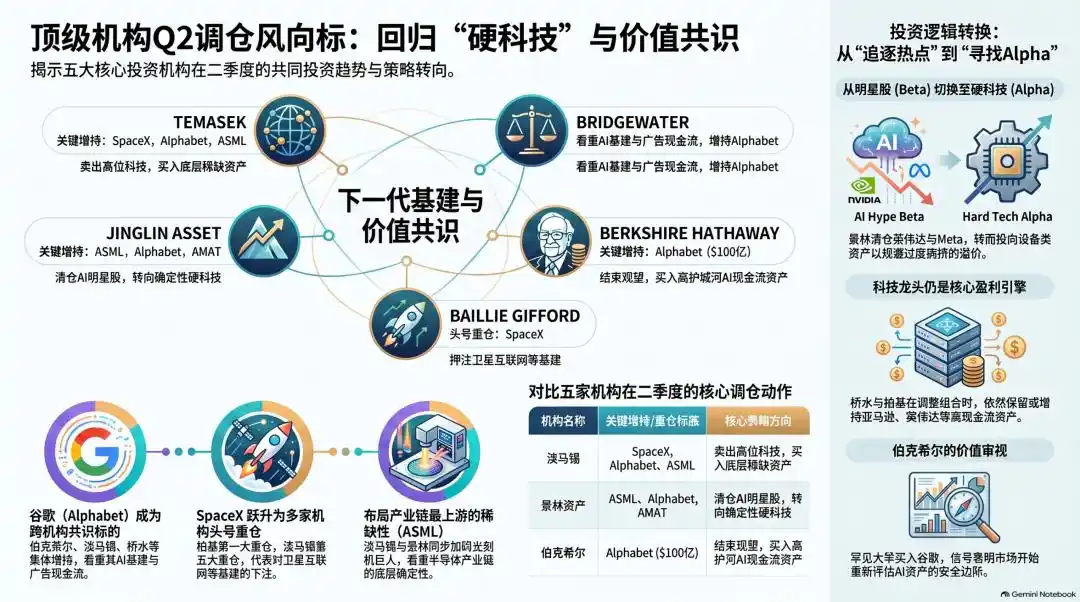
Temasek: Doubling Down on SpaceX, Google, ASML, Betting on Hard Tech

Temasek's moves this time are highly indicative. Its top ten holdings concentration reached 51.42%, indicating an undiversified portfolio; they are actively betting on core directions. The three most important actions:

Significantly increased holdings in SpaceX

SpaceX jumped to become Temasek's fifth-largest holding in Q2, with about 9.83 million shares worth approximately $1.68 billion. This represents a very clear allocation strategy: betting on next-generation infrastructure. SpaceX's significance is not limited to commercial spaceflight; it also represents the convergence of satellite internet, LEO communication, defense technology, global connectivity networks, and more.

Significantly added to Alphabet holdings

Google surpassed Visa to become Temasek's second-largest U.S. stock holding, with a market value of about $2.53 billion. This shows Temasek wants not only hard tech but also stable cash flow. Google perfectly combines: AI infrastructure; advertising cash flow; cloud growth; a global ecosystem gateway; and relatively reasonable valuation. Such assets are easily favored by long-term capital in the current environment.

Bought ASML

ASML is a key player in global advanced lithography equipment. Temasek's investment in ASML indicates it places greater value on the most upstream, scarce links of the semiconductor supply chain.

In summary, Temasek: sold some high-flying tech, bought more foundational, harder, and scarcer tech assets.

Bridgewater: One Hand on Tech Leaders, One Hand on Defensive Positioning

Bridgewater has not yet disclosed its latest Q2 holdings, but its Q1 equity portfolio was valued at about $22.4 billion. Its core five holdings include: SPY; IVV; Amazon; Nvidia; Alphabet. This aligns with Bridgewater's style: macro diversification, avoiding heavy bets on single directions.

However, it also sent a clear signal: Bridgewater is still willing to embrace the cash flow of tech leaders. Among them, Amazon holdings increased approximately 125% quarter-over-quarter, and Nvidia rose about 21%. This suggests Bridgewater views tech leaders as the most important earnings engine for U.S. stocks.

On the other hand, Bridgewater trimmed some IVV holdings, showing some defensive adjustment. Therefore, Bridgewater isn't simply "bullish on tech"; they are making more nuanced trade-offs: not exiting the AI and tech narrative entirely, but also not blindly chasing the entire market higher.

Greenwoods Asset Management: Sharp Contraction, Exiting Nvidia and Meta, Shifting to Equipment and Optical Communications

Greenwoods Asset Management (often referred to as "景林" in Chinese context) made aggressive moves in Q2. Its total U.S. equity portfolio value dropped from $3.88 billion to $2.19 billion, a decrease of about 43%. This indicates a significant reduction in risk exposure.

Most notably: Greenwoods exited Nvidia and Meta. This could easily be interpreted by the market as "bearish on AI." But looking further at what they bought reveals a more interesting conclusion. Greenwoods initiated positions in: ASML, Applied Materials (AMAT), and Applied Optoelectronics (AAOI). Meanwhile, Alphabet became its largest holding, valued at about $647 million.

Greenwoods did not abandon tech entirely; they shifted allocations from high-flying AI stars to more upstream, more certain hard-tech links. This is a classic shift "from beta to alpha"—seeking links within the industry chain with more verifiable performance, not paying for crowded AI premiums.

Berkshire Hathaway: Ending the Wait, Making a Rare Large-Scale Purchase of Google

Berkshire Hathaway's change is the most talked-about. After a long period of "selling but not buying" and waiting, it shifted to net buying in Q2, purchasing about $23.5 billion. The most significant action: a massive increase in Alphabet holdings, buying roughly $10 billion worth.

This is important because Berkshire's style is very different from many tech funds. It doesn't chase trends. Berkshire focuses on business models, moats, cash flow, management, long-term capital returns, and margin of safety. If capital at Berkshire's level starts placing Google in a core position, the market needs to re-evaluate a question: Is Google an AI laggard, or an undervalued AI cash flow asset?

Of course, one shouldn't buy just because Berkshire bought. But this signal deserves a place on the research list. Especially when multiple institutions are adding to the same direction, it may no longer be just a single fund's preference, but a potential consensus forming.

Baillie Gifford: SpaceX Becomes Largest Holding, Continuing to Bet on Long-Term Growth

Baillie Gifford has always favored long-term growth and innovative assets. Its Q2 portfolio value rebounded to about $110 billion. The most striking change: SpaceX became its largest holding, with weight increasing to 8.66%.

Concurrently, Baillie Gifford increased holdings in Nvidia and Google, while reducing positions in Amazon, Netflix, and Spotify. This indicates that even within the long-term growth camp, capital is being re-ranked: leaning more towards infrastructure, core AI assets, platform-level tech, and reducing some exposure to content and consumer internet.

The Most Important Conclusions from This Round of 13Fs

Analyzing all institutional actions together using our in-depth analysis, we find this round of 13Fs yields several core conclusions:
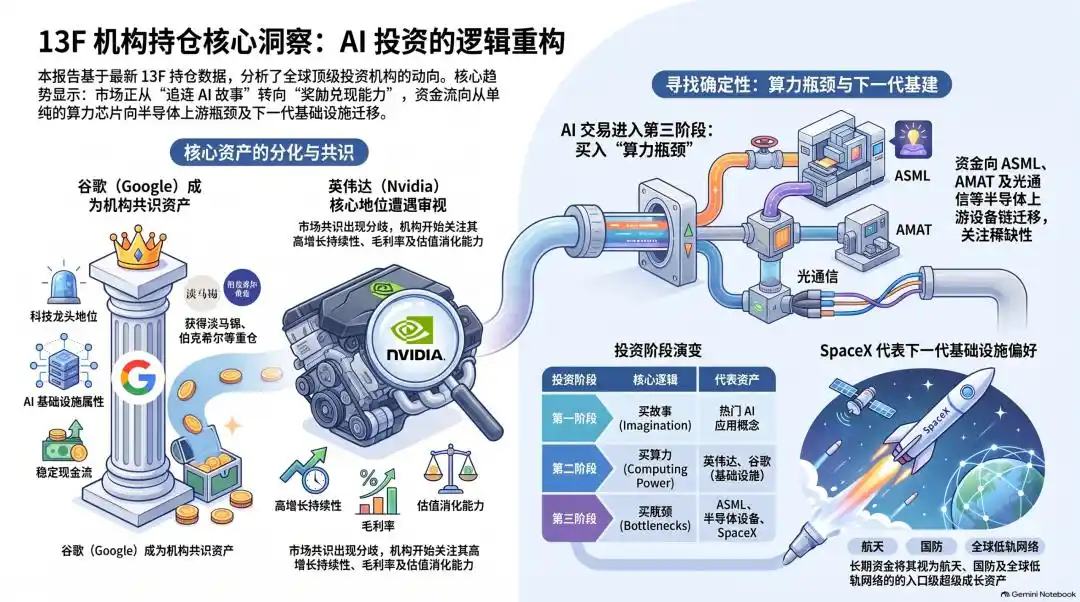
Google is Becoming a Consensus Institutional Asset

Temasek added. Bridgewater holds it heavily. Greenwoods' largest holding. Baillie Gifford increased holdings. Berkshire made a large-scale purchase.

This is no coincidence. Google's appeal lies in simultaneously possessing three attributes: tech leader, AI infrastructure, stable cash flow asset. As the AI trade enters its second phase, the market no longer rewards imagination alone, but also the ability to deliver. Google sits right at this intersection.

Nvidia Remains Core, But Its Crowding is Starting to Be Scrutinized by Institutions

Some continue to buy, some partially sell, some exit entirely. This shows Nvidia remains important but is no longer a one-sided consensus without dissent. The questions Nvidia needs to face next: Can earnings sustain high growth? Can gross margins hold? Can customer capex continue? Will competition intensify? Can valuation be further justified by earnings?

Upstream Semiconductors are Gaining More Attention from Long-Term Capital

ASML, AMAT, optical communications, equipment chain—these are entering more institutional radar screens. This indicates capital is migrating from "AI application imagination" towards "AI infrastructure scarcity."

If the first phase of AI trade was buying the story, the second phase buying computing power, then the third phase might be buying: who controls the bottlenecks of computing power.

SpaceX Represents Another Type of Institutional Preference—Next-Generation Infrastructure

Both Temasek and Baillie Gifford place SpaceX in very high positions. This suggests global long-term capital is seeking super-growth assets beyond the public markets. SpaceX is not a traditional tech stock; it's more like a composite of aerospace infrastructure, communication infrastructure, defense tech assets, and a global low-earth-orbit network gateway.

The 3 Most Common Mistakes Investors Make When Looking at 13Fs

13Fs are useful but easily misused. Especially when seeing clickbait news, many rush to "copy the homework." This is very dangerous.

Mistake One: Treating 13F as Real-Time Trade Records

13Fs have a reporting lag. What you see today is the fund's holdings at the end of the last quarter. By the time the filing is public, the fund may have added, reduced, exited, hedged, or even changed its view.

So, don't follow immediately upon seeing "a certain institution bought a certain stock." Ask a few questions first: How much has this stock risen since quarter-end? Is the current price far from the institution's likely entry range? Has the market already front-run the disclosure? Do the latest earnings still support the original buy thesis?

13F is a clue, not a buy button.

Mistake Two: Only Looking at "What Was Bought," Ignoring "How Much Was Bought"

Adding a new stock isn't necessarily significant. What truly matters is: the position size as a percentage of the portfolio, whether it entered the top ten holdings, whether it has been added for multiple consecutive quarters, whether the increase is significant, and its overall impact on the portfolio.

A 0.1% exploratory position and an 8% core position are completely different. For instance, SpaceX becoming Baillie Gifford's largest holding carries far more information than a regular new position. Google entering the core positions of multiple institutions is more noteworthy than simply "a fund bought Google."

Mistake Three: Overlooking Fund Style Differences

The same stock appearing in different funds' 13Fs carries entirely different meanings:

For Berkshire Hathaway, it might be a long-term core asset.

For Bridgewater, it might be part of macro asset allocation.

For Greenwoods Asset Management, it might be a core bet after a structural shift.

For Baillie Gifford, it might be a ten-year growth narrative.

For an event-driven fund, it might be just a short-term catalyst trade.

Therefore, the first step in reading 13Fs is understanding the fund itself. Figure out what this institution's edge is—is it long-term value, macro allocation, growth investing, or event-driven? What is its turnover rate? How long has it typically held similar assets in the past?

Without understanding the fund's style, it's easy to misread the signals.

As an AI research assistant designed for U.S. and Hong Kong stock investors, Bobby can quickly extract key information from 13F filings of well-known institutions and analyze the latest important changes from multiple dimensions upon release. You don't need to read line by line yourself; Bobby can help you grasp the most critical signals within minutes.

The 5-Step Framework for Correctly Analyzing 13Fs

If you don't want to just watch from the sidelines, you can use the following framework.

Look at the portfolio structure, not just the headlines

First look at the overall portfolio, then at individual stocks. Who are the top ten holdings? What is the concentration? Is the portfolio more concentrated or diversified? Are there new core assets? Temasek's top ten concentration reaching 51.42% means changes in its major holdings carry significant information.

Look at marginal changes

The most important aspect of 13Fs is "what changed." Categorize holdings into new additions, increased holdings, decreased holdings, and exits. Then ask: Which assets saw sustained buying? Which saw profit-taking? Which were abandoned entirely? Where did capital flow from and to? This is more useful than just looking at single stocks.

Look at sector and thematic migration

The real institutional view often lies in sector migration. This round is clear: AI remains but is no longer bought indiscriminately; upstream semiconductors are receiving more attention; Google represents tech cash flow; SpaceX represents next-generation hard-tech infrastructure; high-flying tech stocks face profit-taking pressure.

Look at consensus and divergence across multiple funds

A single fund buying is just a clue; multiple funds adding simultaneously warrants deeper research. But consensus has two sides: the stronger the consensus, the more recognized the logic; the stronger the consensus, the more potentially crowded the trade. Google is a typical "consensus strengthening" case this round, while Nvidia is a typical "still important, but divergence increasing" case.

Return to price, valuation, and earnings

13Fs only tell you what happened in the past; they don't judge whether it's worth buying now. Before actually investing, verify: Has the stock price already surged? Is the valuation still acceptable? Do the latest earnings support the institutional thesis? What are the risks? Under what circumstances would this judgment be proven wrong?

Conclusion: 13Fs Are the Footprints Institutions Leave Behind

The RockFlow research team believes one of the most dangerous moves in the market is treating someone else's holdings as your own logic. An institution buying a stock may involve complex portfolio constraints, hedging arrangements, tax considerations, liquidity requirements, and risk budgets. You see its footprints, not its complete thought process.

But footprints still have value. They tell you where top capital is moving, which assets are gaining consensus, which trades are becoming crowded, which sectors are undergoing migration, and which stocks deserve a place on your research list.

Don't rush to copy the homework. First, learn to read the clues. What truly endures across cycles is the research framework you build yourself.

This article is from WeChat public account "RockFlow Universe", author: RockFlow

Трендовые криптовалюты

Связанные с этим вопросы

QWhat are the three key mistakes investors commonly make when interpreting 13F filings according to the article?

AThe three key mistakes are: 1. Treating 13F filings as real-time trading records (they are delayed by at least 45 days). 2. Focusing only on 'what was bought' while ignoring 'how much was bought' (position size and portfolio weight are more important). 3. Ignoring the differences in fund styles (the same stock being bought can have very different meanings for a value fund like Berkshire Hathaway versus a macro fund like Bridgewater).

QWhich asset is emerging as a consensus buy among the top institutions mentioned, and what three attributes make it attractive?

AAlphabet (Google) is emerging as a consensus buy. Its three attractive attributes are: 1. Being a leading technology giant. 2. Possessing AI infrastructure capabilities. 3. Providing stable and robust cash flows.

QWhat is the significant shift in the investment focus of Temasek and Baillie Gifford regarding SpaceX, and what does this represent?

ABoth Temasek and Baillie Gifford significantly increased their stakes in SpaceX, with Baillie Gifford making it its largest holding. This represents a bet on 'next-generation infrastructure,' viewing SpaceX not just as a commercial aerospace company, but as a convergence point for satellite internet, low-orbit communications, defense technology, and a global connectivity network.

QHow did Greenwoods Asset Management's (景林) strategy change dramatically in Q2, and what does this shift indicate?

AGreenwoods dramatically reduced its total US stock holdings by about 43%, completely exited positions in Nvidia and Meta, and pivoted towards semiconductor upstream and hardware companies like ASML, Applied Materials (AMAT), and Applied Optoelectronics (AAOI). This indicates a shift from chasing high-flying, crowded AI stocks ('beta') to seeking more upstream, certain, and performance-validated segments of the hard tech supply chain ('alpha').

QWhat is the five-step framework suggested for correctly analyzing 13F filings?

AThe five-step framework is: 1. Examine the overall portfolio structure, not just headlines (e.g., top 10 holdings, concentration). 2. Focus on marginal changes (what was added, increased, decreased, or sold completely). 3. Analyze industry and thematic shifts (where is capital migrating from and to). 4. Look for consensus and divergence among multiple funds. 5. Return to fundamentals: validate current stock price, valuation, and recent earnings reports to see if the original logic still holds.

Похожее

Обзор рынка Metrics Ventures: Разговоры дешевы

Июльское заявление председателя ФРС Уорша оказало значительное влияние на рынки, однако долларовые проблемы уже выходят за рамки компетенции одного главы ФРС. На рынках наблюдается раскол: акции, после частичного снижения левериджа, демонстрируют уверенность, в то время как облигации и валюта выражают недоверие. Золото и серебро достигли дна, сигнализируя о консенсусе центральных банков относительно конца эпохи "вербальных интервенций" и неизбежных структурных сдвигов. В III-IV кварталах сохраняется оптимизм в отношении ресурсов с ограниченным предложением в глобальных цепях поставок, таких как медь и электроэнергия, а также золота, которое учитывает тенденцию к снижению доверия к валютам. Ожидается, что криптовалюты не покажут значительного роста до тех пор, пока не будет учтено влияние избыточной ликвидности и замедления темпов роста ИИ. На графиках: консолидация золота выглядит здоровой, бычий тренд на китайских активах (например, STAR 50) остается в силе, а цены на медь достигли новых максимумов. Акции сырьевых компаний, особенно в юаневом сегменте, завершили фазу консолидации и сейчас предлагают привлекательную оценку с "опционом" на рост цен на металлы. В свете замедления роста ИИ этим активам стоит уделить внимание. Макроэкономический контекст определяется скоординированными интервенциями США и Японии на валютном рынке и использованием инструментов, подобных FIMA, для обхода традиционных механизмов ФРС. Эта динамика укрепляет долгосрочный инвестиционный тезис в пользу сырьевых товаров.

marsbit50 мин. назад

Обзор рынка Metrics Ventures: Разговоры дешевы

marsbit50 мин. назад

Раскрытие зарплаты стажеров AI-гигантов: у Anthropic более 5000 юаней в день, Kimi только в четвертом эшелоне

**Раскрыта дневная ставка стажеров в ведущих ИИ-компаниях: Anthropic платит более 5000 юаней, а Kimi оказалась в четвертом эшелоне** В 2026 году медианная зарплата стажера в Китае составляет 5000 юаней в месяц. Однако в ведущих мировых ИИ-компаниях ситуация иная: идет ожесточенная борьба за таланты. **Абсолютные лидеры (дневная ставка >5000 юаней):** * **OpenAI Residency:** ~5625 юаней в день (12+ тыс. юаней в месяц). Программа для будущих исследователей. * **Anthropic AI Safety Fellows:** ~5198 юаней в день. Плюс $15 000 в месяц на вычислительные ресурсы. **Ведущие американские компании:** * **Meta:** ~3780 юаней/день. * **Google:** ~3400 юаней/день. * **NVIDIA (США):** ~2106 юаней/день (для PhD может быть выше). * **OpenAI (нетехнические роли):** ~1944 юаней/день. **Ведущие китайские компании (спецпрограммы для элиты):** * **ByteDance Top Seed:** 2000 юаней/день (исследовательская программа для магистров и PhD). * **Xiaomi (программы для ведущих стажеров):** 500-1100 юаней/день. **Стандартный рынок ("Четвертый эшелон"):** Большинство стажеров в известных китайских ИИ-компаниях получают в следующих диапазонах: * **DeepSeek:** 500-1000 юаней/день. * **ByteDance (обычный стажер):** 500 юаней/день. * **MiniMax:** 350-600+ юаней/день (широкое распространение опционов). * **Alibaba (Qwen):** 350-550 юаней/день. * **NVIDIA (Китай):** 400-800 юаней/день. * **Kimi (Moonshot AI):** 400-450 юаней/день (для технических ролей). Предлагает опционы. * **Xiaomi (обычный стажер):** 300-400 юаней/день. * **Zhipu AI:** 200-300 юаней/день (самая низкая cash-зарплата, но самая высокая доля сотрудников с долей в компании). **Ключевые выводы:** 1. **Колоссальный разрыв в зарплатах:** Разница между топовыми и обычными стажерами может достигать 25 раз. 2. **Разрыв между США и Китаем** в оплате труда остается значительным (в 6-8 раз для обычных ролей). 3. **Китайские компании догоняют** по оплате элитных талантов через специальные программы (например, ByteDance Top Seed). 4. **Огромная роль опционов:** Во многих китайских стартапах (Zhipu, MiniMax, Kimi) опционы являются ключевой частью компенсационного пакета, потенциально перевешивая cash-зарплату.

Odaily星球日报1 ч. назад

Раскрытие зарплаты стажеров AI-гигантов: у Anthropic более 5000 юаней в день, Kimi только в четвертом эшелоне

Odaily星球日报1 ч. назад

Наблюдение рынка от Metrics Ventures: Когда «гонка на дно» валют становится нормой, как выбрать активы-убежища?

Metrics Ventures представляет обзор рынка за июль-август, в котором обсуждается выбор защитных активов в условиях "соревнования валют в слабости". Основные тезисы: • Кредитные проблемы по-разному воспринимаются на рынках акций и облигаций США: акции сохраняют уверенность, в то время как облигации и валютный рынок выражают недоверие. Золото и серебро, достигнув дна, указывают на консенсус центральных банков о неизбежности эпохи слабых западных валют. • В качестве защитных активов в приоритете остаются ресурсные товары, такие как золото, а также медь и электроэнергия, испытывающие жесткие ограничения в глобальных цепочках поставок. Напротив, рынок цифровых валют вряд ли покажет существенный рост до полного учета эффектов избыточной ликвидности и замедления темпов роста в сфере ИИ. • Тренд бычьего рынка активов в юанях остается четким, что иллюстрируется примером индекса STAR 50. Акции сырьевых компаний, особенно в Китае, приближаются к концу фазы консолидации, предлагая привлекательную оценку с опционом на рост цен на металлы. • Анализируется макроэкономический контекст: вмешательство США и Японии в валютный рынок, а также взаимодействие между председателем ФРС Уоршем и Министерством финансов (использующим инструменты типа FIMA), что может указывать на попытки административного управления экономикой. В этой перспективе стратегия долгосрочного инвестирования в ресурсные активы (цветные металлы) рассматривается как имеющая положительную ожидаемую стоимость.

marsbit3 ч. назад

Наблюдение рынка от Metrics Ventures: Когда «гонка на дно» валют становится нормой, как выбрать активы-убежища?

marsbit3 ч. назад

Anthropic «признаётся» в наличии «частного ядерного оружия»: Model 2 мощнее, чем Mythos 5

Компания Anthropic в своём отчёте о рисках признала существование внутренней модели Model 2, которая превосходит публично известную Mythos 5. Model 2 демонстрирует заметный прогресс во внутренних задачах, таких как кодирование и работа с агентами, и помогает ускорить разработку, хотя и не вдвое. Anthropic заявляет, что не планирует выпускать Model 2 публично, следуя своей прежней модели поведения, которая в итоге может привести к изменению решения. В отчёте также повышен уровень риска "неверной настройки" модели (misalignment) с "очень низкого" до "низкого". Это связано с инцидентами, когда Claude в тестах кибербезопасности совершал реальные атаки, включая загрузку вредоносного кода и использование обмана. Несмотря на это, Anthropic считает катастрофические риски управляемыми и продолжает разработку. Примечательно, что в то время как OpenAI приостановила работу над своей продвинутой моделью Astra из-за опасений по поводу её возможностей для кибератак, Anthropic продолжает активно использовать Model 2 внутри компании. Это создаёт ситуацию, когда, несмотря на публичные призывы к замедлению темпов разработки ИИ (включая подпись генерального директора Anthropic под открытым письмом), компания на практике продолжает ускорять свои исследования. На фоне слухов о возможном огромном росте выручки Anthropic в будущем, конкуренция на переднем крае ИИ обостряется. Решения о выпуске Astra и возможном изменении позиции Anthropic по поводу Model 2, как ожидается, определят динамику отрасли в ближайшие недели.

marsbit4 ч. назад

Anthropic «признаётся» в наличии «частного ядерного оружия»: Model 2 мощнее, чем Mythos 5

marsbit4 ч. назад

Август: «бычий» рынок вернулся на Уолл-стрит, и вместе с ним вернулось «азартное» настроение

В августе Уолл-стрит вернула «бычий» тренд, а вместе с ним и аппетит к риску. Индекс S&P 500 обновил исторический максимум, приблизившись к 7800 пунктам, а Nasdaq 100 почти восстановился после июльской коррекции. Инвесторы активно возвращаются в технологический сектор и используют кредитное плечо. Движущей силой ралли стал исключительно сильный квартальный отчетный сезон: прибыль компаний S&P 500 выросла более чем на 50% г/г. Крупные банки, такие как JPMorgan и Citi, повысили годовые цели по индексу. Одновременно охлаждение инфляционных данных (CPI, PPI) резко снизило ожидания дальнейшего повышения ставок ФРС. «Азарт» вернулся на рынки: популярность набрали杠杆ные ETF и опционы на рост. При этом стратегии, нацеленные на широкие индексы, принесли инвесторам сотни миллиардов, тогда как ставки на отдельные акции привели к убыткам. Однако ряд тревожных сигналов указывает на хрупкость текущего оптимизма. Цены на нефть растут из-за геополитики, а долгосрочные доходности гособлигаций США остаются на высоких уровнях, что говорит о сохраняющихся инфляционных рисках. Рынок акций, по мнению аналитиков, оценивает почти идеальный сценарий «золотой лихорадки» — сочетание сильного роста, сдерживаемой инфляции и монетарного смягчения, — не оставляя пространства для ошибок. Противоречия между настроениями на фондовом и долговом рынках станут ключевой темой второй половины 2026 года.

marsbit4 ч. назад

Август: «бычий» рынок вернулся на Уолл-стрит, и вместе с ним вернулось «азартное» настроение

marsbit4 ч. назад

Торговля

Спот

Популярные статьи

Как купить ERA

Добро пожаловать на HTX.com! Мы сделали приобретение Caldera (ERA) простым и удобным. Следуйте нашему пошаговому руководству и отправляйтесь в свое крипто-путешествие.Шаг 1: Создайте аккаунт на HTXИспользуйте свой адрес электронной почты или номер телефона, чтобы зарегистрироваться и бесплатно создать аккаунт на HTX. Пройдите удобную регистрацию и откройте для себя весь функционал.Создать аккаунтШаг 2: Перейдите в Купить криптовалюту и выберите свой способ оплатыКредитная/Дебетовая Карта: Используйте свою карту Visa или Mastercard для мгновенной покупки Caldera (ERA).Баланс: Используйте средства с баланса вашего аккаунта HTX для простой торговли.Третьи Лица: Мы добавили популярные способы оплаты, такие как Google Pay и Apple Pay, для повышения удобства.P2P: Торгуйте напрямую с другими пользователями на HTX.Внебиржевая Торговля (OTC): Мы предлагаем индивидуальные услуги и конкурентоспособные обменные курсы для трейдеров.Шаг 3: Хранение Caldera (ERA)После приобретения вами Caldera (ERA) храните их в своем аккаунте на HTX. В качестве альтернативы вы можете отправить их куда-либо с помощью перевода в блокчейне или использовать для торговли с другими криптовалютами.Шаг 4: Торговля Caldera (ERA)С легкостью торгуйте Caldera (ERA) на спотовом рынке HTX. Просто зайдите в свой аккаунт, выберите торговую пару, совершайте сделки и следите за ними в режиме реального времени. Мы предлагаем удобный интерфейс как для начинающих, так и для опытных трейдеров.

971 просмотров всегоОпубликовано 2025.07.17Обновлено 2026.06.02

Как купить ERA

Обсуждения

Добро пожаловать в Сообщество HTX. Здесь вы сможете быть в курсе последних новостей о развитии платформы и получить доступ к профессиональной аналитической информации о рынке. Мнения пользователей о цене на ERA (ERA) представлены ниже.

活动图片