Why Has NeoCloud Experienced the Largest Rally in This Round of U.S. Tech Stock Rebound?

marsbitОпубликовано 2026-08-13Обновлено 2026-08-13

Введение

This round of tech stock rebound saw NeoCloud companies like CoreWeave and Nebius among the biggest gainers. The market is essentially pricing in highly leveraged AI infrastructure assets with locked-in, fast-deployable compute capacity. The key driver is a shift in AI bottlenecks from just GPUs to the entire ready-to-run capability—GPU clusters, power, data centers, networking—delivered within months. NeoCloud operators fit this gap perfectly. Their value lies in scarce, contractible assets: existing power capacity and data center space that can be locked in via long-term customer agreements. Recent earnings from CoreWeave and Nebius showcased a viable business model, shifting the narrative from "capital-intensive GPU lessors" to "order-backed AI infrastructure operators." Large backlogs and recurring revenue provide visibility, ease financing for expansion, and create a growth flywheel. The outperformance relative to storage or hyperscaler cloud stocks stems from greater leverage and exposure. NeoCloud's smaller revenue base offers higher earnings and valuation elasticity per new contract. Its leverage is threefold: operational (high fixed costs), financial (contracts enabling debt financing), and equity-based (amplified impact on equity value). Ultimately, the rally represents a re-rating of assets that combine GPU, power, and data center capacity into deliverable AI compute. Market focus is now on execution: converting massive backlogs into energized clusters, recogni...

In this round of the U.S. technology stock rebound, one of the strongest trends comes from NeoCloud: CoreWeave, Nebius, and some AI infrastructure companies possessing power and data center resources.

Logically, capital is pricing an AI infrastructure equity instrument with multiple layers of leverage: computing power capacity that is already contractually locked in and can be delivered rapidly.

If AI demand is revised upward, NeoCloud's revenue expectations, financing capabilities, and shareholder equity value may all shift upward simultaneously. This gives it strong upside elasticity during the tech stock rebound phase; the elasticity of power, data centers, financing, and valuation collectively constitutes this layer of leverage.

The bottleneck for AI is shifting. In the early stages, the most critical shortage was GPUs, followed by HBM and high-speed networking. Now, what customers truly lack is a complete set of deployable capabilities: acquiring GPUs, securing sufficient power, completing data center construction, network interconnection, and delivering clusters at scale within a few months.

NeoCloud is positioned precisely at this gap.

Capital is Buying "Already Powered Compute Factories"

NeoCloud's offerings typically include GPU clusters, networking, liquid cooling, data centers, power connectivity, and operational services. Customers are buying a block of large-scale compute capacity that can directly run AI training and inference workloads.

This point is crucial. GPUs can be procured, but power capacity, land, substations, data center permits, and network connectivity cannot be replicated in the short term. While large cloud providers have capital and customers, they are also constrained by construction cycles. Some AI companies seek greater flexibility and are reluctant to concentrate all their demand with a single hyperscaler.

Therefore, NeoCloud firms with readily available power and rapid deployment capabilities have become "accelerators" for AI infrastructure investment.

The market is willing to assign them higher valuations, primarily because such resources have two characteristics:

· Scarcity: Available power and deliverable data center capacity are limited.

· Contractable: Customers are willing to sign multi-year capacity contracts with minimum commitments.

When scarce resources can be locked in with long-term contracts, the market reinterprets them from ordinary IT service revenue into cash-flow assets with infrastructure-like characteristics.

Earnings Reports Changed the Market's View of the Business Model

Previously, the market's primary question for NeoCloud was direct: Buying GPUs and building data centers require massive Capex. Would these companies fall into a cycle of "continuous financing, continuous cash burn"?

Recent earnings reports have provided a more positive answer.

CoreWeave's Q2 revenue reached $2.575 billion, disclosing a backlog (contracted but not yet recognized expected revenue) of approximately $104 billion. Nebius's AI Cloud ARR (Annualized Recurring Revenue) reached $3 billion, disclosing multiple large, long-term contracts. The market focuses on quarterly revenue but pays even more attention to the complete commercial loop emerging from these numbers:

AI clients sign long-term capacity contracts
→ Some clients provide upfront payments or minimum payment commitments
→ Companies find it easier to obtain debt and equipment financing
→ New GPU, data center, and power capacity come online
→ Revenue and EBITDA (Earnings Before Interest, Taxes, Depreciation, and Amortization) grow
→ Financing capacity and expansion ability continue to increase

This shifts NeoCloud's narrative from "high-Capex GPU lessor" progressively towards "AI infrastructure operator supported by orders for expansion."

As long as orders, financing, and delivery can sustainably connect, growth exhibits a clear flywheel effect.

Why Didn't Capital Prioritize Memory and the Big Three Clouds?

Capital's choice reflects the variation in expectations across different segments.

Memory leaders benefit from AI demand, and the outlook for products like HBM and DRAM remains strong. However, the market has already begun to worry about supply ramp-ups, peak prices, margin ceilings, and whether earlier optimistic expectations are fully reflected in stock prices. Strong earnings reports, if not accompanied by upward revisions to future guidance, can easily pressure stock prices.

The challenge for memory companies lies in their cyclical nature. The market trades based on the future path of prices, shipment volumes, and gross margins over the next few quarters. When supply might catch up with demand and average selling prices may decline, strong current earnings find it hard to persistently drive valuation expansion. HBM/DRAM, NAND/SSD, and HDD also belong to different sub-cycles, so the performance of all memory company stocks cannot be attributed to the same single reason.

The Big Three Clouds—Microsoft Azure, Amazon AWS, and Google Cloud—have more robust cash flows, customers, and technical capabilities and are also core beneficiaries of AI investment. Their AI business is diluted by massive revenue bases from advertising, enterprise software, e-commerce, and consumer businesses; the impact of new AI capital expenditures also takes longer to manifest as margin improvements for the entire group. For capital seeking elasticity, a major NeoCloud contract's marginal impact on revenue and valuation is often greater than that of a similarly sized order on the overall valuation of the Big Three Clouds.

NeoCloud sits between these two: lower revenue base, pure AI exposure, fast order growth, and each new large long-term contract can directly support the next round of financing and expansion. Capital easily views it as a high-elasticity AI infrastructure play.

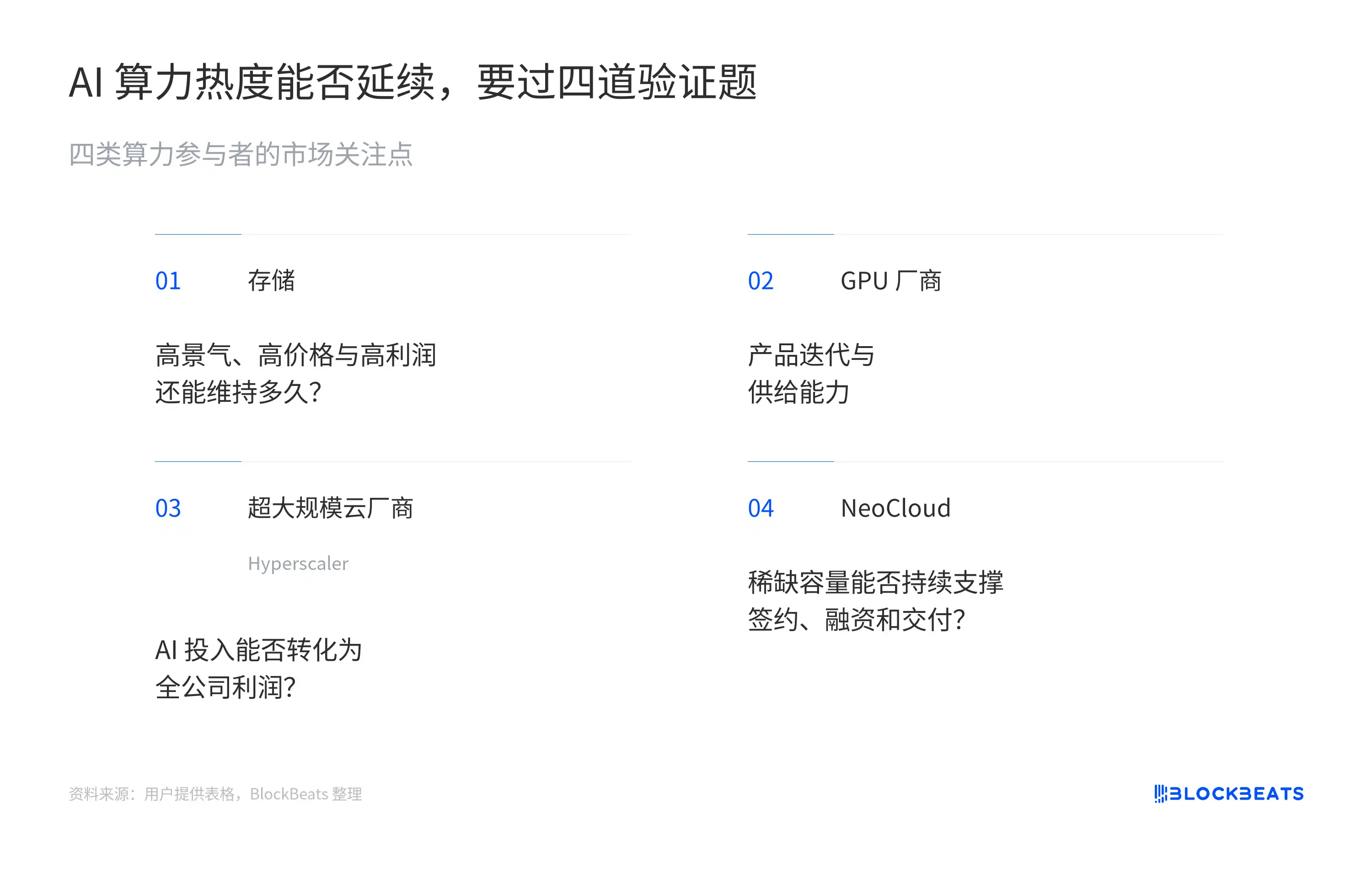
The logic currently traded by the market can be summarized as:
NeoCloud is Essentially a Form of AI Infrastructure Leverage

Understanding NeoCloud's leading gains lies in understanding its leverage effect. Buying shares in these companies is essentially holding an equity asset highly sensitive to AI compute demand, deliverable capacity pricing, and the financing environment. This leverage has three layers of meaning.

The first is operating leverage. Upfront investments in GPUs, data centers, power connectivity, networking, and operations are high, and many costs are relatively fixed once capacity is online. As utilization of active clusters rises and unit capacity pricing improves, incremental revenue can convert into profits relatively quickly, and marginal improvement in profit margins can be significant.

The second is financing leverage. Long-term contracts, non-recourse "take-or-pay" commitments, and customer prepayments enhance the project's attractiveness to lenders and equipment financiers. Companies can thus leverage equity capital to finance larger-scale investments in GPUs, facilities, and power; once new capacity begins billing, revenue can support the next construction cycle.

The third is equity leverage. NeoCloud companies typically have smaller revenue bases and market capitalizations than the Big Three Clouds but have a higher proportion of fixed assets and debt on their balance sheets. If a major contract simultaneously lifts revenue expectations, utilization, and financing accessibility, the market's reassessment of shareholder equity value can be very steep. The rapid post-earnings stock price appreciation often comes from a combination of upward revisions to profit expectations and valuation multiples.

These three layers of leverage create a positive feedback loop in the uptrend:

Larger long-term contracts
→ Easier access to financing and capacity expansion
→ Higher utilization and operating profits
→ Improved equity value and financing ability
→ Securing more contracts and the next expansion opportunity

The same mechanism also magnifies downside risks. If customers delay, utilization falls, GPU or power delivery lags, or debt costs rise, fixed costs and financing obligations can compress shareholder returns. Therefore, the high elasticity priced into NeoCloud by the market also reflects the high execution demands placed on it.

Order Visibility is the Core of This Re-rating

The most attractive aspect of NeoCloud is the visibility of its revenue.

If customers sign non-recourse take-or-pay contracts, even if actual usage fluctuates short-term, customers remain obligated to make certain minimum payments. For operators, this type of revenue is more predictable; for creditors, these contracts also improve the feasibility of asset-based financing.

Therefore, the market will continuously track several metrics:

· Duration, enforceability, and customer creditworthiness of signed contracts;

· Gap between activated MW (Megawatts) and committed MW;

· Revenue per MW and Capex per MW;

· Proportion and payment schedule of customer prepayments;

· Utilization rate, renewal rate, and customer concentration;

· Debt interest rates, debt maturity, and follow-on financing capacity.

Among these, "Activated Capacity" is particularly crucial. Committed MW represents demand; only MW that are powered, equipped, and begin billing enter revenue and cash flow.

This is Also a Re-rating of Power Assets

The most valuable insight from the community regarding NeoCloud shifts the focus from GPU counts to Power (power capacity).

GPU supply will expand with procurement by NVIDIA, AMD, and cloud providers; the formation of high-quality power capacity is slower. It involves the power grid, substations, land, permits, data center construction, and regional network conditions.

Whoever secures sufficient power earlier can convert GPUs into salable compute power sooner.

This is also why some companies transitioning from Bitcoin mining can enter this theme: they already possess some power resources, land, and infrastructure, needing only to shift assets from mining loads to AI loads. Of course, a resource base does not guarantee commercial success; it ultimately still depends on customer acquisition, financing, and delivery capabilities.

NeoCloud's leading gains in the tech stock rebound reflect a market reordering of the AI infrastructure value chain.

The asset currently most valued by capital is computing capacity that can combine GPUs, power, data centers, and long-term customer contracts and deliver rapidly. It captures AI capital expenditure while possessing more contractible characteristics than pure chips and components; it offers both high growth elasticity and a premium for infrastructure scarcity.

Going forward, whether NeoCloud can continue to outperform depends on a straightforward question: Can these massive orders be transformed on time into powered clusters, recognized revenue, and cash flow covering the cost of capital?

Трендовые криптовалюты

Связанные с этим вопросы

QWhat key factor contributed to NeoCloud leading the recent tech stock rebound?

ANeoCloud's significant gains are attributed to its role as a 'powered-up compute factory' that provides a complete, rapidly deployable AI infrastructure package—including GPU clusters, networking, cooling, data center space, power, and operations. This addresses the current critical bottleneck in AI: a lack of ready-to-use, large-scale compute capacity that can be delivered within months. The market is valuing the scarcity of such assets and the long-term, contractually locked-in revenue streams they generate.

QHow have recent financial reports changed the market's view of the NeoCloud business model?

ARecent financial reports from companies like CoreWeave and Nebius have shifted the market's perception from viewing NeoCloud as a high-Capex GPU renter to seeing it as an AI infrastructure operator with a sustainable 'flywheel' business loop. Key metrics like large backlogs, significant Annualized Recurring Revenue (ARR), and long-term customer contracts demonstrate a model where customer commitments lead to improved financing, which fuels capacity expansion and revenue growth, creating a self-reinforcing cycle.

QAccording to the article, why might investors favor NeoCloud over major cloud providers (like Azure, AWS, Google Cloud) during this rebound?

AInvestors seeking higher returns may favor NeoCloud over major cloud providers due to its greater financial and valuation elasticity. NeoCloud has a smaller revenue base and is a purer play on AI demand. A single large contract has a much more significant marginal impact on NeoCloud's revenue and valuation compared to a similar-sized order for a hyperscaler, whose AI business is diluted within their massive, diversified revenue streams.

QWhat are the three layers of leverage that explain NeoCloud's high stock price volatility, as described in the article?

AThe three layers of leverage are: 1) **Operating Leverage**: High fixed costs for infrastructure mean improved utilization and pricing lead to faster profit margin expansion. 2) **Financing Leverage**: Long-term contracts and customer prepayments enable the company to use equity to secure larger debt/equipment financing for further expansion. 3) **Equity Leverage**: A smaller market cap and high asset/debt base mean positive developments (like large contracts) can trigger steep re-ratings of shareholder equity value, combining earnings upgrades with multiple expansion.

QWhat underlying asset revaluation is central to the NeoCloud investment thesis, beyond just GPUs?

AThe investment thesis for NeoCloud involves a fundamental re-rating of **power (electricity) assets**. While GPU supply can increase, high-quality, permitted, and grid-connected power capacity is scarcer and takes longer to develop. The ability to secure and deliver power is now seen as the primary bottleneck for converting GPUs into sellable compute capacity, granting a significant premium to operators who control these resources.

Похожее

Ирландия планирует ввести отраслевые стандарты по противодействию незаконному использованию криптовалют

Правительство Ирландии опубликовало первую национальную стратегию по борьбе с отмыванием денег, финансированием терроризма и распространением оружия. Документ включает меры по регулированию криптоактивов для противодействия их использованию в незаконных целях. Стратегия предполагает введение новых обязательств для поставщиков услуг с криптоактивами, усиление проверок транзакций с частными кошельками и более строгую проверку зарубежных криптокомпаний. Ирландия планирует внедрить эти отраслевые стандарты, соответствующие европейскому регламенту MiCA, во второй половине 2027 года. Стратегия также затрагивает вопросы использования криптоактивов в качестве источника средств для азартных игр.

cointelegraph1 ч. назад

Ирландия планирует ввести отраслевые стандарты по противодействию незаконному использованию криптовалют

cointelegraph1 ч. назад

Grayscale: «Если предложения будут приняты, цены на эти два альткоина могут вырасти»

Глава исследовательского отдела Grayscale Зак Пандл заявил, что обсуждаемые в сообществах Ethereum ($ETH) и Solana ($SOL) изменения в токеномике, направленные на снижение инфляции предложения, могут замедлить рост выпуска новых монет. Это потенциально создаст дефицит и окажет повышательное давление на цены. По оценкам Grayscale, в случае реализации изменений годовая инфляция предложения ETH может снизиться до ~0.4% к концу 2031 года (близко к показателям Bitcoin), а для SOL — до ~1.1%. Для сравнения, ежегодный прирост предложения золота составляет ~1.8%. Пандл отмечает, что предложения по Solana, по-видимому, имеют больше шансов на реализацию. Однако снижение инфляции может также уменьшить вознаграждения для стейкеров, так как значительная часть их дохода формируется за счет эмиссии новых токенов. Выгоду от возможного роста цен в первую очередь получат инвесторы, владеющие токенами без стейкинга. Предложения пока не утверждены окончательно.

cryptonews.ru2 ч. назад

Grayscale: «Если предложения будут приняты, цены на эти два альткоина могут вырасти»

cryptonews.ru2 ч. назад

Эксперты назвали причины падения биткоина после снижения инфляции в США

Благоприятные данные по инфляции в США в июле, соответствовавшие или превзошедшие ожидания, не привели к росту биткоина. Эксперты CryptoQuant видят основную причину в слабом спотовом спросе. Приток в американские биткоин-ETF остаётся низким, а индекс Coinbase Premium, указывающий на активность инвесторов из США, сохраняется в отрицательной зоне. Это свидетельствует об ограниченном покупательном давлении. При этом позиции на фьючерсном рынке остаются высокими, создавая дисбаланс: слабая ликвидность и спрос при значительном объёме маржинальных позиций. В таких условиях даже позитивные макроновости могут не спровоцировать рост, а скорее привести к закрытию лонгов и дальнейшему давлению на цену. Ключевым уровнем сопротивления названа отметка около $68 700. Для возобновления устойчивого роста рынку, по мнению аналитиков, необходим возобновлённый приток в ETF, рост спотовых объёмов, переход Coinbase Premium в плюс и уверенное закрепление биткоина выше $68 700.

cryptonews.ru2 ч. назад

Эксперты назвали причины падения биткоина после снижения инфляции в США

cryptonews.ru2 ч. назад

Курс биткоина опустился до 62 470 долларов, поскольку продавцы вновь тестируют уровень поддержки в 63 000 долларов

Курс биткоина в пятницу продолжил снижение, вновь опустившись ниже уровня поддержки в 63 000 долларов и достигнув дневного минимума в 62 470 долларов. Несмотря на последующее восстановление до отметки около 63 000 долларов, динамика цены оставалась вялой, а рыночная капитализация удерживалась ниже 1,27 трлн долларов. На рынке усилилась волатильность, приведя к значительным ликвидациям длинных позиций с кредитным плечом. Дополнительное давление оказал устойчивый отток средств из спотовых биткоин-ETF, что говорит о возможном отступлении институциональных инвесторов. Ситуацию усугубило предложение провайдера индексов MSCI о новых критериях отбора, которые могут привести к исключению из индексов компаний, активно использующих биткоин в казначейских резервах, таких как Strategy и Metaplanet. Это потенциально спровоцирует их принудительную распродажу институциональными фондами. Strategy публично осудила данную инициативу, заявив, что поставщики индексов должны измерять рынки, а не диктовать компаниям, какими активами владеть. Окончательное решение MSCI ожидается в октябре, и в случае принятия новые правила могут начать действовать уже в ноябре, создавая дополнительные препятствия для роста биткоина в конце года.

cryptonews.ru2 ч. назад

Курс биткоина опустился до 62 470 долларов, поскольку продавцы вновь тестируют уровень поддержки в 63 000 долларов

cryptonews.ru2 ч. назад

Торговля

Спот

Популярные статьи

Как купить ONE

Добро пожаловать на HTX.com! Мы сделали приобретение Harmony (ONE) простым и удобным. Следуйте нашему пошаговому руководству и отправляйтесь в свое крипто-путешествие.Шаг 1: Создайте аккаунт на HTXИспользуйте свой адрес электронной почты или номер телефона, чтобы зарегистрироваться и бесплатно создать аккаунт на HTX. Пройдите удобную регистрацию и откройте для себя весь функционал.Создать аккаунтШаг 2: Перейдите в Купить криптовалюту и выберите свой способ оплатыКредитная/Дебетовая Карта: Используйте свою карту Visa или Mastercard для мгновенной покупки Harmony (ONE).Баланс: Используйте средства с баланса вашего аккаунта HTX для простой торговли.Третьи Лица: Мы добавили популярные способы оплаты, такие как Google Pay и Apple Pay, для повышения удобства.P2P: Торгуйте напрямую с другими пользователями на HTX.Внебиржевая Торговля (OTC): Мы предлагаем индивидуальные услуги и конкурентоспособные обменные курсы для трейдеров.Шаг 3: Хранение Harmony (ONE)После приобретения вами Harmony (ONE) храните их в своем аккаунте на HTX. В качестве альтернативы вы можете отправить их куда-либо с помощью перевода в блокчейне или использовать для торговли с другими криптовалютами.Шаг 4: Торговля Harmony (ONE)С легкостью торгуйте Harmony (ONE) на спотовом рынке HTX. Просто зайдите в свой аккаунт, выберите торговую пару, совершайте сделки и следите за ними в режиме реального времени. Мы предлагаем удобный интерфейс как для начинающих, так и для опытных трейдеров.

987 просмотров всегоОпубликовано 2024.04.12Обновлено 2026.06.02

Как купить ONE

Обсуждения

Добро пожаловать в Сообщество HTX. Здесь вы сможете быть в курсе последних новостей о развитии платформы и получить доступ к профессиональной аналитической информации о рынке. Мнения пользователей о цене на ONE (ONE) представлены ниже.

活动图片