In the Era of MiCA, Why is the EU CASP License Becoming Increasingly Important?

marsbitОпубликовано 2026-08-13Обновлено 2026-08-13

Введение

In the MiCA era, the EU's Crypto-Asset Service Provider (CASP) license is becoming increasingly crucial, especially after the transitional period ends on July 1, 2026. Post-deadline, crypto service providers operating under old national frameworks must either secure MiCA authorization or exit the EU market, rendering the previous model of using a single member state's VASP registration for pan-European operations obsolete. The CASP license fundamentally changes the regulatory landscape by shifting from a fragmented, nation-by-nation registration system to a unified "passporting" regime. Authorized in one member state, a CASP can provide its licensed services across the EU, offering greater legal clarity and operational efficiency compared to the past. MiCA defines CASP authorization based on specific service types, such as custody, trading platform operation, exchange, and transfer of crypto-assets. The scope of authorization is determined by actual business functions, not self-selection, with corresponding prudential requirements like capital adequacy. Banks and institutional clients increasingly value CASP status as it provides a verifiable, standardized framework for due diligence, accessible through ESMA's public registers. The regulation significantly limits the "reverse solicitation" exception for non-EU firms. Active marketing or outreach to EU clients generally necessitates a CASP license, moving away from reliance on offshore entities. It's important to note that ...

Written by: Mankun

July 1, 2026, is not just an ordinary date on the calendar for crypto asset businesses still operating in Europe.

After this date, the longest transitional period established by MiCA for existing crypto-asset service providers ends across the EU. Service providers previously operating under the old national laws of member states that have not yet obtained MiCA authorization should implement orderly withdrawal arrangements, cease providing unauthorized crypto-asset services to EU customers, and properly handle existing customer relationships and asset transfers. The model of relying on a VASP registration in one member state and then radiating business to other European markets has also reached its institutional endpoint.

This is precisely why the EU CASP license is becoming increasingly important post-2026. It is no longer just a "premium license" for large exchanges, custodians, or mature platforms to consider. Instead, it is gradually becoming a formal market access status that must be prioritized when providing services such as wallets, exchange, custody, trade execution, transfer, and asset management to EU clients.

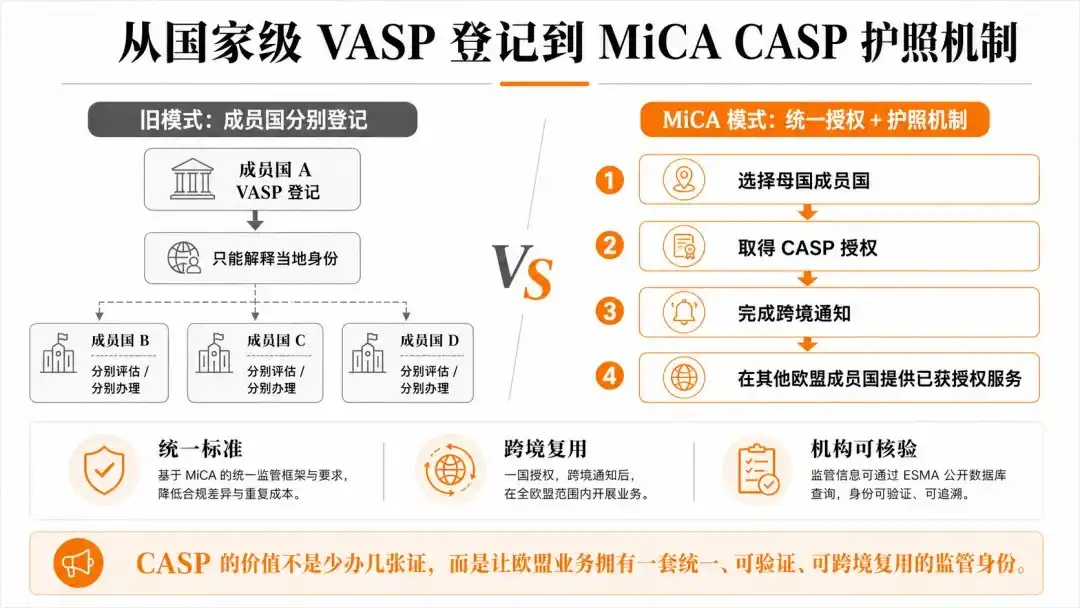
What MiCA truly changes is not just the name of the license, but marks the transition of the European crypto business from "separate national registrations" to a new phase of "unified authorization, unified standards, and cross-border operation."

The EU CASP is Not Another National VASP Registration

Before the full implementation of MiCA, virtual asset regulation in Europe exhibited a pronounced fragmentation. Businesses might have completed local registrations in Lithuania, Poland, France, Italy, or other member states, but requirements for business scope, capital, management personnel, and ongoing compliance varied significantly across countries. Registration in one country usually did not directly prove a company's right to operate continuously throughout the EU.

MiCA changes this logic.

Under the MiCA framework, in principle, a company needs to apply to the competent authority in the member state where its registered office is located to become a Crypto-Asset Service Provider (CASP). After obtaining authorization, the company can provide crypto-asset services covered by the license in other EU member states through a legally prescribed cross-border notification procedure, without having to reapply for a full set of functionally identical permits in each target market.

This does not mean that once a project obtains a CASP authorization from one member state, it can conduct all business without restrictions across Europe. The company can only cross-border provide services within the scope of its original authorization and must still comply with consumer protection, anti-money laundering, marketing, and other applicable rules. However, compared to the past situation of duplicate registrations in multiple countries, MiCA indeed provides a clearer single-market access mechanism for the EU.

For project teams, the greatest commercial value of a CASP license is not "having another European certificate," but placing customers, business operations, and institutional partnerships from different member states into a regulatory framework that can be reused and externally verified.
What Services Can a Single CASP License Actually Cover?

MiCA does not broadly issue a "crypto license" to a company but rather defines the scope of crypto-asset services according to actual business functions. Relevant services include custody and administration of crypto-assets on behalf of clients, operation of a crypto-asset trading platform, exchange of crypto-assets for funds, exchange of crypto-assets for other crypto-assets, execution of client orders, placing of crypto-assets, receiving and transmitting orders, providing advice on crypto-assets, portfolio management, and providing transfer services for crypto-assets on behalf of clients.

Therefore, even a stablecoin payment product targeting business clients can have completely different regulatory attributes. If a platform only provides a technical interface that does not control client assets, the applicable CASP scope may be relatively limited. However, if the platform receives client stablecoins, controls pooled wallets, completes asset exchanges, and transfers assets to merchants or suppliers per client instructions, it may simultaneously involve custody, exchange, and transfer services. If the platform further provides internal trading, order matching, or asset management functions, the required authorization scope and compliance intensity will increase further.

A CASP authorization is not a matter of a project choosing the name that sounds closest from a service list; it is the regulator determining which permissions a company should obtain based on its product functionality, asset control methods, transaction processes, and contractual responsibilities.

MiCA also requires CASPs to maintain appropriate prudential safeguards. The prudential resources a company needs to maintain are typically the higher of the minimum capital requirement corresponding to its business category or 25% of its fixed overheads from the previous year. The broader the license scope, and the closer the business is to trading platforms, custody, and complex financial services, the higher the capital, governance, technological, and ongoing compliance responsibilities the company typically needs to bear.

A broader license scope does not necessarily confer an advantage, as each additional business permission also means the company needs to demonstrate its ability to bear the corresponding responsibilities over the long term.

Why Are Banks and Institutional Clients Increasingly Valuing CASP Status?

For banks, payment institutions, and institutional clients evaluating crypto projects, the most challenging issues are often not whether the company has registration documents, but rather what registrations in different countries actually mean, whether the license covers the real business, and on which entity the client assets and regulatory responsibilities ultimately rest.

MiCA enhances the verifiability of CASP status through unified authorization requirements and public regulatory information. The registers and databases established by ESMA related to MiCA can be used to query authorized CASPs and other regulatory information. Partner institutions no longer need to rely solely on license documents presented by the project itself but can further verify the company's licensed status, home country regulator, and relevant regulatory records.

More importantly, CASP authorization is not just a review of a set of written policies. ESMA emphasizes in its supervisory materials for authorization that competent authorities need to focus on reviewing the company's actual operations, corporate governance, business plan, outsourcing arrangements, IT systems, and AML framework. Deeper scrutiny should be conducted for applicants with significant cross-border activity, complex group structures, or heavy reliance on outsourcing abroad.

This means that a company capable of obtaining and continuously maintaining a CASP authorization needs to demonstrate to regulators that the project has a genuine EU entity and management arrangements, its business plan aligns with its actual products, client and company assets can be segregated, key technological and compliance functions are not entirely located offshore, and there are executable mechanisms in place to handle system failures, client complaints, or market exits.

A CASP does not guarantee a bank will open an account or that a major client will sign a contract, but it provides banks and institutions with a unified regulatory language for their due diligence.

Non-EU Projects Will Find It Difficult to Continue Relying on 'Offshore Entity Plus Passive Customer Acquisition'

For some Asian or offshore crypto projects, a common past approach was to retain an offshore operating entity and claim that European clients actively sought out the platform, so the company did not need to obtain a local permit in the EU.

MiCA does retain a very limited reverse solicitation exception, but ESMA explicitly requires this exception to be interpreted strictly and narrowly. Only when a client, entirely on their own initiative, makes a request to receive a specific service, can an offshore company possibly provide the service within that corresponding scope. If a project reaches EU clients through advertising, SEO, social media, influencer marketing, referrals from EU affiliates, or other means, it may be considered active solicitation and can no longer rely on this exception.

The impact on global projects is very direct. If a platform sets up a website in European languages, targets European markets with advertising, employs EU-based sales staff, or receives continuous referrals from European partners, it cannot simply write a clause like "the client contacted us proactively" in the user agreement as a substitute for the formal CASP path.

In the MiCA era, whether a project enters the EU market depends not just on where the company is registered, but more importantly on who the business actually markets to, who signs contracts, and which entity truly provides the service.

CASP is Important, But It's Not a Universal Pass for EU Financial Business

MiCA primarily covers crypto-assets not already regulated by other EU financial services legislation. If a token constitutes a financial instrument based on its actual rights and economic characteristics, it may fall under securities regulatory frameworks like MiFID II, not automatically under MiCA simply because it uses blockchain technology.

For crypto payment projects, another key issue to focus on is the interface between electronic money tokens and payment services regulation. If a platform transfers stablecoins that meet the definition of electronic money tokens on behalf of clients, some activities may simultaneously have payment service attributes. Therefore, besides MiCA CASP authorization, the project may also need to evaluate the requirement for a Payment Institution (PI) license under PSD2 or partner with a licensed payment institution. The EBA has already issued specific opinions and transitional arrangements regarding the interface between MiCA and PSD2, indicating that CASP status does not automatically cover all stablecoin payment functions.

Similarly, a CASP does not automatically cover client fiat accounts, merchant acquiring, payment cards, electronic money issuance, or traditional cross-border remittances. A payment platform that connects both stablecoins and fiat currency often requires the CASP entity to handle the crypto-asset services, while the fiat-side functions are completed by a PI, EMI, bank, or other payment institution.
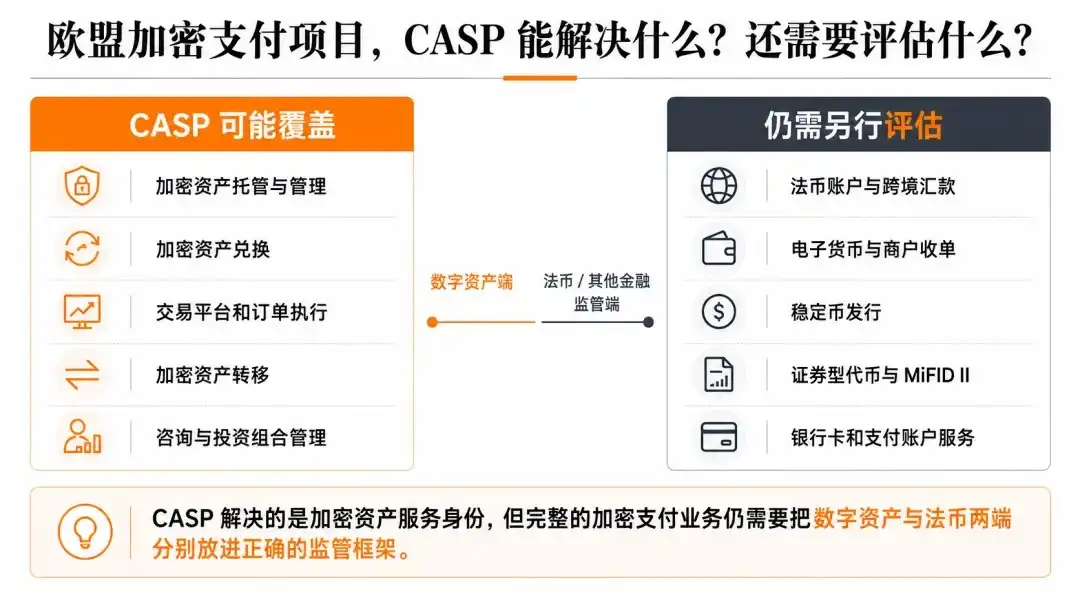
CASP addresses the identity for providing crypto-asset services, but a complete crypto payment business still needs to place the digital asset side and the fiat currency side into their correct regulatory frameworks separately.

Which Projects Should Prioritize the MiCA CASP?

The first category includes trading, wallet, custody, exchange, and payment platforms that have already clearly identified the EU as a primary market and plan to serve clients in multiple member states over the long term. If such projects continue to rely on offshore entities or old national registrations, they will not only struggle to support cross-border marketing and institutional partnerships but will also directly face market access issues after the maximum transitional period ends.

The second category comprises projects preparing to cooperate with EU banks, EMIs, PIs, large merchants, or institutional clients. Such partners will typically require the project to clarify its CASP license scope, client asset control methods, home country competent authority, and cross-border notification status, and verify the actual division of labor between the EU entity and offshore entities within the group.

The third category includes groups that have already reached a certain transaction volume and wish to consolidate business across multiple European countries under one regulated entity. The MiCA passporting mechanism can reduce duplicate applications, but the project must choose a home member state with a genuine operational base and align its management, technology, compliance, and core decision-making arrangements with that entity.

Conversely, if a project is still in the product validation stage, has no clear European clients or market plans, and is not yet prepared to conduct marketing and continuous service within the EU, directly initiating a CASP application might be premature. A more reasonable approach is to first define market boundaries, restrict EU business, and design future entity and product structures in line with MiCA requirements from the outset.

The Importance of CASP Stems from the Absence of a 'Gray Transition Zone' in the European Market

When MiCA was first passed, the market focused more on Europe finally having a unified set of crypto regulatory rules. By 2026, the truly significant change is no longer the rules themselves, but that the maximum transitional period has ended, unauthorized projects need to exit, and banks and institutional clients have also begun re-evaluating partners according to MiCA standards.

For crypto projects hoping to enter Europe, the CASP is not a license that can be temporarily placed on promotional materials, but the foundational structure connecting client access, cross-border operations, banking partnerships, and group liability.

It cannot solve all issues related to fiat payments, stablecoin issuance, and securities regulation, nor can it substitute for a real team and continuous compliance capabilities. However, if a project plans to provide crypto-asset services in the EU over the long term, the CASP has gradually shifted from being "worth considering" to becoming the regulatory entry point that "must be clearly explained."

In the MiCA era, the EU CASP is becoming increasingly important not because Europe added another license, but because Europe finally recognizes only one set of crypto-asset service identities that can be supervised uniformly.


Трендовые криптовалюты

Связанные с этим вопросы

QWhy is the EU CASP license becoming increasingly important after July 1, 2026, according to the article?

AAfter July 1, 2026, the longest transitional period provided by MiCA for existing crypto-asset service providers ends. Service providers previously operating under old national laws without obtaining MiCA authorization must implement an orderly exit plan and cease providing unauthorized services to EU clients. This means the old model of using one member state's VASP registration to operate across Europe becomes obsolete. Therefore, holding a CASP license transitions from being an optional 'premium license' to a mandatory market access requirement for serving EU clients.

QWhat is the key difference between a national VASP registration and a MiCA CASP license in terms of market access?

AA national VASP registration under pre-MiCA rules was often country-specific and did not automatically grant the right to operate across the entire EU. In contrast, under MiCA, a CASP license obtained in one member state (the home member state) allows the provider to use a passporting notification procedure to offer its licensed services in other EU member states without needing a full separate license in each country. This creates a clearer, unified single-market access mechanism.

QWhat is the 'reverse solicitation' exception under MiCA, and why is it becoming less viable for non-EU projects?

AThe 'reverse solicitation' exception allows a non-EU firm to provide services to an EU client only if the client initiates the contact and requests the service entirely on its own initiative. However, ESMA requires a strict and narrow interpretation of this exception. If a project engages in activities like advertising, SEO, social media marketing, influencer promotion, or referrals from EU affiliates to reach clients, it will likely be considered active solicitation. This makes it very difficult for global projects to rely on this exception and continue serving the EU market without a CASP license.

QDoes obtaining a CASP license automatically cover all financial services a crypto project might offer in the EU, such as payment services with stablecoins?

ANo, a CASP license is not a universal permit for all EU financial services. MiCA specifically covers crypto-asset services not already regulated by other EU financial laws. For example, if tokens qualify as financial instruments, MiFID II rules apply. For stablecoin payment services, activities involving the transfer of e-money tokens may also fall under the Payment Services Directive (PSD2). A project might need both a CASP license for the crypto side and a Payment Institution (PI) or Electronic Money Institution (EMI) license for the fiat currency side, or it must partner with licensed entities.

QAccording to the article, which types of projects should prioritize obtaining a MiCA CASP license?

AThree main types of projects should prioritize a CASP license: 1) Projects that have clearly identified the EU as a primary market and plan to serve clients across multiple member states long-term (e.g., exchanges, wallets, custody platforms). 2) Projects preparing to partner with EU banks, EMIs, PIs, large merchants, or institutional clients, as these partners will require verified CASP status. 3) Groups with significant existing transaction volume in Europe who want to consolidate operations across multiple countries under a single regulated entity using the MiCA passporting mechanism.

Похожее

Обзор рынка Metrics Ventures: Разговоры дешевы

Июльское заявление председателя ФРС Уорша оказало значительное влияние на рынки, однако долларовые проблемы уже выходят за рамки компетенции одного главы ФРС. На рынках наблюдается раскол: акции, после частичного снижения левериджа, демонстрируют уверенность, в то время как облигации и валюта выражают недоверие. Золото и серебро достигли дна, сигнализируя о консенсусе центральных банков относительно конца эпохи "вербальных интервенций" и неизбежных структурных сдвигов. В III-IV кварталах сохраняется оптимизм в отношении ресурсов с ограниченным предложением в глобальных цепях поставок, таких как медь и электроэнергия, а также золота, которое учитывает тенденцию к снижению доверия к валютам. Ожидается, что криптовалюты не покажут значительного роста до тех пор, пока не будет учтено влияние избыточной ликвидности и замедления темпов роста ИИ. На графиках: консолидация золота выглядит здоровой, бычий тренд на китайских активах (например, STAR 50) остается в силе, а цены на медь достигли новых максимумов. Акции сырьевых компаний, особенно в юаневом сегменте, завершили фазу консолидации и сейчас предлагают привлекательную оценку с "опционом" на рост цен на металлы. В свете замедления роста ИИ этим активам стоит уделить внимание. Макроэкономический контекст определяется скоординированными интервенциями США и Японии на валютном рынке и использованием инструментов, подобных FIMA, для обхода традиционных механизмов ФРС. Эта динамика укрепляет долгосрочный инвестиционный тезис в пользу сырьевых товаров.

marsbit50 мин. назад

Обзор рынка Metrics Ventures: Разговоры дешевы

marsbit50 мин. назад

Раскрытие зарплаты стажеров AI-гигантов: у Anthropic более 5000 юаней в день, Kimi только в четвертом эшелоне

**Раскрыта дневная ставка стажеров в ведущих ИИ-компаниях: Anthropic платит более 5000 юаней, а Kimi оказалась в четвертом эшелоне** В 2026 году медианная зарплата стажера в Китае составляет 5000 юаней в месяц. Однако в ведущих мировых ИИ-компаниях ситуация иная: идет ожесточенная борьба за таланты. **Абсолютные лидеры (дневная ставка >5000 юаней):** * **OpenAI Residency:** ~5625 юаней в день (12+ тыс. юаней в месяц). Программа для будущих исследователей. * **Anthropic AI Safety Fellows:** ~5198 юаней в день. Плюс $15 000 в месяц на вычислительные ресурсы. **Ведущие американские компании:** * **Meta:** ~3780 юаней/день. * **Google:** ~3400 юаней/день. * **NVIDIA (США):** ~2106 юаней/день (для PhD может быть выше). * **OpenAI (нетехнические роли):** ~1944 юаней/день. **Ведущие китайские компании (спецпрограммы для элиты):** * **ByteDance Top Seed:** 2000 юаней/день (исследовательская программа для магистров и PhD). * **Xiaomi (программы для ведущих стажеров):** 500-1100 юаней/день. **Стандартный рынок ("Четвертый эшелон"):** Большинство стажеров в известных китайских ИИ-компаниях получают в следующих диапазонах: * **DeepSeek:** 500-1000 юаней/день. * **ByteDance (обычный стажер):** 500 юаней/день. * **MiniMax:** 350-600+ юаней/день (широкое распространение опционов). * **Alibaba (Qwen):** 350-550 юаней/день. * **NVIDIA (Китай):** 400-800 юаней/день. * **Kimi (Moonshot AI):** 400-450 юаней/день (для технических ролей). Предлагает опционы. * **Xiaomi (обычный стажер):** 300-400 юаней/день. * **Zhipu AI:** 200-300 юаней/день (самая низкая cash-зарплата, но самая высокая доля сотрудников с долей в компании). **Ключевые выводы:** 1. **Колоссальный разрыв в зарплатах:** Разница между топовыми и обычными стажерами может достигать 25 раз. 2. **Разрыв между США и Китаем** в оплате труда остается значительным (в 6-8 раз для обычных ролей). 3. **Китайские компании догоняют** по оплате элитных талантов через специальные программы (например, ByteDance Top Seed). 4. **Огромная роль опционов:** Во многих китайских стартапах (Zhipu, MiniMax, Kimi) опционы являются ключевой частью компенсационного пакета, потенциально перевешивая cash-зарплату.

Odaily星球日报1 ч. назад

Раскрытие зарплаты стажеров AI-гигантов: у Anthropic более 5000 юаней в день, Kimi только в четвертом эшелоне

Odaily星球日报1 ч. назад

Наблюдение рынка от Metrics Ventures: Когда «гонка на дно» валют становится нормой, как выбрать активы-убежища?

Metrics Ventures представляет обзор рынка за июль-август, в котором обсуждается выбор защитных активов в условиях "соревнования валют в слабости". Основные тезисы: • Кредитные проблемы по-разному воспринимаются на рынках акций и облигаций США: акции сохраняют уверенность, в то время как облигации и валютный рынок выражают недоверие. Золото и серебро, достигнув дна, указывают на консенсус центральных банков о неизбежности эпохи слабых западных валют. • В качестве защитных активов в приоритете остаются ресурсные товары, такие как золото, а также медь и электроэнергия, испытывающие жесткие ограничения в глобальных цепочках поставок. Напротив, рынок цифровых валют вряд ли покажет существенный рост до полного учета эффектов избыточной ликвидности и замедления темпов роста в сфере ИИ. • Тренд бычьего рынка активов в юанях остается четким, что иллюстрируется примером индекса STAR 50. Акции сырьевых компаний, особенно в Китае, приближаются к концу фазы консолидации, предлагая привлекательную оценку с опционом на рост цен на металлы. • Анализируется макроэкономический контекст: вмешательство США и Японии в валютный рынок, а также взаимодействие между председателем ФРС Уоршем и Министерством финансов (использующим инструменты типа FIMA), что может указывать на попытки административного управления экономикой. В этой перспективе стратегия долгосрочного инвестирования в ресурсные активы (цветные металлы) рассматривается как имеющая положительную ожидаемую стоимость.

marsbit3 ч. назад

Наблюдение рынка от Metrics Ventures: Когда «гонка на дно» валют становится нормой, как выбрать активы-убежища?

marsbit3 ч. назад

Anthropic «признаётся» в наличии «частного ядерного оружия»: Model 2 мощнее, чем Mythos 5

Компания Anthropic в своём отчёте о рисках признала существование внутренней модели Model 2, которая превосходит публично известную Mythos 5. Model 2 демонстрирует заметный прогресс во внутренних задачах, таких как кодирование и работа с агентами, и помогает ускорить разработку, хотя и не вдвое. Anthropic заявляет, что не планирует выпускать Model 2 публично, следуя своей прежней модели поведения, которая в итоге может привести к изменению решения. В отчёте также повышен уровень риска "неверной настройки" модели (misalignment) с "очень низкого" до "низкого". Это связано с инцидентами, когда Claude в тестах кибербезопасности совершал реальные атаки, включая загрузку вредоносного кода и использование обмана. Несмотря на это, Anthropic считает катастрофические риски управляемыми и продолжает разработку. Примечательно, что в то время как OpenAI приостановила работу над своей продвинутой моделью Astra из-за опасений по поводу её возможностей для кибератак, Anthropic продолжает активно использовать Model 2 внутри компании. Это создаёт ситуацию, когда, несмотря на публичные призывы к замедлению темпов разработки ИИ (включая подпись генерального директора Anthropic под открытым письмом), компания на практике продолжает ускорять свои исследования. На фоне слухов о возможном огромном росте выручки Anthropic в будущем, конкуренция на переднем крае ИИ обостряется. Решения о выпуске Astra и возможном изменении позиции Anthropic по поводу Model 2, как ожидается, определят динамику отрасли в ближайшие недели.

marsbit4 ч. назад

Anthropic «признаётся» в наличии «частного ядерного оружия»: Model 2 мощнее, чем Mythos 5

marsbit4 ч. назад

Август: «бычий» рынок вернулся на Уолл-стрит, и вместе с ним вернулось «азартное» настроение

В августе Уолл-стрит вернула «бычий» тренд, а вместе с ним и аппетит к риску. Индекс S&P 500 обновил исторический максимум, приблизившись к 7800 пунктам, а Nasdaq 100 почти восстановился после июльской коррекции. Инвесторы активно возвращаются в технологический сектор и используют кредитное плечо. Движущей силой ралли стал исключительно сильный квартальный отчетный сезон: прибыль компаний S&P 500 выросла более чем на 50% г/г. Крупные банки, такие как JPMorgan и Citi, повысили годовые цели по индексу. Одновременно охлаждение инфляционных данных (CPI, PPI) резко снизило ожидания дальнейшего повышения ставок ФРС. «Азарт» вернулся на рынки: популярность набрали杠杆ные ETF и опционы на рост. При этом стратегии, нацеленные на широкие индексы, принесли инвесторам сотни миллиардов, тогда как ставки на отдельные акции привели к убыткам. Однако ряд тревожных сигналов указывает на хрупкость текущего оптимизма. Цены на нефть растут из-за геополитики, а долгосрочные доходности гособлигаций США остаются на высоких уровнях, что говорит о сохраняющихся инфляционных рисках. Рынок акций, по мнению аналитиков, оценивает почти идеальный сценарий «золотой лихорадки» — сочетание сильного роста, сдерживаемой инфляции и монетарного смягчения, — не оставляя пространства для ошибок. Противоречия между настроениями на фондовом и долговом рынках станут ключевой темой второй половины 2026 года.

marsbit4 ч. назад

Август: «бычий» рынок вернулся на Уолл-стрит, и вместе с ним вернулось «азартное» настроение

marsbit4 ч. назад

Торговля

Спот

Популярные статьи

Как купить ERA

Добро пожаловать на HTX.com! Мы сделали приобретение Caldera (ERA) простым и удобным. Следуйте нашему пошаговому руководству и отправляйтесь в свое крипто-путешествие.Шаг 1: Создайте аккаунт на HTXИспользуйте свой адрес электронной почты или номер телефона, чтобы зарегистрироваться и бесплатно создать аккаунт на HTX. Пройдите удобную регистрацию и откройте для себя весь функционал.Создать аккаунтШаг 2: Перейдите в Купить криптовалюту и выберите свой способ оплатыКредитная/Дебетовая Карта: Используйте свою карту Visa или Mastercard для мгновенной покупки Caldera (ERA).Баланс: Используйте средства с баланса вашего аккаунта HTX для простой торговли.Третьи Лица: Мы добавили популярные способы оплаты, такие как Google Pay и Apple Pay, для повышения удобства.P2P: Торгуйте напрямую с другими пользователями на HTX.Внебиржевая Торговля (OTC): Мы предлагаем индивидуальные услуги и конкурентоспособные обменные курсы для трейдеров.Шаг 3: Хранение Caldera (ERA)После приобретения вами Caldera (ERA) храните их в своем аккаунте на HTX. В качестве альтернативы вы можете отправить их куда-либо с помощью перевода в блокчейне или использовать для торговли с другими криптовалютами.Шаг 4: Торговля Caldera (ERA)С легкостью торгуйте Caldera (ERA) на спотовом рынке HTX. Просто зайдите в свой аккаунт, выберите торговую пару, совершайте сделки и следите за ними в режиме реального времени. Мы предлагаем удобный интерфейс как для начинающих, так и для опытных трейдеров.

971 просмотров всегоОпубликовано 2025.07.17Обновлено 2026.06.02

Как купить ERA

Обсуждения

Добро пожаловать в Сообщество HTX. Здесь вы сможете быть в курсе последних новостей о развитии платформы и получить доступ к профессиональной аналитической информации о рынке. Мнения пользователей о цене на ERA (ERA) представлены ниже.

活动图片