Ethereum Community in Uproar! Whose Cake is EIP-8363 Cutting Into?

marsbitОпубликовано 2026-08-06Обновлено 2026-08-06

Введение

**Ethereum Community Debates Controversial Staking Proposal EIP-8363** A new Ethereum proposal, EIP-8363, dubbed "Tapered Issuance Burn," has ignited heated debate within the community. The core idea is to reduce and eventually eliminate new issuance rewards for validators as the total amount of staked ETH approaches 50% of the total supply (around 60.25 million ETH). The authors, including EthCC founder Jérôme de Tychey and Ethereum Foundation researcher Justin Drake, argue the current system perpetually incentivizes more staking, potentially leading to centralization as stake flows to large custodians and liquid staking tokens (LSTs). They also aim to reduce dilution pressure on non-staking ETH holders. Under the proposal, validator rewards from consensus-layer issuance would be partially burned based on a formula tied to the total staked amount. Net rewards would gradually approach zero as staking nears the 50% threshold. Notably, execution-layer rewards (tips, MEV) are unaffected. A proposed 18-month transition period would soften the initial impact. The community reaction has been predominantly critical. Key concerns include: * **Centralization Risk:** Critics like Obol's Oisín Kyne argue very low rewards could drive out solo stakers and smaller operators, leaving only large, cost-insensitive institutions, thus increasing validator centralization. * **Ecosystem Impact:** Aave's Stani Kulechov warns it could hurt ETH's predictable yield appeal for institutions and...

Author: KarenZ, Foresight News

Intuitively, the more ETH staked, the higher the economic cost to attack the network.

However, an expansion in staking scale does not necessarily bring a proportional increase in security gains; if the new staking primarily flows to a few large service providers, the validator ecosystem could become more centralized instead.

On August 4th, EthCC founder Jérôme de Tychey, Ethereum Foundation's Justin Drake, and four other researchers jointly submitted a "Tapered Issuance Burn" proposal, attempting to install a "profit downgrade path" for the ever-increasing staking rate. When the staked amount approaches 50% of the total ETH supply, the consensus layer issuance rewards obtained by validators will be entirely offset.

This proposal was initially released under the number EIP-8361, but was later changed to EIP-8363 after that number was reassigned to another proposal. Although it is still in an early draft stage, it has quickly become one of the most hotly debated topics within the Ethereum community.

What exactly is this proposal trying to do?

Currently, Ethereum consensus layer rewards decrease as the total staked amount increases, but even if all ETH were staked, there remains a theoretical lower bound of about 1.5% for the nominal consensus yield of a single validator.

The authors of EIP-8363 argue that this means the protocol always provides positive incentives for more staking, lacking a real "stop button," potentially driving ETH towards concentration among large custodians, exchanges, and staking derivatives.

Additionally, unstaked ETH is continuously diluted by new issuance. Liquid Staking Tokens (LSTs), because they inherently carry yield, can more easily replace native ETH as collateral and savings assets in DeFi. The proposal authors hope to reduce this dilution pressure, making native ETH a more competitive neutral asset again.

The solution given by the proposal is not to prohibit new validators from entering or to rigidly lock the staking rate at 50%, but to deduct and burn a portion of the validator rewards after their normal calculation. The burn ratio depends on the total network effective staked balance: calculated as "1.5 times the power of the ratio of the total network effective staked balance to 60.25 million ETH," capped at 100%, i.e.:
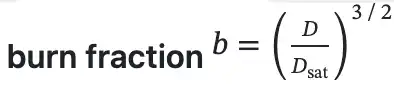
60.25 million ETH is approximately half of the current total ETH supply. As the staked amount approaches this value, the net consensus layer earnings for validators gradually approach zero; when reaching or exceeding this value, the consensus layer issuance rewards earned by normally, fully-functioning validators will be completely offset by the newly added burn deduction. It is worth adding that 60.25 million ETH is a fixed value proposed to be written into the protocol at the time of the hard fork.

There are two points easily misunderstood:

First, 50% is not a staking cap, nor is it a target staking rate. Validators can still continue to join; the proposal merely hopes the market will stop growing on its own before the yield is insufficient to cover liquidity, operational, slashing, and regulatory risks.

Second, so-called "zero earnings" refers only to the net consensus layer issuance reward. Execution layer income such as priority fees and MEV is unaffected by this proposal.
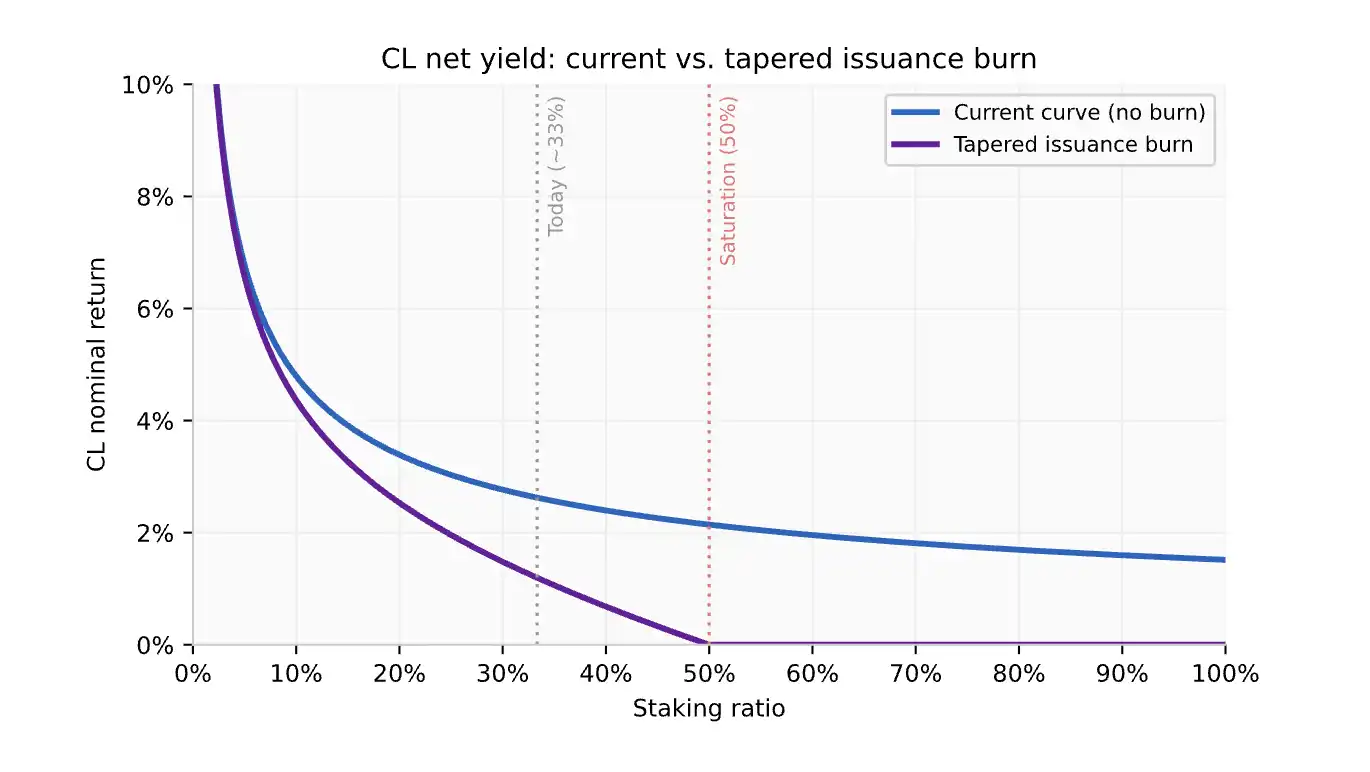
Net consensus layer earnings under the current issuance curve versus the EIP-8363 curve

According to the proposal's curve, the annual consensus layer issuance would peak near a staking rate of about 19.8%, then decline as the staking rate increases. Estimating with the current ~33% staking rate, if this curve were fully implemented at the time of a fork, the consensus layer yield would drop from about 2.6% to about 1.2%.
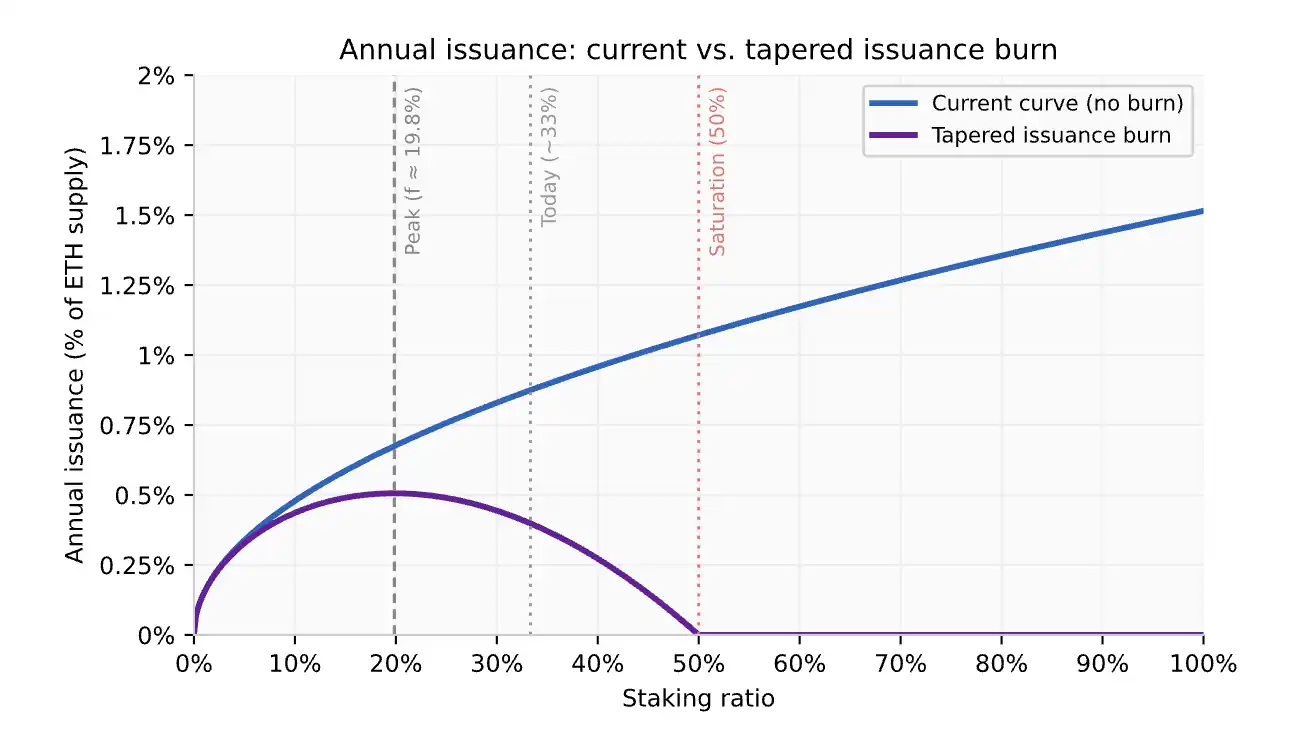
Annual issuance under the current issuance curve versus the EIP-8363 curve

To avoid a sudden halving of earnings, the proposal designs an 18-month transition period: upon activation, the base reward factor is temporarily increased from 64 to 128, then gradually reduced back to 64 over 65 steps, each lasting about 8.6 days. Therefore, net earnings near activation would be close to current levels, gradually declining afterward. However, the curve "providing no consensus layer issuance incentive after 50%" takes effect from the first day of activation and does not wait for 18 months.

Currently, this proposal remains an unmerged Core EIP draft, in the editing review and consensus evaluation stage. The authors have separately submitted PR #12087, hoping to list it as Proposed for Inclusion for the Hegotá upgrade, meaning "proposed for inclusion in discussion." This PR is also not yet merged; the current formal Hegotá Meta EIP does not include it.

Ethereum core developers plan to discuss the Hegotá proposal deadline items at the ACDC 184th meeting on August 6th. Even if it enters Proposed for Inclusion, it does not equal definite implementation; it would still need to go through subsequent steps like developer evaluation, client implementation, testing, and Scheduled for Inclusion.

Community reaction is clearly negative

One of the authors of EIP-8363, Jérôme de Tychey, believes this is a "minimalist, market-driven" change. He also stated in a forum response that the issuance debate started back in 2023, and this proposal merely opens a formal feedback window, not implying definite inclusion.

He also warned that if the validator entrance queue remains constantly full with few exits, by early 2028, the staked amount could exceed 70 million ETH, representing over 55% of the supply; reversing course then could involve larger exit volumes and market disruptions.

Supporters of reducing issuance mainly have three reasons:

  • Ethereum may be paying an excessively high cost for economic security that is already sufficiently ample;
  • Unstaked holders are continuously diluted, forced to choose between "accepting dilution" and "taking staking risks";
  • LSTs, ETFs, and custodial services continuously reduce staking friction, potentially allowing a few intermediaries to eventually control large amounts of ETH and validation rights simultaneously.

However, opposing voices are more concentrated in the public reactions so far.

Aave founder Stani Kulechov believes that consensus layer staking rewards fluctuating with the staking rate and eventually approaching zero would undermine the cash flow predictability valued by institutions when allocating ETH and compress positive interest rate strategies like ETH lending and LST restaking loops.

Obol co-founder Oisín Kyne pointed out that Ethereum's true security depends not only on how much ETH is staked but also on whether validation rights are sufficiently decentralized. If yields drop to extremely low levels, large institutions with low capital costs and insensitivity to yield might have the ability to stay in the game long-term and squeeze out high-cost independent operators.

ether.fi CEO Mike Silagadze criticized the proposal for being submitted just before the Hegotá deadline, leaving insufficient pre-discussion time for ecosystem developers; he worries that low yields would impact staking-related protocols and reduce institutional confidence in Ethereum's governance stability.

Ethereum community member Ryan Berckmans summarized that opponents at least include those worried about who would run validators at zero yield, those unwilling to reduce staking yields, those opposed to changing ETH monetary policy again, and those hoping to avoid controversy escalating and disrupting ecosystem growth. He personally supports moderately reducing issuance but opposes letting yields trend all the way to zero and also believes the current proposal is too divisive for the community.

A relatively neutral view comes from ARK Invest Director of Research Lorenzo Valente. He approached the debate from the perspective of ETH's asset positioning. If more emphasis is placed on ETH's "Internet bond" attribute, weakening staking yields would indeed harm the lending market and yield curve; if more emphasis is placed on ETH being neutral money and a store of value, then the base yield obtained from restaking primarily comes from protocol new issuance, at the cost of unstaked holders being diluted. Reducing issuance means decreasing this transfer of yield—borne by unstaked holders and flowing to stakers and their leverage strategies.

Who benefits, who bears pressure?

If this proposal passes, Solo Stakers would be the first affected.

The 18-month transition period can spread out the earnings decline but will not reduce fixed costs like hardware, electricity, and maintenance. The proposal maintains the current offline penalty intensity while lowering net earnings, meaning it would take longer for a single failure to be compensated by subsequent earnings. The proposal's own estimate suggests that at the current ~33% staking rate, the time needed to compensate for downtime losses could increase to about 3.8 times the current duration.

For large operators with backup power, remote disaster recovery, and 24/7 operations, such changes are relatively easier to absorb; for home validators, a few internet outages or equipment failures could significantly erode annual returns.

Tax treatment might also amplify this disparity. The EIP-8363 proposal notes that in some jurisdictions, it's not yet clear whether tax authorities would recognize income based on the pre-deduction reward. If the burn portion can only be recognized as a capital loss, the after-tax income of solo stakers could be lower than the apparent net yield.

The impact would further transmit to LSTs. The base yield of products like stETH and rETH comes from the underlying validators. When consensus layer issuance declines, the yield gap between LSTs and native ETH will also narrow. Whether users are still willing to bear smart contract, governance, custodial, and depeg risks for an extra one or two percentage points of yield will become a new pricing question.

Loop strategies relying on LST yields would feel the pressure earlier. A common practice is to borrow ETH, buy or mint LST, then use the LST as collateral to borrow more ETH. As staking yield gradually approaches the borrowing cost, the positive spread of such trades will gradually disappear, and leveraged positions might actively unwind. Protocols like Aave, Morpho, Pendle, and products built around LST yields might therefore face decreased ETH borrowing demand, capital utilization, and liquidity.

The impact would ultimately land on the entire DeFi interest rate system. Staking yield is a crucial base rate for the ETH-denominated market; LST lending, fixed income, yield splitting, and leverage loops all price around this benchmark.

Of course, LSTs wouldn't lose all utility because of this. What might truly change is LST's advantage relative to native ETH.

Looking further upstream, the staking income of ETFs, exchanges, custodians, and ETH treasury companies would also decline. For institutions relying on staking yield to improve asset returns, the predictability of ETH's cash flow would weaken, potentially affecting their willingness for new allocations. This is why Aave founder Stani Kulechov believes the proposal would increase the difficulty for institutions to evaluate ETH yields and weaken ETH's competitiveness relative to other yield-bearing assets.

The actual impact on institutions may not be uniform. When base yields fall, high-cost participants might exit first, while the largest institutions least dependent on staking yield might be more capable of staying. This is precisely the reason opponents worry about further validator centralization.

For ordinary ETH holders, the direction of impact is relatively clear. The issuance being burned doesn't go to a specific protocol or fund but benefits all ETH holders collectively by reducing dilution.

However, reduced issuance does not mean ETH will necessarily become deflationary, nor can one infer that the price will necessarily rise. The final supply change still depends on EIP-1559 fee burns, network usage, validator issuance, and market conditions. If lower yields simultaneously weaken institutional allocation, LST demand, and on-chain lending activity, demand-side changes could also offset some of the supply-side benefits.


Трендовые криптовалюты

Связанные с этим вопросы

QWhat is the main goal of the EIP-8363 (Tapered Issuance Burn) proposal?

AThe main goal of the EIP-8363 proposal is to install a 'declining yield path' for staking rewards as the total amount of staked ETH grows. It aims to reduce and eventually cancel out the consensus-layer issuance rewards for validators when the effective staked balance approaches 50% of the total ETH supply. This is intended to prevent excessive dilution for non-stakers, reduce the systemic incentive for further staking concentration in large custodians, and enhance the competitiveness of native ETH as a neutral asset.

QHow does EIP-8363 plan to achieve its goal of reducing staking rewards?

AEIP-8363 plans to achieve its goal by calculating a validator's standard issuance reward and then deducting and burning a portion of it. The proportion burned depends on the total network's effective staked balance relative to 60.25 million ETH (roughly half the supply). The burn ratio increases as the staked amount approaches this threshold, eventually reaching 100%, which would fully offset the consensus-layer issuance reward for a properly functioning validator, effectively bringing the net issuance reward to zero at or above the 50% staking level.

QWhat are some of the main criticisms or concerns raised by the community against the EIP-8363 proposal?

AThe main criticisms include: 1) It could undermine the predictability of cash flows, which is important for institutional investment in ETH. 2) It might lead to further centralization, as low yields could push out high-cost solo stakers while low-cost, yield-insensitive large institutions remain. 3) It was submitted very close to the Hegotá upgrade deadline, leaving insufficient time for community discussion. 4) It could negatively impact protocols and strategies built around staking rewards and LSTs (Liquid Staking Tokens). 5) It represents another contentious change to Ethereum's monetary policy, potentially causing community division.

QAccording to the article, who would be most negatively impacted if EIP-8363 is implemented?

ASolo stakers (individual validators) would be the first and most negatively impacted. Their fixed costs (hardware, electricity, maintenance) remain, but their net rewards decrease. The extended time needed to recoup losses from penalties would disproportionately affect them compared to large operators with better infrastructure. Additionally, Liquid Staking Token (LST) providers, DeFi protocols relying on staking yield (like Aave, Pendle), and leveraged staking strategies would also face pressure as the yield spread narrows or disappears.

QWhat is the '18-month transition period' mentioned in the proposal, and what is its purpose?

AThe 18-month transition period is a design feature in EIP-8363 to avoid a sudden, sharp drop in validator rewards upon activation. It temporarily increases the base reward factor from 64 to 128 at the start and then gradually reduces it back to 64 over 65 steps, each lasting about 8.6 days. This means the net reward at activation would be close to current levels and then slowly decline over the transition period. However, the core rule of 'zero net issuance reward at 50% staking' takes effect from day one.

Похожее

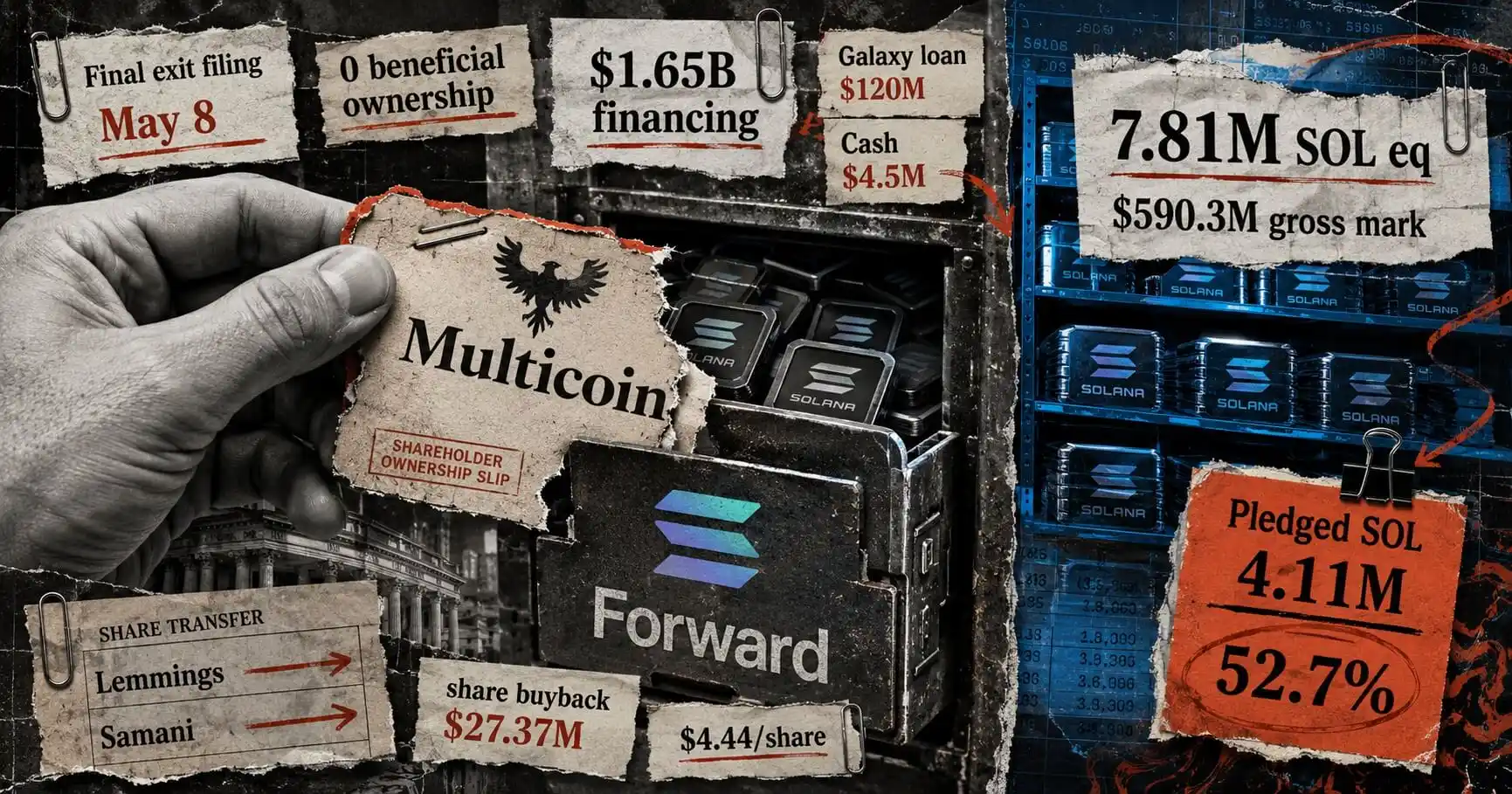
Прошло всего 8 месяцев после совместного создания. Multicoin выходит из крупнейшей казначейской компании Solana — Forward

Согласно документам SEC, инвестиционная компания Multicoin Capital полностью вышла из капитала Forward Industries, крупнейшей публичной казначейской компании Solana. Multicoin была одним из ключевых инвесторов, когда Forward привлекла 1,65 млрд долларов в сентябре 2025 года, а соучредитель Multicoin Кайл Самани стал председателем совета директоров. Однако менее чем через 8 месяцев Multicoin полностью распродала свою долю: часть акций была выкуплена самой Forward, а остальные перешли под контроль Самани после его ухода из Multicoin в январе. Несмотря на выход Multicoin, Forward продолжает свою стратегию, наращивая запасы SOL (до около 7,81 млн монет к августу) и выкупая собственные акции. Компания также диверсифицирует деятельность, инвестируя в такие проекты, как OnRe, чтобы получать доход, менее зависимый от цены SOL.

marsbit54 мин. назад

Прошло всего 8 месяцев после совместного создания. Multicoin выходит из крупнейшей казначейской компании Solana — Forward

marsbit54 мин. назад

Ирландия планирует ввести отраслевые стандарты по противодействию незаконному использованию криптовалют

Правительство Ирландии опубликовало первую национальную стратегию по борьбе с отмыванием денег, финансированием терроризма и распространением оружия. Документ включает меры по регулированию криптоактивов для противодействия их использованию в незаконных целях. Стратегия предполагает введение новых обязательств для поставщиков услуг с криптоактивами, усиление проверок транзакций с частными кошельками и более строгую проверку зарубежных криптокомпаний. Ирландия планирует внедрить эти отраслевые стандарты, соответствующие европейскому регламенту MiCA, во второй половине 2027 года. Стратегия также затрагивает вопросы использования криптоактивов в качестве источника средств для азартных игр.

cointelegraph4 ч. назад

Ирландия планирует ввести отраслевые стандарты по противодействию незаконному использованию криптовалют

cointelegraph4 ч. назад

Grayscale: «Если предложения будут приняты, цены на эти два альткоина могут вырасти»

Глава исследовательского отдела Grayscale Зак Пандл заявил, что обсуждаемые в сообществах Ethereum ($ETH) и Solana ($SOL) изменения в токеномике, направленные на снижение инфляции предложения, могут замедлить рост выпуска новых монет. Это потенциально создаст дефицит и окажет повышательное давление на цены. По оценкам Grayscale, в случае реализации изменений годовая инфляция предложения ETH может снизиться до ~0.4% к концу 2031 года (близко к показателям Bitcoin), а для SOL — до ~1.1%. Для сравнения, ежегодный прирост предложения золота составляет ~1.8%. Пандл отмечает, что предложения по Solana, по-видимому, имеют больше шансов на реализацию. Однако снижение инфляции может также уменьшить вознаграждения для стейкеров, так как значительная часть их дохода формируется за счет эмиссии новых токенов. Выгоду от возможного роста цен в первую очередь получат инвесторы, владеющие токенами без стейкинга. Предложения пока не утверждены окончательно.

cryptonews.ru4 ч. назад

Grayscale: «Если предложения будут приняты, цены на эти два альткоина могут вырасти»

cryptonews.ru4 ч. назад

Эксперты назвали причины падения биткоина после снижения инфляции в США

Благоприятные данные по инфляции в США в июле, соответствовавшие или превзошедшие ожидания, не привели к росту биткоина. Эксперты CryptoQuant видят основную причину в слабом спотовом спросе. Приток в американские биткоин-ETF остаётся низким, а индекс Coinbase Premium, указывающий на активность инвесторов из США, сохраняется в отрицательной зоне. Это свидетельствует об ограниченном покупательном давлении. При этом позиции на фьючерсном рынке остаются высокими, создавая дисбаланс: слабая ликвидность и спрос при значительном объёме маржинальных позиций. В таких условиях даже позитивные макроновости могут не спровоцировать рост, а скорее привести к закрытию лонгов и дальнейшему давлению на цену. Ключевым уровнем сопротивления названа отметка около $68 700. Для возобновления устойчивого роста рынку, по мнению аналитиков, необходим возобновлённый приток в ETF, рост спотовых объёмов, переход Coinbase Premium в плюс и уверенное закрепление биткоина выше $68 700.

cryptonews.ru5 ч. назад

Эксперты назвали причины падения биткоина после снижения инфляции в США

cryptonews.ru5 ч. назад

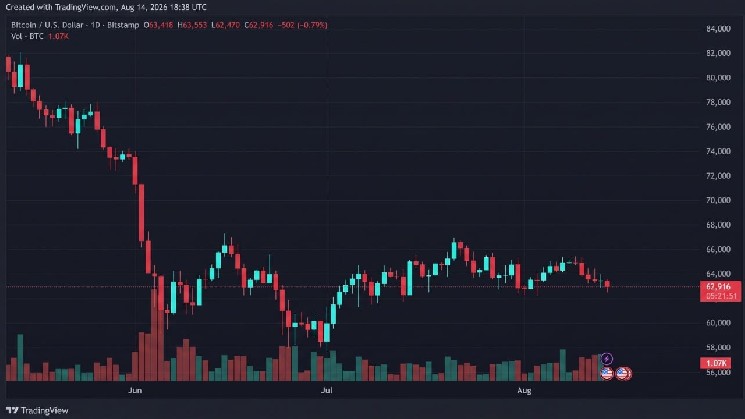
Курс биткоина опустился до 62 470 долларов, поскольку продавцы вновь тестируют уровень поддержки в 63 000 долларов

Курс биткоина в пятницу продолжил снижение, вновь опустившись ниже уровня поддержки в 63 000 долларов и достигнув дневного минимума в 62 470 долларов. Несмотря на последующее восстановление до отметки около 63 000 долларов, динамика цены оставалась вялой, а рыночная капитализация удерживалась ниже 1,27 трлн долларов. На рынке усилилась волатильность, приведя к значительным ликвидациям длинных позиций с кредитным плечом. Дополнительное давление оказал устойчивый отток средств из спотовых биткоин-ETF, что говорит о возможном отступлении институциональных инвесторов. Ситуацию усугубило предложение провайдера индексов MSCI о новых критериях отбора, которые могут привести к исключению из индексов компаний, активно использующих биткоин в казначейских резервах, таких как Strategy и Metaplanet. Это потенциально спровоцирует их принудительную распродажу институциональными фондами. Strategy публично осудила данную инициативу, заявив, что поставщики индексов должны измерять рынки, а не диктовать компаниям, какими активами владеть. Окончательное решение MSCI ожидается в октябре, и в случае принятия новые правила могут начать действовать уже в ноябре, создавая дополнительные препятствия для роста биткоина в конце года.

cryptonews.ru5 ч. назад

Курс биткоина опустился до 62 470 долларов, поскольку продавцы вновь тестируют уровень поддержки в 63 000 долларов

cryptonews.ru5 ч. назад

Торговля

Спот

Популярные статьи

Как купить CAKE

Добро пожаловать на HTX.com! Мы сделали приобретение PancakeSwap (CAKE) простым и удобным. Следуйте нашему пошаговому руководству и отправляйтесь в свое крипто-путешествие.Шаг 1: Создайте аккаунт на HTXИспользуйте свой адрес электронной почты или номер телефона, чтобы зарегистрироваться и бесплатно создать аккаунт на HTX. Пройдите удобную регистрацию и откройте для себя весь функционал.Создать аккаунтШаг 2: Перейдите в Купить криптовалюту и выберите свой способ оплатыКредитная/Дебетовая Карта: Используйте свою карту Visa или Mastercard для мгновенной покупки PancakeSwap (CAKE).Баланс: Используйте средства с баланса вашего аккаунта HTX для простой торговли.Третьи Лица: Мы добавили популярные способы оплаты, такие как Google Pay и Apple Pay, для повышения удобства.P2P: Торгуйте напрямую с другими пользователями на HTX.Внебиржевая Торговля (OTC): Мы предлагаем индивидуальные услуги и конкурентоспособные обменные курсы для трейдеров.Шаг 3: Хранение PancakeSwap (CAKE)После приобретения вами PancakeSwap (CAKE) храните их в своем аккаунте на HTX. В качестве альтернативы вы можете отправить их куда-либо с помощью перевода в блокчейне или использовать для торговли с другими криптовалютами.Шаг 4: Торговля PancakeSwap (CAKE)С легкостью торгуйте PancakeSwap (CAKE) на спотовом рынке HTX. Просто зайдите в свой аккаунт, выберите торговую пару, совершайте сделки и следите за ними в режиме реального времени. Мы предлагаем удобный интерфейс как для начинающих, так и для опытных трейдеров.

818 просмотров всегоОпубликовано 2024.04.12Обновлено 2026.06.02

Как купить CAKE

Обсуждения

Добро пожаловать в Сообщество HTX. Здесь вы сможете быть в курсе последних новостей о развитии платформы и получить доступ к профессиональной аналитической информации о рынке. Мнения пользователей о цене на CAKE (CAKE) представлены ниже.

活动图片