OpenAI Publishes 62-Page Core Manuscript: AI Cracks Ten 'Fields Medal-Level' Problems in a Row

marsbitОпубликовано 2026-08-04Обновлено 2026-08-04

Введение

OpenAI releases a 62-page core manuscript detailing how its AI model independently solved ten major, longstanding mathematical problems considered "Fields Medal-level." The breakthroughs, achieved at an estimated computational cost of only $2,000, include advancing a 46-year-old upper bound for high-dimensional sphere packing and explicitly constructing a non-sofic group—a 27-year-old open question. The manuscript, titled "How the Ideas Came Together," was authored autonomously by the AI (reportedly the next-generation model Astra). It reconstructs the reasoning process for each problem: identifying initial promising paths, obstacles encountered, pivotal shifts in perspective, and the final decisive insights. For sphere packing, the AI moved beyond traditional linear programming limits by employing Mellin transforms and harmonic measure to refine the density exponent. For the non-sofic group, the key was resolving a "crucial mismatch" between having many expansion graphs and needing one, via a controlled median-based function. OpenAI researcher Mo Bavarian reflects on the rapid progress from AI struggling with grade-school math to solving profound mathematical conjectures, calling this moment "more surreal than any before" and akin to the eve of a technological singularity.

Ten 'Fields Medal-Level' Achievements, AI's Complete Proof Process Fully Disclosed!

Today, OpenAI released a heavyweight 62-page 'Core Manuscript,' detailing GPT's complete reasoning process.
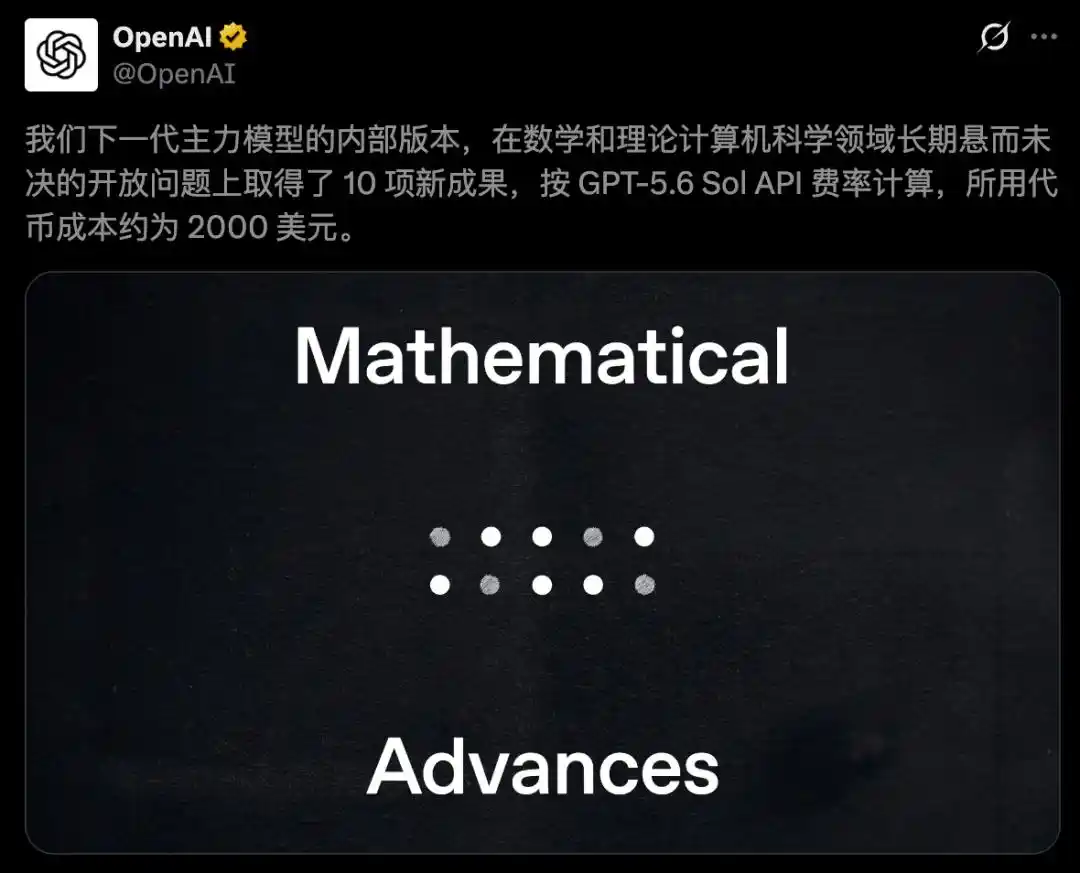
Officially 'stamped,' this astonishing breakthrough was accomplished by the 'next-generation main model.'

Calculated based on the GPT-5.6 Sol API billing standard, the total cost of all Tokens burned was only $2,000.

The release of the AI proof manuscript ignited the internet once again.

Everyone was wildly guessing, 'This must be the legendary GPT-6!' Others exclaimed repeatedly that $2,000 had unlocked ten historic achievements.


GPT Solves Ten Century-Old Problems for Just $2,000

Two days ago, an OpenAI internal employee posted a blog stating that the next-generation model Astra had conquered ten mathematical problems.

A list chart was presented, shocking everyone.

It covers High-dimensional sphere packing, Binary and spherical codes, Group theory, Connes rigidity conjecture, Arithmetic circuit lower bounds, Quantum parallel repetition, Closest vector problem, Ehrhart volume conjecture, Multicolor Ramsey numbers, and Extremal graph theory.
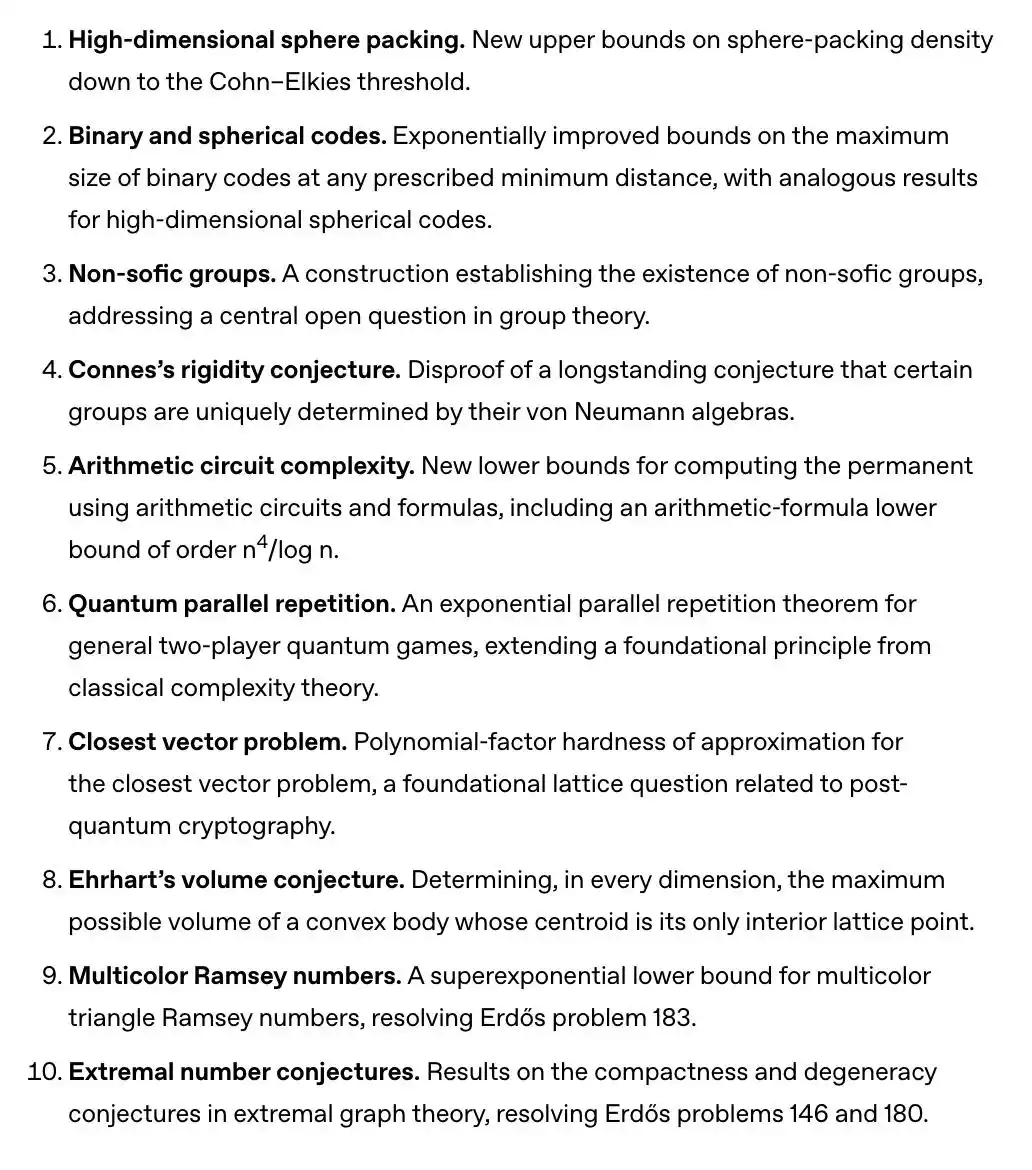
At that time, the official blog posted a 249-page collection of papers and a complete set of Lean 4 formal certificates.

But today, a 62-page manuscript was officially released, titled 'How the Ideas Came Together.'

Portal: https://cdn.openai.com/pdf/reasoning-walkthroughs.pdf

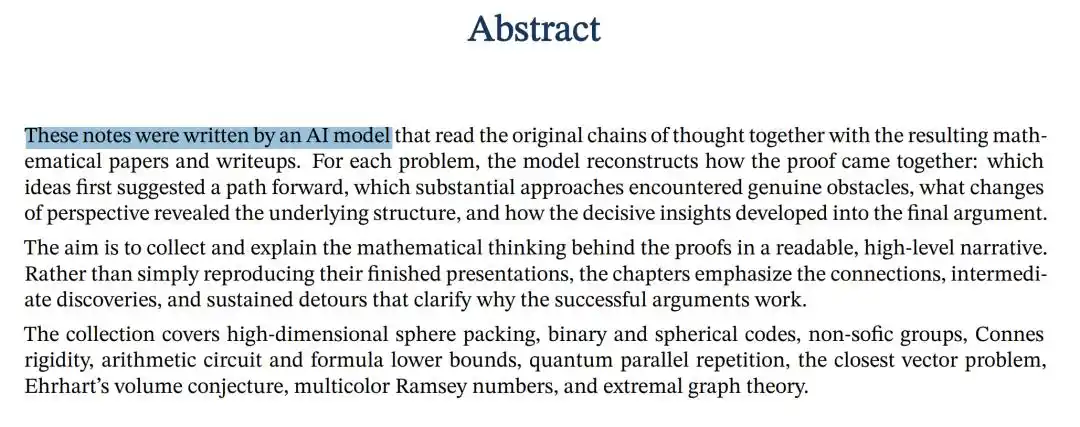
Its 'Abstract' is only a short paragraph, but the information density is astonishing—

This note was written independently by an AI model, with no intervention from the OpenAI team.

The AI read the original CoT and the final mathematical papers, then reconstructed four things for each problem:

Which ideas initially pointed to a viable path;

Which seemingly substantial methods encountered real obstacles;

What kind of perspective shift revealed the underlying structure;

How the decisive insights finally formed the complete argument.
Highly Discussed Problem: High-Dimensional Sphere Packing, Untouched for 46 Years

Among the ten problems, high-dimensional sphere packing has garnered the most attention online.

Leaving aside the profound name, the problem itself is actually easy to understand: put a bunch of same-sized balls into a box—how densely can you pack them?
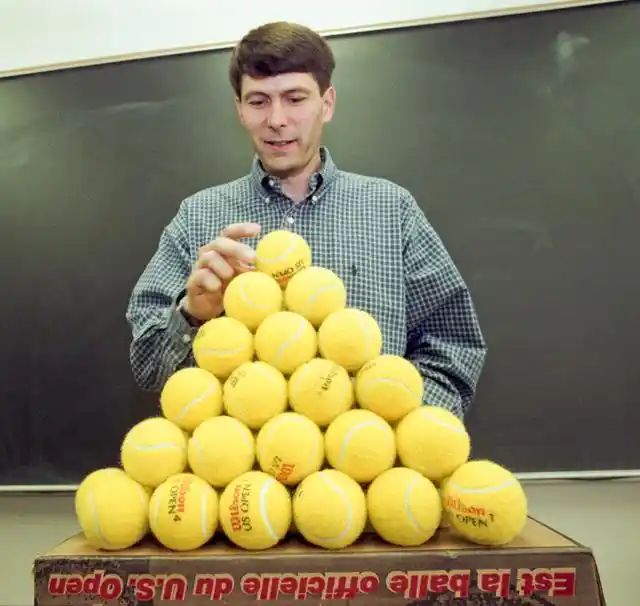
The answer for three-dimensional space has long been known—it's the stacking method used for 'stacking oranges' at a fruit stand.

But for hundreds or thousands of dimensions, humans could only give an 'upper bound'—the maximum possible density cannot exceed a certain value.

The exponent of this upper bound was stuck at 0.5991, with no substantial progress since 1978, a span of 46 years.

Astra directly pushed it to 0.6044005442916776954..., the density upper bound expressed as 2^-(0.6044...+o(1))d.
The key is, how did it achieve this?

First, Astra determined the inherent limits of the Cohn–Elkies linear programming method during the reasoning process.

The AI's initial approach was to use Cauchy–Schwarz to estimate the negative mass of a function. After extensive work, it could only achieve a radius of √d/(2√π).
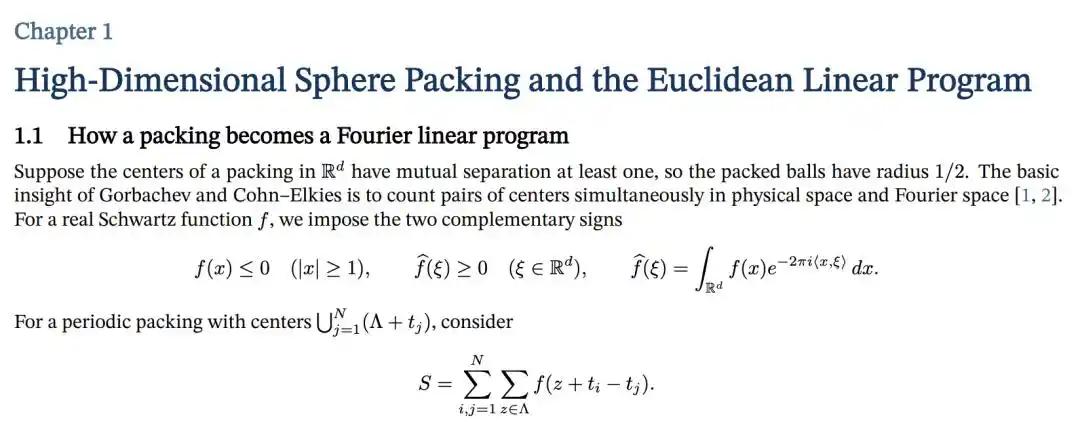
After getting stuck, it made a judgment: the obstacle wasn't poorly optimized constants, but the fact that global norms simply couldn't capture where the negative mass was located.

Thus, Astra decided to change perspective: switch to using Mellin transforms, along with harmonic measures.

But why this?

Because for radial functions, the Fourier transform is essentially a Hankel transform; its kernel depends only on the product of the spatial radius and frequency radius.

On the Mellin side, this becomes an extremely simple operation: reflection, plus an explicit phase.

There's another subtle point here: that phase factor has a constant modulus of 1 on the real axis, revealing nothing on the real axis.

But when analytically continued to the complex plane, it carries precisely the high-dimensional information lost by the norm inequality.

At the limit, the harmonic measure converges to a logistic density, and its logarithmic potential precisely equals the digamma function, whose integral yields exactly log(π/2).
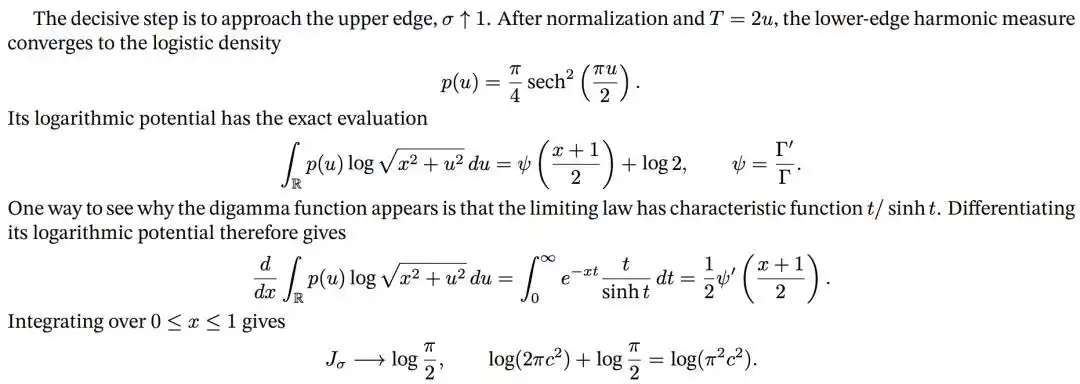
The threshold of 1/π comes from here.

A detail particularly indicative of its understanding:

The total mass of the harmonic measure is (1−σ)/2, not 1. The manuscript specifically notes: Replacing this kernel with a probability density too early would alter the exponential constant.

With the lower bound obtained, we still need to construct a function that actually achieves it.

The Gaussian gives the correct Fourier symmetry, but the saddle point position is wrong.

The solution is to multiply by an even deformation, moving the saddle point without breaking symmetry. After fully utilizing the available damping, an 'ideal profile' is obtained.

The saddle point displacement integral, calculated via the Wallis product, equals exactly −(1/2)log(π/2).

This number precisely moves the Gaussian's radius from 1/√(2π) to 1/π.

Here, the radius predicted by the lower bound and the radius constructed by the upper bound converge.

Another very specific detail in the manuscript:

When constructing the auxiliary function, a positive damping patch is needed for the distant region.

This patch must be added over an entire interval, not at a single point, because adding at a single point would hit a resonant frequency.

Non-Sofic Groups: The Difficulty Lies in 'Many' and 'One'

The second hot topic is the construction of 'non-sofic groups,' unsolved for 27 years.

Manchester University mathematician Thomas Bloom stated, 'Among constructive results, this is more significant than the previous unit distance conjecture counterexample.'

The concept of 'sofic groups' was proposed by Abel Prize laureate, Russian mathematician Mikhail Gromov, in 1999.

In Hebrew, 'sofic' means 'finite.'
In simple terms, whether a group is sofic asks this:

Can this infinitely large, abstract structure be approximately simulated by a series of 'sufficiently large finite shuffle operations'?

Astra provided an explicit construction, answering: there exists an infinite, finitely presented 'non-sofic group.'

The most valuable part of the manuscript is its clarity about the real sticking point—

Kun's theorem gives many expansion graphs, while the Kun–Thom theorem requires one.

The gap between 'many' and 'one' is the core difficulty of the entire chapter.
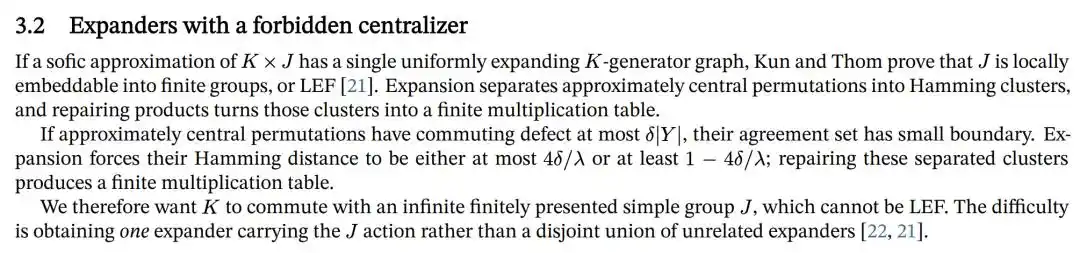
The AI called this 'the crucial mismatch.'

It gave a particularly clear example of why one cannot just pick one arbitrarily:

On the union of two identical Qs (Q⊔Q), the operation 'swap the two copies' commutes exactly with the K-action of expansion—but it does not preserve either copy.

That is, those 'almost central elements' can jump between components; you simply can't pin them down.

There was an earlier detour before this: trying to directly convert property (T) into mixing. This requires a lazy or anti-bipartite averaging set, because a bipartite graph can have spectrum near −1, even if it has a Kazhdan gap at 1.
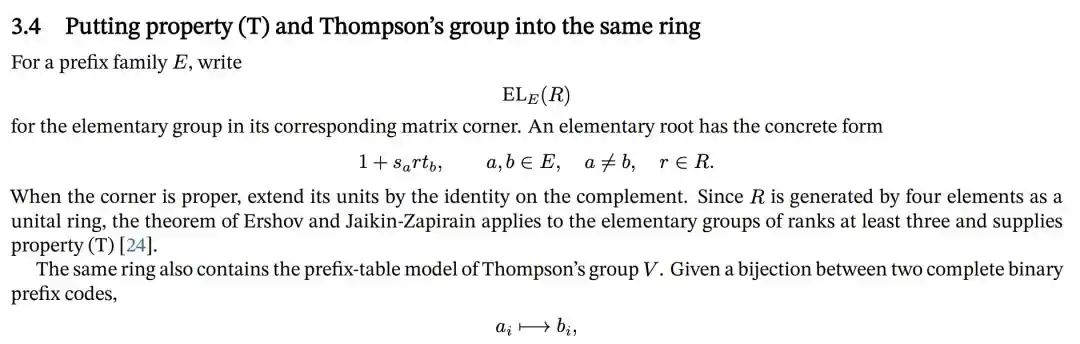
Corrected averaging did fix this spectral issue, but it couldn't fix 'which copy to choose.'

To address this, Astra first tried a scheme: take the logarithm of component sizes, bin them on a randomly shifted grid, then switch to bounded median comparisons.

But this path failed. Based on empirical summary, the AI concluded:

What must be averaged is always a bounded monotone function of component size, never the unbounded size itself.

Therefore, the final version was rewritten following this 'fundamental principle.'

In each ambient expansion component A, take a vertex-weighted median m_A, then define

f(x) = M(x) / (M(x) + m_A)

where M is the component size. This f is always between 0 and 1, and 1/2 is precisely the median on each A.

The advantage of this f is that it transforms an uncontrollable quantity into a controlled one.

The key is that generators are permutations—they only move positions, without adding or removing; walking a cycle results in a total change of zero; and each step can decrease at most a tiny bit, so both sides are suppressed to negligible levels.

Then, cut by height, use expansion for the smaller side, and squeeze from both ends: f equals 1/2 almost everywhere.

This means the sizes of all blocks within the same range are squeezed to be almost identical, allowing them to match one-to-one.

At the final stage, a small region remained.

Astra's handling was counterintuitive: pick a maximally large bad region and discard it entirely—precisely because the largest piece is chosen, it conversely proves it's small enough to be negligible.

Gromov's question now has an answer, 27 years later.

For the AI's proof process of the remaining eight problems, interested parties can refer to: https://cdn.openai.com/pdf/reasoning-walkthroughs.pdf

The 'Singularity' Approaches, Countdown Begins

Upon the manuscript's release, OpenAI reinforcement learning expert Mo Bavarian posted a long thread.

His opening line: this is truly a 'surreal' moment.

In 2021, he and the OpenAI team released the GSM8K dataset—8,500 elementary school math word problems, simple enough to be solved in 2-8 steps.

In the GPT-2/3 era, AI indeed struggled even with elementary math problems, barely suitable for drafting emails.
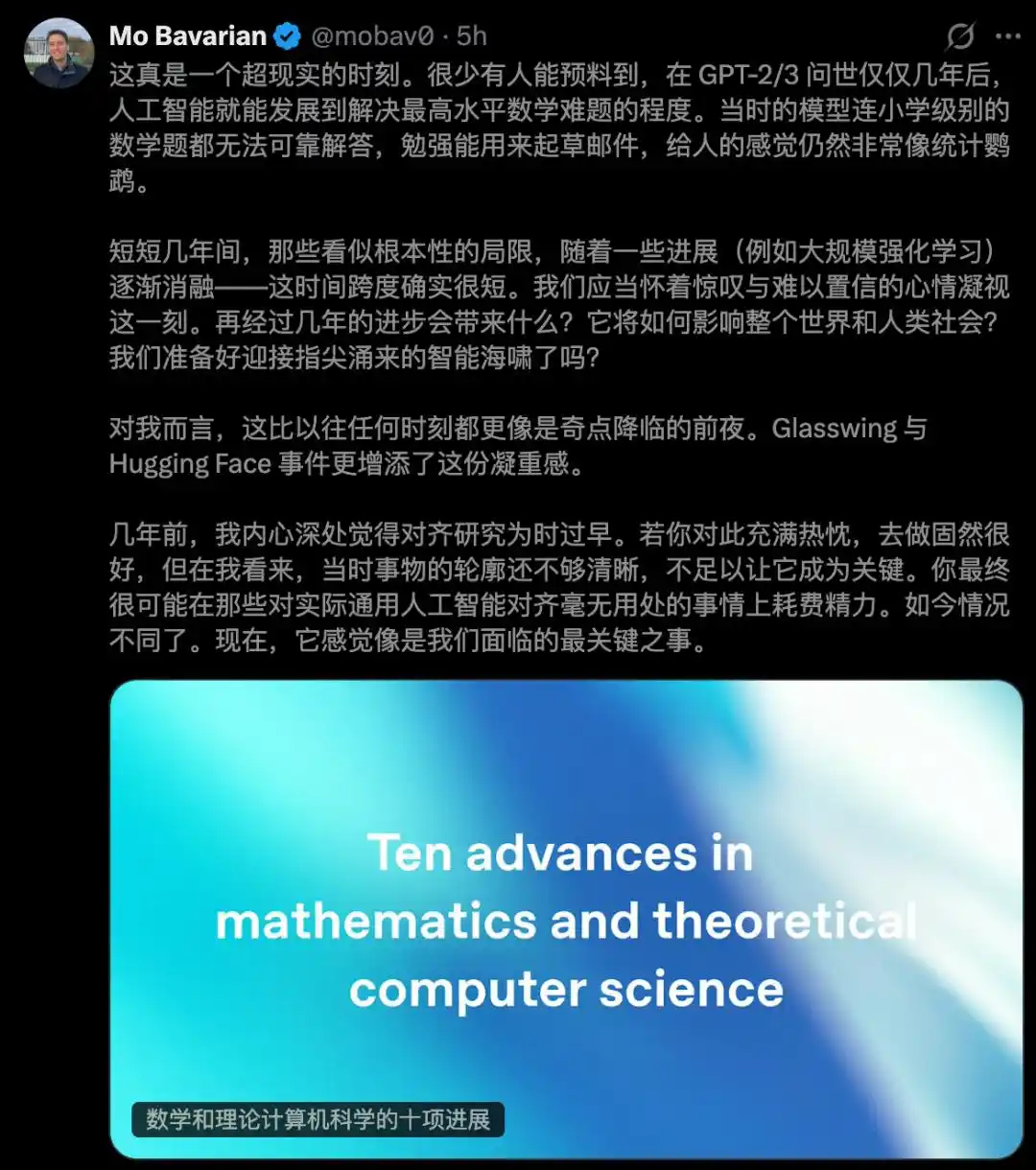
Yet, in just a few years, with the rapid advance of large-scale RL, previously seemingly insurmountable 'technical dead ends' have been shattered one by one.

This time span is unbelievably short.

Mo Bavarian stated, 'For me, this moment feels more like the eve of the Singularity than ever before.'

A few years ago, AI was stumbling over elementary school word problems.

Today, $2,000 worth of Tokens can buy ten answers potentially written into mathematical history.

The 'eve of the Singularity' might not be as distant as it seems.

Reference: https://cdn.openai.com/pdf/reasoning-walkthroughs.pdf

This article is from the WeChat public account 'Xin Zhi Yuan,' author: ASI Revelations; editor: Taozi


Трендовые криптовалюты

Связанные с этим вопросы

QWhat are the two main mathematical problems discussed in detail in the article?

AThe article details the breakthroughs on two main problems: 1) The high-dimensional sphere packing problem (specifically improving the upper bound for packing density in very high dimensions), which had been stagnant for 46 years. 2) The explicit construction of a 'non-sofic group', an open problem in group theory for 27 years.

QAccording to the article, what significant document did OpenAI release and what makes it unique?

AOpenAI released a 62-page document titled 'How the Ideas Came Together'. Its uniqueness lies in the fact that it was written independently by an AI model, which reconstructed the reasoning process for solving the ten problems by analyzing the original chain-of-thought and final mathematical papers, without human intervention.

QHow did the AI, referred to as Astra, approach the high-dimensional sphere packing problem differently after hitting an initial obstacle?

AAfter an initial approach using Cauchy–Schwarz estimation hit a wall, Astra switched its perspective. It abandoned the global norm approach and instead employed Mellin transforms and harmonic measure. This shift allowed it to capture the high-dimensional information lost in the norm inequality, ultimately leading to the improved bound involving a threshold of 1/π.

QWhat was described as the core difficulty or 'crucial mismatch' in constructing a non-sofic group?

AThe core difficulty, described as the 'crucial mismatch', was bridging the gap between 'many' and 'one'. Kun's theorem provided many expansion graphs, but the Kun–Thom theorem required a single, specific one. The challenge was that approximate central elements could jump between components, making it impossible to isolate and select a single, stable component to work with.

QWhat comparison does OpenAI researcher Mo Bavarian make to emphasize the rapid progress of AI?

AMo Bavarian compares the current state to a few years ago when AI (like GPT-2/3) struggled with elementary school math problems from the GSM8K dataset. He contrasts that with the present, where a $2000 investment in compute tokens (for Astra) can yield solutions to ten historically significant mathematical problems. This dramatic progress leads him to describe the moment as feeling 'more like the eve of the singularity than ever before.'

Похожее

SEC и CFTC в один день подали иск против Goliath: Раскрыта криптопирамида на $400 млн, платформам, привлекающим клиентов высокими процентами, больше нет регуляторных лазеек

Авторы: Клод, Deep Wave TechFlow Компания Goliath Ventures, обещавшая инвесторам доход от комиссий в "криптовалютных пулах ликвидности", оказалась финансовой пирамидой, собравшей около $4 млрд с более чем 1300 человек. Соучредитель Кристофер Дельгадо присвоил не менее $51 млн на личные нужды. Комиссия по ценным бумагам и биржам (SEC) и Комиссия по торговле товарными фьючерсами (CFTC) США в один день подали гражданские иски против компании, демонстрируя скоординированный надзор за криптоиндустрией. Схема предлагала "гарантированную" ежемесячную доходность от 3% до 10%, финансируя выплаты старым инвесторам за счет новых вкладчиков. Реальных операций с криптоактивами не проводилось. К ноябрю 2025 года пирамида рухнула, когда приток новых средств прекратился. Дельгадо уже признал себя виновным по уголовным обвинениям в мошенничестве и отмывании денег и согласился на конфискацию активов. Однако инвесторам, вероятно, не удастся вернуть свои средства, общие потери которых оцениваются в $2.5 млрд. Одновременные действия SEC и CFTC сигнализируют о закрытии регуляторных лазеек для платформ, предлагающих нереалистично высокие гарантированные доходы.

marsbit9 мин. назад

SEC и CFTC в один день подали иск против Goliath: Раскрыта криптопирамида на $400 млн, платформам, привлекающим клиентов высокими процентами, больше нет регуляторных лазеек

marsbit9 мин. назад

Уолл-стрит начинает подвергать сомнению историю о ИИ от технологических гигантов

Уолл-стрит начал подвергать сомнению «историю ИИ» технологических гигантов, переходя от общих нарративов к детальному анализу финансовых и физических показателей. Хотя такие компании, как Google (Alphabet), Microsoft и NVIDIA, сообщают о сильном росте выручки и спроса на ИИ-услуги, инвесторы теперь сосредоточены на движении денежных средств и окупаемости огромных капиталовложений. Ключевым тревожным сигналом стало первое отрицательное значение свободного денежного потока (FCF) у Alphabet (-$58.55 млрд) из-за рекордных капитальных затрат ($449.24 млрд) на инфраструктуру ИИ, что привело к падению акций. В отличие от них, Microsoft, несмотря на высокие инвестиции, сохранила положительный FCF ($196 млрд) благодаря росту операционного денежного потока, что было позитивно воспринято рынком. Объявление NVIDIA о планах по привлечению $500 млрд стороннего капитала для финансирования инфраструктуры ИИ также было встречено с осторожностью. Рынок интерпретирует это как признак того, что затраты на ИИ становятся настолько высокими, что превышают внутренние финансовые возможности даже крупных технологических компаний. Аналитики сместили фокус с подтверждения спроса на ИИ на оценку скорости, с которой этот спрос превращается в реальные доходы, прибыль и денежные потоки, способные оправдать стремительные инвестиции. Сейчас Уолл-стрит использует показатель свободного денежного потока в качестве первого фильтра, чтобы отличить компании, которые могут финансировать рост за счёт собственных средств, от тех, кто может столкнуться с финансовым напряжением. Долгосрочная рентабельность капиталовложений в дорогую и быстро устаревающую инфраструктуру ИИ остаётся под вопросом.

marsbit13 мин. назад

Уолл-стрит начинает подвергать сомнению историю о ИИ от технологических гигантов

marsbit13 мин. назад

На рынок литографических установок ворвался неожиданный игрок

В 2026 году Илон Маск анонсировал проект TeraFab по производству чипов, нацеленный на обеспечение вычислительной мощности в 1 тераватт для SpaceX и Tesla. Позже появились сообщения о его возможном выходе на рынок фотолитографии через технологию FEL (свободный электронный лазер), которая рассматривается как потенциальная альтернатива доминирующей технологии EUV от ASML. FEL предлагает иной подход к созданию источника света для литографии по сравнению с текущим методом LPP в EUV-установках ASML. Он обладает потенциальными преимуществами: более высокая мощность (до 10 кВт), отсутствие загрязнения от олова и возможность работы в более коротком, «пограничном с рентгеновским» диапазоне длин волн (2–7 нм). Стартап xLight, поддержанный экс-гендиректором Intel Патом Гелсингером, активно развивает это направление. В статье рассматриваются три основных направления в индустрии фотолитографии. Первое — это постепенная эволюция технологии EUV от лидера рынка ASML, включая разработку дорогостоящих установок High-NA EUV. Второе — революция в источниках света (например, FEL), которая может позволить модернизировать существующие линии, меняя только источник. Третье — альтернативные, не-EUV технологии, такие как наноимпринт-литография (NIL) и электронно-лучевая литография (EBL), которые находят свою нишу. Выход Маска и развитие FEL бросают вызов устоявшимся правилам игры, где ASML долгое время был монополистом. Хотя преодоление пути от лабораторных разработок до массового производства остается сложной задачей, индустрия фотолитографии вступает в период потенциальных перемен.

marsbit13 мин. назад

На рынок литографических установок ворвался неожиданный игрок

marsbit13 мин. назад

Bitcoin Policy Institute призвал разработчиков ИИ предоставить защитникам криптоинфраструктуры доступ к передовым моделям

Институт биткоин-политики (BPI) предупреждает о рисках, которые передовые системы искусственного интеллекта (ИИ) представляют для безопасности криптоинфраструктуры. В открытом письме к разработчикам ИИ аналитики отмечают, что современные модели уже способны анализировать код, находить уязвимости и выполнять сложную техническую работу, и эти возможности могут быстрее попасть в руки злоумышленников, чем защитников открытого ПО. Под угрозой находятся кошельки, криптографические библиотеки, ПО узлов, биржи и платежные сети, причем атаки на цифровые активы могут приводить к быстрым финансовым потерям. BPI подчеркивает, что разработчики критически важного открытого ПО, такие как команда Bitcoin Core, не имеют доступа к самым мощным ИИ-моделям и специализированным инструментам кибербезопасности, которые доступны ведущим лабораториям и их партнерам. Чтобы снизить риски, Институт призывает ИИ-лаборатории создать программы доверенного доступа для квалифицированных разработчиков, защищающих открытую финансовую инфраструктуру. Предложения включают ранний доступ к мощным моделям, выделение вычислительных ресурсов для длительных проверок безопасности, защищенные среды для анализа кода, а также доступ для небольших команд и независимых исследователей. Цель — позволить защитникам находить и устранять уязвимости до того, как ими воспользуются злоумышленники. BPI также призывает криптоиндустрию помочь в определении надежных участников таких программ и координации реагирования на угрозы.

cryptonews.ru32 мин. назад

Bitcoin Policy Institute призвал разработчиков ИИ предоставить защитникам криптоинфраструктуры доступ к передовым моделям

cryptonews.ru32 мин. назад

Bitwise сократила 14% персонала на фоне спада крипторынка

Компания Bitwise Asset Management объявила о сокращении 14% персонала, или около 25 сотрудников, в связи со спадом на крипторынке. Численность штата снизилась со 180 до 155 человек, но конкретные затронутые подразделения не были названы. Генеральный директор Хантер Хорсли заявил, что данные меры подготовки компании к будущему росту рынка, который, по его мнению, будет обусловлен более глубокой интеграцией криптоактивов в мировую экономику. Bitwise является крупным провайдером биржевых продуктов, управляющим активами на сумму около $9 млрд, включая спотовый биткоин-ETF BITB с капиталом $2,3 млрд. Сокращения в Bitwise отражают общий тренд на консолидацию и оптимизацию расходов в криптоиндустрии, который также затронул и других крупных игроков, таких как Hashdex и Grayscale Investments.

cryptonews.ru32 мин. назад

Bitwise сократила 14% персонала на фоне спада крипторынка

cryptonews.ru32 мин. назад

Торговля

Спот

Популярные статьи

Неделя обучения по популярным токенам (2): 2026 может стать годом приложений реального времени, сектор AI продолжает оставаться в тренде

2025 год — год институциональных инвесторов, в будущем он будет доминировать в приложениях реального времени.

2.0k просмотров всегоОпубликовано 2025.12.16Обновлено 2025.12.16

Неделя обучения по популярным токенам (2): 2026 может стать годом приложений реального времени, сектор AI продолжает оставаться в тренде

Обсуждения

Добро пожаловать в Сообщество HTX. Здесь вы сможете быть в курсе последних новостей о развитии платформы и получить доступ к профессиональной аналитической информации о рынке. Мнения пользователей о цене на AI (AI) представлены ниже.

活动图片