US and Japan's Unprecedented Joint Action in 30 Years Marks End of Yen Carry Trade Era

marsbitОпубликовано 2026-08-03Обновлено 2026-08-03

Введение

Japan and the U.S. conducted a rare coordinated intervention in the foreign exchange market around August 3rd to stem the yen's sharp depreciation. U.S. Treasury Secretary Scott Bessette's notepad, photographed by Reuters, revealed plans for a $5-10 billion yen-buying operation. Following official confirmation, the USD/JPY pair plunged from near 164 to around 155-156. The intervention marks a significant shift as the U.S. moved from verbal support to practical coordination. While the core carry trade logic—exploiting the higher U.S. interest rates—remains intact, the risk structure has changed. Traders must now account for potential repeated bilateral actions, altering the risk-reward calculation for yen shorts. The intervention's immediate effect is forcing leveraged positions to unwind, amplifying the yen's rebound. However, analysts note this does not signal the end of the yen carry trade. The fundamental driver—the wide interest rate differential between the U.S. (3.50%-3.75%) and Japan (1%)—persists. The action is seen more as buying time for the Bank of Japan's gradual policy normalization while mitigating imported inflation pressures. To avoid destabilizing the U.S. Treasury market during intervention, authorities utilized the Fed's FIMA repo facility, allowing Japan to obtain dollar liquidity using its Treasury holdings as collateral instead of selling them. The move aims to contain spillover risks. While creating short-term volatility and compressing leverage for...

The signal of joint US-Japan intervention on the yen quickly intensified around August 3.

Japanese Finance Minister Sakaki Katayama confirmed that the Japanese Ministry of Finance has coordinated with the US Treasury to buy yen. US President Trump and Treasury Secretary Scott Bessent also subsequently confirmed US involvement, stating that further joint actions are not ruled out. Following the official announcements, USD/JPY retreated sharply from near a 40-year high of 164 last week, falling to around 155.20 at one point; AP recorded an early August 3 rate of approximately 156.34.

US and Japanese Finance Ministers Meet

The most significant change in this round is not just Japan's renewed selling of dollars and buying of yen, but that the US has moved from verbal support to actual coordination.

For traders who have long bet on yen depreciation, the original logic has not completely failed: US interest rates remain significantly higher than Japan's, and holding dollar assets can still earn interest differentials. However, the risk structure of this trade has changed. In the past, the market mainly judged the scale and duration of Japan's unilateral intervention; now, it must also consider US participation, potential repeated operations by both sides, and the possibility of officials establishing a policy defense line at specific levels.

US-Japan Joint Intervention Materializes, Yen Rebounds Sharply

USD/JPY Retreats Rapidly from 164

The speed of the yen's rebound is itself the most direct evidence of how coordinated intervention affects market expectations.

In late July, USD/JPY approached 164, with the yen hitting its lowest level in about 40 years. A weak yen can boost overseas profits for Japanese exporters when converted to yen, but it also raises the cost of imported energy, food, and raw materials, further increasing living costs for households and operational pressures for companies. As the exchange rate broke through the previously sensitive levels of 150 and 160, the Japanese government's political tolerance for depreciation decreased significantly.

Japan had previously intervened unilaterally to buy yen, but the exchange rate typically rebounded only briefly. The market's familiar script was: the Ministry of Finance steps in, shorts temporarily cover, and then the US-Japan interest rate differential attracts capital back to dollar assets.

This time, the market is facing a different script.

The Japanese Ministry of Finance explicitly used the term 'coordinated intervention,' and Bessent stated that the US Treasury will continue to communicate with Japan and 'will not hesitate' to participate in joint action again. Officials may not need to continuously inject huge sums; as long as traders believe bilateral intervention is possible when USD/JPY nears 164, the tail risk of continuing to short the yen increases significantly.

Signal of $5-10 Billion Exposure, US Moves from Verbal Support to Actual Participation

A Reuters photo taken on July 31 showed Bessent's notepad at a Camp David cabinet meeting stating: 'To Do: Buy Japanese Yen (JPY) $5-10 bil.'
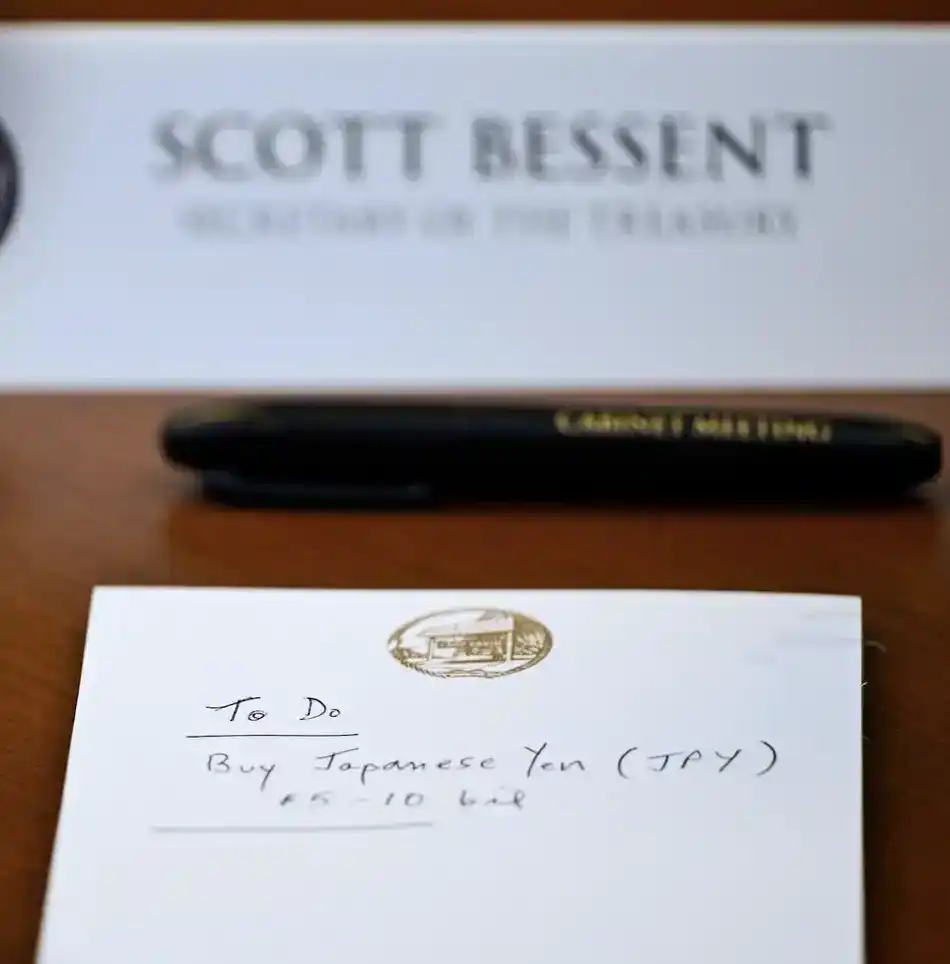
Reuters published a photo of a notepad in front of Bessent at Friday's cabinet meeting. Under the 'To Do' heading, Bessent wrote 'Buy $5-10 bil Japanese Yen (JPY)'.

This notepad does not prove how much yen the US ultimately bought. When the photo surfaced, the US Treasury had not yet confirmed the specific amount. Its key information is that the US Treasury at least seriously considered a yen-buying operation of an actual scale, beyond merely expressing diplomatic support for Japan.

Subsequently, the formal confirmation of joint intervention by the US and Japan further amplified the market significance of this photo. Bessent also publicly stated the US willingness to repeat the action if needed. $5-10 billion might not be enough to change the supply-demand dynamics of the global forex market long-term, but it is sufficient to force highly leveraged yen shorts to recalculate their stop-loss points and position sizes.

The way intervention truly works is not just through official funds directly moving the exchange rate.

When USD/JPY falls rapidly, investors who borrowed yen to buy dollar assets incur exchange rate losses. Some highly leveraged accounts need to post additional margin, and some trend trades and option positions trigger stop-losses. The covering process requires selling dollars and buying back yen, amplifying the yen's short-term gains.

Thus, the rapid retreat from near 164 to the 155-156 range likely includes both official trades and concentrated deleveraging of carry and trend positions.
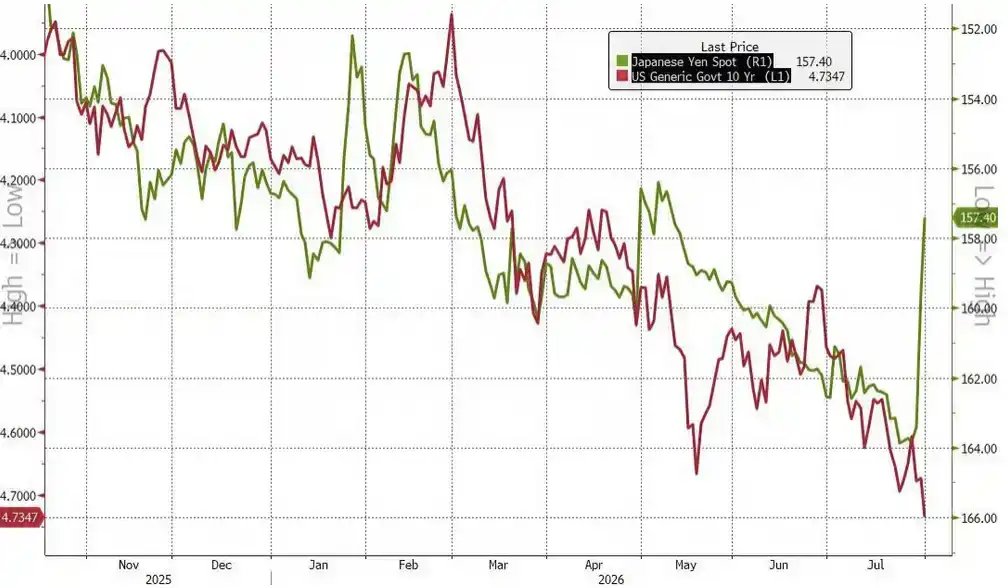
Yen Shorts Begin Retreat, Risk Spills Over to Global Assets

Yen Carry Trade Not Over, But Trade Odds Have Changed

Talk of the 'yen carry trade ending' has emerged in the market, but this judgment is premature.

The Fed kept its federal funds target range at 3.50% to 3.75% on July 29, while the Bank of Japan maintained its short-term policy rate at 1% on July 31. Even without considering hedging costs, US short-term rates remain significantly higher than Japan's, so the fundamental yield from borrowing yen and allocating to dollar assets has not disappeared.

Coordinated intervention changed the risk-reward ratio of this trade.

Previously, investors might have viewed Japan's unilateral intervention as only causing brief volatility, thus willing to re-establish shorts after yen rebounds. Now, they must also price in a higher risk premium for the possibility of US re-entering the market, officials increasing intervention frequency, and the Bank of Japan raising rates earlier.

Yen shorts may therefore reduce leverage, shrink positions, or buy more option protection, but this does not mean capital has entirely abandoned the carry trade. As long as the US-Japan rate differential remains high, the yen may still face new selling pressure on each rebound.

A more accurate assessment is: coordinated intervention has compressed the leverage space for yen shorts but has not yet eliminated the macro fundamentals for shorting the yen.

US Treasuries Face Spillover Risk, But Transmission Mechanism Has Changed

The global impact of yen intervention lies not only in the forex market but also in how Japan funds the dollars needed to buy yen.

US Treasury TIC data shows that as of the end of May 2026, Japan holds approximately $1.143 trillion in US Treasuries, the largest foreign holder. TIC data, affected by factors like custodial account attribution, does not precisely reflect ultimate ownership, but Japan's massive US Treasury holdings remain an important indicator for observing intervention spillover risk.

The traditional operational chain is that the Japanese Ministry of Finance uses foreign exchange reserves to sell dollars and buy yen in the market. If existing dollar cash is insufficient, it could theoretically sell dollar assets, including US Treasuries. Large-scale, sustained selling of US Treasuries could increase market supply, putting upward pressure on US long-term yields.

But this transmission chain is not inevitable.

Bessent revealed that the Fed's FIMA repo facility for foreign central banks and international monetary authorities played a role in this action. This tool allows foreign official institutions to temporarily pledge US Treasuries held at the New York Fed as collateral for dollar loans, thereby obtaining the dollar liquidity needed for intervention without directly selling Treasuries. Bessent also suggested expanding the scale of this facility in the future.

This implies that one aim of US-Japan coordination may be to allow Japan to support the yen while trying to avoid concentrated selling of US Treasuries that could push up US financing costs.

The US Treasury risk therefore needs to be understood on two levels: short-term, the FIMA tool can buffer forced selling pressure; if intervention scales persist and durations lengthen, Japan may still adjust its dollar asset allocation, and only then would the US Treasury market face more noticeable supply impacts.

Intervention Alters Short-Term Odds, Interest Differentials Determine Long-Term Trend

Ministry of Finance Can Buy Time, Central Bank Determines Trend

Coordinated intervention can change short-term positioning but can hardly alone determine the yen's medium-to-long term direction.

The Bank of Japan has gradually exited ultra-easy policy, raising the policy rate to 1%, but the pace of its tightening remains constrained by the domestic economy, government financing costs, and the stability of the Japanese government bond (JGB) market. On July 31, the BOJ maintained rates unchanged with an 8-1 vote, with only one board member advocating an immediate hike to 1.25%.

This creates clear tension for Japanese policy.

The Ministry of Finance wants to prevent excessive yen depreciation to reduce imported inflation and political pressure; the Bank of Japan cannot raise rates rapidly just for the exchange rate, as that could push up JGB yields and increase financing burdens for the government, companies, and households.

Intervention in this process is more like buying time: by creating two-way volatility and forcing shorts to reduce leverage, it creates a window for the BOJ to gradually normalize policy.

But the exchange rate trend ultimately depends on fundamentals. If the BOJ continues to hike and US yields fall, narrowing the US-Japan interest differential, a sustained yen rebound becomes easier; if the differential remains wide long-term, gains post-intervention could still gradually be given back.

Still Far from a 'New Plaza Accord'

Grand narratives like 'New Plaza Accord' and 'end of yen carry trade era' have already appeared in the market, but current facts are insufficient to support these judgments.

The 1985 Plaza Accord involved multiple major economies jointly pushing for an orderly dollar depreciation, encompassing broader policy coordination and global currency realignment. The current action's scope is narrower, directly aiming to curb the yen's excessive, disorderly depreciation and prevent forex and bond market volatility from spilling over into the global financial system.

What can be confirmed at this stage is that the US and Japan have jointly bought yen, Bessent's notepad shows the US considered an operation of $5-10 billion, and both sides explicitly reserve the possibility of intervening again. USD/JPY subsequently retreated rapidly from near 164 to the 155-156 range.

This is enough to change short-term trading but not enough to prove the yen has entered a long-term appreciation cycle.

Three things truly need watching next: whether the US participates in actual trades again, whether the BOJ accelerates its rate hike pace, and whether the FIMA tool allows Japan to continuously obtain dollar liquidity without significantly impacting the US Treasury market.

Until answers to these questions emerge, yen shorts will not disappear completely. But they can no longer easily bet, as in the past, that Japan's intervention is just a brief gust of wind.


Трендовые криптовалюты

Связанные с этим вопросы

QWhat was the most significant change in the recent US-Japan coordinated currency intervention, beyond Japan acting alone?

AThe most significant change was the shift from Japan conducting unilateral interventions to the United States moving from verbal support to actual, coordinated participation in buying Yen.

QHow did the exposure of a note from US Treasury Secretary Scott Bessent influence market perception and the Yen's movement?

AA Reuters photo showing a note on Bessent's notepad with 'To Do: Buy Japanese Yen (JPY) $5-10 bil.' signaled serious US consideration of a sizable Yen-buying operation. This heightened market expectations of joint action, contributing to the Yen's rapid rebound from near 164 to the 155-156 range against the Dollar as it forced leveraged Yen shorts to reassess risks.

QHas the fundamental driver for the Yen carry trade been eliminated by the coordinated intervention?

ANo, the fundamental driver has not been eliminated. The interest rate differential remains, with US rates still significantly higher than Japan's. The intervention changed the risk-reward structure by introducing the credible threat of repeated, bilateral action, which compresses leverage and increases risk premiums for Yen shorts, but does not remove the underlying incentive for the carry trade.

QWhat mechanism did the US Treasury highlight to help Japan fund its Yen-buying intervention without necessarily selling US Treasuries?

AUS Treasury Secretary Bessent highlighted the Federal Reserve's FIMA (Foreign and International Monetary Authorities) repo facility. This tool allows foreign central banks to temporarily pledge their US Treasury holdings at the New York Fed as collateral to obtain dollar loans, providing the liquidity needed for intervention without immediately selling the bonds.

QWhat are the three key factors the article suggests need to be observed to determine if the Yen's recent strength can be sustained?

AThe three key factors are: 1) Whether the US participates in actual market interventions again. 2) Whether the Bank of Japan accelerates the pace of its interest rate hikes. 3) Whether the FIMA repo tool can allow Japan to persistently access dollar liquidity without significantly disrupting the US Treasury market.

Похожее

Джим Крамер объявил, что продаст все свои биткоины

Известный ведущий CNBC Джим Крамер объявил о продаже всех своих биткоинов. Это решение он принял из-за опасений, что квантовые компьютеры могут в ближайшие 3-4 года поставить под угрозу системы шифрования криптовалют, о чём ранее заявил генеральный директор IBM Арвинд Кришна. Данное заявление быстро вызвало реакцию в криптосообществе. Многие вспомнили про феномен «обратного Крамера», когда его прошлые рекомендации о продаже часто совпадали с рыночными минимумами. На момент объявления цена биткоина составляла около 63 700 долларов, показав рост примерно на 1% за сутки. Эксперты отмечают, что потенциальная угроза квантовых компьютеров для биткоина, основанного на эллиптической криптографии, обсуждается давно. Однако они подчёркивают, что практической реализации этой угрозы пока нет, и при необходимости сеть может перейти на алгоритмы, устойчивые к квантовым атакам.

cryptonews.ru50 мин. назад

Джим Крамер объявил, что продаст все свои биткоины

cryptonews.ru50 мин. назад

Strategy снова продала биткоин для поддержки своих акций

Компания Майкла Сейлора MicroStrategy продала 1638 биткоинов на сумму $104,7 млн в период с 27 июля по 2 августа. Средняя цена продажи составила $63 957 за монету. Вырученные средства были направлены на две цели: половина ($52,4 млн) пошла на выплату дивидендов держателям привилегированных акций STRC, другая половина ($52,3 млн) — на обратный выкуп этих же акций с рынка. После этой продажи MicroStrategy по-прежнему владеет значительным резервом в 842 138 BTC. Параллельно компания увеличила свой долларовый резерв до $4 млрд, частично за счёт привлечения $290,6 млн от размещения акций MSTR. Данная продажа биткоинов является частью новой капитальной стратегии компании, объявленной в конце июня. Стратегия допускает использование крипторезервов для финансирования дивидендов по STRC, годовая ставка по которым была повышена до 12%. Эти меры направлены на поддержку цены привилегированных акций STRC, которые в начале августа торговались с дисконтом около 10,6% к целевому номиналу в $100. Устойчивость этой схемы финансирования будет зависеть от того, сможет ли компания удержать интерес инвесторов к бумагам STRC и избежать их существенного обесценения.

cryptonews.ru1 ч. назад

Strategy снова продала биткоин для поддержки своих акций

cryptonews.ru1 ч. назад

Ежегодный сигнал для биткоина: «Затишье перед бурей…»

Криптоаналитик Люк Мартин отмечает, что 30-дневная волатильность биткоина упала ниже волатильности акций технологических компаний (индекс QQQ), что является редким сигналом, возникающим примерно раз в год. Исторические данные показывают, что после появления такого сигнала в прошлом следовал значительный рост цены биткоина. В среднем, через 7 дней после сигнала рост составлял 20,58%, через 30 дней — 141,81% (положительный результат во всех 12 зафиксированных случаях), а через 90 дней — 635,94%. Мартин описывает текущий период низкой волатильности как «затишье перед бурей», указывая на его историческую благоприятность для «быков». В то же время он напоминает, что прошлые результаты не гарантируют будущих, а выводы основаны на ограниченном наборе данных.

cryptonews.ru1 ч. назад

Ежегодный сигнал для биткоина: «Затишье перед бурей…»

cryptonews.ru1 ч. назад

Биткойн стремится к отметке в 64 тыс. долларов на фоне снижения вероятности принятия закона CLARITY до 27%

В понедельник биткоин приблизился к отметке в 64 000 долларов, начав неделю с роста после положительного закрытия июля. Однако достижение внутридневного максимума выше 63 900 долларов сопровождалось волатильностью: цена сначала упала до 62 216 долларов на фоне новостей о продаже компанией Strategy 1 638 BTC. Позже курс восстановился благодаря сообщениям о переговорах администрации Трампа с Ираном, подскочив более чем на 1 000 долларов за три часа. Рыночная капитализация биткоина достигла 1,28 трлн долларов, а общая капитализация крипторыка — 2,28 трлн. Ключевым сдерживающим фактором для дальнейшего роста остается неопределенность вокруг закона CLARITY. После исключения законопроекта из повестки Сената вероятность его принятия до парламентских каникул 7 августа резко упала — с 38% до 27%, согласно данным Polymarket. Для преодоления тупика необходимы уступки по этическим гарантиям и правилам для стейблкоинов. Если закон не будет принят до каникул, его шансы снизятся еще больше из-за предвыборной кампании и переноса обсуждений на период после выборов.

cryptonews.ru2 ч. назад

Биткойн стремится к отметке в 64 тыс. долларов на фоне снижения вероятности принятия закона CLARITY до 27%

cryptonews.ru2 ч. назад

ETF на эфир продолжают недельный рост благодаря притоку средств в размере 27 млн долларов, в то время как биткоин потерял 61,5 млн долларов

На прошедшей неделе потоки средств в криптовалютные ETF продемонстрировали разнонаправленную динамику. В то время как ETF на биткоин в целом зафиксировали недельный отток капитала в размере 61,53 млн долларов, ETF на эфир продолжили рост, привлекая 27,42 млн долларов и продлив положительную серию до четырёх недель подряд. Неделя для биткоин-фондов началась с оттока, затем сменилась притоком в середине недели, однако масштабный вывод средств в пятницу (265 млн долларов) перечеркнул восстановление. В итоге июль завершился для этой категории с чистым притоком в 172,8 млн долларов. Среди лидеров по притоку — IBIT от Blackrock (86,9 млн), а наибольшие оттоки показали FBTC от Fidelity и GBTC от Grayscale. ETF на альткоины показали разную динамику. Фонды на XRP привлекли 14,86 млн долларов, на Solana — 2,82 млн. В то же время фонды на $HYPE продолжили терять капитал, зафиксировав отток в 14,75 млн долларов третью неделю подряд. Общая картина свидетельствует об избирательности инвесторов: предпочтение отдаётся относительно стабильному эфиру и отдельным альткоинам, в то время как более чувствительные к макрофакторам биткоин-позиции, а также перенасыщенные направления, такие как $HYPE, подвергаются коррекции. Решение ФРС оставить ставки без изменений, но с наличием голосов за их повышение, усилило волатильность на рынке.

cryptonews.ru2 ч. назад

ETF на эфир продолжают недельный рост благодаря притоку средств в размере 27 млн долларов, в то время как биткоин потерял 61,5 млн долларов

cryptonews.ru2 ч. назад

Торговля

Спот

Популярные статьи

Как купить S

Добро пожаловать на HTX.com! Мы сделали приобретение Sonic (S) простым и удобным. Следуйте нашему пошаговому руководству и отправляйтесь в свое крипто-путешествие.Шаг 1: Создайте аккаунт на HTXИспользуйте свой адрес электронной почты или номер телефона, чтобы зарегистрироваться и бесплатно создать аккаунт на HTX. Пройдите удобную регистрацию и откройте для себя весь функционал.Создать аккаунтШаг 2: Перейдите в Купить криптовалюту и выберите свой способ оплатыКредитная/Дебетовая Карта: Используйте свою карту Visa или Mastercard для мгновенной покупки Sonic (S).Баланс: Используйте средства с баланса вашего аккаунта HTX для простой торговли.Третьи Лица: Мы добавили популярные способы оплаты, такие как Google Pay и Apple Pay, для повышения удобства.P2P: Торгуйте напрямую с другими пользователями на HTX.Внебиржевая Торговля (OTC): Мы предлагаем индивидуальные услуги и конкурентоспособные обменные курсы для трейдеров.Шаг 3: Хранение Sonic (S)После приобретения вами Sonic (S) храните их в своем аккаунте на HTX. В качестве альтернативы вы можете отправить их куда-либо с помощью перевода в блокчейне или использовать для торговли с другими криптовалютами.Шаг 4: Торговля Sonic (S)С легкостью торгуйте Sonic (S) на спотовом рынке HTX. Просто зайдите в свой аккаунт, выберите торговую пару, совершайте сделки и следите за ними в режиме реального времени. Мы предлагаем удобный интерфейс как для начинающих, так и для опытных трейдеров.

1.8k просмотров всегоОпубликовано 2025.01.15Обновлено 2026.06.02

Как купить S

Sonic: Обновления под руководством Андре Кронье – новая звезда Layer-1 на фоне спада рынка

Он решает проблемы масштабируемости, совместимости между блокчейнами и стимулов для разработчиков с помощью технологических инноваций.

2.4k просмотров всегоОпубликовано 2025.04.09Обновлено 2025.04.09

Sonic: Обновления под руководством Андре Кронье – новая звезда Layer-1 на фоне спада рынка

HTX Learn: Пройдите обучение по "Sonic" и разделите 1000 USDT

HTX Learn — ваш проводник в мир перспективных проектов, и мы запускаем специальное мероприятие "Учитесь и Зарабатывайте", посвящённое этим проектам. Наше новое направление .

1.9k просмотров всегоОпубликовано 2025.04.10Обновлено 2025.04.10

HTX Learn: Пройдите обучение по "Sonic" и разделите 1000 USDT

Обсуждения

Добро пожаловать в Сообщество HTX. Здесь вы сможете быть в курсе последних новостей о развитии платформы и получить доступ к профессиональной аналитической информации о рынке. Мнения пользователей о цене на S (S) представлены ниже.

活动图片