The summer of 2026 is destined to be recorded in the annals of Chinese business history.
On July 27th, ChangXin Memory Technologies (CXMT) made its debut on the STAR Market (China's Nasdaq-style board), with its market capitalization soaring past 3.28 trillion yuan, instantly becoming the most valuable stock on the A-share market. On the morning of July 31st, it further surged past 4 trillion yuan. Zhu Yiming, the company's founder—a Tsinghua University physics graduate who pledged "no salary until the company turns profitable" and went without a single yuan in salary for seven full years—saw his personal shareholding value exceed 90 billion yuan.
In the same month, Wang Xingxing, founder of robotics company Unitree Robotics, graced the cover of TIME magazine under the headline, "The Robot Age Has Arrived." The full-page cover featured a photo of him standing beside the company's 2.7-meter-tall mass-produced manned mech, the GD01. TIME described him as "an atypical prophet of the AI era." It had been a full eight years since the last Chinese entrepreneur, Baidu founder Robin Li, appeared on the magazine's cover.
Just a month prior, AI chipmaker Cambricon became the first company on the STAR Market to surpass a market cap of 1 trillion yuan, with shares held by its 'post-85s' founder Chen Tianshi valued at nearly 300 billion yuan. Meanwhile, Liang Wenfeng, founder of DeepSeek which had just completed its first funding round, topped the global AI wealth list with a fortune of $36 billion, while ByteDance founder Zhang Yiming retained the top spot on the New Fortune 'Creation & Wealth' list with 543.9 billion yuan.
This cluster of events points unmistakably to the same profound shift: China's entrepreneur community is undergoing a deep-seated generational transition.
01. From "Internet" to "Artificial Intelligence"
The changing composition of China's wealth lists offers the most direct window into the evolution of the Chinese economy.
Over the past two decades, the protagonists of China's rich lists have changed several times. Real estate, retail, internet, FMCG, e-commerce, social media, and mobile internet entrepreneurs have successively entered the core positions of the wealth rankings.
Behind this lies the constant shifting of China's leading industries.
Today, the wealth landscape is undergoing another major reshuffle.
Zhang Yiming's defense of his top spot is first and foremost a testament to ByteDance's commercial success. However, to view it merely as the victory of an internet company would be to underestimate the deeper significance of this wealth shift: ByteDance is itself in the midst of migrating from the internet era to the AI era.
Zhang Yiming's ascension, in a sense, reflects the shifting primary drivers of wealth creation in China—from demographic dividends to technological dividends. The development prospects of AI business are also a key factor driving the continuous revaluation of ByteDance's market capitalization.
Zhang Yiming first appeared on a major wealth list in 2018, with his estimated holdings valued at around 12 billion yuan. The rocket-like speed of his wealth accumulation in the following few years is backed by the super-cycle of mobile internet and AI convergence, as well as the market's continuous revaluation of ByteDance's global business and AI potential.
A significant change here is: Entrepreneurial wealth increasingly reflects market expectations for future technological competitiveness.
This is even more evident in the 2026 New Fortune list. The list shows that 114 individuals from the TMT (Technology, Media, Telecommunications) sector made the cut, with a combined shareholding value of 4.6 trillion yuan, accounting for 26.9% of the total wealth on the list—a record high. AI large language models, chips, optical modules, embodied AI, and AI hardware emerged as the most concentrated wealth creation directions.
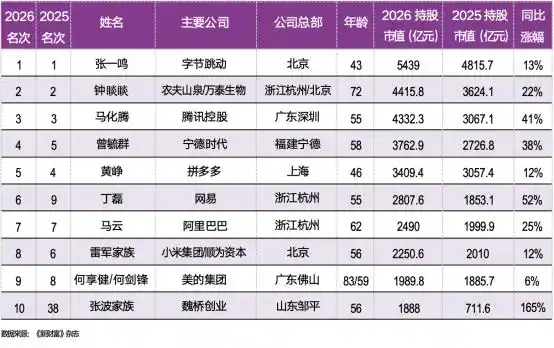
▲ Top 10 of the 2026 New Fortune 500 Creation & Wealth List. Source: Shenzhen News Network
Independent innovation and breakthroughs in core technologies, with AI leading the charge, are creating and concentrating wealth at an unprecedented speed and scale. In the 2025 New Fortune 500 list, DeepSeek founder Liang Wenfeng debuted on the list, entering the top ten with a fortune of 184.62 billion yuan. According to relevant institution statistics, the large model sector has already created at least 36 billionaires, with cumulative wealth reaching several hundred billion yuan.
The reshaping of the wealth map is not merely an industrial replacement, but a generational handover of entrepreneurs. Names like 43-year-old Zhang Yiming, 41-year-old Liang Wenfeng, 36-year-old Wang Xingxing, and 41-year-old Chen Tianshi are replacing those born in the 1960s and 1950s as the leading figures on China's wealth lists.
This is not a transfer of wealth between different individuals, but the passing of the baton from one era to the next.
02. From "Doing Business" to "Developing Technology"
If the most important keywords of the previous wave of Chinese business were "market" and "business model," then today's most important keyword is "technology."
This generation of entrepreneurs shares a distinct common trait: the starting point for many of their ventures is not a business plan, but a laboratory.
Chen Tianshi is a typical case.
Born in 1985, he entered the Special Class for the Gifted Young (SCGY) at the University of Science and Technology of China at age 16, completed his undergraduate and doctoral studies there, and then conducted research at the Institute of Computing Technology, Chinese Academy of Sciences, focusing on deep learning and artificial intelligence, becoming a world-class scientist in the AI field. In 2016, he co-founded Cambricon with his brother Chen Yunji, choosing a direction that was at the time extremely cutting-edge and challenging—AI chips.
Cambricon did not rapidly monetize through a proven business model. Instead, it underwent a long period of technological investment. At its 2020 IPO, its revenue was only 4.59 billion yuan, with a net loss attributable to shareholders of 4.35 billion yuan. In subsequent years, revenue fluctuated around 7 billion yuan, while net losses attributable to shareholders expanded annually, reaching a peak loss of 12.57 billion yuan in 2022.
Finally, the turning point arrived in 2025. The company achieved revenue of 64.97 billion yuan, with a net profit attributable to shareholders of 20.59 billion yuan, marking its first annual profit. In Q1 2026, revenue reached 28.85 billion yuan, a year-on-year increase of 159.56%; net profit attributable to shareholders was 10.13 billion yuan, up 185.04% year-on-year. On June 30th, Cambricon's market capitalization broke through 1 trillion yuan for the first time, becoming the first company on the STAR Market to achieve a trillion-yuan valuation.
Regarding this journey from losses to profitability, from a valuation of tens of billions at IPO to a trillion yuan, what deserves the most attention is not the stock price increase, but one fact: China's AI chips have progressed from laboratory technology to the stage of industrial-scale production.
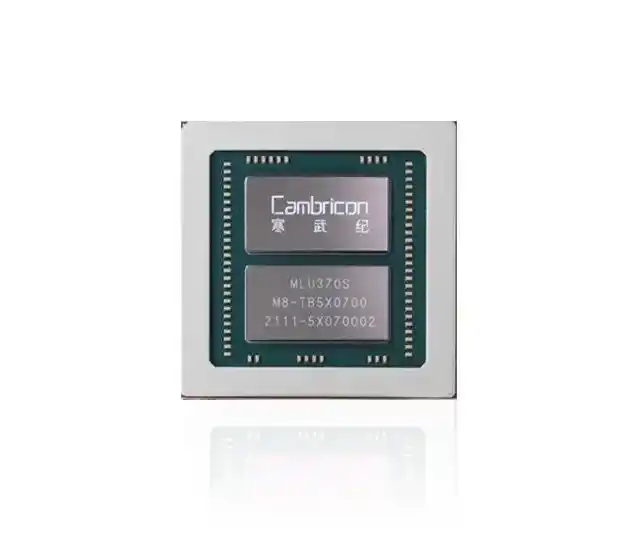
▲ Image Source: Cambricon
Liang Wenfeng presents another type of archetype.
He studied at Zhejiang University for his bachelor's and master's degrees. In 2015, he co-founded quantitative hedge fund High-Flyer Capital (幻方量化), before later entering the large model field. The emergence of DeepSeek made the world reassess Chinese AI entrepreneurs.
Its unique aspect is that Liang Wenfeng did not start with "building an AI application." Instead, he began from more fundamental problems like model architecture, training algorithms, and computational efficiency optimization, leading to disruptive innovation. At the time DeepSeek shone on the world stage, its core R&D team, including Liang Wenfeng, numbered fewer than 150 people—a stark contrast to the scale of international AI giants like OpenAI.
This mode of entrepreneurship is indeed different from traditional internet startups. Internet entrepreneurship often starts by finding users, then searching for a product; technological entrepreneurship frequently reverses this: first solving a technical problem, then discovering the industrial potential it can unlock.
Zhu Yiming's story illustrates this change even more profoundly.
In 2005, he returned to China to found GigaDevice. In 2016, he dedicated himself to building China's domestic DRAM industry; after 2018, he focused his primary efforts on ChangXin Memory Technologies, pledging not to take a salary until the project became profitable. For a full seven years, he did not receive a single yuan in salary.
ChangXin also experienced a long period of losses, with a net loss attributable to shareholders of 16.34 billion yuan in 2023, and 7.145 billion yuan in 2024. In 2025, the company achieved revenue of 61.799 billion yuan, a year-on-year increase of 155.60%; net profit was 7.144 billion yuan, marking its first annual profit.
In Q1 2026, driven by rising DRAM prices, growing computing power demand, and production capacity ramp-up, revenue further reached 50.8 billion yuan, up 719.13% year-on-year; net profit attributable to shareholders was 24.762 billion yuan. On its first trading day, July 27th, ChangXin's market cap soared to 3.28 trillion yuan.
But more noteworthy than the market capitalization is the position this company has reached—a position where few Chinese enterprises have been able to firmly stand before.
DRAM is a highly concentrated market with extremely high technical barriers, long dominated by Samsung, SK Hynix, and Micron. According to Omdia data, based on Q4 2025 sales statistics, ChangXin's global market share has increased to 7.67%, making it the world's fourth-largest DRAM manufacturer.
It has not yet changed the established global memory market landscape, but it has entered the list of major global players. This is a historic leap.
The length of this journey far exceeded most people's imaginations. From the project launch in 2016 to its first profit in 2025, ChangXin walked a full nine years. This is not a story about wealth; it is a story about faith in technology.
A UBS report shows that in 2025, 70 new billionaires emerged in mainland China, with the technology sector becoming the primary engine of wealth creation. The emergence of these "engineer billionaires" signifies a fundamental change in the composition of China's business elite:
The starting point of entrepreneurship is shifting from "doing business" to "developing technology."
03. From "Expanding the Market" to "Deepening the Industry"
Rather than saying Chinese entrepreneurs are simply undergoing a change of guard, it's more accurate to say: the Chinese economy is presenting entrepreneurs with a new set of questions.
The previous generation of entrepreneurs laid the foundation; today's tech entrepreneurs are building the skyscraper upon it.
Without the foundation, the building cannot rise high.
If not for the groundwork laid by Wang Shi and Wang Jianlin in urbanization and real estate, the internet popularization driven by Jack Ma and Pony Ma, the supply chain accumulation from decades of Chinese manufacturing, the influx of a large number of engineering talents into the industry, and the massive digital consumer market, there wouldn't be the fertile industrial soil for today's AI, chip, and robotics entrepreneurs.
The pioneer-level entrepreneurs solved the most critical questions of one or even several eras. Today, the questions have changed.
The 2025 Government Work Report proposed developing New Quality Productive Forces according to local conditions, promoting the integrated development of technological innovation and industrial innovation, cultivating future industries like biomanufacturing, quantum technology, embodied AI, and 6G, and continuously advancing the "AI Plus" initiative.
By the 2026 Government Work Report, it was further noted that China had taken a lead in the R&D and application of AI, biopharmaceuticals, robotics, and quantum technologies, achieving new breakthroughs in chip self-reliance, and seeing domestic large models leading the global open-source ecosystem.
Consequently, the entire Chinese economy has bid farewell to the stage of "crossing the river by feeling the stones," entering a new era of true innovation-driven, and moreover, independent innovation-driven growth: achieving the possible where others deem it impossible, and reaching global leadership in areas others thought China could not.
For Zhu Yiming's ChangXin, the turning point from massive losses to huge profits was singular: product competitiveness brought by technological breakthroughs.
For Chen Tianshi's Cambricon, the leap from losses to profit crossed not just financial thresholds, but critical points in technological capability.
For Liang Wenfeng's DeepSeek, challenging OpenAI's massive compute route with a low-cost training strategy is not about following, but about originality.
These names represent a new type of entrepreneur: original, groundbreaking, global in impact. The stage they are ascending is no longer just China's business arena, but the table of global industrial competition.
This so-called "generational handover" never concerns just wealth or titles. What is being handed over is a nation's structural capacity to participate in global competition.
The previous generation of entrepreneurs accomplished the commercial expansion through learning and catching up; the task for the new generation is to push Chinese technology from "keeping up" to "capable of original innovation, breakthroughs, and industrialization."
The shift from business innovation to technological innovation, from traffic-driven growth to technology-driven growth, from "expanding the market" to "deepening the industry"—it's all just beginning.
The names highlighted today—Zhu Yiming, Chen Tianshi, Liang Wenfeng, Wang Xingxing... are merely the first batch of individuals stepping into the center stage of this era.
This article is from the WeChat public account "HuaShang Strategy" by HuaShang Strategy.