10,000 Scientists Get 1 Year of Free Access: OpenAI Brings the Scientific Research Pipeline into ChatGPT

marsbitОпубликовано 2026-07-30Обновлено 2026-07-30

Введение

OpenAI has launched the "ChatGPT for Academic Researchers" program, offering free one-year access to its flagship models for 100,000 university researchers globally, with 10,000 spots available this summer. Selected institutions include prestigious centers like ENS Paris and the IAS at Princeton. The initiative provides an integrated research workspace within ChatGPT, bundling tools like ChatGPT, ChatGPT Work, and Codex, along with expanded Deep Research capabilities, higher usage limits, and specialized tools for life sciences. The suite connects to platforms like Zotero and GitHub, aiming to streamline the entire research workflow from literature review and coding to data analysis and manuscript drafting. OpenAI notes that about 1.3 million people already use ChatGPT weekly for advanced science and math. The program targets building long-term user dependency by embedding these tools into daily research habits. However, access comes with limitations: it does not include API credits or model weights, and eligibility is restricted to verified academic researchers from supported countries. This approach contrasts with Anthropic's "AI for Science" program, which offers API credits but not an integrated workspace. Both companies emphasize preventing misuse by withholding model weights, a point of contention for AI researchers seeking transparency. The core strategy remains clear: provide a powerful, integrated environment to foster user reliance ahead of the post-free period.

100,000 university researchers, each getting one year of free access to flagship models!

On July 29, OpenAI gave a big gift to the academic community, officially launching 'ChatGPT for Academic Researchers,' offering 100,000 researchers free access to cutting-edge models.
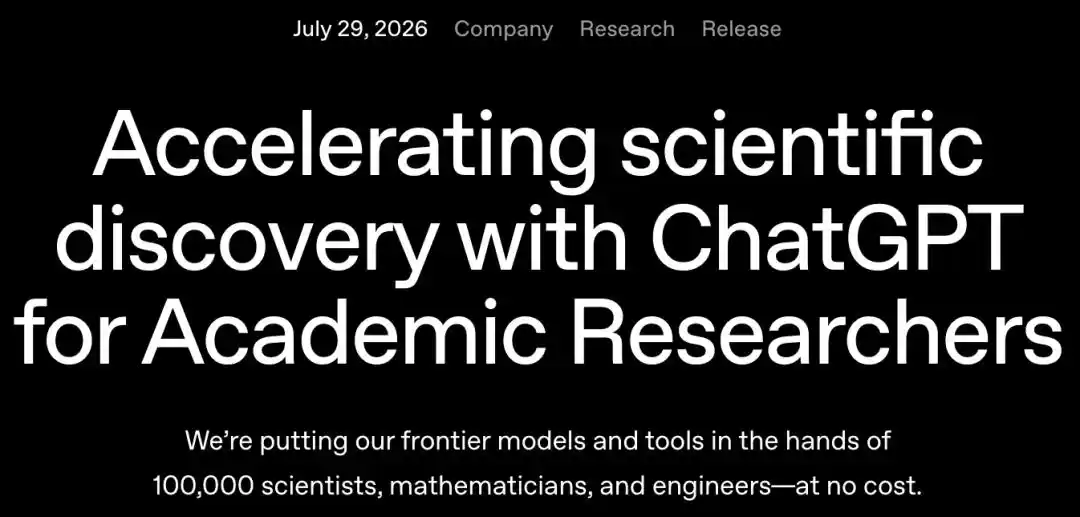
Prestigious institutions like École Normale Supérieure (ENS), which has produced many Nobel and Fields Medal laureates, and the Institute for Advanced Study (IAS) where Einstein worked, are among the first batch of selected institutions.

Eligible researchers can use GPT-5.6 Sol Pro, OpenAI's current top-tier flagship model.

It's important to clarify that the 100,000 target is for 2027, with the first 10,000 spots being released this summer.

An Entire Research Pipeline, Packaged and Delivered

What can this suite change for a researcher?

Reading literature in the morning, querying an idea, and letting it generate a few hypotheses on the fly can be done with ChatGPT.

Writing code, running data, and performing formal verification in the afternoon can be done with Codex.

When it's time to apply for funding, write grant proposals, or draft manuscripts, ChatGPT Work can take over.

This isn't just 'one more chat window'; it's your entire research workflow, which was previously scattered across editors, reference management software, terminals, and chat windows, all packaged into a single workspace.

Researchers approved for this program receive precisely this entire suite: ChatGPT, ChatGPT Work, Codex, along with an expanded Deep Research, higher usage limits, and a larger context window.

It's also stacked with over 75 life sciences skills: from genetics, genomics, single-cell analysis, all the way to protein modeling and drug discovery.

Additionally, there's a bunch of connectors; hook up literature databases, public genome and clinical databases, satellite imagery, even Zotero and GitHub, and they're ready to use.
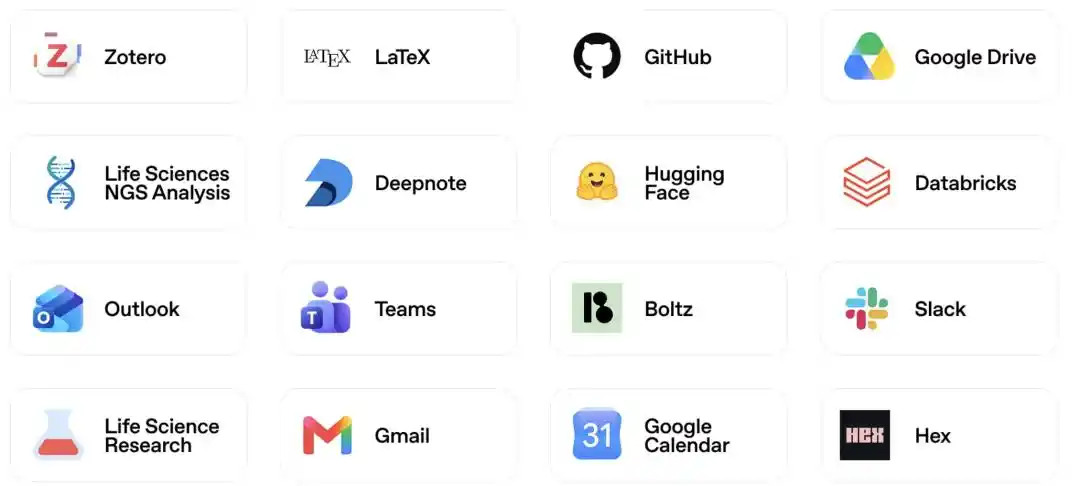
From Zotero, GitHub to Boltz, NGS analysis, commonly used research tools are packaged and connected into the same workspace.

The models also have their specialties: GPT-5.6 Terra handles daily tasks, Luna runs lightweight tasks, and Sol tackles the hardest scientific and mathematical problems.

On FrontierMath Tier 4, which measures research-level mathematical reasoning, Sol scored 83%, while the previous generation GPT-5.5 scored only 72.5%. On GeneBench Pro, which tests complex biological data analysis, Sol Pro solved 31.5% of the problems.

From searching literature, writing code, running analysis, to finalizing and submitting drafts, every step of a researcher's process is integrated into the same system.

OpenAI's goal is clear: move your entire research workflow into ChatGPT.

1.3 Million People Weekly Are Already Using ChatGPT for Research

Scientists, in fact, have been using it this way for a while.

OpenAI's official data states: approximately 1.3 million people use ChatGPT weekly for advanced science and mathematics, generating about 8.4 million messages.

A more direct signal comes from the mathematics community: arXiv math papers acknowledging ChatGPT grew from 14 in February to 100 in just the first three weeks of July.
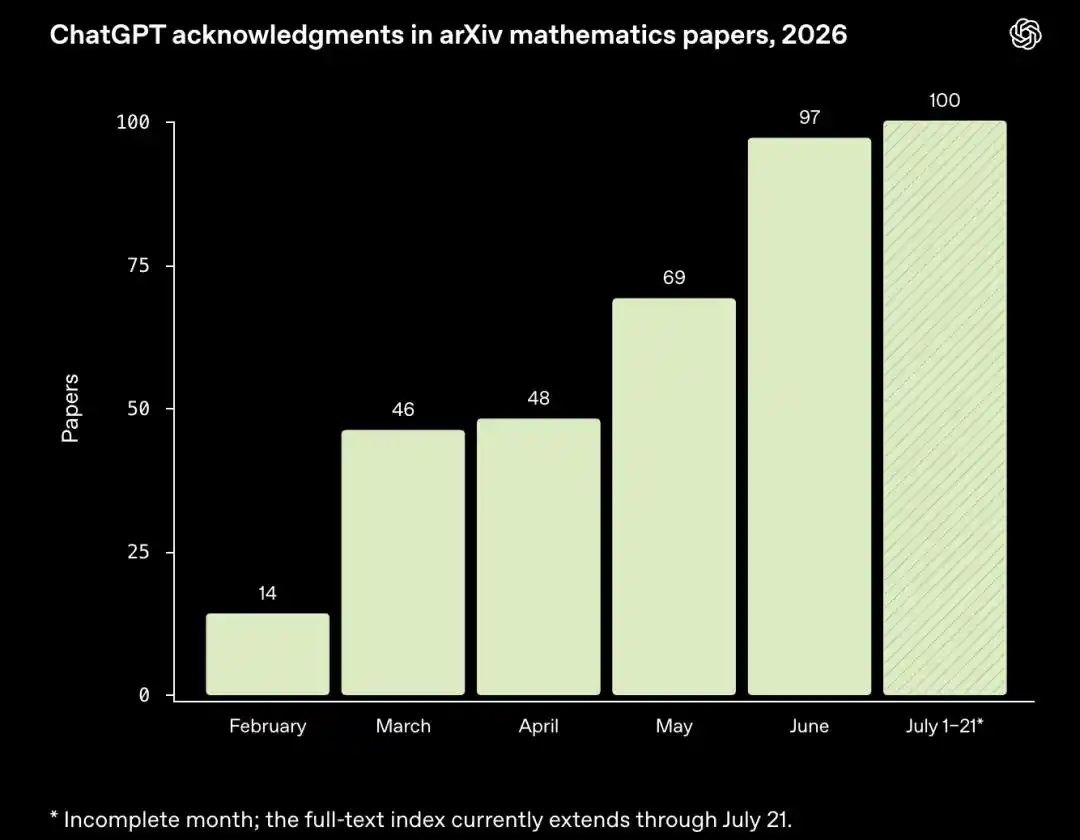
Number of arXiv math papers acknowledging ChatGPT: increased from 14 in February to 97 in June; reached 100 in just the first 3 weeks of July (up to the 21st). (Source: OpenAI)

Furthermore, the more intensely it's used, the more people dare to delegate entire large tasks:

Among the top 20% of scientists in terms of AI usage, close to 7% are willing to hand over entire tasks estimated to take over 4 hours to AI; this is only 3.5% among other peers, exactly double.

This shows that once a tool becomes familiar, people actively delegate increasingly heavy work to it. Habits are formed this way, gradually.

Seeing these numbers, OpenAI's motivation for giving away something this expensive for free to 100,000 scientists isn't hard to understand.

This workspace by default doesn't use your content to train models and provides ample enterprise-grade privacy protection. What it wants isn't your data, but your habits.

When a postdoc completes a full year of research solidly within this workflow: all the instincts for searching, analyzing, and writing become ingrained in ChatGPT and Codex.

By the time the one-year free window closes, the switching cost will have become too high to bother with.

As one industry observer bluntly stated: What lab leaders should really pay attention to is which company's tools their team members are quietly making their default choice upon opening their computers.

That choice will continue to compound long after the free period ends.

Three Limitations of the Free Lunch

This free offer comes with three limitations.

First, it's not unlimited use. The official statement is clear: the limits are similar to ChatGPT Pro, and exceeding them requires purchasing additional credits.

Second, it doesn't include API access. The self-serve plan explicitly states: it does not include OpenAI API credits.

Third, and most crucial: this is not open-source; no model weights are provided at all.

Researchers receive 12 months of product access, the ability to call the models, but cannot see the weights or modify the models.

Furthermore, the bar to get this free lunch is not low.

Applicants must be faculty or postdoctoral researchers at universities, pass SheerID institutional verification, be from a supported country, and submit a paper published in the last 3 years on arXiv, bioRxiv, or ChemRxiv with their name on it.

The most subtle point: the very group that actually wants the model weights is precisely bypassed.

Those doing AI research have been calling for weights and training data. Because only with these can they independently evaluate model behavior, verify reproducibility, and conduct safety audits.

OpenAI's response is: to prevent misuse, weights cannot be given.

In essence, OpenAI is opening up usage rights but firmly guarding the model itself. The underlying system remains a black box.

Anthropic Has Been in the Game, Just With a Different Approach

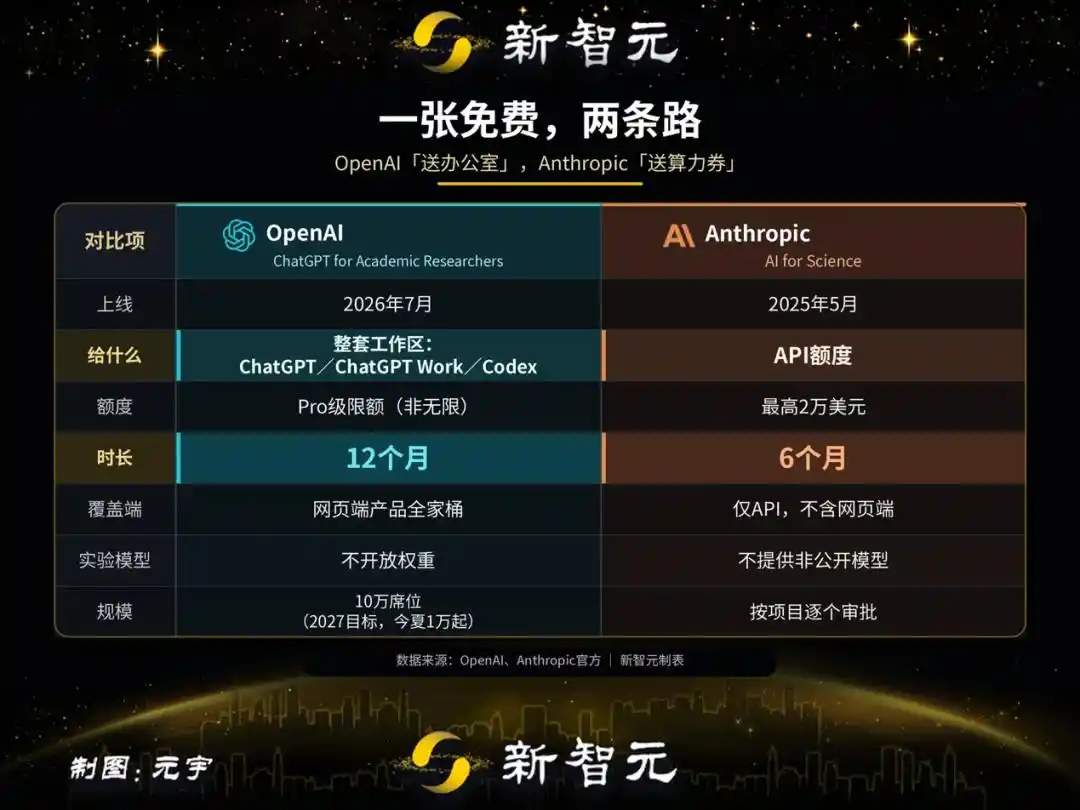
As early as May 2025, Anthropic launched its AI for Science initiative:

Offering up to $20,000 in API credits for researchers at academic and non-profit institutions, valid for 6 months, with a focus on biology and life sciences.

But what the two companies are offering is not the same thing.

Anthropic provides API credits, usable only via the interface, not the Claude web interface, and without access to non-public experimental models. Essentially, it's a compute credit.

OpenAI provides the entire workspace, Pro-level limits, and seats for a team of 5.

One provides AI tools, the other provides an AI work environment. The latter's binding effect on usage habits is much deeper.

However, the two companies are strikingly aligned on one point: neither opens up model weights.
The very scientists researching 'AI itself' are precisely the ones who want the weights and training data.

Because only with these can they independently evaluate model behavior, reproduce results, and conduct safety audits.

This program targets math, physics, chemistry, biology, medicine, and engineering, neatly sidestepping the core demands of this group.

The reason given by both OpenAI and Anthropic: limiting weight access prevents abuse.

Regardless, for a researcher who has just received a year of free credits, the utility of this tool is real and substantial.

But, when the free period ends, will you still be able to walk away?

References:

https://x.com/OpenAI/status/2082516370949062989

https://openai.com/index/chatgpt-for-academic-researchers/

This article is from the WeChat public account "Xinzhiyuan" (New Intelligence), author: ASI启示录 (ASI Revelation)


Трендовые криптовалюты

Связанные с этим вопросы

QWhat is the main announcement made by OpenAI in this article, and what are the key benefits for the researchers?

AOpenAI announced the 'ChatGPT for Academic Researchers' program, offering 10,000 (with a goal of 100,000) researchers free, one-year access to its flagship models, including GPT-5.6 Sol Pro. Key benefits include a full suite of tools (ChatGPT, ChatGPT Work, Codex) integrated into a single workspace, specialized models for different tasks, connectors to tools like Zotero and GitHub, and over 75 life sciences skills.

QAccording to the article, how is OpenAI's offering to researchers different from Anthropic's 'AI for Science' plan?

AOpenAI provides a complete, integrated workspace with its chat interface, team seats, and higher usage limits, aiming to integrate the entire research workflow. Anthropic's 'AI for Science' offers API credits (up to $20,000) for use via interface calls, focusing primarily on providing computing power rather than a full user-facing work environment. However, neither company provides access to the underlying model weights.

QWhat are the three main limitations or conditions attached to OpenAI's free offer for academic researchers?

A1. Usage is not unlimited; it has caps similar to ChatGPT Pro, requiring payment for overages. 2. It does not include OpenAI API access/credits. 3. It is not open-source; researchers receive product access but not the model weights. Additionally, eligibility is restricted to university faculty and postdocs in supported countries who can provide a recent paper published on platforms like arXiv.

QWhat evidence does the article provide to show that scientists are already heavily using ChatGPT for research?

AThe article cites OpenAI data showing approximately 1.3 million people use ChatGPT weekly for advanced science and math, generating about 8.4 million messages. It also points to the rapid increase in arXiv mathematics papers acknowledging ChatGPT, rising from 14 in February to 100 in just the first three weeks of July.

QWhat is the article's perspective on OpenAI's long-term strategic motivation behind offering this free program?

AThe article suggests OpenAI's primary motivation is not to collect user data (as the workspace promises not to use content for training) but to cultivate user habits and dependency. The goal is to embed its tools so deeply into a researcher's daily workflow over the free year that the switching cost becomes prohibitively high, creating long-term, 'compounding' user retention after the free period ends.

Похожее

Сенатор предложил создать бюро борьбы с криптовалютным бизнесом Трампа

Сенатор Чак Шумер предложил создать независимое федеральное бюро для расследования коррупции, связанной с криптовалютным бизнесом, и возврата незаконно полученных средств. Инициатива направлена на борьбу со злоупотреблениями госслужащих. Шумер также предлагает разрешить частным лицам и прокурорам штатов подавать иски против чиновников и компаний. В качестве примера он привёл доходы Дональда Трампа и его семьи, превышающие $5,4 млрд с 2025 года от таких проектов, как World Liberty Financial и мемкоины TRUMP и MELANIA. Белый дом отвергает наличие конфликта интересов. Споры вокруг криптобизнеса Трампа заблокировали законопроект CLARITY: демократы настаивают на включении в него запрета на получение прибыли от криптовалют для высших должностных лиц и их семей. Ранее Шумер с коллегами безуспешно пытался внести аналогичные поправки в закон о стейблкоинах GENIUS.

cryptonews.ru1 ч. назад

Сенатор предложил создать бюро борьбы с криптовалютным бизнесом Трампа

cryptonews.ru1 ч. назад

Руководитель HIVE: Графические процессоры для ИИ приносят в 10 раз больше дохода в час, чем майнинговые фермы

Руководитель HIVE заявил, что использование графических процессоров для вычислений в сфере искусственного интеллекта приносит в 10 раз больше дохода в час, чем майнинг биткоина. Конкретный кластер из 504 GPU Nvidia B200 приносит около $2,90 за GPU-час, в то время как майнинговые установки компании генерируют примерно $0,12 в час. Эта разница лежит в основе стратегии компании: инвестиции направляются в высокодоходный ИИ-бизнес при продолжении майнинговой деятельности. В 2026 финансовом году выручка HIVE выросла на 158% до $297,8 млн, а доход от нового подразделения ИИ и высокопроизводительных вычислений (HPC) составил $19,5 млн. Компания ранее сделала крупную ставку на чипы Nvidia, что дало ей преимущество с началом бума ИИ. HIVE строит в Торонто центр обработки данных для ИИ мощностью 320 МВт, который после запуска в 2027 году сможет приносить около $360 млн годовой выручки. Компания ставит цель увеличить доход от ИИ/HPC в десять раз к концу финансового года. Аналогичный тренд наблюдается и у других майнинговых компаний, таких как MARA, Hut 8 и Terawulf, которые также переориентируют мощности на более доходные контракты в сфере ИИ и HPC на фоне снижения маржинальности майнинга биткоина.

cryptonews.ru1 ч. назад

Руководитель HIVE: Графические процессоры для ИИ приносят в 10 раз больше дохода в час, чем майнинговые фермы

cryptonews.ru1 ч. назад

«Каждый день без правил — это потеря капитала»: Grayscale обратилась к Сенату из-за CLARITY Act

Компания Grayscale Investments обратилась к лидерам Сената США с призывом провести голосование по законопроекту CLARITY Act до августовского перерыва Конгресса. В открытом письме компания подчеркивает, что американская криптоиндустрия годами работает без четкой законодательной базы, вынужденно адаптируясь к «регулированию через принудительное правоприменение», что создает неопределенность для бизнеса и инвесторов. Принятие CLARITY Act, по мнению Grayscale, установит ясные правила, распределит полномочия между CFTC и SEC и повысит конкурентоспособность США, остановив отток капитала и инноваций в юрисдикции с более понятным регулированием, такие как Сингапур или Абу-Даби. Закон также будет способствовать развитию рынка крипто-ETF и других регулируемых инвестиционных инструментов. Законопроект, являющийся результатом двухпартийной работы, уже прошел комитетские стадии. Однако его рассмотрение в Сенате откладывается из-за перегруженного законодательного календаря и приоритета других вопросов. Несмотря на достигнутый прогресс, в том числе по блоку этических поправок, документ продолжает сталкиваться с критикой. Генеральный прокурор Нью-Йорка опасается ослабления борьбы с мошенничеством на уровне штатов, а крупные банки призывают ужесточить регулирование стейблкоинов, чтобы предотвратить отток депозитов.

cryptonews.ru1 ч. назад

«Каждый день без правил — это потеря капитала»: Grayscale обратилась к Сенату из-за CLARITY Act

cryptonews.ru1 ч. назад

Grayscale считает, что появление 3 000 ончейн-хранилищ с активами на сумму более 7 млрд долларов станет следующим прорывом в криптовалютной сфере

Стейблкоины и токенизированные активы меняют традиционные финансы. Grayscale прогнозирует, что следующим прорывным направлением станут ончейн-хранилища (vaults) — блокчейн-инструменты управления активами, аналогичные традиционным обеспеченным кредитным обязательствам (CLO). Они объединяют капитал инвесторов в портфели для получения доходности, но вместо посредников используют смарт-контракты в сетях типа Ethereum. Это обеспечивает прозрачность, операционную эффективность и потенциально более высокую ликвидность. В настоящее время рынок хранилищ невелик: около 3000 хранилищ с активами на $7 млрд под управлением 57 кураторов, при этом 79% стратегий ориентированы на стейблкоины. Для сравнения, глобальный рынок CLO оценивается в $1,5 трлн. Главным препятствием для развития является регулирование. В США активная роль кураторов в управлении может привлечь внимание регуляторов к вопросам соблюдения законов о ценных бумагах и инвестиционных компаниях. Успех хранилищ будет зависеть от способности отрасли сочетать эффективность смарт-контрактов с соблюдением правовых и операционных стандартов традиционного финансового мира.

cryptonews.ru1 ч. назад

Grayscale считает, что появление 3 000 ончейн-хранилищ с активами на сумму более 7 млрд долларов станет следующим прорывом в криптовалютной сфере

cryptonews.ru1 ч. назад

Крупный криптоинвестор вывел из стейкинга HYPE на $57 млн

Крупный инвестор ("кит"), купивший 1,02 млн токенов $HYPE по средней цене $18 17 месяцев назад, вывел их из стейкинга и перевел на биржи FalconX и Coinbase Prime, что, вероятно, указывает на подготовку к продаже. Потенциальная прибыль от такой сделки может превысить $39 млн. В тот же день с другого кошелька было выведено из стейкинга ещё 1,89 млн $HYPE на сумму $105,9 млн. Эти действия являются частью общей тенденции: объём токенов $HYPE, ожидающих вывода из стейкинга, за неделю вырос более чем вдвое — с 4,09 млн ($241 млн) до 9,1 млн ($496,6 млн). Общее количество застейканных монет за месяц сократилось, что может сигнализировать о медвежьих настроениях среди долгосрочных держателей. Курс $HYPE демонстрирует негативную динамику: после отскока от отметки $72 три недели назад он торгуется в нисходящем тренде, потеряв за месяц 16,15% и опустившись до $54,4. Ранее, в июне, сооснователь BitMEX Артур Хейс также продал все свои токены $HYPE на $18,02 млн, несмотря на прежние оптимистичные прогнозы.

cryptonews.ru1 ч. назад

Крупный криптоинвестор вывел из стейкинга HYPE на $57 млн

cryptonews.ru1 ч. назад

Торговля

Спот

Популярные статьи

Как купить ONE

Добро пожаловать на HTX.com! Мы сделали приобретение Harmony (ONE) простым и удобным. Следуйте нашему пошаговому руководству и отправляйтесь в свое крипто-путешествие.Шаг 1: Создайте аккаунт на HTXИспользуйте свой адрес электронной почты или номер телефона, чтобы зарегистрироваться и бесплатно создать аккаунт на HTX. Пройдите удобную регистрацию и откройте для себя весь функционал.Создать аккаунтШаг 2: Перейдите в Купить криптовалюту и выберите свой способ оплатыКредитная/Дебетовая Карта: Используйте свою карту Visa или Mastercard для мгновенной покупки Harmony (ONE).Баланс: Используйте средства с баланса вашего аккаунта HTX для простой торговли.Третьи Лица: Мы добавили популярные способы оплаты, такие как Google Pay и Apple Pay, для повышения удобства.P2P: Торгуйте напрямую с другими пользователями на HTX.Внебиржевая Торговля (OTC): Мы предлагаем индивидуальные услуги и конкурентоспособные обменные курсы для трейдеров.Шаг 3: Хранение Harmony (ONE)После приобретения вами Harmony (ONE) храните их в своем аккаунте на HTX. В качестве альтернативы вы можете отправить их куда-либо с помощью перевода в блокчейне или использовать для торговли с другими криптовалютами.Шаг 4: Торговля Harmony (ONE)С легкостью торгуйте Harmony (ONE) на спотовом рынке HTX. Просто зайдите в свой аккаунт, выберите торговую пару, совершайте сделки и следите за ними в режиме реального времени. Мы предлагаем удобный интерфейс как для начинающих, так и для опытных трейдеров.

883 просмотров всегоОпубликовано 2024.04.12Обновлено 2026.06.02

Как купить ONE

Обсуждения

Добро пожаловать в Сообщество HTX. Здесь вы сможете быть в курсе последних новостей о развитии платформы и получить доступ к профессиональной аналитической информации о рынке. Мнения пользователей о цене на ONE (ONE) представлены ниже.

活动图片